The Crusade Against the Christians

The 4th Crusade Was Christians vs. Christians

The 4th Crusade Was Christians Against Christians

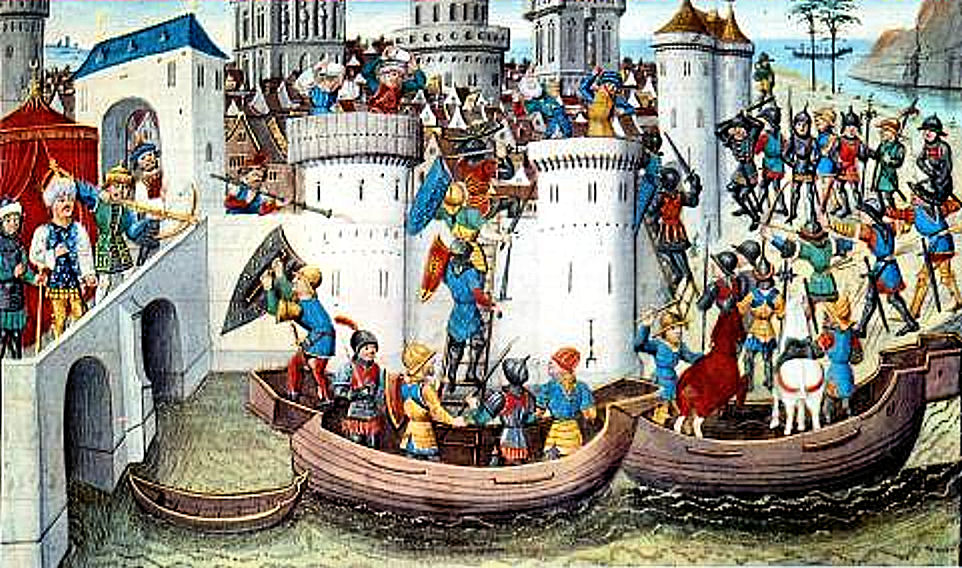
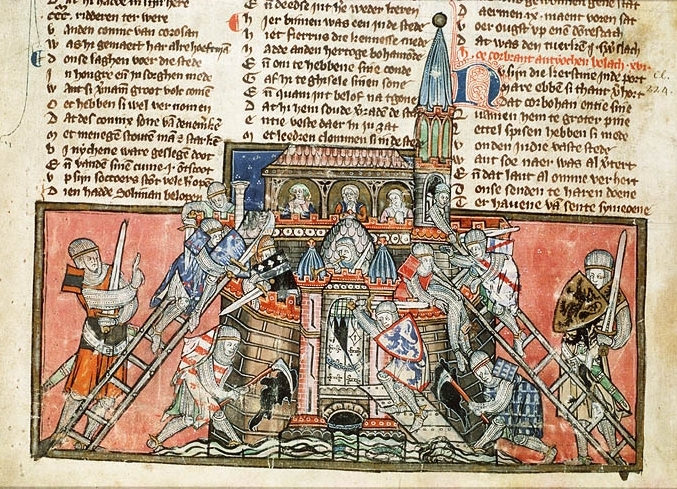
Pope Innocent III didn’t plan it that way, but the 4th Crusade (1202-1204) was mostly Christians fighting Christians.When the knights involved in that crusade decided to go to the Holy Land by sea, they contracted with the Venetians to carry 30,000 bodies and associated horses and supplies to retake Jerusalem.

There was only one little problem. Although the Venetians spent a year building a fleet to carry the 30,000 crusaders, only about a third of that number showed up. Oops! That didn’t sit well with Enrico Dandolo, the 90-year-old blind Doge of Venice—but no pushover when it came to negotiations.

Venice was upset that the Adriatic port of Zara (now called Zadar) now belonged to Hungary. The Doge negotiated with the leaders of the crusade to stop and capture Zara “on the way” to the East. Unfortunately, Zara was not only Christian: It was Roman Catholic. And King Emico of Hungary wore the crusaders’ cross himself. A deal was a deal, and the crusade did not want to start on in debt to the Venetians. So, they attacked and took Zara, returning it to the Venetians.

That was only the beginning of their problems. A Byzantine prince named Alexius Angelos offered to pay a fortune to the crusade and to their Venetian transport … if only they would see fit to returning him to the throne of Constantinople. His father, Isaac II Angelos, has been the emperor; but his elder brother Alexius III Angelos, had him blinded and deposed him.

It looked like a good deal. Although Prince Alexius had been drumming up support for his cause among the crowned heads of Europe, he was pretty much ignored. Too flighty, it seems. But the crusaders were committed, and the idea of all that loot turned their heads.

So off to Constantinople they sailed. They besieged the city from the Golden Horn side, and after a number of attacks finally prevailed. Prince Alexius was set up as Alexius IV Angelos. And now it was time for payback. Except, Alexius IV was unable or unwilling to pay what he had promised. So the crusaders not only took the city, but looted and burned it, raping and killing at will. And, um, they never did get to the Holy Land.

Pope Innocent III was furious. If you can’t trust 10,000 crusaders wearing crosses over their armor to do what they promised, whom can you trust?

The story is well told in Jonathan Phillips’s The Fourth Crusade and the Sack of Constantinople, complete with extensive notes, a large bibliography, and an alphabetical index.


Antioch 1097-1098

One of the Most Horrendous Battles in History

One of the Most Horrendous Battles in History

It is generally known that the First Crusade attained its goal, the capture of Jerusalem. But what happened along the way left a taste of ashes in the mouths of its survivors. I have just finished reading Thomas Asbridge’s The First Crusade: A New History. What stuck in my mind was what happened along the way to Jerusalem, at Antioch.

Antioch was one of the great cities of Jerusalem, but it was under the firm control of the Turks. It was a huge city, well fortified, and incorporating portions of two mountains and a powerful citadel. The Crusaders set up for a protracted siege, and protracted it certainly was: It lasted for a year and a half. It was only when Bohemond of Taranto managed to persuade a traitor to let the Latins into the city that the first stage of the siege was ended.

Yes, there was a second stage. After the Crusaders were ensconced within the walls, they were in turn besieged by the huge army of Kerbogha, the Atabeg of Mosul (the same Mosul that is now under the control of ISIS/ISIL/Daesh). Asbridge thinks that he commanded some 35,000 fighters (some said as many as 300,000, which is unlikely), which at that time far exceeded the diminished ranks of the Crusaders.

However greedy and petty the Crusade leaders may have been, they did not lack for bravery. There was some mummery about the lance with which the Roman centurion Longinus had pierced the side of the crucified Christ being found buried in a church. The discovery of this relic raised the spirits of the besieged, such that they sallied forth from the walls of Antioch and routed the Turks, raising the second siege and clearing the way to Jerusalem.

We don’t think much about the Crusades, but the memory of them has not faded from the Muslim man in the street. Are we destined forever to be Crusaders in the Middle East?


“They Stomped the Floor”

Alabama Governor and Presidential Candidate George C. Wallace (1919-1998)

Alabama Governor and Presidential Candidate George C. Wallace (1919-1998)

Politically speaking, I come from a very divided family. My brother and I were Liberal Democrats, my mother was an independent (she loved John B. Anderson in 1980), and my father was a staunch follower of segregationist Alabama Governor George C. Wallace.

Actually Wallace was not always a segregationist. He started out as a circuit judge of the Third Judicial Circuit in Alabama, where he was known for his fairness, irrespective of race. He even called Black attorneys “Mister” rather than patronizingly referring to them by their first names.

When he ran for governor of Alabama in 1958, he was defeated by John Malcolm Patterson, who ran with the support of the Ku Klux Klan, against which Wallace had spoken on occasion. (in fact, the NAACP had supported Wallace.) This loss wrought a change in the candidate: “You know why I lost that governor’s race? … I was outniggered by John Patterson. And I’ll tell you here and now, I will never be outniggered again.” And he wasn’t.

From this point on, Wallace adopted an wavering segregationist policy. “You know, I tried to talk about good roads and good schools and all these things that have been part of my career, and nobody listened. And then I began talking about niggers, and they stomped the floor.”

Alas, my poor father was also anti-integration. As an uneducated factory worker, he was afraid that Southern Blacks were coming to take away his job. So he thought Wallace was the man to stem that tide. Today, he would probably vote for Trump.

What Do These Burmese Kings Have in Common?

Put Your Thinking Caps On

Put Your Thinking Caps On

The four Burmese kings are: Uzana, Minrekyawswa, Razadarit, and (of course) Tabinshweti.

Uzana was trampled to death by an elephant in 1254; Minrekyawswa was crushed to death by an elephant in 1417;
Razadarit died while lassoing elephants in 1423; and Tabinshweti was beheaded while searching for an elephant in 1551.

Now if you were a king in Burma, that suggests you stay away from the GOP.

The above is courtesy of the Futility Closet.

Flea-Bitten Empire

With the Legions Came Another Invader ....

With the Legions Came Other Invaders ….

According to an article in The Guardian, we tend to give a lot of credit to the Romans for cleanliness and hygiene. What is not commonly associated with them are “lice, fleas, bed bugs, bacterial infections from contamination with human feces, and 25ft-long tapeworms, a misery spread across the empire by the Roman passion for fermented fish sauce.”

But what about all those Roman baths? Well, how often was the water changed? Or did the bathers regale themselves in a bacteriological soup until the bucket brigade of slaves renewed the water? Unchanged water “left the bathers swimming in a warm soup of bacteria and the eggs of parasites such as roundworm and whipworm.” Then, too, many simply bathed themselves in olive oil, which was cleaned off with a strigil, an kind of scraper with a curved blade used to scrape sweat and dirt from the skin in a hot-air bath or after exercise.

Roman Baths

Roman Baths

And what about those tapeworms? Here the culprit was the Romans’ use of a fermented raw fish sauce called garum. According to Piers Mitchell, from whose article in The Journal of Parasitology this information is derived: “Wrapped around the Romans’ intestines …, the parasites could remove nutrients from food before it could be digested, which could cause severe or even fatal anaemia. Evidence from some Roman sites in Italy revealed that up to 80% of the child skeletons had evidence of severe anaemia.”

Another common source of ill health was the use of human feces to fertilize vegetable gardens. If the human wastes were allowed to compost for a year or more, there would be no danger from bacteriological infections; but there is no proof that the Romans knew of this.

Archaeologists found that the Romans with their baths were no freer from infection and worms and such like than the supposedly more primitive Vikings.

Sic transit gloria Imperii!

King Charles’s Head

Mr. Dick, Who Cannot Get King Charles I’s Head Out of His Writing

Mr. Dick in David Copperfield, Who Cannot Get King Charles I’s Head Out of His Writing

Today, I attended the European History Meetup Group at the Will and Ariel Durant Branch Library in Hollywood. The subject under discussion was “The King, the Parliament, and the Death of Absolute Monarchy in Great Britain.” We concentrated on the Seventeenth Century, particularly the arrest and trial of Charles I, the rule of Oliver Cromwell as Protector, and the Restoration.

It was for this meeting that I had read Christopher Hill’s great book, The World Turned Upside Down: Radical Ideas During the English Revolution. As usual, for these meetings I am usually more interested in cultural history than names, dates, and battles.

The group leader, Bronislaw Meyler, does an excellent job of introducing the subject and putting all the pieces together.


America’s Concentration Camps

Why Not the Germans and Italians?

Why Not the Germans and Italians?

Today, Martine and I returned to the Skirball Cultural Center to see their new exhibit of Ansel Adams photographs of the Manzanar Relocation Center for Japanese-Americans during Wold War Two. In 2010, we had traveled to the Owens Valley to visit the Manzanar site, midway between Lone Pine and Independence. It was there I photographed the above rather disgusting display image.

Manzanar now has an interesting visitor center which is worth a stop on the long highway between Los Angeles and Reno.

In addition to Ansel Adams’s work, there are a number of photos by Dorothea Lange and others, as well as interesting documents relating to the “evacuation” and the maintenance of a system of concentration camps throughout the American Southwest.

Miné and Her Brother Hear the Radio Announcement About the Pearl Harbor Attack

Miné and Her Brother Hear the Radio Announcement About the Pearl Harbor Attack at Breakfast

Down the hall, there was a smaller exhibit of artwork by Miné Okubo, who published a book of sketches called Citizen 13660 about her experiences at the Tanforan and Topaz War Relocation Centers.

Below is a photo of me taken by Martine at the monument to those who died at Manzanar, in lieu of individual headstones.

Monument to Manzanar’s Dead

Monument to Manzanar’s Dead

Born in Discord

Map of Argentina in 1816

Map of Argentina in 1815

We tend to forget the sharp birth pangs of any republic. After we approved our famed constitution, it took seventy-five years and a bloody civil war in which millions died before we could begin to act as a unified country. (Though, even now, that seems in doubt.)

In Argentina, the process took roughly as long, and not without substantial rough spots until as recently as 2002. Originally, the country was called the United Provinces of the River Plate. Then, after the Congreso de Tucumán in 1815, the land was briefly named after the congress.

But major trouble lay ahead: A long conflict between the Federalists and the Unitarians. In South America, both parties had no relation to the U.S. Federalists or the Unitarian church. In San Martín: Argentine Soldier, American Hero, John Lynch wrote:

In spite of his fanatical liberalism, [Bernardino] Rivadavia was essentially a man of peace; bowing to the opposition of provincial caudillos and porteño [Buenos Aires] Federalists, he stepped down from the presidency in July 1827 and retired to poverty and exile. He did not appreciate the changing pattern of power in Argentina. Did San Martín? The Rivadavia group consisted essentially of intellectuals, bureaucrats, professional politicians, ‘career revolutionaries’ as they have been called, who did not represent a particular economic interest or social group. His [federalist] enemies, on the other hand possessed real power; the estancieros [ranchers] formed a strong political base, rooted in the country and the cattle industry, and they wanted their profits to remain in the province instead of being absorbed into a national economy. The estancieros were the new men of the revolution; they brought a military and economic power to the federal party and soon began to seek direct political power.

If you ever want to read a damning indictment of the Federalist caudillos, I recommend you read Domingo  Faustino Sarmiento’s Facundo, about the crimes of dictator Juan Manuel de Rosas. After several periods of political exile, Sarmiento became president of Argentina from 1868 to 1874.

When Everything Changed

The Caisson Bearing Kennedy’s Body Enroute to the Cemetery

The Caisson Bearing Kennedy’s Body Enroute to the Cemetery

It was another blast furnace day in Southern California. To avoid the smell of charred walls and furniture in our apartment, Martine and I decided to spend the afternoon in the air-conditioned video library of the Paley Center in Beverly Hills. While Martine watched Gale Storm in episodes of “My Little Margie” (1952-55), I watched the funeral cortège of the assassinated John F. Kennedy (November 24, 1963).

What would have happened if Kennedy were never shot dead in the streets of Dallas? (Way back in the depths of my mind, I have never forgiven Texas for being the scene of that sad event.) America was stunned. The news seemed to go on all hours: Poor Walter Cronkite talked about Lee Harvey OsBURN being shot by Jack Ruby. I remember watching the coverage at the auditorium of the newly opened Hopkins Center at Dartmouth College, where the TV coverage was aired in the auditorium.

Blackjack, the Riderless Horse in JFK’s Funeral Cortege

Blackjack, the Riderless Horse in JFK’s Funeral Cortège

The President was buried with full military honors. Six grey horses pulled the artillery caisson on which his flag-draped coffin lay. Behind the caisson was a riderless black horse named Blackjack with stirrups and riding boots reverse, whose friskiness was in marked contrast to the grim pace of the procession. The muffled drums, the horns breaking out into the marche funèbre, the tolling bells of St. Christopher’s church, the grim faces of First Lady Jacqueline Kennedy and the two surviving Kennedy brothers—all added up to one of history’s grinning death’s heads.

What would have happened if President Kennedy were not assassinated? Would the conservative insurgency that followed years later ever have happened? There are so many terms in the equation that follows that it is difficult to conclude anything with any degree of certainty. There was Viet Nam, Cuba, Communism, the Economy, even the Mafia to consider. I guess, in the end, whatever happened was fated to happen.

Certain images from that funeral have stuck in my mind. Among the heads of state, there was the gigantic Charles de Gaulle in the front line. There were endless women crying—women that looked different in that period over half a century ago. As the procession proceeded, it was followed on either side by hundreds, perhaps thousands of everyday people who wanted to miss nothing.

Under Four Flags

Lord Thomas Cochrane (1775-1860)

Lord Thomas Cochrane (1775-1860)

He must have been an amazing sight to his enemies, towering over six feet with red hair. Lord Thomas Cochrane, 10th Earl of Dundonald, was an impoverished Scot of noble birth who was a brilliant attacking sea captain. Because of various circumstances, mostly relating to his problems with authority, he was perhaps the most brilliant naval strategist who did not actually command a fleet. Had the Admiralty not been so venal and corrupt, he could have shortened the Napoleonic Wars by incursions against the mainland of France, forcing Napoleon back from Russia ahead of schedule. But that was not to be.

Some people are not meant to get along well with politicians. (I am one such myself, though not with one thousandth the talent of the Scotsman.) Cochrane developed a whole slew of enemies, hobnobbing as he did with Radicals as William Cobbett and Sir Francis Burdett. He even spent time at King’s Bench Prison for stock fraud—a mostly bogus charge cobbled together by his enemies with a complaisant and corrupt judge on the bench.

Stripped of his Order of the Bath and drummed out of the Navy, Cochrane accepted an offer the command the navy of the emerging Republic of Chile. He fought a number of sharp naval actions until the Spanish Pacific Fleet was driven off. Then he assisted Dom Pedro I of Brazil fight for that country’s independence from Brazil.

Memorial to Cochrane in Valparaiso, Chile

Memorial to Cochrane in Valparaiso, Chile

Finally, he ended up commanding the fleet of the Greeks who were then fighting to free themselves from the Ottomans. Here he was least effective, largely because of the rampant factionalism of the Greeks. According to Donald Thomas in his excellent biography Cochrane, “he wrote to the Chevalier Eynard of the Philhellenic Committee in Paris, describing the government of Greece as depending on ‘bands of undisciplined, ignorant, and lawless savages.’” This was a far cry from the well-trained British and Chilean sailors he had commanded.

Eventually, Greece won her independence, but only after the British, Russians, and French combined to dictate terms against the Turks.

Cochrane reminds me of General George Patton, another brilliant military leader who paid a heavy price for refusing to kiss the butts of military administrators.