I learned most of what I know about English grammar and style in 9th Grade, when I was fourteen years old. My English teacher at Chanel High School was the Rev. Gerard Hageman, S.M. In the first week of classes, he handed out a single-sided mimeographed sheet on yellow paper entitled “Random Rules of Grammar and Style.”
Thereafter, in the frequent themes we wrote for class, there were only two possible grades: 100% or 0%, the latter if we violated any of the rules on the infamous yellow sheet. Since at our high school, all grades were stated as percentages, any mistakes were disastrous to our grade point average. That first semester, I got an 89%—and that was the high grade in our class.
In this blog post, I discuss the first five lines on the yellow sheet, which opened with a strange line that went:
D SAPS DT C CINQ MOC
The line was a mnemonic of sorts. The letters stood for Direct Address (D), Salutation (S), Appositives (A), Parentheticals (P), Series (S), Dates (D), Titles After Names (T), Compound Sentences (C), Contrasting Ideas (C), Introductory Adverbial Clauses (I), Non-Restrictives (N), Direct Quotations (Q), Mild Interjections (M), Omitted Words (O), and Common Sense (C). Late in the game, Father Hageman also included City and State, but it didn’t fit the mnemonic. Maybe that’s why he put it in parentheses.
An appositive is a noun, pronoun, or phrase placed next to another noun, pronoun, or phrase to rename, identify, or explain it. For example: Jack, a real chess whiz, beat me in three moves.
A parenthetical is very much like an appositive. The same example above applies.
Here is an example of an introductory adverbial clause: As expected, Tyler won the race handily.
As for non-restrictives, that refers to clauses which give additional information that is not vital to one’sunderstanding of the sentences. For example: Cleveland, which is situated on the shores of Lake Erie, used to be the seventh largest city in the country.
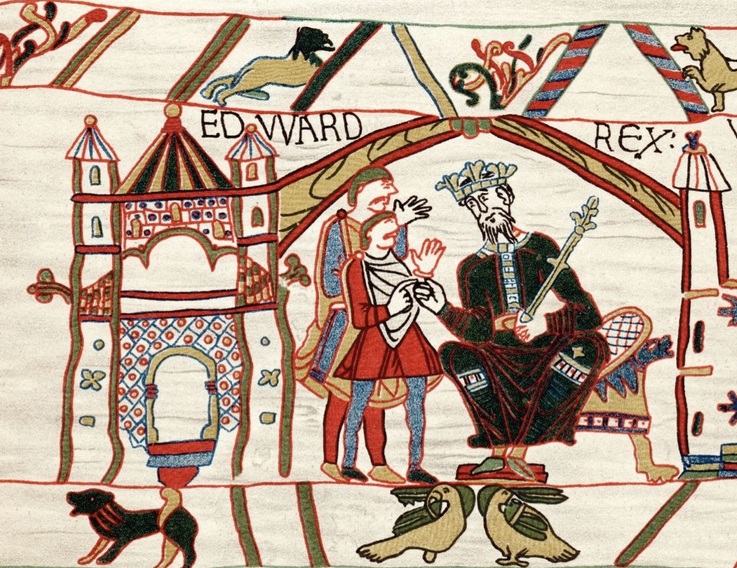
One of Many Anglo-Saxon Edwards Who Preceded the Conquest
The English language has a long history. We don’t have any samples of what the English spoke during the Roman occupation. In fact, it was not until the Angles, Saxons, and Jutes crossed the Channel into Britain that we have the bare bones of a literature. Today, I present one of the great Anglo-Saxon poems.
If you want to hear the poem in the original Anglo-Saxon of the Dark Ages, you can do so by checking out this YouTube site. It is a far, far cry from the language we speak today.
Here is “The Wanderer” in a modern translation from the Poetry Foundation:
The Wanderer
Always the one alone longs for mercy, the Maker’s mildness, though, troubled in mind, across the ocean-ways he has long been forced co stir with his hands the frost-cold sea, and walk in exile’s paths. Wyrd is fully fixed.
Thus spoke the Wanderer, mindful of troubles,
of cruel slaughters and dear kinsmen’s downfall: “Often alone, in the first light of dawn, I have sung my lament. There is none living to whom I would dare to reveal clearly my heart’s thoughts. I know it is true that it is a nobleman’s lordly nature to closely bind his spirit’s coffer, hold fast his treasure-hoard, whatever he may think. The weary mind cannot withstand wyrd, the troubled heart can offer no help, and so those eager for fame often bind fast in their breast-coffers a sorrowing soul, just as I have had to take my own heart— Often wretched, cut off from my own homeland, far from dear kinsmen—and bind it in fetters, ever since long ago I hid my gold-giving friend in the darkness of earth, and went wretched, winter-sad, over the ice-locked waves, sought, hall-sick, a treasure-giver, wherever I might find, far or near, someone in a meadhall who might know my people, or who would want to comfort me, friendless, accustom me to joy. He who has come to know how cruel a companion is sorrow for one with few dear friends, will understand: the path of exile claims him, not patterned gold, a winter-bound spirit, not the wealth of earth. He remembers hall-holders and treasure-taking, how in his youth his gold-giving lord accustomed him to the feast—that joy has all faded.
And so he who has long been forced to forego
his lord’s beloved words of counsel will understand: when sorrow and sleep both together often bind up the wretched exile, it seems in his mind that he clasps and kisses his lord of men, and on his knee lays hands and head, as he sometimes long ago in earlier days enjoyed the gift-throne. But when the friendless man awakens again and sees before him the fallow waves, seabirds bathing, spreading their feathers, frost falling and snow, mingled with hail, then the heart’s wounds are that much heavier, longing for his loved one. Sorrow is renewed when the memory of kinsmen flies through the mind; he greets them with great joy, greedily surveys hall-companions—they always swim away; the floating spirits bring too few familiar voices. Cares are renewed for one who must send, over and over, a weary heart across the binding waves.
And so I cannot imagine for all this world
why my spirit should not grow dark when I think through all this life of men, how suddenly they gave up the hall-floor, mighty young retainers. Thus this middle-earth droops and decays every single day; and so a man cannot become wise, before he has weathered his share of winters in this world. A wise man must be patient, neither too hot-hearted nor too hasty with words, nor too weak in war nor too unwise in thoughts, neither fretting nor fawning nor greedy for wealth, never eager for boasting before he truly understands; a man must wait, when he makes a boast, until the brave spirit understands truly where the thoughts of his heart will turn.
The wise man must realize how ghastly it will be
when all the wealth of this world stands waste, as now here and there throughout this middle-earth walls stand blasted by wind, beaten by frost, the buildings crumbling. The wine halls topple, their rulers lie deprived of all joys; the proud old troops all fell by the wall. War carried off some, sent them on the way, one a bird carried off over the high seas, one the gray wolf shared with death—and one a sad-faced man covered in an earthen grave. The Creator of men thus destroyed this walled city, until the old works of giants stood empty, without the sounds of their former citizens.
He who deeply considers, with wise thoughts,
this foundation and this dark life, old in spirit, often remembers so many ancient slaughters, and says these words: ‘Where has the horse gone? where is the rider? where is the giver of gold? Where are the seats of the feast? where are the joys of the hall? O the bright cup! O the brave warrior! O the glory of princes! How the time passed away, slipped into nightfall as if it had never been! There still stands in the path of the dear warriors a wall wondrously high, with serpentine stains. A storm of spears took away the warriors, bloodthirsty weapons, wyrd the mighty, and storms batter these stone walls, frost falling binds up the earth, the howl of winter, when blackness comes, night’s shadow looms, sends down from the north harsh hailstones in hatred of men. All is toilsome in the earthly kingdom, the working of wyrd changes the world under heaven. Here wealth is fleeting, here friends are fleeting, here man is fleeting, here woman is fleeting, all the framework of this earth will stand empty.’
So said the wise one in his mind, sitting apart in meditation.
He is good who keeps his word, and the man who never too quickly shows the anger in his breast, unless he already knows the remedy a noble man can bravely bring about. It will be well for one who seeks mercy, consolation from the Father in heaven, where for us all stability stands.
A Word of Explanation
The following discussion is taken from the Octavia Randolph website:
Wyrd is an Old English noun, a feminine one, from the verb weorthan “to become”. It is related to the Old Saxon wurd, Old High German wurt, Old Norse urür. Wyrd is the ancestor of the more modern weird, which before it meant odd or unusual in the pejorative sense carried connotations of the supernatural, as in Shakespeare’s weird sisters, the trio of witches in MacBeth. The original Wyrd Sisters were of course, the three Norns, the Norse Goddesses of destiny.
Wyrd is Fate or Destiny, but not the “inexorable fate” of the ancient Greeks. “A happening, event, or occurrence”, found deeper in the Oxford English Dictionary listing is closer to the way our Anglo-Saxon and Norse forbears considered this term. In other words, Wyrd is not an end-point, but something continually happening around us at all times. One of the phrases used to describe this difficult term is “that which happens”.
I was watching the National Geographic Channel last night when suddenly I sat bolt upright. On her show entitled “Trafficked,” Mariana van Zeller investigates a man who flew to Mozambique to claim an inheritance, only to find himself in jail for attempting to travel with heroin in his luggage—heroin disguised as candy that was given to him by a man from South Africa to give to someone in Nigeria.
Nigeria? Oh oh! Can anything legitimate have anything to do with Nigeria? Apparently, there is a term in Nigerian Pidgin describing the types who are so imprudent as to turn up in Africa for their “inheritance”: that term is maga, which means “easily fooled idiot.” On the show, Van Zeller interviews a masked Nigerian baddy (no doubt a Prince) who points out that the man imprisoned in Mozambique is nothing more than a maga for actually showing up to claim his non-existent inheritance.
Ha ha, it is to laugh!
So when all those flyover country chuckleheads show up at Trump rallies wearing their MAGA hats, is it merely a case of self-identification? “I’m an easily fooled idiot. Lie to me!”
I ran across the word in a review in the Times Literary Supplement (TLS). Hiraeth is a Welsh term meaning a longing for something that can’t be recovered. Like, for instance, one’s youth; the ten-year-old ball point pen I lost at the Los Angeles Central Library; my friends who have passed on; my 1997 Nissan Pathfinder that was declared totaled by the insurance company for a damaged passenger door; and my first love.
There is something inexpressibly lyrical about certain terms in the Welsh and Anglo-Saxon languages. The following snippet comes from a lament for Hywel ab Owein, a prince of North Wales:
Since Hywel is gone, who bore battle gladly, by whom we used to stand, we are all avowedly lost, and the host of Heaven is the fairer.
Come what may of wealth from land domain, yet this world is a deceptive dwelling-place; with a spear Hywel the Tall, the hawk of war, was pierced.
This afternoon I finally took the plunge. I had been delaying reserving my flight and hotel in Hawaii until Martine got her passport (without which she couldn’t take a flight, as she doesn’t have a REAL ID drivers license). She finally got her passport in the mail on Saturday; and, today I went to the Culver City office of the Auto Club and made our reservation.
Now I have some direction and can do some more detailed planning on destinations and public transportation.
Speaking of direction, the whole north/south/east/west system of directions is generally not used in Hawaii. Think of it for a second: Hawaii is a collection of volcanic mountains upraised from the floor of the ocean. With few exceptions, most people live within hailing distance of the Pacific; and relatively few live in the interior. Therefore, the words Hawaiians most frequently used for directions are maukaand makai—namely, inland and shore.
In Honolulu, the same words are used; but since it is a big city, there are two additional directions: Toward Ewa (west of Pearl Harbor) or toward Diamond Head.
It’ll take some getting used to, but I can understand its usefulness.
Children learning their native language in Hawaii don’t study their ABCs. For one thing, there is no “B” or “C” in the Hawaiian alphabet. In fact, their are only twelve letters in all—the same five vowels we have and seven consonants. Then, too, there is the okina, or glottal stop, which looks like a single apostrophe. You can see it in the above illustration next to the Hawaiian flag.
The sparseness of the alphabet could be the reason there are so many long words in the language. For instance, my favorite Hawaiian singer, the late Israel Kamakawiwo’ole has a name that is virtually unpronounceable to us haoles (i.e., mainlanders). When Bruddah Iz, as he was called, died in 1997 at the age of 38, he was well over 700 pounds. The flag of Hawaii flew at half mast—the only non-governmental-official to be so honored. He had the voice of an angel. I own several of his albums on CD and regard them among my most treasured possessions.
As a rare treat, here is Iz singing “Somewhere over the Rainbow”:
The video also shows his funeral, when his ashes were scattered in the Pacific.
Here are just a few Hawaiian street and neighborhood names in Honolulu. Imagine trying to pronounce them aloud to a native after you’ve had a few drinks::
Kaka’ako
Kekeaulike
Kalakaua
Kawaiaha’o
Nu’uanu
’Aihualama
Pu’uohi’a
Likelike
Kapahulu
Kapi’olani
Sadly, the Hawaiian language is endangered, with most natives reverting to Pidgin, which I discussed in an earlier post.
In Hawaii, there are two official languages—English and Hawaiian—and one unofficial one. I am speaking about the Hawaiian version of Pidgin English. Although it is thought of as being lower in status than the two official languages, it is becoming ever more prevalent as a kind of native slang. It contains bits of English, Hawaiian, Chinese, Filipino, Spanish, Korean, Portuguese, and Japanese. According to one website:
The local patois (Hawaiian slang) was originally developed by Chinese immigrants to make business transactions easier. They created an easy-to-understand lingo and named it “pidgin,” which literally translates to “business.” These days, natives on the islands have adopted this as a means of short-hand speak, as well as a way to mess with tourists.
I can vouch for Pidgin as a way of messing with tourists. Consider the following expressions:
Broke Da Mouth – What delicious food does
Your Kokua Is Appreciated – Your assistance, compliance, or contribution is appreciated
This Buggah is Pau – Your car is finito
Da Kine – Watchamacallit, Thingamajig
B-52 Bombah – Giant flying cockroach
Grinds or Grindz – Food
Hamajang – Something that is messed up, out of whack, disorderly, or needs tending
Kanak Attack – The feeling you’ve eaten way too much
’Ono – Tasty, delicious
Slippas – Flip-fops or sandals
There is an amusing (and very detailed) YouTube video illustrating how Hawaiian Pidgin is pronounced:



 Tarnmoor
You must be logged in to post a comment.