Leaves and Concrete

My Preferred Walking Surface

My Preferred Walking Surface

One of my meditations at Descanso Gardens related to the type of surface we walk on. For us city-dwellers, most of our lives are spent walking on artificial surfaces such as concrete, asphalt, wood, or padded carpets. Yesterday, I cut through the 150-acre wood consisting mostly of oak trees and camellias, roughly from a point just south of the lilac garden to the cactus garden on the other side of the park.

During most of that time, I was treading on a lush carpet of dead leaves and fallen camellia blossoms as pictured above. It was the most resilient surface on which I have ever walked. So much death all around me! But was it really? How much of our skin and hair do we slough off every day of our lives? Yet they are renewed (well, except maybe the hair), as are the leaves and camellia blossoms. It is a little death among so much life. And it made me think that, perhaps, we ourselves are like leaves or blossoms of a much larger living entity.

We hardly ever see ourselves that way, what with our gimme gimme now now lives and somewhat tawdry needs. Going to Descanso always makes me think about our role in the larger life of the planet. We have destroyed so many of the green spaces that make us realize our part in the universe; and, as a result, we have become unhappier and more disconnected.

Eschscholzia californica

Macro Image of a California Poppy

Macro Image of a California Poppy (Eschscholzia californica)

We got an extra day off from work today, so Martine and I drove to Descanso Gardens in La Cañada-Flintridge, perched in the hills above Glendale. We have always associated the gardens with peace of mind, and today was no exception. Martine and I usually split off for a couple of hours and meet at the front gate just before closing time. While she wanders to her favorite sites, I look to get lost on the lesser known trails and perhaps do a bit of meditation.

The plethora of California poppies—the official state flower—kept distracting me. I took a number of close-ups, including the picture above, There is something so simple and yet so splendid about these blossoms that they kept interrupting my meditations. One never knows when one will run into a clump of these.

If it weren’t for tax season, I would have made a point of visiting the Antelope Valley California Poppy Preserve about fifteen miles west of Lancaster. Some 1,745 acres are full of California poppies and other native wildflowers, and there is a small visitor center maintained by the California Department of Parks and Recreation. (Of course, with the state’s current budgetary problems, I don’t even know if the park is still being funded.)


“Grassed Down and Forgotten”

tess

Cover of Tess of the D’Urbervilles

The past was past; whatever it had been it was no more at hand. Whatever its consequences, time would close over them; they would all in a few years be as if they had never been, and she herself grassed down and forgotten. Meanwhile the trees were just as green as before; the birds sang and the sun shone as clearly now as ever. The familiar surroundings had not darkened because of her grief, nor sickened because of her pain.

She might have seen that what had bowed her head so profoundly—the thought of the world’s concern at her situation—was founded on an illusion. She was not an existence, an experience, a passion, a structure of sensations, to anybody but herself. To all humankind besides Tess was only a passing thought. Even to friends she was no more than a frequently passing thought. If she made herself miserable the livelong night and day it was only this much to them—’Ah, she makes herself unhappy.’ If she tried to be cheerful, to dismiss all care, to take pleasure in the daylight, the flowers, the baby, she could only be this idea to them—’Ah, she bears it very well.’ Moreover, alone in a desert island would she have been wretched at what had happened to her? Not greatly. If she could have been but just created, to discover herself as a spouseless mother, with no experience of life except as the parent of a nameless child, would the position have caused her to despair? No, she would have taken it calmly, and found pleasure therein. Most of the misery had been generated by her conventional aspect, and not by her innate sensations.—Thomas Hardy, Tess of the D’Urbervilles

Be Cool, You Fool!

If You’re in College, and You’re Uncool, You’re Nowhere

If You’re in College, and You’re Uncool, You’re Nowhere

When I work Sundays the last five or six weeks of tax season, I always break my workday in two. The high-rise where my accounting firm is located does not run air-conditioning on Sundays, with the result that the oxygen level gets pretty well depleted. So I usually take a four-to-six mile walk around the UCLA area, eat lunch in the UCLA student union, and shop at the UCLA bookstore, returning to work around one in the afternoon.

The Ackerman Union has several chain restaurant outlets and a number of TV monitors that are kept tuned to mtvU, where the programming seems (on Sundays anyhow) to be all music videos.

If these music videos have a message, it is: If you’re not cool, you’re nothing—the Twenty Teens’ equivalent of the Beatles’ Nowhere Man. Everyone in a rock music video is always dressed in the just-right casual style, like the group shown above. Nowhere is seen anything as forbidden as a book, an older person, or a work of classical music. (is it because these are all associated with Schoolwork?)

In the world of music videos, all that matters is looking right and making all the cool moves to impress one’s peers. The peer group is everything, to the exclusion of all else. It almost verges on the tribal.

Bad Times Are Gonna Come

Our Lives Are All Subject to Reverses

Our Lives Are All Subject to Reverses

I remember a story that one film industry friend told me several years ago. A family was so solicitous about the health of their son that they raised him on an organic and vegetarian diet. When he grew up, he wanted to go into the movies as a technician like his Dad. That first day on the job, he ate a McDonald’s hamburger and became deathly ill. He had to be hospitalized for weeks.

You can’t stay entirely out of the way of troubles that are sure to come. One of your loved ones could sicken and die, your health could take a turn for the worse, you could be forced out of your home, your investments could disappear as a result of fraud, your best friend could turn on you, your lover could prove unfaithful to you … the list is endless. How are you going to avoid all of those pitfalls, plus the ones not mentioned? Are you going to be like the vegetarian child for whom the world is toxic?

I would like to think that encountering troubles is a powerful inducement for having greater sympathy for your fellow man. It is not easy when your fellow man cuts you off on the street and leaves you with an upraised middle finger and the exhaust from his BMW; but if your response is nothing but rage, you will only hurt yourself.

Look around you. The world is full of people who need a little help. Even when their gratitude is not what you would hope for, you will feel better about yourself.


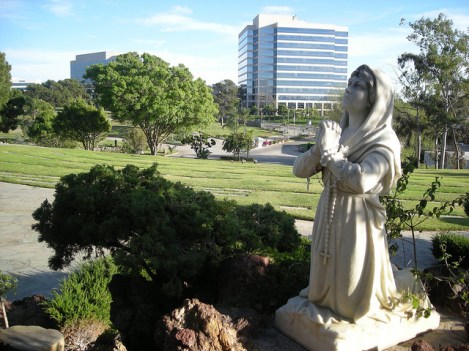
Cemetery Blues

Holy Cross Cemetery in Culver City

Holy Cross Cemetery in Culver City

Today, after doing a half day of tax work (on a Saturday!), Martine and I went to Holy Cross Cemetery in Culver City. Today is the first anniversary of the death of our apartment manager, Tony. Not that we liked him very much, but we liked his mother, who died twelve years ago; and believe that, although his son grossly mismanaged his own life, he deserves to be commemorated—not for what he was, but for what he could have been.

Once again, I thought to myself that, when it is my time to go, I do not want to be embalmed and buried—not anywhere. My wish is to have my remains cremated and dispersed, preferably in the ocean. If that’s not possible, on the surface of the earth will be almost as good.

Since we had a little extra time, we did a little Hollywood celebrity grave search. We found out where Bela Lugosi, Jimmy Durante, Rita Hayworth, Zasu Pitts, Bonita Granville, John Candy, and Fred MacMurray are interred.

Then we went to Dinah’s Family Restaurant at Centinela and Sepulveda, one of Martine’s favorite venues for fried chicken.

Three from Robin Tanner

Three Interesting Quotes on How Life has Changed

Three Interesting Quotes on How Life has Changed

We mourned for a lost Eden. Farming was becoming a noisy, mechanised, stinking business. Wagons, ploughs, and the horses that drew them were all disappearing. Wood and stone were giving place to asbestos and corrugated iron. Care and grace, and the old slow pace and the old thoroughness and craft were all abandoned. The farm tractor was now king, and speed was all-important. Thatched ricks, cut-and-laid hedges, shocks of corn and cocks of hay, handmade wooden gates and stiles, were rare sights now. The stone-breaker was no longer needed since the white limestone lanes were tarred. Flowers that were once common had become rare, and only a few of the old mixed pastures escaped the zeal of farmers keen to sow ‘leys’ without a ‘weed’. Those who never saw Edwardian England can have no idea of its beauty. Old photographs show this with great poignancy. True, the children in them often looked cowed and ill-clad, and the men and women are bowed with labour, but that need not have been the heavy price paid for beauty and naturalness: the brash angularity of today, its harsh shapes and unsympathetic textures, its litter of poles and wires, its makeshift, temporary appearance lie like an ugly palimpsest upon the old countryside.

* * * * *

In the sleepy England of my childhood it was an event to see a motor car, or watch a biplane for the first time until it became a speck in the distance and vanished. Nothing ever changed. Sugar was twopence a pound, and a letter required a penny stamp. Yet the ugly and stupid technological revolution was imminent. Over the years I have watched the change from age-old agriculture to a mechanised ‘agro-business’. Horses and men have gone, and traditional farming craftsmanship such as rick-building and thatching, coppicing and hedge-laying has been extinguished in the process. A hedge has become an obstacle to be removed, and wild flowers troublesome weeds to be exterminated.

* * * * *

Year by year we lose more and more of the things we have loved: ancient woodlands, flowery meadows, handsome old farm buildings, stiles and gates of oak and ash; things made of wool, linen or silk; cloth-bound books of lissom paper, their sections properly stitched so they open easily; and a multitude of domestic things that were good to handle – all made before the fatal invasion of synthetic substances and shoddy methods.—Robin Tanner, Double Harness (1987)

Keeping My Resolution

If It Were Only That Simple!

If It Were Only That Simple!

On February 6, I made a kind of belated New Years’ resolution that I would not get so vitriolic about what Republicans are doing to this country. Well, so far, I’ve held to it, but as the sequestration looms. (First it was the Fiscal Cliff. What’s next, the Budget Apocalypse?)

Then I started looking at a website called Laudator Temporis Acti, which has some really interesting quotes, among which I found this one by Owen Felltham (1602?-1668) on the subject of being too censorious:

No man can write six lines, but there may be something one may carp at, if he be disposed to cavil. Opinions are as various, as false. Judgement is from every tongue, a several. Men think by censuring to be accounted wise; but, in my conceit, there is nothing layes forth more of the Fool….Frequent dispraises are, at best, but the faults of uncharitable wit. Any Clown may see the Furrow is but crooked, but where is the man that can plow me a streight one? The best works are but a kind of Miscellany; the cleanest Corn, will not be without some soil: No not after often winnowing. There is a tincture of corruption, that dies even all mortality. I would wish men in works of others, to examine two things before they judge. Whether it be more good, then ill: And whether they themselves could at first have perform’d it better.

Felltham has a point. I think I found here a website from which I’ll be drawing some interesting quotes in the future.

“The Divinity of the Groves”

Tree Cutting

Tree Cutting

Then we went to work to cut down the trees. The slim stems were an easy task to a good woodman, and one after another they toppled to the ground. And meantime, as I watched, I became conscious of a strange emotion.

It was as if someone were pleading with me. A gentle voice, not threatening, but pleading—something too fine for the sensual ear, but touching inner chords of the spirit. So tenuous it was and distant that I could think of no personality behind it. Rather it was the viewless, bodiless grace of this delectable vale, some old exquisite divinity of the groves. There was the heart of all sorrow in it, and the soul of all loveliness. It seemed a woman’s voice, some lost lady who had brought nothing but goodness unrepaid to the world. And what the voice told me was that I was destroying her last shelter.

That was the pathos of it—the voice was homeless. As the axes flashed in the sunlight and the wood grew thin, that gentle spirit was pleading with me for mercy and a brief respite. It seemed to be telling of a world for centuries grown coarse and pitiless, of long sad wanderings, of hardly won shelter, and a peace which was the little all she sought from men. There was nothing terrible in it. No thought of wrong-doing. The spell which to Semitic blood held the mystery of evil, was to me, of the Northern race, only delicate and rare and beautiful. Jobson and the rest did not feel it, I with my finer senses caught nothing but the hopeless sadness of it. That which had stirred the passion in Lawson was only wringing my heart. It was almost too pitiful to bear. As the trees crashed down and the men wiped the sweat from their brows, I seemed to myself like the murderer of fair women and innocent children. I remember that the tears were running over my cheeks. More than once I opened my mouth to countermand the work, but the face of Jobson, that grim Tishbite, held me back.—John Buchan, “The Grove of Ashtaroth,” The Moon Endureth: Tales and Fancies

Fire and Ice

A Warehouse Fire in Chicago Presents Some Strange Contrasts

A Warehouse Fire in Chicago Presents Some Strange Contrasts

On one hand, we have global warming. We are already seeing shipping along the Arctic Sea north of Russia and Siberia. On the other, we can have some anomalies as the Chicago warehouse fire in single-digit (Fahrenheit) temperatures . The fire burns away amid ice and low temperatures.

It’s an interesting contrast. I don’t envy the firefighters, though, who get to choose between frostbite and severe burns.