The End of Coat and Tie

What Ever Happened to Men’s Coat and Tie Fashions?

Up until the 1960s, the wearing of coat and tie, and usually a white shirt, was de rigeur for American men. When I started working on my first full-time job around 1968, I noticed for the first time that men were no longer 100% certain to wear a coat and tie to the office. What happened?

From the point of view of Los Angeles, I noticed the weather slowly started heating up, such that the traditional wool men’s uniform tended to be on the uncomfy side during warm weather.

When I started working in an accounting office in 1992, we were all required to wear a coat and tie every day. It was only a few years later that it was no longer required, even when clients were due to visit our offices. By the 2000s, I rarely had to wear a tie, except perhaps when I had to visit a client’s premises.

I watch a lot of noir films of the 1940s and 1950s, which makes me particularly aware of changes in the way men dress today as compared to then.

This evening I watched two Humphrey Bogart films that showed the star in a flashy dark suit in both The Maltese Falcon (1941) and The Big Sleep (1946). Whether playing Sam Spade or Philip Marlowe, Bogie looked ready for the big time even as he was supposed to be a cheap detective in a not-too-swank office. In the latter film, he even carried a pocket flask full of rye.

Was it climate change that doomed the wool suit? Or was it the swinging 1960s and 1970s that made casual a viable option? Probably it was a combination of the two.

Attaining Isness

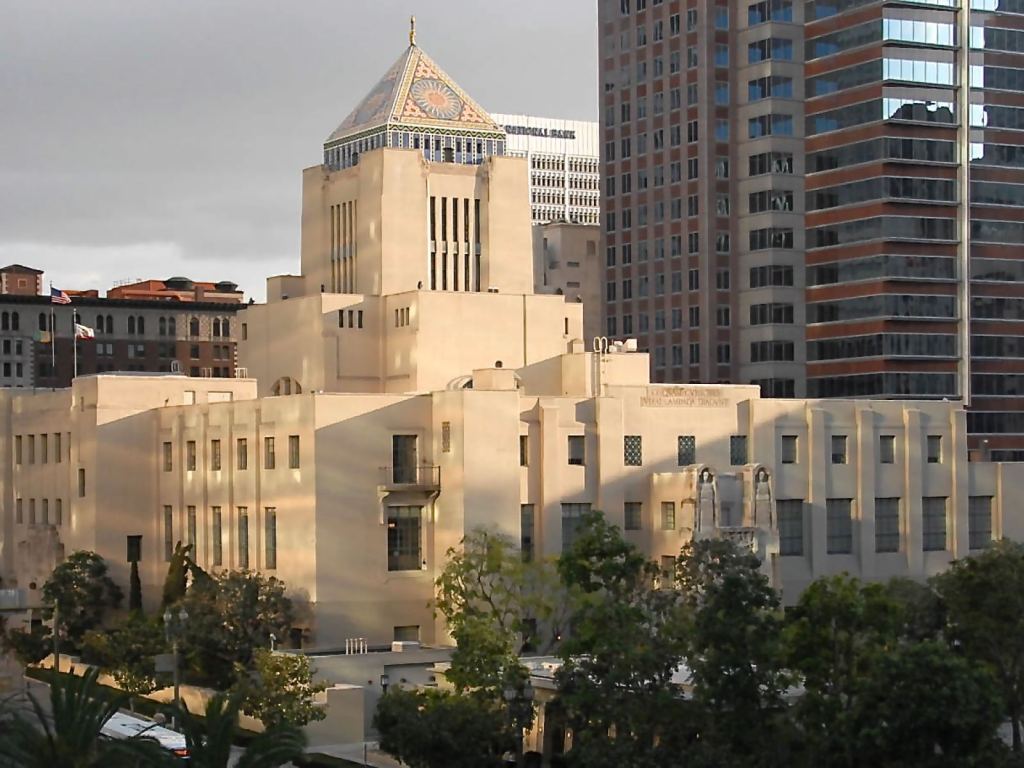
The Los Angeles Central Library at 5th and Flower Streets

Four years after the Covid lockdown put it on hold, seemingly permanently, the Central Library has restarted the guided mindful meditations on Thursday afternoons at 12:30. The meditations are conducted under the auspices of UCLA Health’s Mindfulness Education Center.

Today I attended for the third straight week and hope to continue. I find that the guided meditations ground me. Instead of endlessly planning the future or being swept up by my unfulfilled desires, I ground myself in the present. There is time for planning and for desires, but it helps first to immerse yourself in what I call the “isness” of your being.

This form of meditation is not connected with any religion or even any culture. It is presented solely as a discipline to free your mind from endless distractions. There is no required lotus position or any other position. You merely have to sit or lie down comfortably.

If you want to get a feel for what this is like, you can select one of the following prerecorded guided meditations from your computer, or select from a list from the UCLA Mindful website:

Many a times when, while trying to sleep, my mind is swirling around with plans for the next day or frustrations or unfulfilled desires, I’ve found the practice of meditation helps me drift off to sleep.

Steps

The Inca Ruins at Machu Picchu

I knew I was getting old when I was at the ruins of Machu Picchu ten years ago when I was 69 years old. There was a light drizzle, and there were hundreds of rough slightly wet steps without guard rails. I envisioned myself stumbling and pitching down the mountain into the Valley of the Urubamba below.

For me, getting older is not what I thought it would be. In general, my mental acuity has not suffered, but I do lurch a bit when I walk. And going down a flight of stairs requires a firm grip on the handrail and a slow, somewhat painful progress to the bottom. (Going up a flight is not as bad, so long as there’s a handrail.)

Now that the Los Angeles Central Library has resumed its mindful meditation sessions, I take the light rail to the 7th Street Metro Center and walk three blocks to the library. There is an escalator going up to the street level, but on the return trip, I must take the elevator. Downtown Los Angeles has a large homeless population, so it is rare to ride the elevator when it is free of various bodily effluvia. Today, it wasn’t. But it was still better than taking the stairs, especially when there are people sitting on the stairs that have to be gotten around without access to the handrails.

Yes, there are some problems about getting old. The good news is that, for me, they are not insurmountable. I could probably even go to Peru again, but next time I’ll take a collapsible cane.

Winning

I have never been one of those smiley-faced individuals who always have to be on the winning side. It’s even got me into trouble when I was a Director of Corporate Communications for a computer software company. I always saw things from both sides, unlike those corporate marionettes who advertise “ask your doctor” pharmaceuticals on television.

It’s probably due to my Hungarian ancestry. Hungary was on one of the two main invasion paths from Asia into Europe (the other being Poland). I have perhaps an ancestral memory that pretending to have happy thoughts will not prevent Attila and Genghis Khan from their accustomed pattern of rapine, looting, and murder.

Winning is nice when it happens, but it’s not a permanent condition. After all, we all will eventually sicken and die. If you live long enough, your skin will resemble the craters of the moon; and your days will be accompanied by bouts of pain and even suffering. Oh, and you can forget right off about drawing admiring glances from hot young women. Unless you pay them well.

So if your days, like mine, are a strange mix of winning and losing, you can find some fleeting happiness in small pleasures. In my retirement years, I feel gratified in not having to spend 40+ hours a week dancing to the tune of some megalomaniacal boss, of which I have had several. I read books; I cook; I do chess problems; I travel when I can. Maybe that’s as close to winning as one can get in this life.

Standing Tall at the Podium

Height Is the Only Advantage for This Mental Midget

Today I watched the debate between Vice President Kamala Harris and her opponent. There couldn’t possibly be two candidates who were more different from each other.

Trump’s only advantage is that he is almost a foot taller than Harris, and America is a country which tends to over-reward candidates who are tall. I myself am of medium height (5 feet 8 inches, or 1.75 meters), though because of a pituitary tumor I had from an early age, I was the shortest male in class throughout my elementary school years. It was only after the tumor was removed at age 21 that I grew to my present height.

There have been statistics to the effect that greater than average height is a clear advantage in politics, business, and wooing. My own thinking is that the height advantage, while real, is no guarantee of success.

At today’s presidential debate, it was Kamala Harris who stood tall. She was quick to react, made frequent eye contact, and even began by going to Trump’s podium and shaking his hand, which no doubt surprised the ex-president to no end. Trump, on the other hand, looked like the grumpy old man that he is, wanting to chase all the darned kids off his lawn, and speaking with a cold, constipated rage that made me think we probably wouldn’t live out his term if elected.

The Scruffy and the Soshes

Me at the Living Desert in the Coachella Valley 2022

There are two types of guys in this world (now where have you heard that before?)—the scruffy and the soshes (pronounced sōsh-es). I am clearly among the scruffy, though you will not find me wearing T-shirts, shorts, or flip-flops in public. Also: No tattoos. I guess that makes me a middling scruffy guy.

I have never been a fashion plate. In fact, I have looked down on guys that were. To me, they were soshes: People who were self-conscious about their appearance and, at the same time looked down on people like me, who just didn’t care.

As a retired senior on a fixed income, I have a clothes budget that approaches zero. Some of my shirts and pants are older than many of my acquaintances.

If I had the money, I would probably wear pants that would fit me better, what with my short legs and pot belly, but I would still avoid anything that would smack of GQ or Country Club. At this point in my life, who am I trying to impress? Do I have any possible future as a chick magnet at age 79? Would I even want to? These are important questions as I age.

Fortunately, I feel comfortable in my own skin, even if that skin at times resembles the lunar surface.

Dog Halloween

Fireworks Galore, But Does Anyone Care What They’re Celebrating?

As I write this blog, I hear the spluttering of fireworks near and far. What I do not hear is the barking of dogs. No doubt they are cowering under beds and couches while their super-sensitive ears are assailed by the endless sound of explosions.

I used to attend fireworks shows, until I used to dislike parking miles away and joining a large crowd of people for a show that lasted all of fifteen or twenty minutes. Hell, I even set off some illegally purchased firecrackers myself—and I still have all ten fingers and toes! Eventually, I just decided that here was another holiday which didn’t really mean much to anybody.

Which holidays have any meaning any more?

  • Halloween, because it’s still fun and everyone likes candy
  • Thanksgiving, so you discover who in your family is demented enough to vote for Trump
  • Christmas, so you can spend $$$ on what you don’t need and your friends and relatives don’t want

Independence Day has become a kind of Dog Halloween. It results in scaring your dogs and cats half to death. At least, Roxie, the little lapdog downstairs, hasn’t barked once today. It would be too much to hope that her silence will continue, as she still, after more than a year, regards me as little more than a bindlestiff.

Glorious Fourth

As I write these words, the air is thick with explosions as juvenile delinquents of all ages set off fireworks, terrorizing their pets and injuring themselves in an orgy of carelessness. This is what the anniversary of our independence has come to mean: explosions and barbecues.

Forgive me i I choose not to join in the festivities. At one time, I did; but the combination of too much charred meat and too many overcrowded fireworks displays has, in time, soured me.

Instead I took a walk to the Colorado Center’s park, at a central point called The Landing, where there is shade, a roof, and metal seating. On weekends and holidays, I am more likely to see janitors and security guards going from building to building than locals. There was a bench with two girls, a couple of serious kickboxers practicing, and two or three people walking their dogs.

I had planned to begin reading Georges Simenon’s The Shadow Puppet, an early (1932) Inspector Maigret novel; but I found had already finished the book same under another title, namely Maigret Mystified. No matter, I merely reveled in the peace and quiet with relatively few fireworks explosions in the background.

Then I walked the mile and a half back to my apartment and continued my reading of an interesting history of Spain by John A. Crow entitled Spain: The Root and the Flower.

The Long Retreat

Middle School Greek Dancers at St Nicholas Greek Orthodox Church

I remember a time when most foreign-born Americans were of European ethnicity. My father, Elek Paris, was born in what is now the Republic of Slovakia; and my mother, who was actually born in Ohio, was taken to Hungary to be raised by her grandparents. For the first five or six years of my life, I thought that Hungarian was the language of the United States.

What inevitably happens has happened. The children of European-born immigrants see their parents’ culture, religion, and language as something quaint which they are being reluctantly marshaled into accepting. The three-year Covid-19 lockdown has brought this tendency into sharper focus.

Yesterday, Martine and I attended the annual Greek Festival at St Nicholas in Northridge for the first time since 2019. Sure enough, the tours of the church were more perfunctory; the calamari was more breading than squid; and there were fewer people able to do the traditional dance steps. I noticed much the same at the two Hungarian festivals we attended this month. Only the Grace Hungarian Reform Church in Reseda had anything like the same quality of food and entertainment as before the lockdown.

Our neighbors downstairs are refugees from Putin’s Ukrainian invasion. I notice that their two little daughters are addressing their mother in English instead of Ukrainian.

When I first came to Los Angeles, there were at least half a dozen Hungarian restaurants. Now there are none. If I want real Hungarian food, I’ll either have to cook it myself or visit my brother more often. (He’s a far better cook than I am.)

If Martine and I expect to find more authentic ethnic events, we will have to concentrate on the Asian and Latin American ethnic events, as they have arrived in this country more recently.

Stuck in a Bubble

As we age, we tend to find ourselves stuck in a bubble. Even with the wonders of the smart phone and social media, we seem to have found a new way of isolating ourselves. One of my friends cannot have a conversation without mentioning the politics and culture of America between 1966 and 1976. His talk is of the Kennedy assassinations (he was actually present at Robert Kennedy’s), the FBI vs. the Sioux at Pine Ridge, the Manson Family, and related topics. He goes back frequently to his college days or his Midwestern upbringing.

If one is feeling stressed, I can understand trying to find refuge in the past. It is a particular temptation as one ages, especially if life has not proved satisfactory in some way. And, when you think about it, it rarely does. We are all mortal, and the stresses do not disappear when one is up against the endgame. As we all inevitably are.

My way of fighting the bubble-ization of old age is to try to understand the present. Mind, I didn’t say to accept it. For instance, I do not own a smart phone—though I have a flip phone I use occasionally. I use FaceBook mainly as a content provider: All my WordPress posts are sent to my FaceBook page, and I usually add a couple of funny comics to boot. I do not have any Twitter, Instagram, TikTok, or other social media accounts. (And I don’t feel socially deprived as a result.)

When people try to put me down with an “Okay, Boomer!,” I merely point out that I am pre-Baby-Boom, having been born during the last days of the Second World War. In fact, I was born some six months before the Trinity A-Bomb test, so I’m also pre-Atomic-Age. That only means I am older than dirt. But I am still alive.