The Scruffy and the Soshes

Me at the Living Desert in the Coachella Valley 2022

There are two types of guys in this world (now where have you heard that before?)—the scruffy and the soshes (pronounced sōsh-es). I am clearly among the scruffy, though you will not find me wearing T-shirts, shorts, or flip-flops in public. Also: No tattoos. I guess that makes me a middling scruffy guy.

I have never been a fashion plate. In fact, I have looked down on guys that were. To me, they were soshes: People who were self-conscious about their appearance and, at the same time looked down on people like me, who just didn’t care.

As a retired senior on a fixed income, I have a clothes budget that approaches zero. Some of my shirts and pants are older than many of my acquaintances.

If I had the money, I would probably wear pants that would fit me better, what with my short legs and pot belly, but I would still avoid anything that would smack of GQ or Country Club. At this point in my life, who am I trying to impress? Do I have any possible future as a chick magnet at age 79? Would I even want to? These are important questions as I age.

Fortunately, I feel comfortable in my own skin, even if that skin at times resembles the lunar surface.


Dog Halloween

Fireworks Galore, But Does Anyone Care What They’re Celebrating?

As I write this blog, I hear the spluttering of fireworks near and far. What I do not hear is the barking of dogs. No doubt they are cowering under beds and couches while their super-sensitive ears are assailed by the endless sound of explosions.

I used to attend fireworks shows, until I used to dislike parking miles away and joining a large crowd of people for a show that lasted all of fifteen or twenty minutes. Hell, I even set off some illegally purchased firecrackers myself—and I still have all ten fingers and toes! Eventually, I just decided that here was another holiday which didn’t really mean much to anybody.

Which holidays have any meaning any more?

  • Halloween, because it’s still fun and everyone likes candy
  • Thanksgiving, so you discover who in your family is demented enough to vote for Trump
  • Christmas, so you can spend $$$ on what you don’t need and your friends and relatives don’t want

Independence Day has become a kind of Dog Halloween. It results in scaring your dogs and cats half to death. At least, Roxie, the little lapdog downstairs, hasn’t barked once today. It would be too much to hope that her silence will continue, as she still, after more than a year, regards me as little more than a bindlestiff.

Glorious Fourth

As I write these words, the air is thick with explosions as juvenile delinquents of all ages set off fireworks, terrorizing their pets and injuring themselves in an orgy of carelessness. This is what the anniversary of our independence has come to mean: explosions and barbecues.

Forgive me i I choose not to join in the festivities. At one time, I did; but the combination of too much charred meat and too many overcrowded fireworks displays has, in time, soured me.

Instead I took a walk to the Colorado Center’s park, at a central point called The Landing, where there is shade, a roof, and metal seating. On weekends and holidays, I am more likely to see janitors and security guards going from building to building than locals. There was a bench with two girls, a couple of serious kickboxers practicing, and two or three people walking their dogs.

I had planned to begin reading Georges Simenon’s The Shadow Puppet, an early (1932) Inspector Maigret novel; but I found had already finished the book same under another title, namely Maigret Mystified. No matter, I merely reveled in the peace and quiet with relatively few fireworks explosions in the background.

Then I walked the mile and a half back to my apartment and continued my reading of an interesting history of Spain by John A. Crow entitled Spain: The Root and the Flower.

The Long Retreat

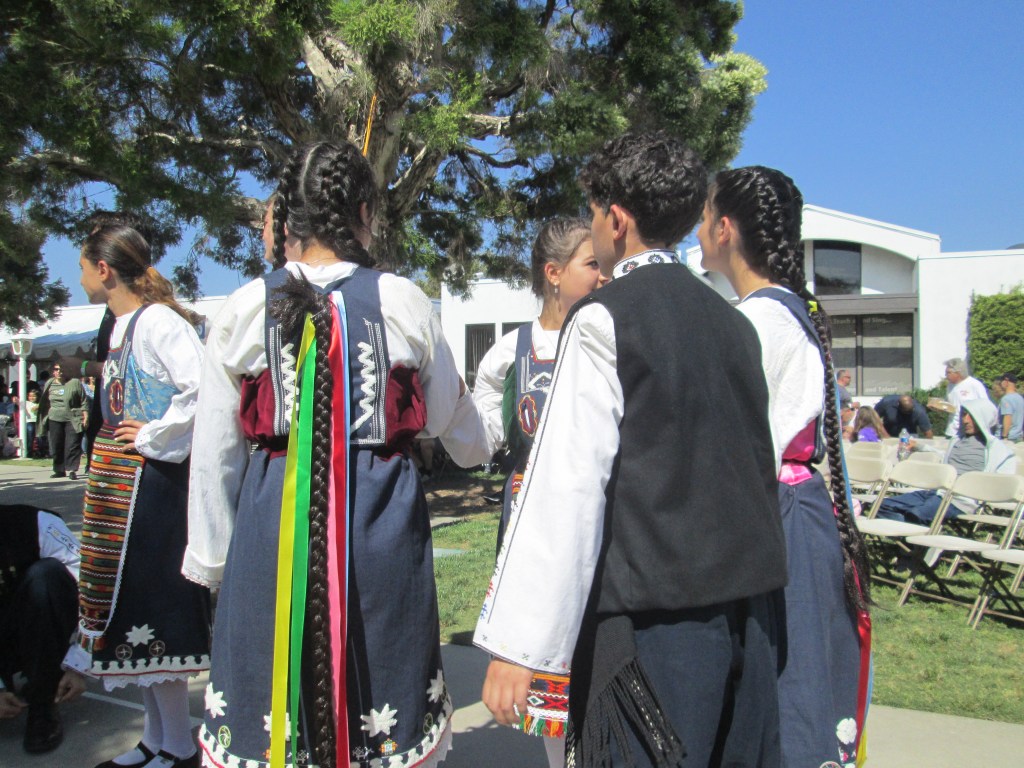
Middle School Greek Dancers at St Nicholas Greek Orthodox Church

I remember a time when most foreign-born Americans were of European ethnicity. My father, Elek Paris, was born in what is now the Republic of Slovakia; and my mother, who was actually born in Ohio, was taken to Hungary to be raised by her grandparents. For the first five or six years of my life, I thought that Hungarian was the language of the United States.

What inevitably happens has happened. The children of European-born immigrants see their parents’ culture, religion, and language as something quaint which they are being reluctantly marshaled into accepting. The three-year Covid-19 lockdown has brought this tendency into sharper focus.

Yesterday, Martine and I attended the annual Greek Festival at St Nicholas in Northridge for the first time since 2019. Sure enough, the tours of the church were more perfunctory; the calamari was more breading than squid; and there were fewer people able to do the traditional dance steps. I noticed much the same at the two Hungarian festivals we attended this month. Only the Grace Hungarian Reform Church in Reseda had anything like the same quality of food and entertainment as before the lockdown.

Our neighbors downstairs are refugees from Putin’s Ukrainian invasion. I notice that their two little daughters are addressing their mother in English instead of Ukrainian.

When I first came to Los Angeles, there were at least half a dozen Hungarian restaurants. Now there are none. If I want real Hungarian food, I’ll either have to cook it myself or visit my brother more often. (He’s a far better cook than I am.)

If Martine and I expect to find more authentic ethnic events, we will have to concentrate on the Asian and Latin American ethnic events, as they have arrived in this country more recently.

Stuck in a Bubble

As we age, we tend to find ourselves stuck in a bubble. Even with the wonders of the smart phone and social media, we seem to have found a new way of isolating ourselves. One of my friends cannot have a conversation without mentioning the politics and culture of America between 1966 and 1976. His talk is of the Kennedy assassinations (he was actually present at Robert Kennedy’s), the FBI vs. the Sioux at Pine Ridge, the Manson Family, and related topics. He goes back frequently to his college days or his Midwestern upbringing.

If one is feeling stressed, I can understand trying to find refuge in the past. It is a particular temptation as one ages, especially if life has not proved satisfactory in some way. And, when you think about it, it rarely does. We are all mortal, and the stresses do not disappear when one is up against the endgame. As we all inevitably are.

My way of fighting the bubble-ization of old age is to try to understand the present. Mind, I didn’t say to accept it. For instance, I do not own a smart phone—though I have a flip phone I use occasionally. I use FaceBook mainly as a content provider: All my WordPress posts are sent to my FaceBook page, and I usually add a couple of funny comics to boot. I do not have any Twitter, Instagram, TikTok, or other social media accounts. (And I don’t feel socially deprived as a result.)

When people try to put me down with an “Okay, Boomer!,” I merely point out that I am pre-Baby-Boom, having been born during the last days of the Second World War. In fact, I was born some six months before the Trinity A-Bomb test, so I’m also pre-Atomic-Age. That only means I am older than dirt. But I am still alive.

A Civilized Man

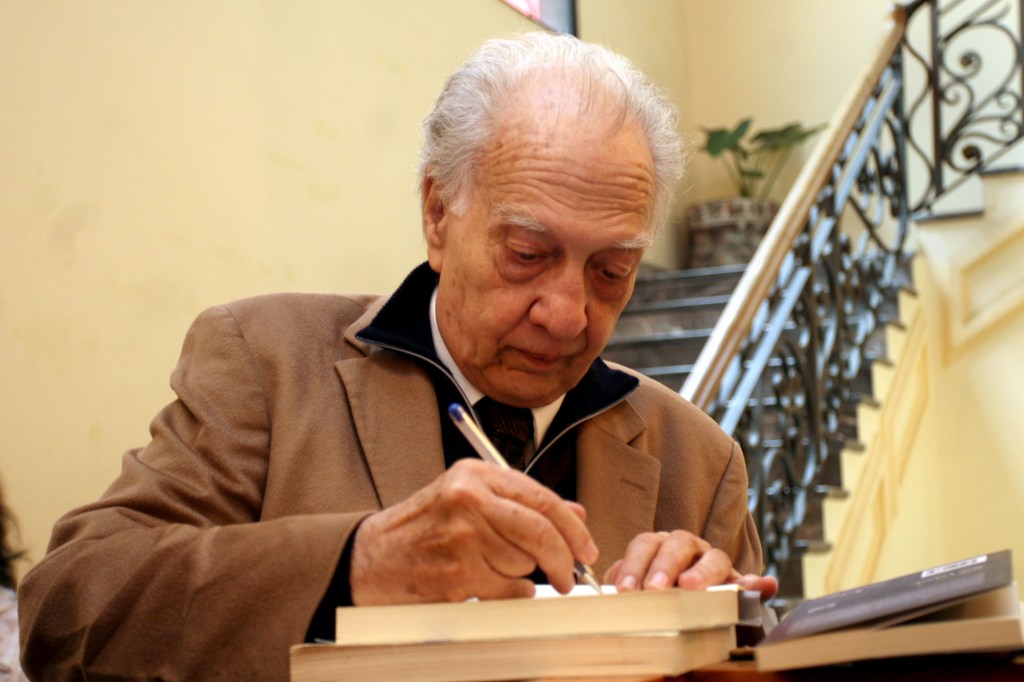
MƒEXICO D.F. 19 NOVIEMBRE2007.-El escritor Sergio Pitol, presento su nueva obra literaria que lleva como titulo “Trilog’a de la Memor’a” esto en la Casa del Refugio. FOTO: GUILLERMO PEREA/CUARTOSCURO.COM

Mexican author Sergio Pitol Deméneghi (1933-2018) was a man of the world. As a writer and diplomat, he traveled the world and wrote some fascinating books that were a curious mélange of literature, autobiography, and travel. The following is taken from his The Art of Flight.

[Italian philosopher] Norberto Bobbio offers a definition of the “civilized” man that embodies the concept of tolerance as daily action, a working moral exercise: The civilized man “lets others be themselves irrespective of whether these individuals may be arrogant, haughty, or domineering. They do not engage with others intending to compete, harass, and ultimately prevail. They refrain from exercising the spirit of contest, competition, or rivalry, and therefore also of winning. In life’s struggle [civilized men] are perpetual losers. […] This is because in this kind of world there are no contests for primacy, no struggles for power, and no competitions for wealth. In short, here the very conditions that enable the division of individuals into winners and losers do not exist.“ There is something enormous in those words. When I observe the deterioration of Mexican life, I think that only an act of reflection, of critique, and of tolerance could provide an exit from the situation. But conceiving of tolerance as it is imagined in Bobbio’s text implies a titanic effort. I begin to think about the hubris, arrogance, and corruption of some acquaintances, and I become angry, I begin to list their attitudes that most irritate me, I discover the magnitude of contempt they inspire in me, and eventually I must recognize how far I am from being a civilized man.

Happy Dance

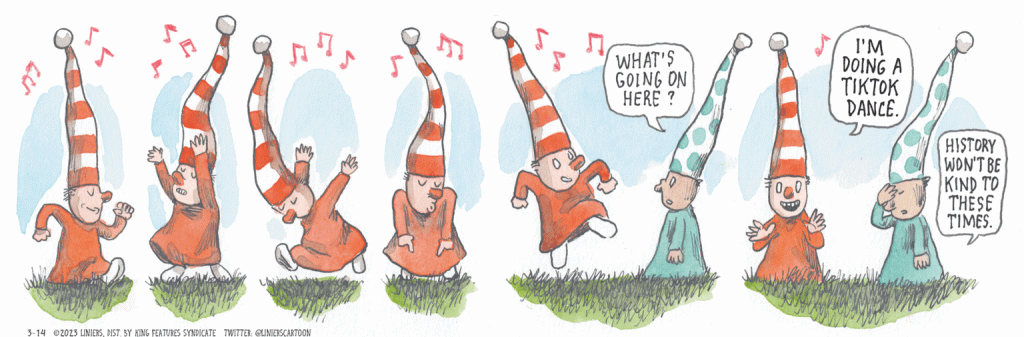
Macanudo Comic Strip for Today

Turn that frown upside-down.

Well, that works, doesn’t it? All you have to do is crack a smile, do a happy dance, and you’re guaranteed to be happy, no?

Okay, I’ll believe that works in the case of Charles Schulz’s Snoopy, but it’s a little different for humans. Happiness is transitory, but unhappiness tends to persist. Of the Four Noble Truths of Buddhism, the first is about suffering:

The First Noble Truth is the idea that everyone suffers and that suffering is part of the world. Buddhists believe in the cycle of samsara, which is the cycle of birth, life, death and rebirth. This means that people will experience suffering many times over. All of the things a person goes through in life cause suffering and they cannot do anything about it. Instead, they have to accept that it is there. People may use temporary solutions to end suffering, such as doing something they enjoy. However, this does not last forever and the suffering can come back when the enjoyment ends. Buddhists want to work to try to stop suffering. However, the first step is to acknowledge that there is suffering – it happens and it exists.

That’s one of the main reasons I get this smirk on my face when someone does a Happy Dance on TV because his trash is being picked up, his or her skin is free from eczema, or it’s Friday and TGIF.

Is that because I am an unhappy person? Not at all. It’s just that putting on a happy face does not mean you are happy. It just means that you are employing magical thinking to avoid acknowledging the reality of suffering in our lives.

If you absolutely must do a Happy Dance, do it like Snoopy: Realize that life is what it is, and your little dance interlude won’t change that.

Future

George Jetson’s Neighborhood

If any writer alive today has a handle on the future—what it is likely to be—that writer is William Gibson, the author of Neuromancer and the inventor of the term cyberspace. I have just finished reading his book of essays, entitled Distrust That Particular Flavor. In a talk delivered o the Book Expo America in 2010, he wrote:

But I really think [that pundits are] talking about the capital-F Future, which in my lifetime has been a cult, if not a religion. People my age are products of the capital-F Future. The younger you are, the less you are a product of that, If you’re fifteen or so, today, I suspect you inhabit a sort of endless digital Now, a state of atemporality enabled by our increasingly efficient prosthetic memory. I also suspect that you don’t know it, because, as anthropologists tell us, one cannot know one’s own culture.

The Future, capital-F, be it crystalline city on a hill or radioactive postnuclear wasteland, is gone. Ahead of us, there is merely … more stuff. Events. Some tending to the crystalline, some to the wasteland-y. Stuff: the mixed bag of the quotidia.

I think of Gibson’s capital-F Future as being more along the line of the old The Jetsons animated television program or the novels of H. G. Wells or Isaac Asimov. The future presented in those works is more a reflection of their creators’ times, and not our own.

William Gibson

I think that, because of his belief regarding the future, Gibson’s more recent novels have been less science fiction-y. Books such as Zero History are set in what appears, on one hand, to be the present—but instead are set in some not-too-distant future with multiple hooks to our present.

In a number of essays, Gibson examines our strange atemporal present, with fascinating essays on Tokyo (“My Own Private Tokyo”) and Singapore (“Disneyland with the Death Penalty”).

Pants On Fire

According to the Baltimore Catechism in which we Catholic schoolkids were drilled in religion class, there are seven types of capital sin. They are:

  • Pride
  • Covetousness
  • Lust
  • Anger
  • Gluttony
  • Envy
  • Sloth

Conspicuously missing from the list is lying, which seems to me to be the prime sin of the 21st Century. According to the Washington Post, our former president told 30,573 lies during his four years in office. Now we have George Santos (R-NY), who seems unable or unwilling to tell the truth about anything. And it’s not just a Republican vice, though it seems most prevalent in the political world.

I can deal with violations of any of the above mentioned capital sins, but I find myself revulsed by someone who lies to me. None of the seven capital sins affects me as much as lying, which is an offense I feel is directed at me, to deliberately mislead me.

A Grier-Musser Valentine

Valentine’s Day Memorabilia at the Grier-Musser Museum

On Sunday, Martine and I stopped in at the Grier-Musser Museum in the shadow of Downtown L.A. to see their Valentine’s Day memorabilia. Of late, Susan and Rey Tejada have been concentrating on paper in the form of old-fashioned images on postcards, greeting cards, and books—especially with pop-up illustrations.

There’s something about seeing this type of material in the Victorian mansion on Bonnie Brae Street that sends you back in time. Afterwards, we sat down with Rey and Susan over cookies and punch and talked for a couple of hours.

Although I got Martine a card for Valentine’s Day, we both decided to go out for lunch on the day after, when we were less likely to run into crowds. So tomorrow we will have a nice English lunch at Ye Olde King’s Head in Santa Monica. It is a great place to have fish and chips or bangers and mash or Cornish pasties. Fortunately, one is not likely to encounter such downmarket English cuisine items as spaghetti sandwiches or baked beans on toast.

Martine and I hope you enjoyed this little gem of a holiday. Why do I call it that? I would rather honor the love I feel than some bogus political or historical event, such as Columbus “discovering” America. After all, wasn’t he met at the beach by the local residents?