When I was a child at St. Henry’s Elementary School in Cleveland, Ohio, I studied in religion class how the holiday began. Apparently there was a Saint Valentine. Actually, there were three of them; the one after whom the holiday was named was called Saint Valentine of Rome. According to the Catholic Online web site: “St. Valentine is the Patron Saint of affianced couples, bee keepers, engaged couples, epilepsy, fainting, greetings, happy marriages, love, lovers, plague, travellers, and young people. He is represented in pictures with birds and roses and his feast day is celebrated on February 14.”
I find it interesting that Valentine is also the patron saint of epilepsy, fainting, and plague. This seems to go against all the lovey dovey stuff, but then that happens fairly frequently with the saints.
When I wish Martine a Happy Valentines Day tomorrow morning, I will of course refrain from bringing up all the negative stuff.
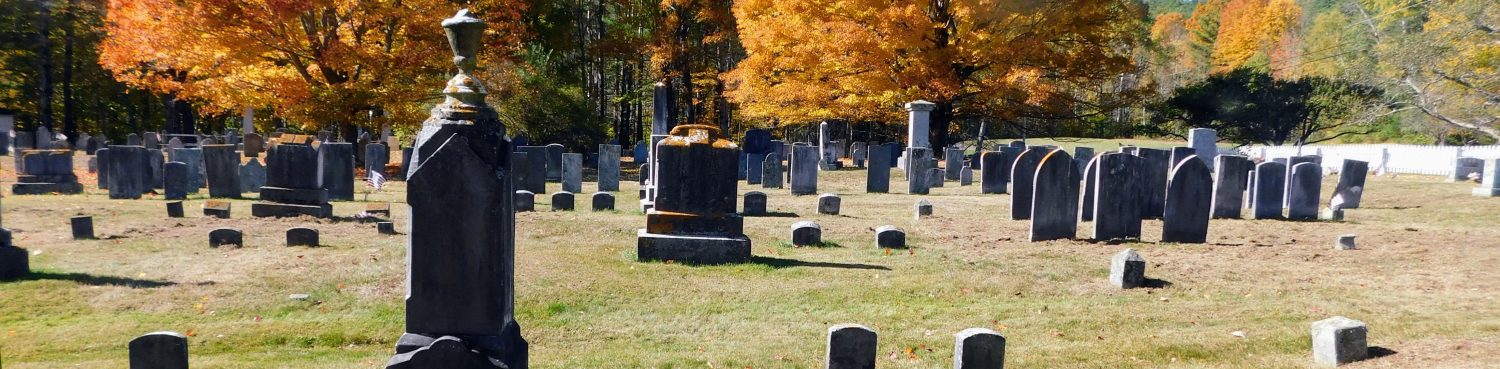
It was early in the morning of February 9, 1971 at precisely 6:00 AM Pacific Standard Time. I was half-asleep when I suddenly heard the howling of several dogs in the Santa Monica neighborhood where I lived. Within seconds, I felt the bed and the whole building shaking, accompanied by a deep noise as if the earth was being fractured (which it was). I held on to the mattress for dear life, but found myself on the floor nonetheless.
That was my experience of the Sylmar Earthquake, also known as the San Fernando Earthquake. Ever since then, I have been scared of quakes. Was it a small quake? Perhaps it was the precursor of a much larger quake. The Northridge Earthquake of January 17, 1994 was like that, following in the wake of several much smaller quakes centered in Santa Monica Bay.
Now when I see pictures of the Gaziantep temblor that shook parts of Turkey and Syria, I feel as if the solidity I feel of my footsteps on the ground is a possible illusion. Without warning, the buildings around me could come crashing down, possibly with me in one of them.
This afternoon, I took a walk along the Venice Boardwalk, stopping in at Small World Books to buy the work of a recommended Swiss author. As I looked at the buildings along the Boardwalk, I almost felt the ground under my feet begin to move. I remember the Tsunami Evacuation Route signs scattered around the streets in the area and felt that terra firma within a matter of seconds could sport waves like the sea; and, if the quake was out at sea, a giant wave could inundate the low-lying blocks along the ocean before I could get to safety.
If you’ve never been in a major quake, you could laugh away the small quakes. But after 1971 and 1994, there is no laughing. I am on high alert. Will it rapidly get worse? Or is this just another little memento mori?
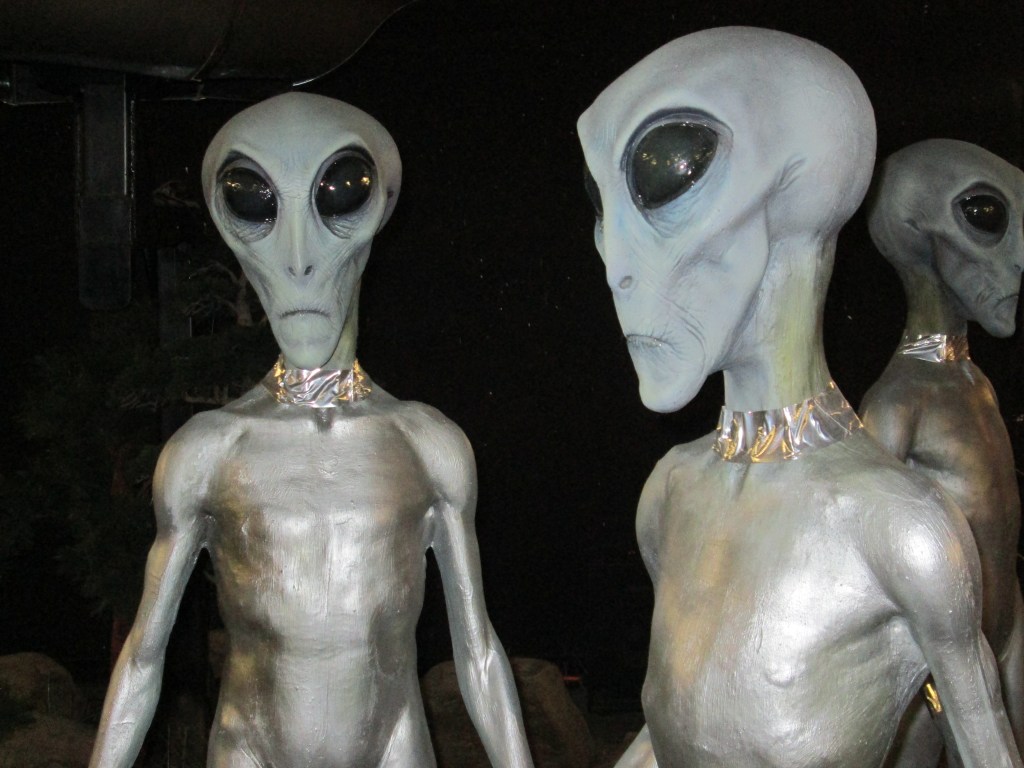
What happens to Christianity if space aliens from another world were to make contact with us? What would they made of the Garden of Eden, the Incarnation, the Crucifixion and a thousand other details that are part and parcel of Christianity? What are the chances that any of the space aliens would ever convert to Christianity?
In fact, all the major monotheistic religions would come across as quaint and primitive. That includes Judaism and Islam. The life experience of creatures from another world would be so radically different that they in turn would affect how (and whom) earthlings worshiped.
I do not necessarily believe that we will ever contact space aliens, but I do wonder what would be the result of such a contact. At worst, it would be like that famous Twilight Zone episode from Season Three of that show entitled “To Serve Man.” (At the end of the episode, it is revealed that the “To Serve Man” book the aliens carried was not an altruistic guide, but a cookbook!) At best, there is the movie The Day the Earth Stood Still (1951) with Michael Rennie’s Klaatu come to warn Earth that it is in danger of destroying itself.
Myself, I am more inclined to think of any space invaders as Conquistadores come to enslave the planet and mine it for its riches.
Over the last few decades, I have become quite blasé about my date of birth. I usually saw I was born on the thirteenth day of the thirteenth month (which is true, as the months wrap around). When asked for my astrological sign, I say, “No Trespassing.”
When you’re young, you get all kinds of cake and presents. When you’re my age, you just get measurably older.
Am I any wiser? Not really, I am probably a little more tolerant maybe up two percentage points. I have definitely noticed I am getting more crabby. (Those kids had better get off my lawn, STAT, or I’ll have to reach for my flamethrower.)
After what I went through with my brain tumor more than half a century ago, I never thought I would live this long. Even as a grade school kid, I looked forward to the year 2000 and thought, “Wow, if I live to that year, I’ll be fifty-five years old!” And to an eight-year-old, that seemed really O-L-D.
My father died at the age of seventy-four; and my mother, at the age of seventy-nine. Though I am minus a few body parts (pituitary gland, left hip), I am still surprisingly healthy. The joints are getting a bit creaky, but I can still walk. As for my mind, well let us speak respectfully of the dead.
I wonder, what kind of crap will I write when I reach seventy-nine?
It Baffled Einstein, But Suggests a Whole Different Outlook on the Universe
Einstein called it “spooky action at a distance” and quipped, “God does not play dice with the universe!” But apparently, He does. Mind-bending experiments have seemingly invalidated the speed of light (186,000 miles per second) when two protons shot in opposite directions sped away from each other at that speed. A measurement of one of the two protons affected the other one instantaneously, although theoretically communication between them was impossible. Here is one recent explanation by a physicist.
In the Wikipedia article on Quantum Entanglement, it says:
Measurements of physical properties such as position, momentum, spin, and polarization performed on entangled particles can, in some cases, be found to be perfectly correlated. For example, if a pair of entangled particles is generated such that their total spin is known to be zero, and one particle is found to have clockwise spin on a first axis, then the spin of the other particle, measured on the same axis, is found to be anticlockwise. However, this behavior gives rise to seemingly paradoxical effects: any measurement of a particle’s properties results in an irreversible wave function collapse of that particle and changes the original quantum state. With entangled particles, such measurements affect the entangled system as a whole.
Apparently some things in the universe are linked together in ways we do not yet understand.
At the same time, I think people are also similarly “entangled.” For example, I firmly believe one cannot avoid auto accidents without being able to make a good guess whether the other driver (whose face you have not seen) is going to cut in front of you. Unless I am distracted by conversing with a passenger, I am pretty good at “reading” traffic. How is that possible?
Then there is the whole question of presentiments of disaster which are proven to be true, There have been studies that people who have survived disasters had some foreshadowing of what was to occur. Does that mean that people are in some strange way entangled with events?
We are used to seeing people, things, and events as existing in separate “boxes.” What if some elements are in fact separate, and others are interlinked in ways we cannot foresee? Perhaps in future scientists will be able to describe how some of these entanglements work. Until then, we will just have to open our minds to a certain degree of strangeness. Which is probably a good idea in any case.
From the beginning of October to the end of the Tournament of Roses Parade is one unending holiday, which I call HallowThanksMas, but others shorten (not by much) to HalloThankMas. It’s supposed to be a time of family closeness, warmth, and happiness—but isn’t, not by a long shot.
This is why I love the whole idea of Festivus—a holiday for the rest of us—as introduced by the Seinfeld show in 1997. It consists of the following:
A vertical, unadorned aluminum pole
A Festivus dinner, during which there is an “airing of grievances”
In response to pushback from the diners, there are “feats of strength,” during which the whiners are wrestled to the ground
“Festivus Miracles” are easily explained coincidences
I actually like Halloween, though I never attend Halloween parties, nor would any of my friends be so unwise as to invite me to one. But Thanksgiving and Christmas could and probably should be replaced by something like Festivus. It’s cheaper, does not involve the consumption of dry birds, does not involve greeting cards or gifts, and airs out all the hidden aggressions behind the holidays.
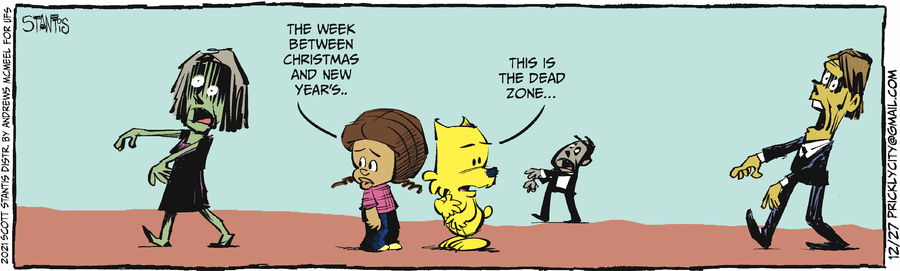
To date, I have written five posts about the Maya “month” of Uayeb or Wayeb, which consists of the last five days of the Haab Calendar of 365 days. The Haab calendar has twenty months of eighteen days each, which isn’t quite enough to make up the full complement, so the Maya added a short stub of a month containing the five “nameless days.”
There is also a Maya god named Uayeb, who is the god of misfortune. That sounds about right.
The Cartoonist Scott Stantis Has an Intuitive Understanding of Uayeb
Here is a link to my previous posts on the subject:
Below is the Maya glyph for the “month” of Uayeb, or Wayeb (kind of looks like a tiny-headed god flexing his muscles, doesn’t it?)
In his comments to last year’s post, my friend Mudpuddle noted that “the glyph looks like a surfer headed for muscle beach!”
I am amused by how well a Maya calendrical belief fits in so well with our civilization, in which the days between Christmas and New Year and almost universally considered as dead time.
So don’t make any big plans until the New Year. But you kind of knew that anyway, no?
In the Northern Hemisphere, where 90% of the Earth’s population lives, this is the Winter Solstice, the shortest day of the year. Conversely, in the Southern Hemisphere, it is the Summer Solstice, the longest day of the year. Apparently, it all has something to do with the way our planet is tilted on its axis, with us in the North being farther from the Sun.
Since I am retired, it doesn’t matter to me that it gets dark early. I no longer have to put up with December traffic on my way home from work in the dark.
And as for darkness, it really isn’t all that dark, With all the external building lighting, together with the numerous fairy lights from my computer, television, air purifier, microwave, and whatnot, I can usually make way way around my apartment in the wee hours of the morning without kicking the furniture with my bare feet.
As for the title of this post, it comes from Simon & Garfunkel’s hit song, “The Sound of Silence”:
Hello darkness, my old friend
I've come to talk with you again
Because a vision softly creeping
Left its seeds while I was sleeping
And the vision that was planted in my brain
Still remains
Within the sound of silence
From left, Moscow-appointed head of Kherson Region Vladimir Saldo, Moscow-appointed head of Zaporizhzhia region Yevgeny Balitsky, Russian President Vladimir Putin, Denis Pushilin, leader of self-proclaimed Donetsk People’s Republic and Leonid Pasechnik, leader of self-proclaimed Luhansk People’s Republic pose for a photo during a ceremony to sign the treaties for four regions of Ukraine to join Russia, at the Kremlin in Moscow, Friday, Sept. 30, 2022. The signing of the treaties making the four regions part of Russia follows the completion of the Kremlin-orchestrated “referendums.” (Dmitry Astakhov, Sputnik, Government Pool Photo via AP)
Why is it no surprise to me that Vladimir Putin is so much shorter than his political lieutenants? Actually, he is 5 feet 7 inches (170 cm), which is only an inch shorter than the mean height of men around the world. (For the record, I myself am 5 feet 8 inches, the average height.)
Well, that isn’t very short after all. But then look at the height of all the U.S. Presidents and presidential candidates since FDR:
I was shocked to find that the only times in recent history that the shorter candidate won was when Jimmy Carter defeated Gerald Ford; George W. Bush beat John Kerry and Al Gore; and Joe Biden defeated Donald Trump.
Americans seem to vote for the taller candidate. Why is that? Do we think that taller candidates are more imposing? Is that, perhaps, why we have never had a woman in the White House? Perhaps one of the reasons Hillary Clinton lost to the man from Mar-a-Lardo is that she is a full ten inches shorter than him.
The only candidate who was my height was Michael Dukakis, who was trounced by George H. W. Bush. And that was a pretty ignominious defeat, so you can bet that I’m not tempted to run for anything. (Though there are not a few things I would run from.)
Whoever ordered the tombstone for poet and counterpuncher Charles Bukowski knew what he (or she) was about. There is a two-word epitaph: “Don’t Try.” Below it is a silhouette drawing of a boxer with his gloves raised.
The poet’s grave is at Green Hills Memorial Park in San Pedro which I have passed scores of times 0on visits to my friend Peter who lives a couple miles further south. Maybe next town, I’ll stop by and pay my last respects.
On Bukowski.Net, there is an explanation by Bukowski’s wife Linda which sheds some light on he meant:
See those big volumes of books? [Points to bookshelf] They’re called Who’s Who In America. It’s everybody, artists, scientists, whatever. So he was in there and they asked him to do a little thing about the books he’s written and duh, duh, duh. At the very end they say, ‘Is there anything you want to say?’, you know, ‘What is your philosophy of life?’, and some people would write a huge long thing. A dissertation, and some people would just go on and on. And Hank just put, “Don’t try.”
I am reminded of Portuguese writer Fernando Pessoa in The Book of Disquiet, who sees life as a roadside inn where we all have to stay until the coach from the abyss pulls up:
Night will fall on us all and the coach will pull up. I enjoy the breeze I’m given and the soul I was given to enjoy it with, and I no longer question or seek. If what I write in the book of travellers can, when read by others at some future date, also entertain them on their journey, then fine. If they don’t read it, or are not entertained, that’s fine too.
In the days to come, I plan several more posts about Bukowski and what he means to me.









You must be logged in to post a comment.