I cannot help but think that life is grimmer than ever, based on all the happy dances on TikTok and TV commercials. Together with all the pharmaceutical commercials, with their family-happiness-in-the-outdoors tropes, the happy dances are a promise that is almost never fulfilled. How does that delirious couple in the photo above look when medical bills and their mortgage are more than they could bear. Even if they got that great house for the cheap price of a zillion dollars.
The one happy dance which doesn’t bother me is Matt Harding’s “Where the Hell Is Matt? 2008.” That son of a bitch had something to dance about—the sheer joy of life—and it would be my pleasure to join him:
There is no question in my mind that reading books can be a form of therapy. Not all books, but certainly those that make you think. Some books could be the opposite of therapeutic, like anything by Ayn Rand or Donald J. Trump.
I read incessantly. Only when I am ill do I not pick up a book. Since September 1998, I have read 2,750 books, ranging from literary classics to poetry to philosophy to history to travel.
Beginning in 1975, the year of my first real vacation (in Yucatán, Mexico), I decided to prepare several months in advance by reading books about my destination. They included archaeology, history, fiction, and descriptions of journeys. That way, when I finally reached my destination, I was there as a person who knew all sorts of things about where he was. That made me feel good about traveling. I didn’t feel like an ignorant interloper.
The therapeutic aspect was there, too. I came to the conclusion that the best philosophy books were written by the ancient Greeks and Romans. Cicero, Marcus Aurelius, and Epictetus had more to say about the human condition than the vast majority of academic philosophers, whose works were by and large unreadable. And it didn’t involve swallowing a whole lot of dogma administered by organized religion.
If you were to read the four dialogues of Plato about the death of Socrates (Euthyphro, Apology, Crito, and Phaedo), you will have read the greatest works of Western Philosophy ever written.
Also worth considering are some of the Hindu, Taoist, and Buddhist texts, such as The Bhagavad Gita, The Tao Te Ching, and the literature of Zen Buddhism. They taught me that desire is always accompanied by suffering. The less one desires, the happier one is. And happiness is not a lasting thing: It goes into hiding and manifests itself only at irregular intervals.
Now if I can only declare my book purchases as medical expenses….
I never thought I would be alive at the age of 77. My father died at 74 years old; and my mother, at 79. When I was a student at St. Henry Elementary School, I thought, “Gosh, I’ll be 55 years old when we get to the year 2000.” I passed that milestone at a run.
In the illustration above, I am somewhere between the third and fourth figure. Thankfully, my health is good. I can get about without a cane, though I find going down a flight of stairs to be painful. Kneeling on a hard surface is out of the question.
When I think about aging, I call to mind the first stanza of Robert Browning’s poem “Rabbi Ben Ezra”:
Grow old along with me!
The best is yet to be,
The last of life, for which the first was made:
Our times are in His hand
Who saith “A whole I planned,
Youth shows but half; trust God: see all, nor be afraid!”
I see some of my friends fall by the wayside, some dying, some suffering personality disorders as they age, and some just isolating themselves.
This is not a subject anyone likes to think about. There are, however, dangers inherent in suppressing any important subject.
The times are always bad—and always have been. Yes, what is happening in Ukraine is terrible. But so was ducking under my school desk at St. Henry to practice for a Communist H-Bomb attack. So was World War Two. So was … oh … Genghis Khan.
I always wanted to be a writer. And in a manner of speaking, I am one. I don’t care about compensation or fame. Just sitting down around 9 o’clock most evenings and writing this blog is a worthwhile effort. It makes me feel good about myself.
Louis Jouvet (Right) Sweating a Suspect (2nd from Left)
The French criminal justice system is very different from our own. I have just finished reading Georges Simenon’s Maigret and the Burglar’s Wife [Maigret et la grande perche] (1951); plus I have just recently seen Henri-Georges Clouzot’s film Quai des Orfêvres (1947). In both works, the investigating inspectors give their suspects the third degree. It is a process of intimidating the suspect until he or she talks, no matter how long it takes. In the film, there was a kind of tag team of interrogation, involving Inspector Antoine (Louis Jouvet) and the two detectives above with cigarettes hanging from their lips.
I wonder if things have changed that much in the last seventy years or so. France’s laws are based on the Napoleonic Code of 1804, in which there is a presumption of guilt rather than innocence, as in English Common Law. Suspects could be held in custody for longer periods of time until the evidence was clear.
In the Simenon novel, Inspector Maigret proceeds with the arrest even before this point, because he is so sure that the evidence is forthcoming. In the movie, the suspects, Maurice Martineau and Jenny Lamour, are convinced they will be framed by Inspector Antoine, who actually frees them when he gets a confession (albeit by sustained intimidation) from the real murderer.
It is interesting to see and read about police procedurals from other countries. In the United States, we have adopted English law. I rather suspect that, in the end, both legal systems are equally fair—or unfair.
A traditional way of celebrating New Years Eve in France is by setting cars alight. According to the BBC, as of some 12 hours ago, a total of 874 cars have been set on fire. I’m sure that’s kind of like a firecracker, but multiplied out, that’s got to be about 10 million dollars in damages.
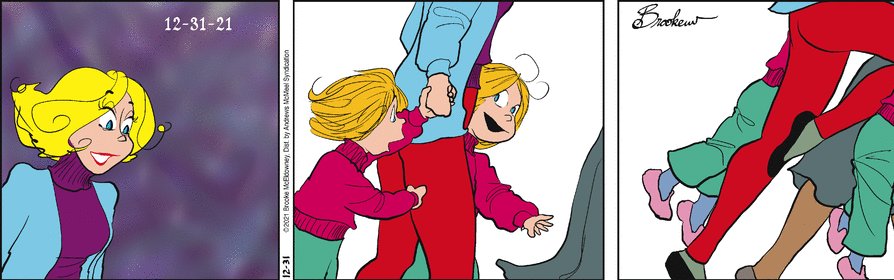
Far better is a series of two cartoons from Brooke McEldowney in his “9 Chickweed Lane” series. The first cartoon ran on December 31 and was a bit confusing:
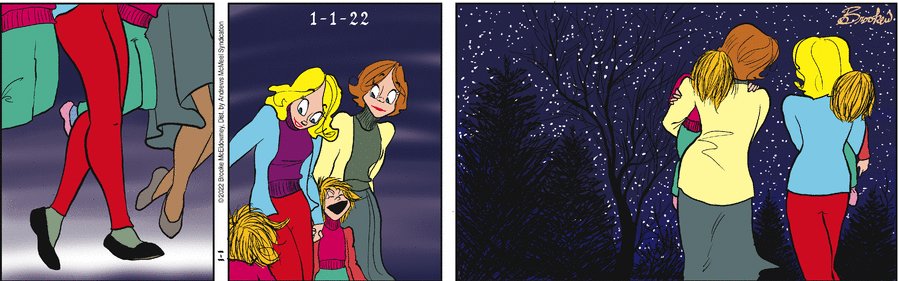
It all came clear with today’s cartoon:
I loved this set of images. We make a jump from one reality to another. Actually, it’s the same reality: Just a different template overlaying it. BTW, the look on the little girl’s face is priceless.
So let’s take that leap without incinerating any automobiles, if you please.
Every year around this time, the press and the broadcast media like to run stories in which they remind us of the many infamies of the year that is to expire. I say let it expire in peace, without unnecessary commemoration.
It is good that we now have vaccines. If only we had people who were caring enough to take advantage of them. Today, I saw on Santa Monica Boulevard a pickup truck plastered with signs attacking the vaccine as a nefarious government plot to impugn our purity of essence, or some other likely rot. The vaccine would have been a triumph, but not in a nation teeming with ignorant mofos.
It’s equally to difficult to look back at the disasters wrought by climate change: California wildfires, tornadoes, floods, hurricanes, and a steadily rising mercury level.
While the economy hasn’t altogether collapsed yet, it gives dangerous signs of doing so.
So please forgive me if I neglect to celebrate the passing year. Only a fool celebrates the passing of time.
I am no Ebenezer Scrooge (post the three spirits), dancing with joy, dispensing gifts, and in general comporting myself around Christmas time with uncomely glee. Today, going to lunch with Martine, I encountered scores of stressed-out drivers in the process of driving in such a way that easily merited a serious car crash. (Also, I encountered far fewer drivers who drove with courtesy and watchfulness.)
Christmas as a religious holiday gets my respect. I myself am unaffiliated with any official religion, but I can understand the significance of the Incarnation for Christians.
It’s Christmas as a secular holiday which is out of whack. You should see the frenzied shoppers trying to fit into the Culver City Costco parking lot around noon. I imagine many had to roam the lot for upwards of an hour before they found a spot. For many, this weekend is the optimal time to get those last-minute gifts.
Well, I’m not shopping for gifts this Christmas, though Martine and I did send out a number of cards—both religious and secular—to our friends and relatives.
What’s wrong about the holiday is the whole secular mythology: Santa, the Xmas tree, stockings by the fireplace, the f—ing “Elf on the Shelf,” Christmas parties, yearly attending the Nutcracker, reindeer antlers on car windows, those stupid Santa hats…. Need I go on? What we have year is a recipe for distress. It’s damn near impossible to have a perfect Christmas with all the trimmings and cancer-like accumulated practices
My Christmas, Chanukah, and Kwanzaa wish for all my readers is simple: Enjoy, but when you begin to stress, PULL BACK! It’s not worth making a nightmare out of the whole thing. Above all, survive in good spirits!
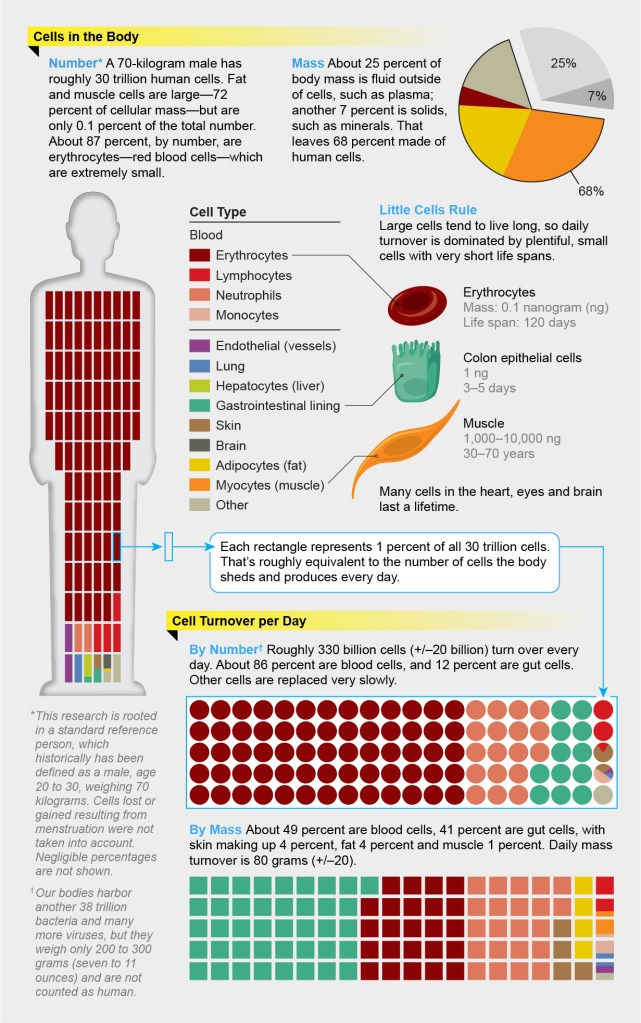
What makes you YOU? Is it a single thing? or an alliance of upwards of 30 trillion things working together? According to an article in the April 2021 issue of Scientific American:
The human body replaces its own cells regularly. Scientists at the Weizmann Institute of Science in Rehovot, Israel, have finally pinned down the speed and extent of this “turnover.” About a third of our body mass is fluid outside of our cells, such as plasma, plus solids, such as the calcium scaffolding of bones. The remaining two thirds is made up of roughly 30 trillion human cells. About 72 percent of those, by mass, are fat and muscle, which last an average of 12 to 50 years, respectively. But we have far more, tiny cells in our blood, which live only three to 120 days, and lining our gut, which typically live less than a week. Those two groups therefore make up the giant majority of the turnover. About 330 billion cells are replaced daily, equivalent to about 1 percent of all our cells. In 80 to 100 days, 30 trillion will have replenished—the equivalent of a new you.
In a strange way, every human being, every animal, every plant is an alliance of micro particles. In my lifetime, I have given birth to and sloughed off untold trillions of tiny pieces of me. Yet I still see myself as a unified being with certain likes and dislikes, certain patterns of thought.
When it comes time for me to die, it’s like Better.Com firing 900 employees on a Zoom call. Except some 30 trillion parts of me would be abruptly cashiered—without benefit of unemployment compensation. I would like to think that my mental processes would continue somehow, but that’s getting into highly disputed territory.
So far my alliance has held together pretty well. The whole coronavirus situation has been like an invasive plant or insect species. Undoubtedly, I have ingested perhaps thousands, perhaps even millions of Covid-19 viruses, but never enough to disturb the majority population of the alliance, which, by the way, itself includes billions of non-threatening viruses of various sorts.
When you look at yourself as an agglomeration of tiny living things, it makes you feel humble. And it makes you laugh at a lot of the things that make people worry.
I feel good about myself because, as of now anyway, my 30 trillion parts are a kind of parliamentary democracy in which all the components still work together, peacefully for the most part.
I don’t usually pay much attention to holidays. That does not mean I’m a Jehovah’s Witness: It just means that I think most holidays are a major pain in the ass. Some of them, such as Thanksgiving and Christmas, are notorious for putting incredible stresses on families, and sometimes breaking them up.
The men and women of our armed forces typically did not join because they wanted to serve our country. I think most wanted to lift themselves out of poverty and take advantage of educational opportunities that would jump start their post service careers. Unfortunately, in the process, they often put themselves in harm’s way fighting our nation’s interminable wars.in Korea, Vietnam, the Dominican Republic, Lebanon, Grenada, Panama, Kuwait, Iraq, Somalia, Haiti, Bosnia, et cetera ad infinitum.
In those “little wars,” some 100,000+ Americans gave their lives. And a much larger number came back with debilitating physical or mental scars.
I consider myself fortunate that my brain surgery operation in 1966 gave me a Selective Service rating of 4F, so that I would not have to fight in Vietnam. Truth to tell, I would probably have been 4F in any case, as I had been walking around with a pituitary tumor for ten years or more and was not in great shape.
During the Vietnam Era, many war protestors held a grudge against the armed forces. I didn’t. Most of them were just trying to survive under difficult circumstances. Instead, I wish them well.
It seems that, as time goes on, Halloween is becoming an ever more popular holiday. It has moved from being a children’s celebration to one that is equally observed by adults. In the Catholic liturgy, it is merely the eve of All Saints Day, which continues to diminish in importance as Christianity slowly recedes. The next day, All Souls Day—November 2—is the Mexican Dia de los Muertos, the Day of the Dead.
What with all the horror films and Stephen King novels and Jack O’Lanterns, Halloween tends to flirt with death without really facing it. As a culture, we tend to stay in the outskirts of death without descending into the center of it. The skulls and skeletons we affect are free of putrefaction and stench.
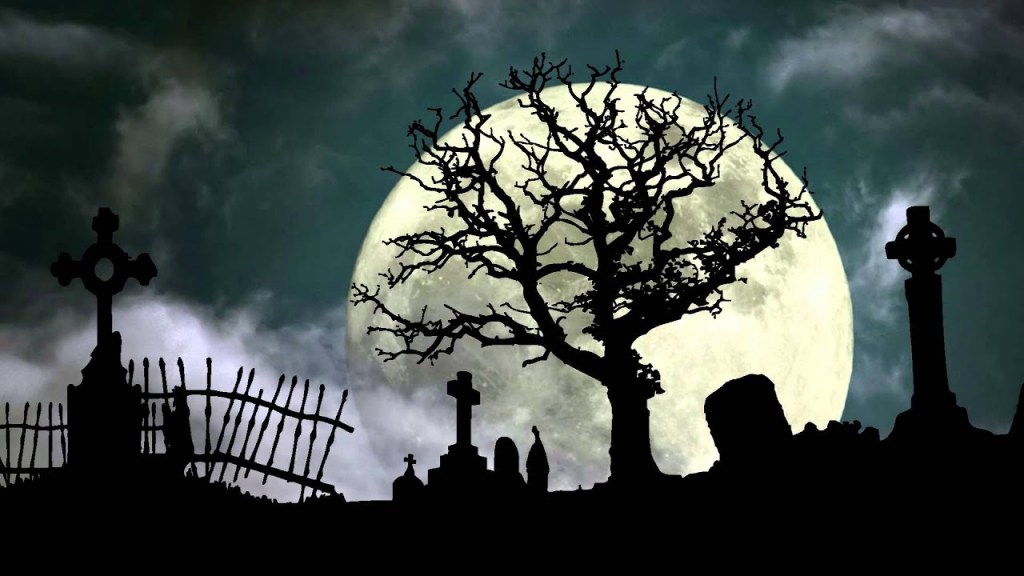
When I was a student at Dartmouth College, I spent four years in the remote Middle Wigwam dormitory (later re-christened McLane Hall). To get to the center of campus, I had to pass along the northern edge of the Hanover, New Hampshire cemetery, which has tombstones dating back to the 18th century, as Dartmouth was founded in 1769. It was an eerie experience, especially when walking home at night after a movie, play, or visit to Baker Library. Yet it looked nothing like the fantasy cemetery pictured above. Even the much older Copps Hill Burying Ground in Boston, where Cotton and Increase Mather are interred, is nowhere near as nasty as a typical horror film cemetery.
We like to keep our cemeteries on the neat side else no one would want to visit them. That’s because we are forced to acknowledge death, but we’d rather not think about it. And when we do, we use typical horror themes to frighten ourselves before returning to normality. Among these are vampires, zombies, Frankenstein monsters, ghosts, hauntings, mummies, shock operas like Hitchcock’s Psycho, demons, goblins, and so on. In fact, most of these themes are wildly fictional and outside the experience of most everyone.
Absent from most of these themes is the real sting of death: a numbing sense of loss of our loved ones and the realization that we will not escape the same fate.
So celebrate Halloween by all means. I certainly do. This month I read Thomas Ligotti’s stories in Grimscribe and Shirley Jackson’s The Haunting of Hill House. And I just started Sheridan LeFanu’s Uncle Silas (1864).












You must be logged in to post a comment.