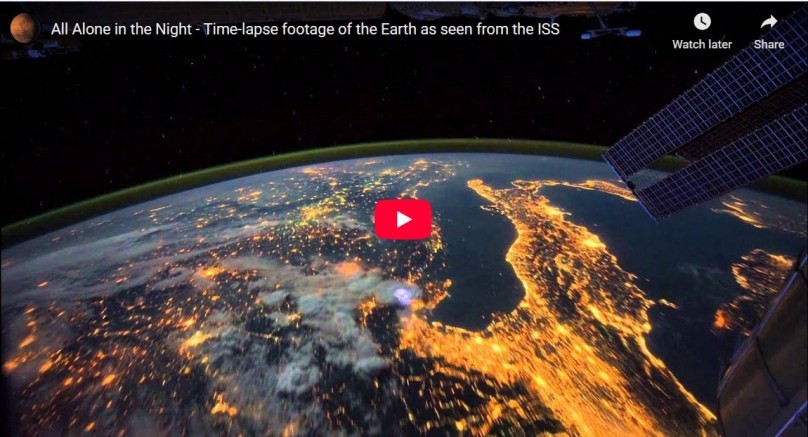
One of my favorite websites is NASA’s Astronomy Picture of the Day Archive. Rarely do I dip into it without coming up with a gem. In this particular case, we follow the rotation of the earth at night. Highlighted are the bright lights of urban concentrations and the strobes of widespread lightning strikes.
The overall effect is of watching a planet that is alive. And that’s just night: Imagine if we could also see the swirling winds, the tides, and storms at sea.
Don’t click on the image above: It’s just there as an illustration. To watch the video, click here.
It’s my belated Christmas gift to all of you, wherever you may be.
Yesterday, I posted a quote from Loren Eiseley’s The Unexpected Universe about spiders. He frequently thought about and wrote about seemingly small and insignificant creatures. Here is a poem he wrote about spiders in 1928 that was published in Prairie Schooner:
Spiders
Spiders are poisonous, hairy, secretive. Spiders are old—
they watch from dark corners while wills are made.
They weave grey webs for flies, and wait… tiles drop from the roof, leaves turn moldy under the black, slanting rain, people die… and the spiders inherit everything.
Spiders are antiquarians— fond of living among ghosts and haunted ruins, The black jade pillars totter in the halls of Marduk;
stones fall from the archways, at night grey sand whines by the lampless windows.
The god lies shattered, his green-jeweled eyes are gone; the sockets are hacked and empty as a skull. Upon his face a squat tarantula is creeping…
a bland yellow noon smiles at a black tarantula creeping on the skull of a god!
Spiders are ghouls— they live secret lives in graveyards,
A red spear of light pierces the stained vault-window and makes a warm pool on a black coffin in a niche.
A lean spider droops on a thread from above, falls into the light, and changes color… a crimson spider sprawling on an ebony coffin mumbles a fly in his toothless mouth.
Spiders… time is a spider, the world is a fly caught in the invisible, stranded web of space.
It sways and turns aimlessly in the winds blowing up from the void.
Slowly it desiccates… crumbles… the stars weave over it.
Probably the most famous lesson learned from a spider weaving its web is of Robert the Bruce, King of Scotland, who, hidden in a cave, marveled at a spider’s persistence in completing its web. Supposedly, it inspired him to attack the English at Bannockburn in 1314 and win a decisive victory. American naturalist Loren Eiseley learned a very different lesson watching an orb spider weaving its web. The following quote comes from his collection of essays entitled The Unexpected Universe.
For example, I once received an unexpected lesson from a spider.
It happened far away on a rainy morning in the West. I had come up a long gulch looking for fossils, and there, just at eye level, lurked a huge yellow-and-black orb spider, whose web was moored to the tall spears of buffalo grass at the edge of the arroyo. It was her universe, and her senses did not extend beyond the lines and spokes of the great wheel she inhabited. Her extended claws could feel every vibration throughout that delicate structure. She knew the tug of wind, the fall of a raindrop, the flutter of a trapped moth’s wing. Down one spoke of the web ran a stout ribbon of gossamer on which she could hurry out to investigate her prey.
Curious, I took a pencil from my pocket and touched a strand of the web. Immediately there was a response. The web, plucked by its menacing occupant, began to vibrate until it was a blur. Anything that had brushed claw or wing against that amazing snare would be thoroughly entrapped. As the vibrations slowed, I could see the owner fingering her guidelines for signs of struggle. A pencil point was an intrusion into this universe for which no precedent existed. Spider was circumscribed by spider ideas; its universe was spider universe. All outside was irrational, extraneous, at best, raw material for spider. As I proceeded on my way along the gully, like a vast impossible shadow, I realized that in the world of spider I did not exist…..
I began to see that among the many universes in which the world of living creatures existed, some were large, some small, but that all, including man’s, were in some way limited or finite. We were creatures of many different dimensions passing through each other’s lives like ghosts through doors.
This is a story that the naturalist Loren Eiseley (1907-1977) tells in his book The Firmament of Time. I instantly fell in love with it:
There is a story about one of our great atomic physicists—a story for whose authenticity I cannot vouch, and therefore I shall not mention his name. I hope, however, with all my heart that it is true. If it is not, it ought to be, for it illustrates well what I mean by a growing sense of self-awareness, a sense of responsibility about the universe.
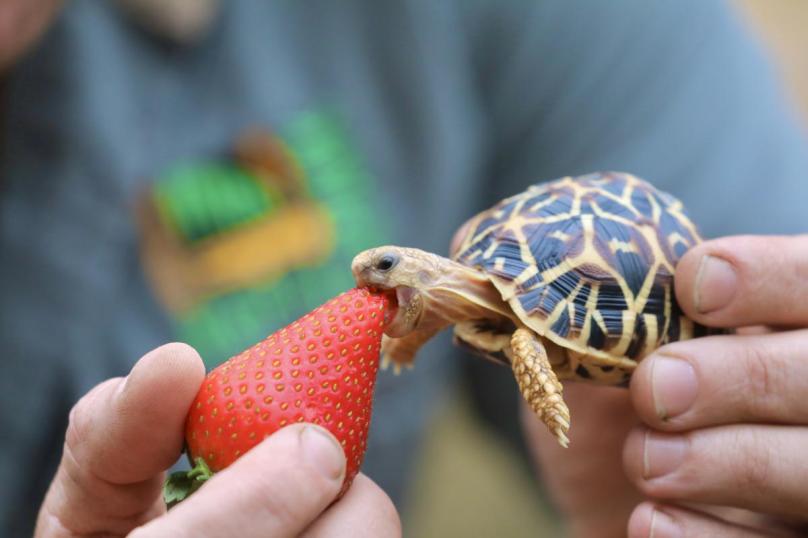
This man, one of the chief architects of the atomic bomb, so the story runs, was out wandering in the woods one day with a friend when he came upon a small tortoise. Overcome with pleasurable excitement, he took up the tortoise and started home, thinking to surprise his children with it. After a few steps he paused and surveyed the tortoise doubtfully.
“What’s the matter?” asked his friend.
Without responding, the great scientist slowly retraced his steps as precisely as possible, and gently set the turtle down upon the exact spot from which he had taken him up.
Then he turned solemnly to his friend. “It just struck me,” he said, “that perhaps, for one man, I have tampered enough with the universe.” He turned, and left the turtle to wander on its way.
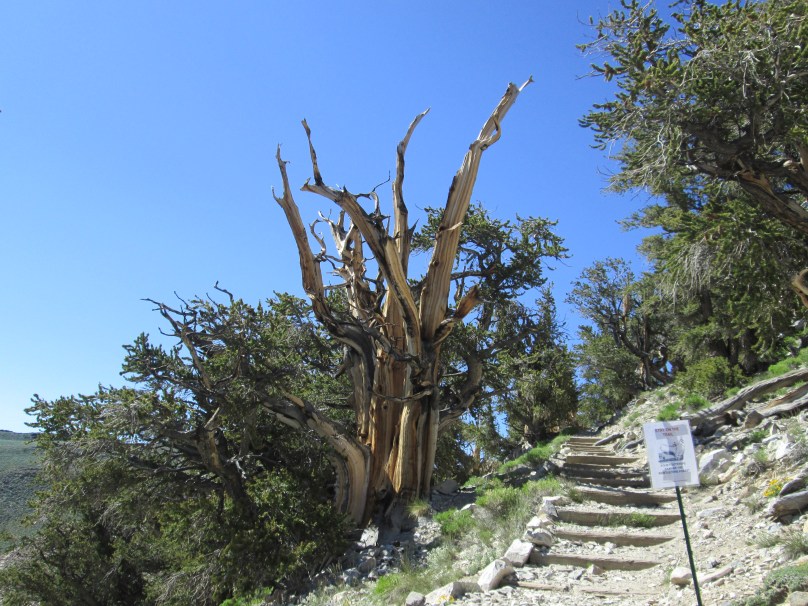
It has been said that the earliest living things on Earth are the Great Basin Bristlecone Pine trees in California’s Ancient Bristlecone Pine Forest within the Inyo National Forest. Martine and I visited the Schulman Grove (Altitude 10,100 feet or 3,078 meters) and its visitor center in 2019.
While there, we hiked along a trail (shown above) where there were numerous Great Basin Bristlecones (Pinus longaeva). Eventually, the altitude started to get to us; so we headed back down.
The most amazing thing we learned of at the visitor center is how scientists have been able, using the comparable annual rings of living and dead Bristlecones found in the same area, to calculate how long the species has been growing in the region. According to research conducted by C. W. Ferguson and D. A. Graybill of the Laboratory of Tree Ring Research at the University of Arizona, they were able to go back as far as 6700 B.C. This is a period of approximately 8,725 years when you add in the 2025 years of the Christian Era..
If you are a Young Earth Creationist who follows the teachings of James Ussher, Bishop of Armagh, who deduced in 1650 that the universe and everything in it was created at Noon on October 23, 4004 B.C., you are out of luck.
If global warming was some sort of challenge to us, then I would say we lost. There are still multitudes that will think nothing of denying it until their own asses catch fire. Re-reading J. R. R. Tolkien’s The Lord of the Rings, I am conscious of a kind of Celtic sadness as the Barbarians stagger up to the gates and unthinkingly push back against anything that will help our world as we knew it survive into the future.
There are just too many Barbarians, and they delight in making grimaces at us Libtards. We are to be pwned at all events. It as as Sly says in Shakespeare’s The Taming of the Shrew: “Therefore, paucas pallabris, let the world slide. Sessa!”
Well we some some indications of what the world’s “slide” will entail. There are hurricanes, tornadoes, overheated oceans that cook the fish, floods, droughts, record heat. And that°s just the start.
Face it, we humans are toxic to the earth. So we can expect that the earth will just up the ante and make it impossible for us to live as we have done into the future. I can think of no better symbol for our future than the floods at Burning Man near Nevada’s Black Rock City:
Perhaps to come are cacti growing in the Amazon Basin, Hurricanes in Southern California (hey, we had one last week!), trees growing the northern Alaskan bush, accelerated extinction of plant and animal species, ever fiercer and more widespread wild fires, food shortages, water shortages, the disappearance of green lawns—and that’s just the beginning.
So continue to say there is no such thing as global warming, and get ready to run for your life.
In 2000, University of Maine geological scientist Roger LeB. Hooke estimated that human beings now move more earth than any other geomorphic agent, 6 metric tons of earth and rock per capita each year (31 tonnes in the United States!), for a global total of about 35 billion tonnes.
For comparison, ancient Egypt moved 625 kg per capita per year, Easter Island 260 kg, and the Mayan city of Copán 665 kg. Rome, at its zenith, including the roads, moved 3.85 tonnes of earth per person each year. Hooke estimates that the earth we’ve moved in the last 5,000 years could build a mountain range 4,000 meters high, 40 km wide, and 100 km long. And if the current rates of increase persist (mostly due to technology and population growth), that mountain range could double in length by 2100.
“One may well ask how long such rates of increase can be sustained, and whether it will be rational behavior or catastrophe that brings them to an end.”
And mixed with these were splashes of California poppies. These too are of a burning color—not orange, not gold, but if pure gold were liquid and could raise a cream, that golden cream might be like the color of poppies.
As I mentioned in yesterday’s post, my favorite flowers are tulips and California poppies.
Some people say that it is illegal to pick a California poppy. The truth is actually a little more complicated. According to the CBS News site for San Francisco:
Now here is the interesting part: as a native Californian, I grew up believing it is illegal to PICK a California Poppy. As that turns out, it’s not entirely true! You can pick, bend, eat or smoke a Poppy as long it is not on state property. However, if a Poppy or any other flower is on School, Park, a median or even outside a courthouse, DO NOT pick or hurt the flower. Harming the flower or plant life could be considered a misdemeanor offense, and you can be fined up to $1000 and as many as six months in jail. That’s real Flower Power!
I wouldn’t pick a California poppy for different reasons: They are so beautiful that they should be left alone so that they can continue to bring joy to passers-by.
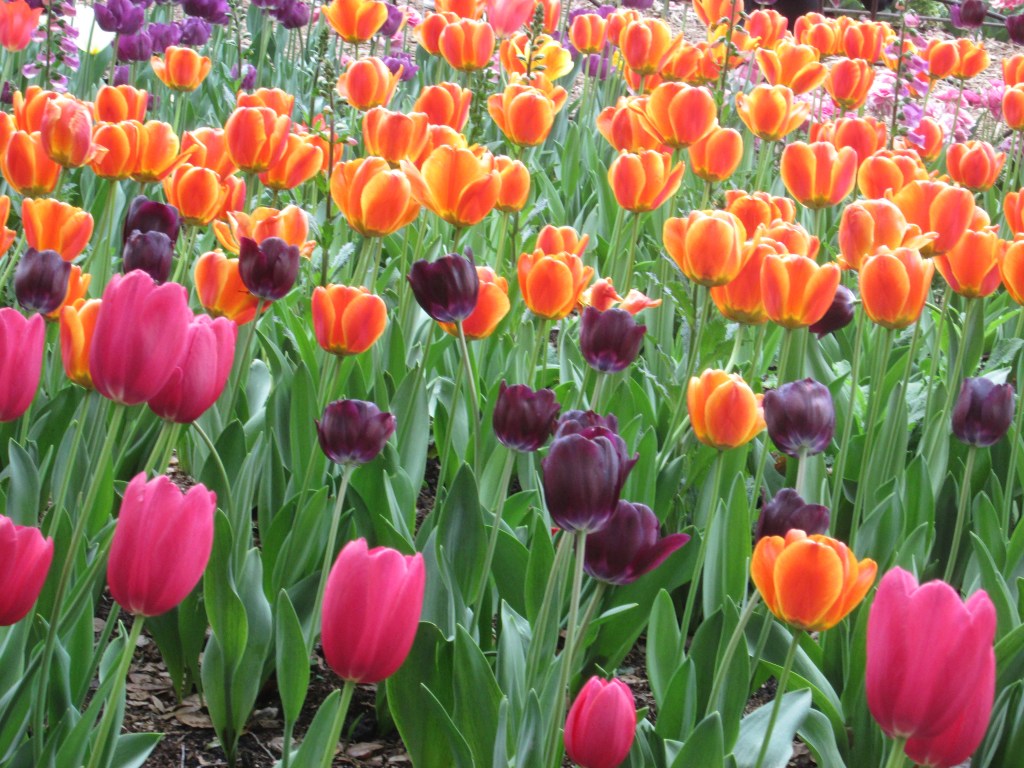
If you were to ask me what my favorite flowers are, I would unhesitatingly answer, “Tulips!” (In a close second would be California Poppies.) Yesterday, Martine and I braved the springtime crowds at Descanso Gardens to see the springtime flowers. Our first interest were the tulips, which we were the first thing we visited when we got there, and then again the last thing we saw before closing time.
What I love most about tulips are the gorgeous colors. Unfortunately, they last such a short time and are not seen anywhere for most of the year. They originally came from the Middle East in the 11th century AD, and were taken up by the Dutch only around the 1500s.
The world’s first speculative bubble was not in stocks or currency, but in Dutch tulip bulbs. The bubble lasted from 1634 to 1637, and saw numerous fortunes made and lost. In 1850, Alexandre Dumas Père, of The Three Musketeers and The Count of Monte Cristo fame, published a novel called The Black Tulip, which is well worth reading. It contains the following syllogism:
To despise flowers is to offend God The more beautiful the flower is, the more does one offend God in despising it The tulip is the most beautiful of all flowers Therefore, he who despises the tulip offends God beyond measure
In Chapter 9 of his book about Australia entitled In a Sunburned Country, Bill Bryson writes about an encounter with New South Wales’s Australian Flies, called in Australia “March Flies,” because that’s when they manifest themselves.
I had gone no more than a dozen feet when I was joined by a fly—smaller and blacker than a housefly. It buzzed around in front of my face and tried to settle on my upper lip. I swatted it away, but it returned at once, always to the same spot. A moment later it was joined by another that wished to go up my nose. It also would not go away. Within a minute or so, I had perhaps twenty of these active spots all around my head and I was swiftly sinking into the state of abject wretchedness that comes with a prolonged encounter with the Australian fly.
Flies are of course always irksome, but the Australian variety distinguishes itself with its very particular persistence. If an Australian fly wants to be up your nose or in your ear, there is no discouraging him. Flick at him as you will and each time he will jump out of range and come straight back. It is simply not possible to deter him. Somewhere on an exposed portion of your body is a spot, about the size of a shirt button, that the fly wants to lick and tickle and turn delirious circles upon. It isn’t simply their persistence, but the things they go for. An Australian fly will try to suck the moisture off your eyeball. He will, if not constantly turned back, go into parts of your ears that a Q-tip can only dream about. He will happily die for the glory of taking a tiny dump on your tongue. Get thirty or forty of them dancing around you in the same way and madness will shortly follow.
And so I proceeded into the park, lost inside my own little buzzing cloud of woe, waving at my head in an increasingly hopeless and desultory manner—it is called the bush salute—blowing constantly out of my mouth and nose, shaking my head in a kind of furious dementia, occasionally slapping myself with startling violence on the cheek or forehead. Eventually, as the flies knew all along, I gave up and they fell upon me as on a corpse.






 Tarnmoor
You must be logged in to post a comment.