Martine Is Back!

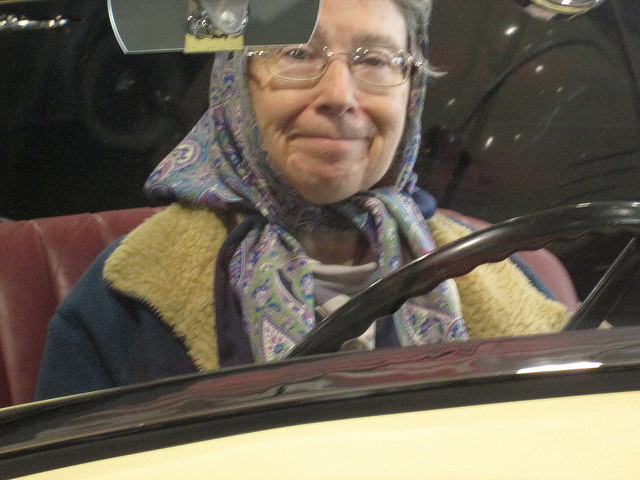
Martine at the Automobile Driving Museum in El Segundo

This morning, as I was watching the movie Odds Against Tomorrow (1959), the doorbell rang. I thought, “Who could that be? Is it the Jehovah’s Witnesses? LDS Missionaries?” I opened the door to find Martine with her suitcase. She had taken buses from South Central LA to Union Station, and from there the 704 bus, which drops her off two short blocks from home.

Martine had stayed at a women’s shelter run of Volunteers of America near Broadway and West 88th Street, in the heart of South Central. The facility contained some forty bunk beds on each of two floors, sleeping some one hundred sixty women. Martine, who is by no means a sound sleeper, had three nights of no sleep on a mattress that was too soft for her bad back. She had no complaints about the way she was treated or the food that was served, but she could not tolerate another sleepless night. Fortunately, I had purchased for her a senior TAP card with a few dollars of stored value which enabled her to take buses at a discount without having to worry about exact change, so she could take a bus virtually anywhere in the county at will.

During her absence, I was less worried about her because I knew she was being well cared for. Plus she called me three times during her three day sojourn at the center, though I was not able to call her. I suspect that most of the women at the shelter were there because they had been abused by husbands and boyfriends. How were the receptionists to know that I was not an abuser?

Martine’s “escapes” are a symptom of her depression. All I can do is demonstrate to her that I continue to love her and that she can trust me. In all her actions, there is no sign of enmity or exasperation with me. As she stood at my doorstep with her luggage, there was a big smile on her face. I can accept that.


Another Getaway

Martine at the Automobile Driving Museum

Today Martine left me for the fifth time. It wasn’t really a break-up. We wished each other well, and Martine managed to get a space in a women’s shelter in South Central Los Angeles where she could wallow in her depression. She will lie on her back all day and stare at the wall. This evening, at least, she called me and told me where she was staying and how I could get in contact with her. I can’t see how she would be able to tolerate such a minimalist life, though I’ve seen her go through stretches like that here in the apartment. I still love her and hope she herself will come out of her dudgeon long enough to see that the life she has chosen for herself is too unspeakably grim even in the short term.

In her previous getaways, Martine made it to Sacramento, Truckee, Salt Lake City, and some unspecified point in the California desert. She doesn’t want me to interfere with these getaways, yet she always wants to keep at least a minimal line of communication open. That at least is a good thing.

I have gone through these episodes before and have become slightly inured to them. Still, my thoughts are always with her; and I regard my life alone as being incomplete, as if several vital organs were missing. The two things that keep me on an even keel are my old friends and my books. I hope she comes back and decides that maybe the old man is no longer a sexy beast, but he does love her after his own fashion.


Historic Schoenbrunn Village

My First Trip

Heck, I was just a kid at the time; so I didn’t know any better. All the other family trips were decided on by my parents—and we didn’t travel much even then. Up until the mid 1960s, the farthest I ever went with them was Detroit and Pontiac, Michigan, to the west and Niagara Falls to the east. Then, one day they listened to me. I suggested that we visit Schoenbrunn Village near New Philadelphia, Ohio. We had just learned in school that it was the first white settlement in Ohio, founded in 1772 by Moravian missionaries intending to convert the Delaware Indians.

What we found was a Disneyfied patch of log cabins that looked so badly chinked that they probably had to plug the leaks every year. There was the obligatory souvenir stand on the premises and (although I do not specifically remember it) a snack bar. Of the souvenir stand I am sure, because my folks bought a rubber-tipped spear for my little brother. The return trip was hard on him so he detonated by the time we neared Akron.

It was not particularly a fun trip. Once the fact settled in that it was the first settlement in Ohio, the rest was primarily just visiting all the cabins and nodding sagely. Interestingly, Los Angeles was first settled nine years later than Schoenbrunn Village, and some of the original buildings are still around, such as the Avila Adobe on Olvera Street and scattered Spanish missions and adobes scattered around town. I guess log cabins of that design don’t last long.

Fortunately, all my subsequent trips were much better than that ill-fated day trip some 60 plus years ago.


Skin, Left Anterior Proximal, Upper Arm

Squamous Cell Carcinoma

About a week and a half ago, I went to see a new dermatologist, the one I had been seeing having retired. The reason for my visit was an annoying skin tag that was dangling from my left upper eyelid. While I was there, the doctor checked my body for suspicious signs of skin cancer—this being Sunny Southern California. I was surprised to learn a few days later that one of the three suspicious signs did indeed prove upon biopsy to be a “Squamous cell carcinoma in situ (Bowen’s disease), lesional cells extend to a peripheral edge of the biopsy.” It looked very much like the one in the above photograph.

Within two hours, I was in the doctor’s office having a lozenge-shaped piece of tissue from my left arm removed and replaced with several stitches. I was rather surprised by the outcome, because that portion of my upper left arm was never directly exposed to sunshine: I never work tank tops or other “young men’s folly” types of T-shirts. The skin cancer cells ignored my cotton/polyester blend shirts and started their nefarious work where I did not expect it.

Fortunately, the particular bump that was removed had just appeared one or two weeks previously; so we likely stopped it at an early stage.

I remember one of my friends lost his father because he was used to hanging his left arm outside the open window of his automobile. He got some form of skin cancer, did not seek treatment, and eventually the cancer metastasized and killed him. He did most of his driving in the San Fernando Valley, an inordinately hot part of L.A. I never hang my arm out the window: I use it to aid me in steering my car. Besides, my window is usually closed in summer because I have the air conditioner on.

Life is a bunch of close calls. I think I ducked this particular bullet.


Adventures in the Here and Now

Los Angeles Central Library

As I have written in another post, I usually travel downtown on Thursdays to visit the Central Library on 5th Street between Hope and Flower. I like to show up at opening time (10 am) and reading for about two hours. Then I scan the stacks for books I want to read, check them out, and go to Conference Room A for the weekly Mindful Meditation session guided by John Kneedler, an instructor for the UCLA Mindful Awareness Research Center (MARC).

The whole point of mindful meditation is to learn how to live in the here and now. Most of the time, one’s thoughts are all over the place. Take this classic example from Aldous Huxley’s Those Barren Leaves, in which Miss Thriplow tries to concentrate on the nature of God:

God is a spirit, she said to herself, a spirit, a spirit. She tried to picture something huge and empty, but alive. A huge flat expanse of sand, for example, and over it a huge blank dome of sky; and above the sand everything should be tremulous and shimmering with heat—an emptiness that was yet alive. A spirit, an all-pervading spirit. God is a spirit. Three camels appeared on the horizon of the sandy plain and went lolloping along in an absurd ungainly fashion from left to right. Miss Thriplow made an effort and dismissed them. God is a spirit, she said aloud. But of all animals camels are really almost the queerest; when one thinks of their frightfully supercilious faces, with their protruding under lips like the last Hapsburg kings of Spain… No, no; God is a spirit, all-pervading, everywhere. All the universes are made one in him. Layer upon layer… A Neapolitan ice floated up out of the darkness. She had never liked Neapolitan ices since that time, at the Franco-British exhibition, when she had eaten one and then taken a ride on Sir Hiram Maxim’s Captive Flying Machines. Round and round and round. Lord, how she had been sick, afterwards, in the Blue Grotto of Capri! ‘Sixpence each, ladies and gentlemen, only sixpence each for a trip to the celebrated Blue Grotto of Capri, the celebrated Blue Grotto, ladies and gentlemen….’ How sick! It must have been most awkward for the grown-ups…. But God is a spirit. All the universes are one in the spirit. Mind and matter in all their manifestations–all one in the spirit. All one—she and the stars and the mountains and the trees and the animals and the blank spaces between the stars and… and the fish, the fish in the Aquarium at Monaco…. And what fish! What extravagant fantasies! But no more extravagant or fantastic, really, than the painted and jewelled old women outside. It might make a very good episode in a book—a couple of those old women looking through the glass at the fishes. Very beautifully and discreetly described; and the fundamental similarity between the creatures on either side of the glass would just be delicately implied—not stated, oh, not stated; that would be too coarse, that would spoil everything, but just implied, by the description, so that the intelligent reader could take the hint. And then in the Casino… Miss Thriplow brusquely interrupted herself. God is a spirit. Yes. Where was she? All things are one, ah yes, yes. All, all, all, she repeated. But to arrive at the realization of their oneness one must climb up into the spirit. The body separates, the spirit unites. One must give up the body, the self; one must lose one’s life to gain it. Lose one’s life, empty oneself of the separating Me. She clasped her hands tightly together, tighter, tighter, as though she were squeezing out her individual life between them. If she could squeeze it all out, make herself quite empty, then the other life would come rushing in to take its place.

Many people avoid trying to concentrate their minds because they are too harsh with themselves. The mind resists being in the here and now: During today’s session, I thought of where I would eat lunch, what book I would read next, whether Martine would stage another departure. I kept coming back to the simple inhalation and exhalation of my breath. So I am nowhere near perfect. But I keep trying.


Caught Between the Warring Twins

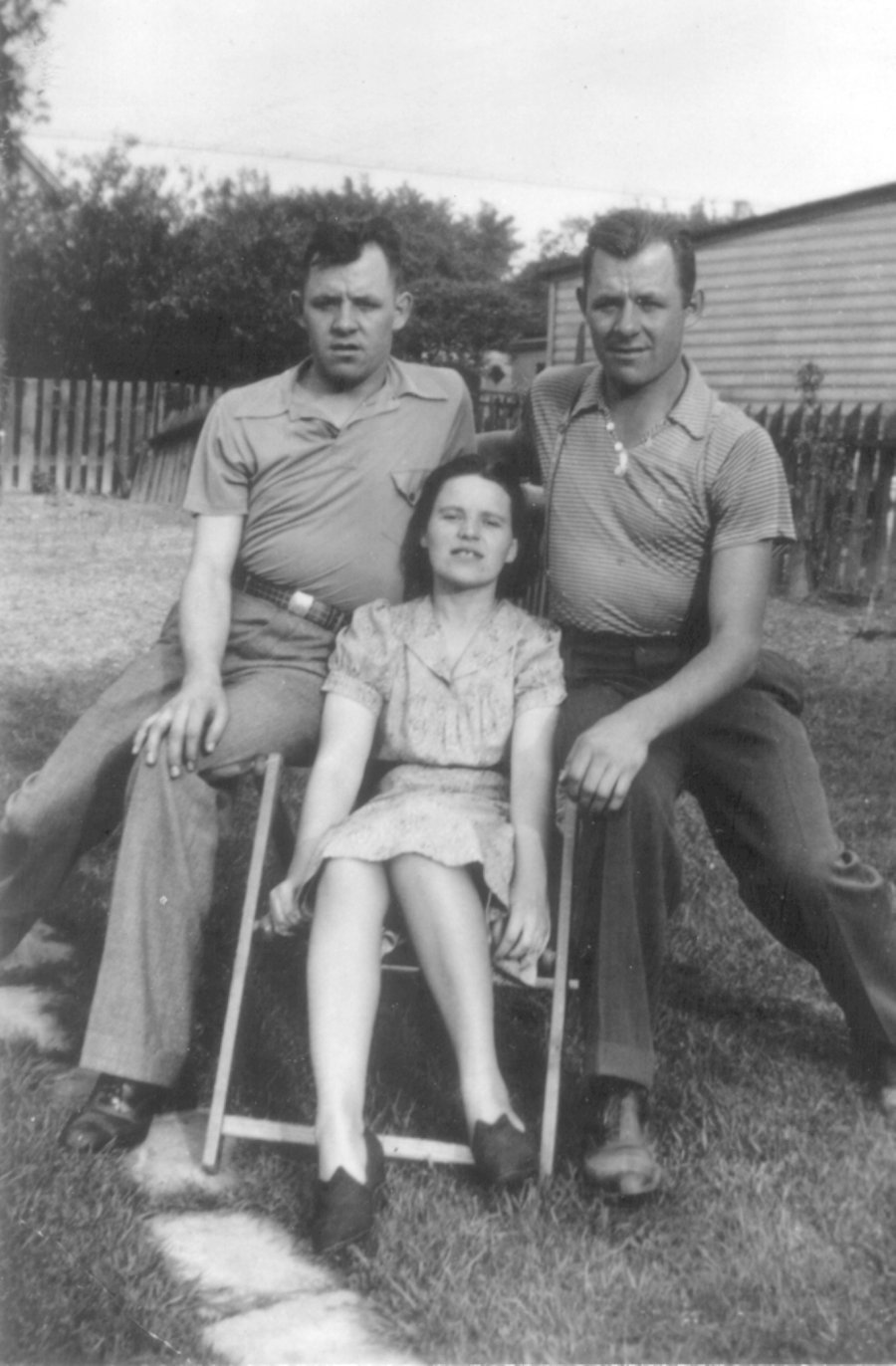
Emil, Margit, and Elek Paris

The following post appeared on my Multiply.Com blog site on January 16, 2011.

It’s been a while since I revisited my past. This time, I’m going back into the period before my birth. The above picture was taken at some point in the 1930s and shows the Paris twins, Elek (Alex) and Emil, and their sister Margit.

Can I tell which one of the men is my father? Probably, it is the one on the right, because my father Elek was always better tanned and more athletic but not so well dressed as Emil. Even later in life, I sometimes had to wait for them to start talking before I recognized them, because they had very distinctive voices.

Elek and Emil could never live far apart from each other. When Emil bought a condominium in Hollywood, Florida, my Dad followed—in the same Carriage Hills condo complex. My father died in October 1985; and Emil died a few months later, of pretty much the same combination of diabetes and heart failure. At my Dad’s funeral, Emil was visibly shaken, as if his world had been taken away from him.

All their lives, the two twins competed through their children. Dad had the two sons, my brother Dan and myself; Uncle Emil had a son and daughter, Emil Jr. and Peggy. At times, the competition got bitter, especially when my cousins faltered in school and in their personal lives. Dan and I, however, always liked our cousins and regretted any bad blood between the brothers. They were just that way.

Margit was a different case: She never married. I don’t even know whether she dated very much or even wanted to marry eventually. Some years after this photo was taken, she opened May’s Bridal Shop in Garfield Heights, Ohio, and lived on the premises spending her time sewing bridal gowns. My job when visiting there was to pick up fallen pins with a magnet. I would also look with admiration at all her old calendars with Currier & Ives illustrations.

I don’t remember when Margit (whom we called Nana) closed the shop and retired to Florence, South Carolina, but I think it was in the early 1970s. She didn’t last very long because, shortly after I returned from Hungary in 1977, I got a call that Margit had died suddenly. The timing was unfortunate, as my parents were still in Hungary visiting. So I notified my brother and the two of us attended the funeral—after sending a telegram to Dad in Hungary. He was very broken-up that he couldn’t make the funeral in time, but was grateful that Dan and I went.

Whatever the competitiveness between the frequently warring twins, I always felt that my Uncle, my cousins, and my Aunt loved us for what we were. Although Margit was closer to her brother Emil than to Elek, that never impacted on the next generation. I did feel, however, that my Dad had never said certain unkind things about my cousins that I wish he hadn’t. Cousin Emil was always good-hearted and frequently protected me from neighborhood bullies when I was a little shrimp of a kid; and Cousin Peggy was, I always thought, incredibly cute.

A life is always strange when one looks at it all of a piece. I cannot help but feel that I have grossly oversimplified the complex web of interrelationships that existed among us. The important thing is that I accepted the few bad things because they were more than made up for with kindness and love. Elek, Emil, and Margit now exist inside of me; and all the conflicts have been resolved.


The Houses of Poets

The Robert Frost House in Franconia, NH

When traveling, I like to visit the houses in which poets I admire lived. When I was in Chile in 2015, I made a point of visiting all three of Pablo Neruda’s houses: Isla Negra, La Sebastiana, and La Chascona. In Paris, I visited the flat in which Victor Hugo had lived. And, in Franconia, New Hampshire, I visited the farmhouse which Robert Frost occupied beginning in 1915 after he published his collection A Boy’s Will and afterwards as a summer house through most of the 1930s.

Frost remains one of my favorite American poets, along with Emily Dickinson and Walt Whitman. If you look through the same window a great poet has looked through, you begin to understand something about his work.

Mailbox at the Franconia House

Before he died in 1963, I attended a poetry reading by Frost at the newly opened Hopkins Center at Dartmouth College. Frost had attended Dartmouth for a while, but dropped out. He also attended Harvard, but he never graduated college. As old as he was, Frost was in complete command of his mind at the age of 87. And I have been moved by his poetry ever since. I got the feeling that Frost was not the bumbling old poet who read his poem “The Gift Outright” at John F. Kennedy’s inauguration in 1961: Hearing him speak, I had a feeling that Frost knew exactly what he was doing, and had no trouble handling an auditorium filled with sharp college undergraduates.


At The Mall

The Westfield Mall in Culver City

As the heat of summer has descended on Los Angeles, I have increasingly been spending more time at the air-conditioned Westfield Mall in Culver City. There are places to sit and read, plenty of perfectly acceptable restaurants, and—very important to me—not a large number of smelly bums. Oh, did I sound not too terribly Progressive with that last line? Perhaps it’s because I¹m not 100% Progressive.(Especially as there is a bum encampment across the street from my apartment.)

If you think I should be ever so much more understanding than I appear to be, I urge you to see a 1932 French film director by Jean Renoir called Boudu Saved from Drowning (Boudu sauvé des eaux). A used bookseller played by Charles Granval rescues a tramp (played by the great Michel Simon) from drowning in the Seine. Out of a total lack of gratitude, Boudu opens a rare edition of Honoré de Balzac, spits in it, closes the book, and returns it to the shelf. If someone were to spit in one of my Balzacs, I would gladly perforate his spleen and any adjacent internal organs.

One interesting thing about sitting in a mall is the variety of people who pass by. It is incredible to me how many Americans are grossly overweight. Also, since the mall is located in Culver City, I am amazed by how many drop-dead gorgeous young African-American women there are. Also, at least during the day, people are unusually nice to one another.

Among the restaurants, there are some interesting Asian choices, such as Bibigo (Korean), Dot Saigon (Vietnamese), 101 Noodle Express (pan-Asian), and Panda Express (Gringo Chinese). If I wanted to go more upscale, there is an Oliver Garden and a Wokcano at the ground level.

Next week, the temperature is supposed to be particularly heinous (with temps going up as high as 108° F in the interior, probably higher given the unusual Southern California conservatism in predicting high heat).


The Allergy Sufferer

Yup, That’s Me, All Right!

I was first made conscious of it in high school. I sneezed a lot, and my scalp was full of flakes. My doctor concluded that I had allergies. Consequently, I was sent to an allergist around Cleveland’s University Circle. He produced a rectangular network of scratches on my arm, each one representing a known allergen. The upshot: I was allergic to cats (that one I already knew), tomatoes, and oats. I did not believe in those last two.

Nevertheless, I was in the doctor’s office every Saturday morning for the next year or so getting a shot to fight my allergies. The results were imperceptible: Every time we visited my uncle’s house, my eyes watered, I sneezed, and my face was essentially an ugly red splotch. My parents rightly decided that this therapy was taking me nowhere.

Then, when I came to Los Angeles, I discovered I had asthma. I suspect that was the result of sleeping on the floor with all the dust mites and other nasty biota. I had a bed, but I liked the idea of sleeping on a firm surface. I still do, but I sleep in bed on an extra-firm mattress instead.

This spring has been a bad time for my allergies. It started with two months of blepharitis, an annoying allergy to the dandruff in my eyelashes?! Then there was the inevitable nose-blowing and lava-flows of thin mucus. My super-power in this time of year? I become Mucus Man. I slime all evil-doers.

To top it all off, I occasionally get a light spell of asthmatic wheezing. Yuck!


Fish in My Life

Icelandic Cod, One of My Favorites

Here I am, talking about food again. Today for lunch, Martine and I went to Captain Kidd’s Seafood Restaurant in Redondo Beach for a delicious fish feast. Martine had sautéed Alaskan cod while I had fish tacos.

When I was young, I wouldn’t eat any seafood. Don’t forget: I was raised near Lake Erie, the shallowest of the Great Lakes, which was badly polluted until recently. When I saw fish in their natural element, they were mostly floating in a state of advanced decay on the surface of the lake. The only other place I saw them was at church fish fries. I occasionally attended, under duress, but did not like the fish: I merely nibbled on the French Fries. (That was before I discovered what malt vinegar does to improve fried fish and potatoes.) We never had fish at home.

It was not until I came to California that I began to eat fish. I ascribe this to (1) being distantly removed from family pressures and (2) the influence of my co-workers when I began working in the computer software industry. And from eating cooked fish, it was only a small stutter-step to eating sushi. My sushi-eating reached its peak in the 1980s and 1990s, when it was most fashionable in Southern California. Now I find it too expensive, and I find that really good places with trained Japanese sushi chefs are now few and far between.

I even eat shellfish from time to time, but I find I have a curious allergy to shrimp and lobster caught in warm waters. The symptoms are like a sudden onset of strep throat pain lasting for up to two hours. When I go to cold-water places like Canada and Iceland, I have no trouble with either; and I positively love good lobster.

This past week, I’ve had fresh fish three times. Twice it was in the form of spicy fish fillet in black bean sauce at local Chinese restaurants. The Hong Kong Barbecue on Broadway in Chinatown makes a particularly tasty version.