A Wedding in Temecula

A Winery in Temecula, CA

Yesterday, I drove 100 miles to the city of Temecula, midway between Riverside and San Diego on Interstate 15. My niece Jennifer Duche was being married to her boyfriend John Margolis at the Falkner Winery east of the city.

The wedding ceremony itself was short and sweet; but as we waited for the outdoor reception to begin, a cold wind from the west set us all to shivering. I was just recovering from a cold from the week before, so I decided to leave before dinner was served.

So instead of tri-tips with chimichurri, I stopped at an In-N-Out Burger in town on my way back to the motel. At least I think I was spared from a relapse.

Temecula is a weird town surrounded by picturesque wineries and neo-Spanish architecture. Most of the restaurants were from regional or national chains. My hotel was brand new, full of elegant suites; and I think I was the only tenant.

The important thing was that I was there to wish Jen and John a good start to their married life together.

The English Teacher

Daily writing prompt
Share a story about someone who had a positive impact on your life.

It was September 1958. I had just entered high school and been introduced to my English teacher, the Rev. Gerard R. Hageman, S.M.—a Catholic priest of the Marist order. He was incredibly strict. We had frequent quizzes in which one could only get two possible grades, 100 or 0 (Z-e-r-o). And the numerical grades were averaged out.

Father Hageman had created a one-page mimeographed summary on yellow paper of jis “Random Rules of Grammar and Style.” I will present you with two excerpts. The first are the rules which call for commas. This was abbreviated to D SAPS DT C CINQ MOC. The letters stood for: Direct address, salutation, appositives (I have since forgotten what those were), parentheticals, series, dates (city and state), titles after names, compound sentences, contrasting ideas, introductory adverbial clauses, non-restrictives, direct quotations, mild interjections, omitted words, and common sense.

Here are three random rules from the yellow sheet:

  • Pronouns are weak. If used, they must have clear and definite antecedents.
  • Introductory participles, infinitives, and gerund phrases must refer to the subject; and the subject must come immediately after.
  • Nouns and pronouns used as modifiers of gerunds are in the possessive case.

Imagine the impact on a thirteen-year-old boy and the threat of a zero score for any single violation of the rules.

Father Hageman was relentless. But, you know what? I still follow his rules religiously. The young student who wanted to be a nuclear physicist wound up preferring writing and, maybe, becoming an English teacher.

Unfortunately, Father Hageman returned to the Marist college in Atlanta, where he died suddenly on January 1, 1961. I wish I had a picture to show you, but that was years before the Internet.

In a 2018 interview with the then Catholic bishop of Atlanta, Joel M. Konzen, S.M., the interviewee noted:

All of us who went to Josephinum had a wonderful education there, but particularly wonderful in English. Writing and languages were highly emphasized at the Josephinum in that day. We had a wonderful teacher, Msgr. (Leonard J.) Fick. I think that anyone who went there would tell you the same thing. …

It was … kind of what they say about Father (Gerard) Hageman at Marist, that if you ever had either of those, you knew you were good to go in terms of writing and so I liked to write.

East Side, West Side

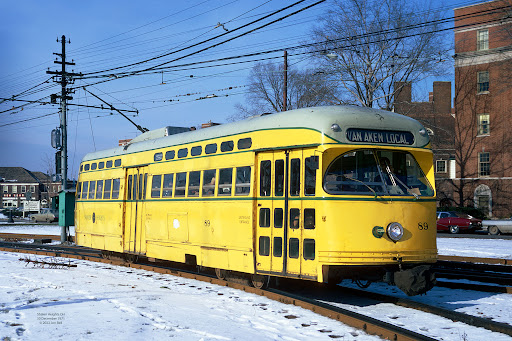
Cleveland’s Shaker Rapid—Way Back When

This was a particularly vivid dream that I had last night. I was visiting in Cleveland, and my mother was still alive. I was wandering the streets of downtown looking for the bus stop of the #71 CTS (Cleveland Transit System) line that went down Pearl Road to York Road, letting me out in Parma Heights where my mother lived.

The stop used to be near the corner of Prospect and Ontario, but in my dream the streets were different; and I didn’t see any bus stops. So I walked to Public Square and around Euclid and Superior Avenues, noting where Schroeder’s Bookstore used to be when I was young.

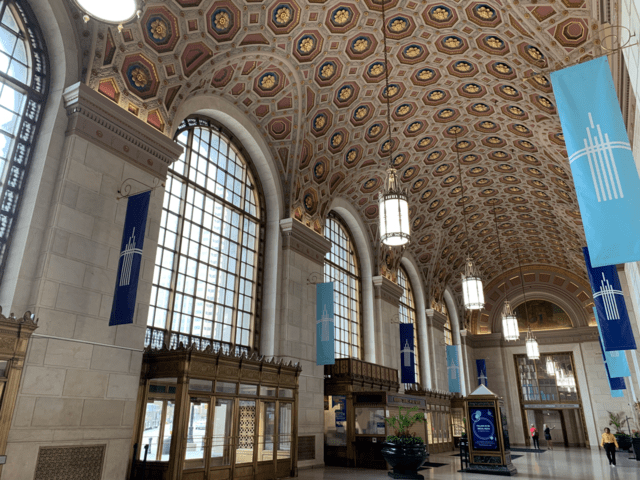
I gave up and decided to take the Shaker Rapid instead and headed for the concourse under the Terminal Tower.

Entrance to the Terminal Tower Concourse

But wait! Mom lived in Parma Heights on the West Side of Cleveland, while the Shaker Rapid served the East Side, where we used to live in the Lee-Harvard area.

My dream ended inconclusively, as I got stuck in a busy store and then had to deal with a Shaker Rapid ticket seller who pointedly ignored me.

It wasn’t a nightmare: I almost never have nightmares. It was just a curious amalgam of my many trips from home to downtown and back again. It was at a point after my childhood after 1985, when my father died. My widowed mother lived alone in Cleveland until she decided to move to Hollywood, Florida, a number of years later.

My Own Nationality

A Different Kind of Hungarian

As I get older, I am increasingly unwilling to interact with strangers. Chatting with people I do not know is just something I would rather not do any more. I don’t even like sharing an elevator. The absolute worst is having to interact with American tourists when I am traveling abroad.

And yet I remember helping a group of French tourists in Iceland get guesthouse accommodation in Höfn, Iceland, when they couldn’t find any locals who understood them.

The difference was they didn’t have any expectations of help, whereas many or most American travelers, on the contrary, would. It is at that point that I reply to their question(s) very politely in my off rural Hungarian dialect from the 1930s. I could be telling them in Hungarian to get stuffed, but I actually try to answer them politely in my native language.

There is always the danger that the person accosting me knows the Magyar language. That actually happened to me once in Vancouver’s Chinatown, when the beggar asking for spare change recognized what I was saying and answered me back in Hungarian. I immediately melted and gave him a five dollar bill. He actually invited me for coffee, but I was on my way to a movie screening and didn’t want to be late. Else I would have obliged him.

I am not that way, of course, with my friends and acquaintances. Or even with waiters or cashiers. It’s just that I have a phobia of dealing with demands placed on me by strangers. That even includes the unsmiling visage that I characteristically assume—all to avoid having to deal with the public at large.

Budapest. Keleti Pályudvar. 1977.

Keleti Pályudvar (Train Station) in Budapest

In the summer of 1977, I joined my parents in Budapest for a visit to locations in Hungary and Czechoslovakia (as it was called then). They flew to Budapest from Hungary, while I flew first to London and bought an Austrian Airlines ticket to Budapest by way of Vienna.

After a few days in Budapest, we decided to take a train to meet my relatives in Prešov in what is now Slovakia. We made our way to the Keleti Pályudvar from where trains went to Košice, where we would be met with our cousin Miroslav driving his trusty Škoda.

This was during the days of Communist rule, when things were a bit disorganized at times. As our train was pulling into the station, we jumped into a first class compartment for six and took our seats. In a few minutes, as the train was departing, another man jumped into our compartment. As it turn out, the man was Romany, a gypsy, or in Hungarian, a cigány.

Central and Eastern Europe are strongholds for many types of racism. So it is not surprising that my father’s first instinct was to grab the interloper by the collar and throw him off the slow-moving train, all the while calling him a büdös cigány (stinking Gypsy).

I sat there shocked not quite knowing how to react. Obviously things were different in this part of the world. This was confirmed for me when we went through a border inspection as we crossed into Czechoslovakia at Čaňa and my father bribed an inspector with a pack of Marlboro cigarettes.

That was an interesting trip. It involved my pretending to be a Hungarian railway worker so that we could use a MÁV (Hungarian State Railways) hostel in Szeged. (My cousin Ilona worked for MÁV in Budapest.) Apparently I was able to carry off the impersonation by grunting whenever spoken to.

PCs and Nizards

My First Book, Sort Of

Back when I was a toddler in my crib at 2814 East 120th Street in Cleveland, my mother used to tell me stories in Hungarian to help me drop off to sleep. When the stories were her own, they usually involved a fairy princess and a dark forest. But when she was running out of ideas, she would take out children’s story books from the city library on East 116th Street and translate the story into Hungarian while showing me the pictures.

One of them I remember very clearly was Dr. Seuss’s The King’s Stilts. Picture to yourself a kingdom that was below sea level, surrounded by tall dikes covered with trees. These trees were constantly under attack by flying nizards, which went after the roots.

Fortunately, there were legions of patrol cats (P.C.s) deputed by King Birtram to keep the nizards from destroying the trees and flooding the kingdom. When not busy signing proclamations, the king delighted to whizzing around his kingdom on a pair of red stilts.

One day, wicked Lord Droon decided to have the king’s stilts buried by Eric, the royal page, because he thought it was too infra dig for the monarch to be enjoying himself so much. The king was thereupon so despondent that he no longer gave orders to the patrol cats, and the nizards’ attacks were resulting in streams of water flooding into the kingdom.

Fortunately the story has a happy ending. Here, on YouTube, is the Dr. Seuss book, complete with words and pictures:

Naturally, I own a copy of the book. It is a constant reminder of my mother’s ingenuity and love.

Return to Life

Two Weeks of Acid Reflux!

If I have not been posting much lately, it is because I have been ill. The month started with an Addisonian Crisis (lack of adrenaline). No sooner did I get discharged from UCLA Ronald Reagan Hospital than Los Angeles damned near burned down. Then I started feeling week with a severe pain around my sternum. That turned out to be acid reflux.

As a result, I lost nineteen pounds because it was just to painful to eat. Even when I put myself on the BRAT diet (Bananas, Rice, Applesauce, Toast), any food make my stomach hurt for hours.

Finally, my doctor put be on a drug that relieved the pain. Now I have to be able to build up my strength after lying on the couch for weeks.

Hopefully, I’ve seen the worst and am on the mend. Wish me luck!

DMV

Time to Renew My Drivers License

As my drivers license expires in three weeks, I thought it would be a good idea to renew it before it was too late. I used to go to the Santa Monica DMV on Colorado Avenue. The last few times I went there, however, I felt as if I were in a Soviet bread line. Last time, I renewed my license in Torrance, which wasn’t bad. This time, I went to Culver City, which is much closer.

Everything went like clockwork. I was delighted that I no longer had to take the multiple choice “Knowledge Test” with its gotcha questions about blood alcohol, child seats, and obscure legal penalties—none of which is relevant to my driving experience. I was in and out in less than thirty minutes—a record for me. And I walked out with an Interim Driver License until the permanent one with my photo arrives after the holidays.

People tend to be very negative about the Department of Motor Vehicles. Probably, they all went to the Santa Monica branch.

Love and Pain

The Dartmouth College Campus in 2005

I spent four years at Dartmouth College in New Hampshire while suffering from a brain tumor that caused severe frontal headaches that lasted until midnight. It was then that I started my homework, not going to sleep until three or four in the morning. It was truly horrible when I had classes scheduled for 8:00 AM.

Worst of all were the morning swimming classes that I had to attend the first two years. At the time, the college had a requirement that all students be able to swim fifty yards in one minute. I was, of course, handicapped by my pituitary tumor; but I eventually passed the test. If MRIs and CAT Scans existed back in the mid-1960s, I would have been excused. But they didn’t. The doctors all thought that I was just being a pussy. It was not until I graduated in 1966 that I collapsed at home in Cleveland, just prior to leaving for graduate school at UCLA.

Still, I loved going to Dartmouth. It was everything I wanted. It was far from home at a time when my parents were undergoing a rough patch in their marriage. It was a college that challenged students to excel intellectually. And, situated in the upper Connecticut River Valley, it was a place of beauty. Most of the majestic elm trees are long gone, having succumbed to Dutch Elm Disease; but while I was there, the campus was strikingly beautiful.

When I went with Martine to re-visit the campus in 2005, I was appalled by the campus building program that was putting multi-story buildings in all the green spaces where I tossed a frisbee with my classmates. But then, I guess that that is a problem common to many campuses. It wasn’t the buildings that educated me: it was the caliber of the faculty and the students.

A Very Personal Holiday

Mom and Me Circa 1950

Let’s see, the celebrations this last week have come fast and furious:

  • Halloween (October 31)
  • All Saints’ Day (November 1)
  • All Souls’ Day (November 2)

And now:

  • My Mother’s Birthday (November 3)

It was Sophie Paris’s goal to make it to her 80th birthday. She admired her grandmother, my great-grandmother Lidia Toth, who made it into her mid-eighties. Unfortunately, she died several months short of her 80th birthday in the summer of 1998.

I don’t write often enough about my mother, although I owe my life and much of my happiness to her. She was abandoned by her own parents, so her grandmother and grandfather raised her. Although she was born in the United States, Daniel and Lidia Toth took her and raised her on a farm near Felcsut, Hungary in the Province of Fehérmegye. She returned to the U.S. with them in 1937 as the Nazi menace began to loom throughout Central Europe.

She met my father in Cleveland around 1943 and married him shortly thereafter. I was born in 1945, and Daniel Toth died in that year. Lidia never really liked my father, Alex Paris, and told my mother that, being his son, I should be allowed to die in my crib. In time, my brother and I developed a strong relationship with Lidia, who helped bring us up. With my father, however, it was war from start to finish.

Sophie was about 5 feet (1.525 meters) tall in her stocking feet. To compensate for her short stature, she had an oversized heart and loved my brother and me. That love has been very instrumental in Dan’s happiness and certainly mine.

Today, as Martine and I ate lunch at the Siam Chan in West L.A., we overheard two tattooed and pierced young men talking about getting up enough energy to attend an Alcoholics Anonymous (A.A.) meeting. The streets in our neighborhood are full of bums who suffering from various stages of mental illness and dependency on drugs and alcohol. I realize how lucky we are because of the love of our parents, Alex and Sophie Paris.

So Happy Birthday, Mom. You are not forgotten and never will be.