Discovering the Long Scroll

Excerpt from the Long Scroll of Sesshū Tōyō

For the first time in my life, I away away from home, alone. I was seventeen years old when I found myself at Dartmouth College. The only person I knew from before was Frank Opaskar, with whom I had gone to Chanel High School in Bedford, Ohio. But I quickly found myself becoming estranged from Frank because of his anxiety about his complexion. I had the top bunk in our dorm room, and Frank insisted in smearing himself with Noxzema. Every night, I was wafted into sleep by the medicated stench of his facial preparation.

Naturally, I was desperate to lift my mind from the humdrum life of study and Noxzema. Fortunately, I found several ways of escape. One of them was art….

In my first year at Dartmouth, the Hopkins Center for the Arts opened. One of the first shows in the art gallery was of the Long Landscape Scroll by Sesshū Tōyō (1420-1506), a Zen Buddhist master whose art work made me feel at home. I don’t know why: I had had no previous exposure in my Catholic education to Zen ink and wash paintings of the Muromachi school.

But what I saw was magical. It was a landscape of mists and rocks and water in which pilgrims were trekking from one place to another. I loved it at once. Did I see a sudden paradigm of my own life, wrenched from a close Hungarian family into the wide world? I followed the scroll from left to right—not just once, but many times in numerous visits while the exhibit lasted.

If you want to see what I saw, you can see an image by clicking here. Scroll about a third of the way down and scroll slowly to the right. The image doesn’t allow you to get close, but you get the general idea. I bought a copy of the scroll from Tuttle, the Japanese-American publishing house then located in nearby Rutland, Vermont.

You can say it was Sesshū Tōyō  who introduced me to Zen Buddhism. It was a splendid introduction.

A Yankee Way of Knowledge?

Carlos Castaneda’s First Don Juan Book

In the 1970s I was heavily influenced by the works of Carlos Castaneda based on the teachings of a Yaqui shaman named Don Juan Matus. The first book, whose cover is shown above, hit me between the eyes. And for years afterwards, I was kept in a high state of excitation by the books that followed. Although I was deeply influenced by the teachings described by Castaneda, one thing I was not affected by was the taking of mescaline, which played a major part in the teachings.

At the time, I considered myself lucky to be alive. In 1966 I had major brain surgery (a pituitary tumor, or chromophobe adenoma); and I knew I had to take steroids as long as I lived, as my body no longer produced any. So taking mescaline, LSD, cocaine, psilocybin, opium, and what not were strictly out of the question. (I did, however, take marijuana socially, especially in the form of brownies—smoking always made me go into asthmatic spasms.) But, other than that damnable mescaline, the concepts that Castaneda came up with were so damned brilliant that I was in thrall.

This evening, I had an interesting conversation with my friend Peter about those days. It has been years since I even thought about Castaneda. Now I want to re-read his books, which I still have on my back shelves, just to reacquaint myself with the young man that was me some forty plus years ago.

Carlos was actually born in Cajamarca, Peru, and came to this country in the early 1950s, becoming a naturalized citizen in 1957. As critics started looking at his books as works of fiction, it became evident that he had done some cross-cultural comparisons. In place of the Amazonian tribes that take ayahuasca to produce visions, he set his works among the Yaqui Indians of Northern Mexico. Unfortunately, he used Spanish terms that were not common among the Yaqui, arousing suspicions.

There is an anecdote about a patient describing his life to a psychiatrist, who keeps nodding his head and saying, “That’s very interesting!” Finally, the patient gets angry and says, “Well, that’s all a pack of lies which I just made up. What do you think of that?” The psychiatrist does not miss a beat: “That’s even MORE interesting!” That, in the end, is my reaction to Castaneda. I think there are some fascinating truths to be found in his books, along with some things that were just made up.

I will return to the subject as I re-read his books.


My Periodicals

The New York Review of Books (Semi-Monthly)

There are four periodicals to which I subscribe which I actually read. They are, in descending order of importance to me:

  • The New York Review of Books, a semimonthly on politics with book and art reviews.
  • The New Yorker, a weekly that has seen better days, but still publishes at least one or two great essays a month.
  • Gilbert, the monthly publication of the American Chesterton Society.
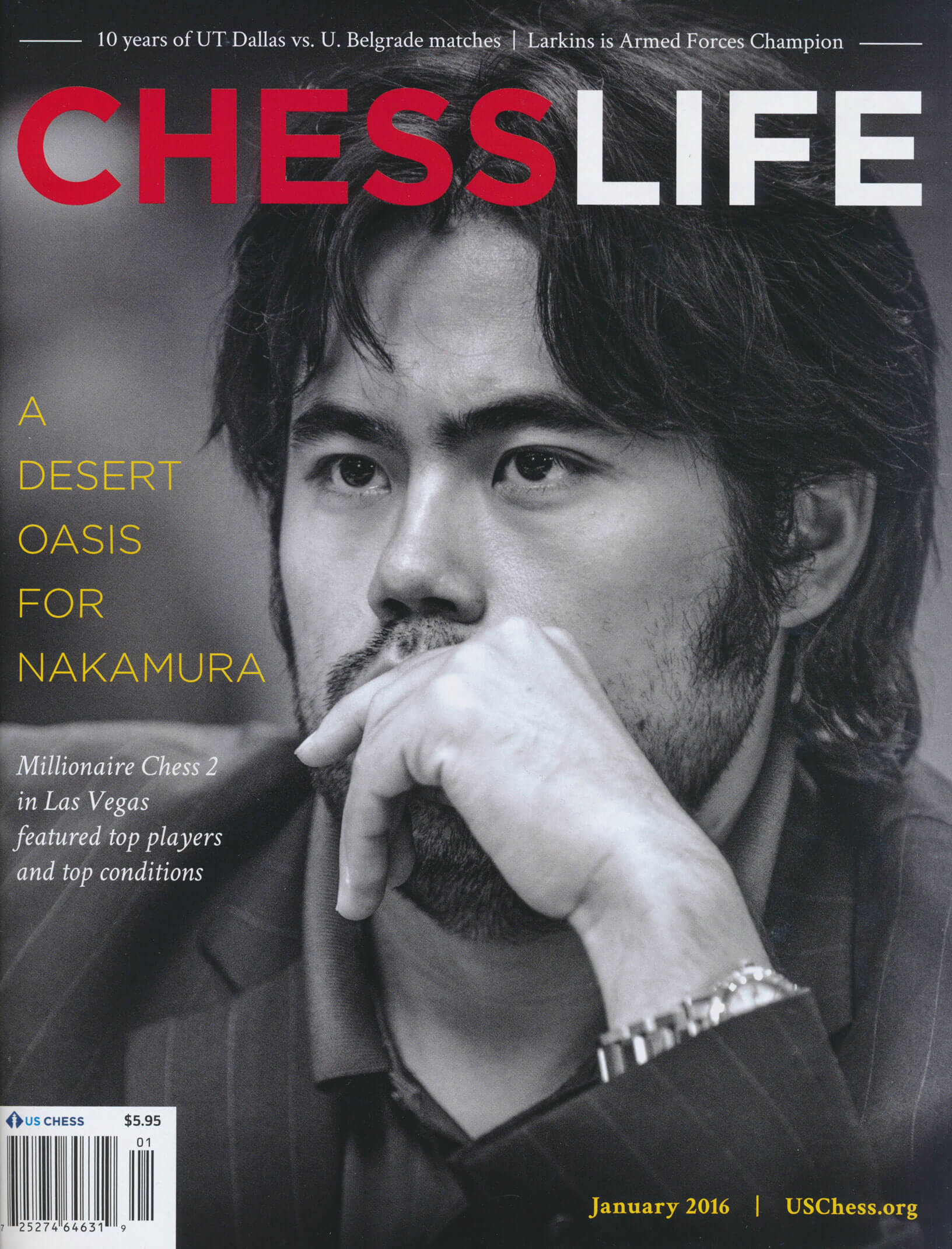
  • Chess Life, a monthly which I scan and about which I entertain a pipe dream of being able to read with the attention it deserves.

The one that is probably least familiar to most readers is Gilbert. Each issue has a couple of rare essays by G. K. Chesterton and other articles on Catholicism and distributism, Chesterton’s pet economic policy that is described at length in several of his books.

A Recent Issue of Chess Life Featuring U.S. Grandmaster Hikaru Nakamura

I’ve always had this dream of being able to take the time to analyze grandmaster-level chess games intelligently. It takes intense work, and if in public, one is likely to be interrupted by someone who wants to play chess with you. (I would prefer to avoid playing chess with strangers—too much ego involved!)  I don’t actually want to be able to play chess well as much as I want to develop better analytical skills. At my age, I don’t think I can become a much better chess player than I already am, but it is fun to see the decision-making skills of people like Hikaru Nakamura. It’s actually more of an aesthetic impulse on my part.

I also have a library of books with annotated chess games by the great masters. Whether I will ever be able to spend any time doing this remains to be seen. Some people go for golf or fishing. Fior me, it’s chess.

The Past Recaptured?

Hungarian Stuffed Cabbage with Rye Bread and Sour Cream

I do not have anything to say about Proust in this posting. Maybe I should have called it “You Can’t Go Home Again” or some such title. My earliest memories are about being raised in a Hungarian household in Cleveland by loving parents. I could not, would not ever repudiate that part of me; and I keep going in search of experiences that, like Proust’s madeleine bring back the happy memories of my childhood.

There used to be some good Hungarian restaurants in Los Angeles; but, as big a city as this is, there do not appear to be any at this time. So Martine and I show up at the local Hungarian Reformed Churches for their festivals. I go to recover my memories, and Martine goes because (although she is French) she loves Hungarian food more than any other.

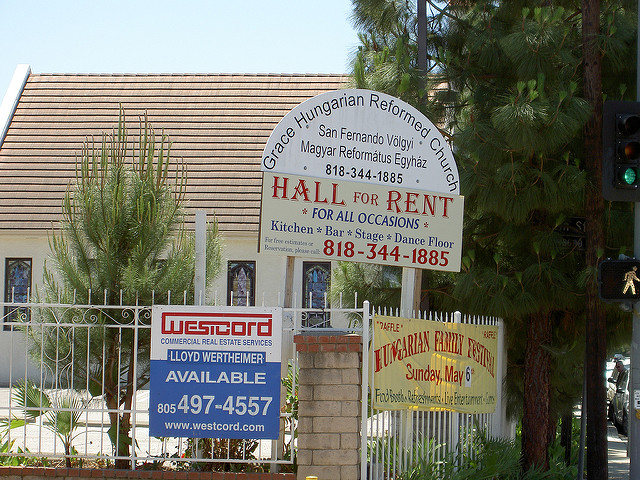
Despite a rare May rain shower, we went to the Majális festival at the Grace Hungarian Reformed Church in Reseda. We have been going here for almost ten years. Even within that short time, we have seen the parishioner base age as the old Hungarians die off and the younger ones spread out to the four winds. Still, the food is excellent. Their stuffed cabbage is superb, and their baked goods are world class.

The Grace Hungarian Reformed Church as It Looked Several Years Ago

Their pastor is still Zsolt Jakabffy, who keeps soldiering away at maintaining a parish amid the rapidly changing demographics of the San Fernando Valley.

Wait a minute! What’s a Catholic boy like me doing hanging out at a Protestant church? It all goes back to when my Catholic father and my Protestant Reformatus mother made before their children were born. Any boys would be brought up as Catholic; any girls, as Protestant. Just my mother’s luck that she gave birth to two sons.

So, yes, I have no compunction looking for God wherever He is invoked.


My Los Angeles

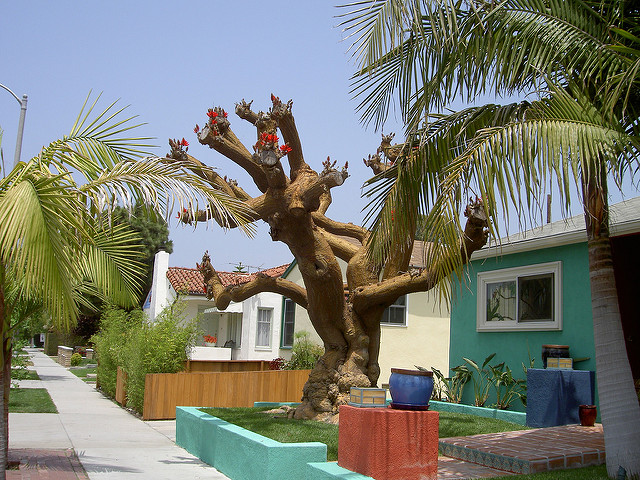
Tree on Ocean Avenue in Venice

I guess that by now I’m officially an Angeleno. It was late in December 1966 that I took a train to arrive at L.A.’s Union Station and was met by former neighbors from Cleveland, Ohio. It was the first time I had ever been west of Chicago, so all I saw was new to me. All that pastel stucco instead of the sooty red brick of Northeastern Ohio. The plants were all different. The climate was strange. Even the people were somewhat odd. Fortunately, I was rooming on Sunset Boulevard with a friend from Dartmouth College days, with whom I am still a close friend.

Mind you, I did not take to the place at once. For years, I thought of myself as an Easterner. It was only by slow degrees that the light of Southern California, with those beautiful sunsets over the Pacific, started to work a sea change in me. There were some things that repulsed me. Numero Uno: Earthquakes. The Sylmar quake of 1971 hurled me out of my bed and scared the stuffing out of me. Last night, while I was recording a Max Ophüls film—The Earrings of Madame de … (1953)—on videotape, I felt a sharp jolt. Even after all these years, I felt a moment of terror. Should I run for the bedroom hallway, where I would be safe from falling building parts? Should I just shrug my shoulders? I opted to go to bed.

Martine is even more nonchalant about temblors than I am—probably because she never felt one of the big ones, such as the ones in 1971 and 1994. Ah, well, she’ll learn!

I still don’t think much of L.A. drivers. They tend to be lazy about following the law, such as signalling lane changes and crashing red lights and stop signs. But then, it could be that way in most other big cities, too. I seem to remember not liking to drive in Miami, Calgary or Las Vegas either.

Some things I really like about Los Angeles are:

  • The food. California looks South (Latin America) and West (Asia) for its cuisine.
  • The politics. As a determined Trumpf-hater I feel in good company in this very Blue State.
  • The mountains. There are some mountains in Los Angeles County that are 10,000 feet high, a far cry flat flat Ohio.
  • The deserts. So we don’t get much rain, but the deserts of the Southwest are beautiful, so long as you don’t make the mistake of visiting them at the wrong time.
  • The coast. Driving along the Pacific can be gorgeous, especially in the early morning before the Beemer bozos get out of bed.

You’ll notice that I didn’t mention the weather. I’ve never liked really hot weather: And every year we get about 20 days of horrendously torrid weather. Fortunately, Martine and I live only two miles inland from the coast, so we can usually catch a few breezes, but not always.

The L.A. Times Book Festival

Hitting the Books on Earth Day

I used to go every year to the Los Angeles Times Book Festival, back when it was held on the nearby UCLA Campus. Then I went to the first festival at USC and decided that they didn’t know how to handle it right. For one thing, they haven’t yet realized that the temperature that far inland is generally ten degrees warmer; and the need for shade correspondingly greater. This year, things were better—but I still wish it moved back to UCLA.

I picked up five books at the festival:

  • Juan Gabriel Vásquez, Reputations, by an up and coming Colombian novelist
  • Joan Didion, South and West: From a Notebook
  • Yukio Mishima, Five Modern Nō Plays
  • Irène Némirovsky, Suite Française
  • Dashiell Hammett, The Big Knockover

Some of the prices were great, others were at the publisher’s suggested price. No matter: I plan to read them all, and will probably enjoy them all.

Fortunately the temperature wasn’t too hot today, and we didn’t make the mistake of driving. It cost us only 35¢ each to take the Expo Line train, which let us off right at the back gate of the festival. Else, I would have had to pay $15.00 and walk several blocks each way.


Mental or Dental, I Say It’s Spinach!

Right After Tax Season, My Mouth Fell Apart!

There I was, just outside the Grand Central Market on Broadway, munching on a chewy Mexican cocada, when I suddenly felt there were a couple of dental crowns moving around with the coconuts. Fortunately, I was able to pick out the crowns, wash them, and slip them in a plastic bag. This morning, I had an appointment with my dentist, who, with her assistant, worked the better part of two hours trying to fix my upper left molars. The job was made more difficult by my swallowing one of the gold crowns that had come loose: She had placed it in my mouth to determine whether it would still fit well in my mouth. Well, that’s a moot point now.

In addition, she discovered the beginnings of an abscess in my far left upper molar. That means a root canal. Oh yummy!


Tax Day—Whew!

It’s Finally Over

I’ve worked twenty-five consecutive tax seasons, and each one seems more grueling than the one before it. This year, because the deadline was April 18, we had three extra days to suffer. Last year, we also had February 29 because it was leap year. And Martine Luther King’s birthday? And President’s Day? Nope, we worked those days, as well as most Saturdays and some Sundays.

Although I had been working part time since May 2016, I worked full time from the beginning of March to today, primarily because our tax manager, Don Yamagishi, died on February 28. I do not have one-tenth of Don’s tax smarts, but I know a lot about the tax software and how to use it effectively. So I slaved with the rest of them because I did not want all the burden going on their shoulders.

Tomorrow, I’m going downtown to visit the Central Library and the Last Bookstore at 5th & Spring. It’ll be nice to relax a bit.


The Calm Before the Storm


Tulips at Descanso Gardens

Tulips at Descanso Gardens

Since the beginning of May, I have been semi-retired. Now, with the passing of our tax manager on Tuesday, I am being asked to come back full time—at least until the end of tax season. I had hoped to avoid another high-pressure tax season, but I pretty much had to agree to help out; else, I might have been forced to look for another job at my advanced age. So I can expect the next six weeks to be highly stressful. Life is like that sometimes.

But before I started in on the heavy-duty work, I decided to go to Descanso Gardens with Martine. The tulips were planted, and this was the first weekend of a two-=weekend Cherry Blossom Festival. Only some of the cherry trees were in flower, but the gardens were crowded, mostly with Japanese-Americans looking for an American equivalent of their own cherry blossom festivals. Fortunately, Descanso is large enough that one can easily escape the crowds and still find beauty.

The beauty of the tulips, and even of the lone lilac that came into bloom early, will help me in the weeks to come. Unfortunately, the tax deadline this year is Tuesday, April 18. That happens whenever April 15 falls on a Saturday or Sunday. This year it is on Saturday, and Monday is a holiday (Emancipation Day) in the District of Columbia; so, Tuesday is the tax deadline.

I’ve already filed my taxes, so at least I don’t have to worry about that.


A Nattering Nabob of Negativity

Sometimes There Is a Point To Being Negative

Sometimes There Is a Point To Being Negative

American culture frowns on negativity. People who are seen as being mostly negative are shunned and are constantly ducking brickbats thrown by amateur psychologists. But sometimes, it is good to be negative. For instance, I have nothing positive to say about the Trumpf administration, except that he has not pitched us into a global war—yet! (Even that f at the end of his name is negative, no?) Many of my friends say that they are taking a “wait and see” attitude. That I cannot understand.

We are so anti-negative that we sometimes confuse ourselves. The Patriot Act during the last Bush administration was essentially an attack on our liberties, pretending to protect us from terrorism. Hast it? No.

There is a long standing battle between the conservatives and women on the subject of abortion. Both sides are “pro” something: one is pro-life, and the other is pro-choice. How can anyone be against life or a woman’s choice on bearing a child? Here is a list of such euphemisms:

  • Passed away instead of died
  • Correctional facility instead of jail
  • Departed instead of died
  • Differently-abled instead of handicapped or disabled
  • Ethnic cleansing instead of genocide
  • Negative patient outcome instead of dead
  • Relocation center instead of prison camp
  • Collateral damage instead of accidental deaths
  • Downsizing instead of firing someone
  • Put to sleep instead of euthanize
  • Pregnancy termination instead of abortion
  • On the streets instead of homeless

For more examples, check out this website.

Now it seems that every piece of legislation, regardless how nefarious, must bear a positive moniker.

Maybe I react the way I do because I am a Hungarian. My people were on one of the two main invasion paths into Europe—the other was through Poland. When one is the product of a history of almost constant warfare, one is likely to not always look on the bright side of life.

That does not mean that I am, in Spiro T. Agnew’s memorable phrase, a “nattering nabob of negativity”; but I do not lay myself open to accepting arguments solely because they are framed using positive language. No more than I would call a bill urging Republicans to commit suicide the Glorious Sunset Act.