What, Me, Getting Lost?

This Image Is Practically Engraved in My Memory

Apparently, I have this phobia of getting lost. When my brother and I were in Ecuador last October, we could not find any street atlases; though, it wouldn’t have done us any good if we had them, because outside the central tourist area of the cities, there were no street signs. Dan made fun of me for my meltdowns when we wandered off what maps we had. There mus have been an incident in my childhood when getting lost from my Mommy and Daddy terrified me. I wrote a blog about this entitled Where the Streets Have No Name.  (Sorry, Edge and Bono!)

Where this is all leading to is a dream I had last night. I was traveling alone in the City of London. Having been there five or six times and having expended fierce amounts of shoe leather each time, I have a good picture of the city permanently resident in my head. I was trying to find a bookstore near Charing Cross Road, but had no idea where I was. And, even more peculiar, there did not appear to be any Underground or Tube stations on the inadequate map I had.

I had had some sort of meeting and was wandering around the city with some of the participants. At one point, they decided to stop and have an impromptu cricket match, which fortunately did not last long. When they stopped, we kept wandering in an easterly direction, coming on a square with a large Catholic church and a troupe of nuns ministering to the need of a large bump encampment. I thought to myself, “Gee, I had no idea there were so many bums in London.”

In the end, the dream just came to a stop. (Did I wake up at that point?) Although I jnever got to my bookstore nor to any other recognizable monument or building, I was more perplexed than terrified.

Thi9s is not the first time I got lost in my dreams. In none of them did my reaction rise to nightmare levels, but it is an interesting recurring theme—sort of like having to give a public speech while buck naked.


Musashi and the Flies

You Don’t Have to Draw a Sword to Prove Your Swordsmanship

I had forgotten the movie in which this scene took place until I viewed the DVD this morning. The great masterless samurai, Musashi Miyamoto (played by the redoubtable Toshiro Mifune), is holed up in a cheap inn in which a loud group of gamblers was partying. When Musashi’s disciple, Jotaro, goes out and tells them to shut up, they decide to teach Musashi a lesson. They charge up he stairs to his room, where Musashi is calmly eating a dish of noodles with his chopsticks. He is not much bothered by the gamblers, but he is irritated by the flies buzzing around him and his meal. Without sparing a glance elsewhere, he reaches out with his chopsticks and kills several flies, one after the other. The gamblers are awestruck at Musashi’s demonstration of icy control and quietly back out of his room. In fact, their ringleader, Kumogoro, insists on becoming Musashi’s disciple.

The film is Duel at Ganryu Island (1956), the third film in Hiroshi Inagaki’s Samurai trilogy.

Although the Inagaki trilogy is by no means the greatest of samurai films, I have so many happy memories of seeing the films that I have invested them with perhaps more merit than they deserve. They are, in fact, quite good—particularly at influencing a 21-year-old who had just arrived in Los Angeles and found the whole genre congenial to him.

Samurai Swords

Toshiro Mifune as Musashi Miyamoto

The above scene is an evocative moment in Musashi Miyamoto (1954), the first film in Hiroshi Inagaki’s Samurai trilogy. Musashi, heretofore called Takezo, has been imprisoned in Himeji Castle by the wily (and wise) Buddhist priest Takuan for three years. He has just stepped out of the castle for the first time and takes a look back at the walls that held him while he learned to tame his wild impulses.

I first saw Inagaki’s trilogy at a seminal point in my life. I had just moved to Los Angeles to start studying film history and criticism at UCLA. Before my classes  began in January 1967, the Toho La Brea theater began screening Musashi Miyamoto. In the following months, Duel at Ichijoji Temple (1955) and Duel on Ganryu Island (1956)—the remaining films of the trilogy—were to be shown. Although I had seen many films at Dartmouth College, I was just starting to get into the whole jidai-geki genre.

Also, I fell in love with Kaoru Yachigusa, the perennially frustrated love interest in the trilogy.

In fact, I got so much into it that, in June, I moved to an apartment on Mississippi Avenue, right in the heart of the Sawtelle Japanese-American neighborhood. At that time, there were two Japanese restaurants around the corner, the O-Sho and the Futaba Grill, where I frequently dined, learning how to tame those unruly chopsticks. My ignorance was still pretty much in evidence: I took the squares of tofu in my miso shiru soup to be shark’s fin.

Kaoru Yachigusa as Otsu, the Love Interest in the Trilogy

Before long, I was going with my film friends to all five Japanese movie theaters in Los Angeles: Not only he Toho LaBrea, but the Kabuki (Shochiku Studio) and Kokusai (Daiei Studio) near Adams and Crenshaw, and the Sho Tokyo (Daiei Studio) and Linda Lea (Tohei Studio). Now all five theaters are gone, but back then, I collaborated with two of my friends (Alain Silver and Jim Ursini) in a column for The UCLA Daily Bruin entitled “The Exotic Filmgoer,” which commemorated not only the Japanese theaters, but some of he others. We wrote under the collective pseudonym of Tarnmoor.

The Criterion Collection has released DVD and Blue-Ray editions of the Samurai trilogy, which are well worth your while.

“This Must Be Thursday”

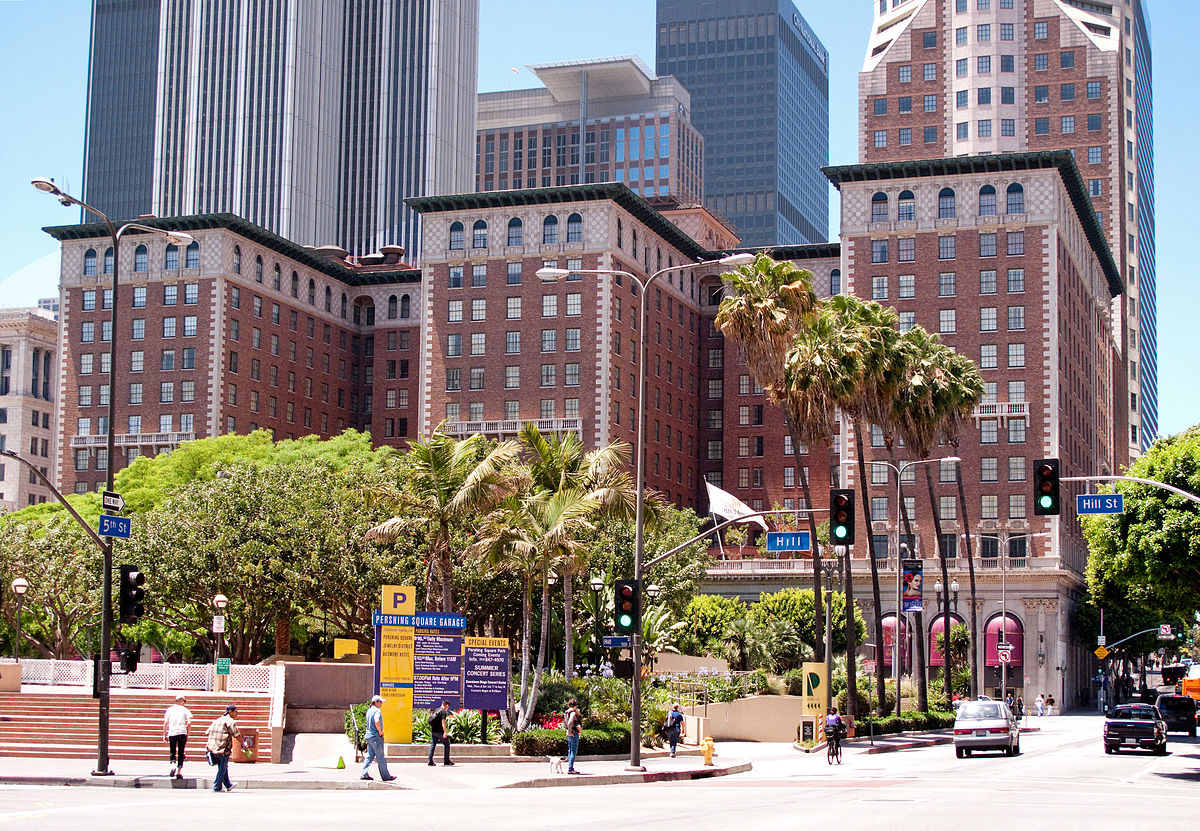
The Richard Riordan Central Library in Downtown Los Angeles

The entire quote is from Douglas Adams, author of The Hitchhiker’s Guide to the Galaxy: “This must be Thursday. I never could get the hang of Thursdays.” And that’s the way I felt when I was working full time in an accounting office. I never did get along very well with my boss (nobody could), so when he cut me back to two days a week, I saw that as an opportunity. I said, “Okay, I’ll work on Tuesdays and Fridays.” Those were days when our late tax manager worked, so my boss couldn’t use me as a highly unqualified tax manager, which he was not above doing.

One Thursday in June 2016, I took the Expo Line downtown and hung out at the Central Library on Fifth Street. Just by chance, I noticed that there was a regular Mindful Meditation session conducted by the UCLA Mindful Awareness Research Center (MARC), and I attended.  And I’ve been attending ever since. I read for a couple of hours in the Literature and Fiction Department on the top floor, and usually check out a couple of books. Then I go to Meeting Room A on the ground floor where the sessions are held.

In more ways than one, the Central Library has become a part of my life. I feel energized by these meditation sessions. Afterwards, I go for lunch either to the Grand Central Market on Hill Street, Little Tokyo, Chinatown, or Olvera Street. Then I take the Big Blue Bus R10 freeway flier back home.

So now I can say I get the hang of Thursdays. It’s one of my favorite days of the week. That leaves Mondays and Wednesdays for doctors’ appointments and miscellaneous explorations of this gigantic city of which I am becoming more of a part as time passes.


Alienation Effect

Rod Serling with Playhouse 90 Logo

Today was a strange day. It was beastly hot and humid, with a Mexican Monsoon effect. Having no air conditioning in our apartment—and living in an area that regularly gets hit by power blackouts—Martine and I decided to go to the Paley Center for Media in Beverly Hills.  The lobby was crowded with young tourist couples seeing the displays about American Horror Story, a series on FX with which I was previously unacquainted. These guys (and their women) were heavily tattooed, wore their baseball hats backwards, did not know to flush toilets, and led with their smart phones taking pictures of everything in sight.

I suddenly felt old. Here I was with a large group of young people that made me feel alienated. And here I was going to see a couple of Playhouse 90 episodes from 1959. I might has well have been talking in Armenian to a group of prairie dogs. Did I feel bad about that? In a way I did, though I would not have considered going far to seek common ground with them: The gulf between me and them yawned as big as the Grand Canyon.

But I felt delighted with the Playhouse 90 episodes I saw, shot in consecutive weeks. The first was “The Town That Turned to Dust,” written and introduced by Rod Serling and directed by John Frankenheimer. The story was about a lynching in a small Texas border town called Dempseyville of a Mexican youth who was accused by William Shatner, as the local dry goods merchant, of beating up his wife Fay Spain and robbing the store. The sheriff who is powerless to prevent the lynching is Rod Steiger, in a powerful role, with James Gregory as a visiting newspaperman.

The other was a dramatization of “The Great Gatsby” starring Robert Ryan as Gatsby and Jeanne Crain as Daisy May Buchanan. Rod Taylor was excellent as Nick Carraway. Rod Serling introduced the episode, which was directed by Franklin Schaffner.

Although I do not watch much (if any) current television, I have a great deal of love and respect for the early days of the medium. Back at the beginning, they not only knew how to produce superlative entertainment, but used people who knew how to act, not just nod their heads meaningfully.

Discovering the Long Scroll

Excerpt from the Long Scroll of Sesshū Tōyō

For the first time in my life, I away away from home, alone. I was seventeen years old when I found myself at Dartmouth College. The only person I knew from before was Frank Opaskar, with whom I had gone to Chanel High School in Bedford, Ohio. But I quickly found myself becoming estranged from Frank because of his anxiety about his complexion. I had the top bunk in our dorm room, and Frank insisted in smearing himself with Noxzema. Every night, I was wafted into sleep by the medicated stench of his facial preparation.

Naturally, I was desperate to lift my mind from the humdrum life of study and Noxzema. Fortunately, I found several ways of escape. One of them was art….

In my first year at Dartmouth, the Hopkins Center for the Arts opened. One of the first shows in the art gallery was of the Long Landscape Scroll by Sesshū Tōyō (1420-1506), a Zen Buddhist master whose art work made me feel at home. I don’t know why: I had had no previous exposure in my Catholic education to Zen ink and wash paintings of the Muromachi school.

But what I saw was magical. It was a landscape of mists and rocks and water in which pilgrims were trekking from one place to another. I loved it at once. Did I see a sudden paradigm of my own life, wrenched from a close Hungarian family into the wide world? I followed the scroll from left to right—not just once, but many times in numerous visits while the exhibit lasted.

If you want to see what I saw, you can see an image by clicking here. Scroll about a third of the way down and scroll slowly to the right. The image doesn’t allow you to get close, but you get the general idea. I bought a copy of the scroll from Tuttle, the Japanese-American publishing house then located in nearby Rutland, Vermont.

You can say it was Sesshū Tōyō  who introduced me to Zen Buddhism. It was a splendid introduction.

A Yankee Way of Knowledge?

Carlos Castaneda’s First Don Juan Book

In the 1970s I was heavily influenced by the works of Carlos Castaneda based on the teachings of a Yaqui shaman named Don Juan Matus. The first book, whose cover is shown above, hit me between the eyes. And for years afterwards, I was kept in a high state of excitation by the books that followed. Although I was deeply influenced by the teachings described by Castaneda, one thing I was not affected by was the taking of mescaline, which played a major part in the teachings.

At the time, I considered myself lucky to be alive. In 1966 I had major brain surgery (a pituitary tumor, or chromophobe adenoma); and I knew I had to take steroids as long as I lived, as my body no longer produced any. So taking mescaline, LSD, cocaine, psilocybin, opium, and what not were strictly out of the question. (I did, however, take marijuana socially, especially in the form of brownies—smoking always made me go into asthmatic spasms.) But, other than that damnable mescaline, the concepts that Castaneda came up with were so damned brilliant that I was in thrall.

This evening, I had an interesting conversation with my friend Peter about those days. It has been years since I even thought about Castaneda. Now I want to re-read his books, which I still have on my back shelves, just to reacquaint myself with the young man that was me some forty plus years ago.

Carlos was actually born in Cajamarca, Peru, and came to this country in the early 1950s, becoming a naturalized citizen in 1957. As critics started looking at his books as works of fiction, it became evident that he had done some cross-cultural comparisons. In place of the Amazonian tribes that take ayahuasca to produce visions, he set his works among the Yaqui Indians of Northern Mexico. Unfortunately, he used Spanish terms that were not common among the Yaqui, arousing suspicions.

There is an anecdote about a patient describing his life to a psychiatrist, who keeps nodding his head and saying, “That’s very interesting!” Finally, the patient gets angry and says, “Well, that’s all a pack of lies which I just made up. What do you think of that?” The psychiatrist does not miss a beat: “That’s even MORE interesting!” That, in the end, is my reaction to Castaneda. I think there are some fascinating truths to be found in his books, along with some things that were just made up.

I will return to the subject as I re-read his books.


My Periodicals

The New York Review of Books (Semi-Monthly)

There are four periodicals to which I subscribe which I actually read. They are, in descending order of importance to me:

  • The New York Review of Books, a semimonthly on politics with book and art reviews.
  • The New Yorker, a weekly that has seen better days, but still publishes at least one or two great essays a month.
  • Gilbert, the monthly publication of the American Chesterton Society.
  • Chess Life, a monthly which I scan and about which I entertain a pipe dream of being able to read with the attention it deserves.

The one that is probably least familiar to most readers is Gilbert. Each issue has a couple of rare essays by G. K. Chesterton and other articles on Catholicism and distributism, Chesterton’s pet economic policy that is described at length in several of his books.

A Recent Issue of Chess Life Featuring U.S. Grandmaster Hikaru Nakamura

I’ve always had this dream of being able to take the time to analyze grandmaster-level chess games intelligently. It takes intense work, and if in public, one is likely to be interrupted by someone who wants to play chess with you. (I would prefer to avoid playing chess with strangers—too much ego involved!)  I don’t actually want to be able to play chess well as much as I want to develop better analytical skills. At my age, I don’t think I can become a much better chess player than I already am, but it is fun to see the decision-making skills of people like Hikaru Nakamura. It’s actually more of an aesthetic impulse on my part.

I also have a library of books with annotated chess games by the great masters. Whether I will ever be able to spend any time doing this remains to be seen. Some people go for golf or fishing. Fior me, it’s chess.

The Past Recaptured?

Hungarian Stuffed Cabbage with Rye Bread and Sour Cream

I do not have anything to say about Proust in this posting. Maybe I should have called it “You Can’t Go Home Again” or some such title. My earliest memories are about being raised in a Hungarian household in Cleveland by loving parents. I could not, would not ever repudiate that part of me; and I keep going in search of experiences that, like Proust’s madeleine bring back the happy memories of my childhood.

There used to be some good Hungarian restaurants in Los Angeles; but, as big a city as this is, there do not appear to be any at this time. So Martine and I show up at the local Hungarian Reformed Churches for their festivals. I go to recover my memories, and Martine goes because (although she is French) she loves Hungarian food more than any other.

Despite a rare May rain shower, we went to the Majális festival at the Grace Hungarian Reformed Church in Reseda. We have been going here for almost ten years. Even within that short time, we have seen the parishioner base age as the old Hungarians die off and the younger ones spread out to the four winds. Still, the food is excellent. Their stuffed cabbage is superb, and their baked goods are world class.

The Grace Hungarian Reformed Church as It Looked Several Years Ago

Their pastor is still Zsolt Jakabffy, who keeps soldiering away at maintaining a parish amid the rapidly changing demographics of the San Fernando Valley.

Wait a minute! What’s a Catholic boy like me doing hanging out at a Protestant church? It all goes back to when my Catholic father and my Protestant Reformatus mother made before their children were born. Any boys would be brought up as Catholic; any girls, as Protestant. Just my mother’s luck that she gave birth to two sons.

So, yes, I have no compunction looking for God wherever He is invoked.


My Los Angeles

Tree on Ocean Avenue in Venice

I guess that by now I’m officially an Angeleno. It was late in December 1966 that I took a train to arrive at L.A.’s Union Station and was met by former neighbors from Cleveland, Ohio. It was the first time I had ever been west of Chicago, so all I saw was new to me. All that pastel stucco instead of the sooty red brick of Northeastern Ohio. The plants were all different. The climate was strange. Even the people were somewhat odd. Fortunately, I was rooming on Sunset Boulevard with a friend from Dartmouth College days, with whom I am still a close friend.

Mind you, I did not take to the place at once. For years, I thought of myself as an Easterner. It was only by slow degrees that the light of Southern California, with those beautiful sunsets over the Pacific, started to work a sea change in me. There were some things that repulsed me. Numero Uno: Earthquakes. The Sylmar quake of 1971 hurled me out of my bed and scared the stuffing out of me. Last night, while I was recording a Max Ophüls film—The Earrings of Madame de … (1953)—on videotape, I felt a sharp jolt. Even after all these years, I felt a moment of terror. Should I run for the bedroom hallway, where I would be safe from falling building parts? Should I just shrug my shoulders? I opted to go to bed.

Martine is even more nonchalant about temblors than I am—probably because she never felt one of the big ones, such as the ones in 1971 and 1994. Ah, well, she’ll learn!

I still don’t think much of L.A. drivers. They tend to be lazy about following the law, such as signalling lane changes and crashing red lights and stop signs. But then, it could be that way in most other big cities, too. I seem to remember not liking to drive in Miami, Calgary or Las Vegas either.

Some things I really like about Los Angeles are:

  • The food. California looks South (Latin America) and West (Asia) for its cuisine.
  • The politics. As a determined Trumpf-hater I feel in good company in this very Blue State.
  • The mountains. There are some mountains in Los Angeles County that are 10,000 feet high, a far cry flat flat Ohio.
  • The deserts. So we don’t get much rain, but the deserts of the Southwest are beautiful, so long as you don’t make the mistake of visiting them at the wrong time.
  • The coast. Driving along the Pacific can be gorgeous, especially in the early morning before the Beemer bozos get out of bed.

You’ll notice that I didn’t mention the weather. I’ve never liked really hot weather: And every year we get about 20 days of horrendously torrid weather. Fortunately, Martine and I live only two miles inland from the coast, so we can usually catch a few breezes, but not always.