Halloween vs Christmas

Display at the Grier Musser Museum

At first, Martine and I liked visiting the Grier Musser Museum because of the of the interesting holiday related displays. We still like the displays, but in the meantime, we have become friends with the owners, Rey and Susan Tejada. Re-visiting the museum and chatting with the Tejadas has become part of the fun surrounding holidays.

Speaking of holidays, it is becoming ever clearer to me that celebrating Halloween is becoming more of a thing, and that celebrating Christmas is becoming less of a thing. Perhaps because it is so associated with guilt trips: so many things that have to be done, some many unrealized goals that remain unrealized, so much expenditure of cash and effort.

Halloween, on the other hand, is cheaper and more fun. And it is not tinged with guilt. It involves pretending that you’re a ghastly monster (no difficulty for most people), attending fun events, and eating a ton of candy.

So even if we don’t get any trick-or-treaters this year (they don’t like climbing stairs), Martine and I feel good about Halloween. Martine got her annual pumpkin pie from Marie Callender’s, we stockpiled candy in case some trick-or-treaters do ascend the stairs, and I’ve read some good scary books this month.

Of course, coming up is my least favorite holiday. I really dislike Thanksgiving. And I’m not overly fond of the traditional food items associated with it.

In Hot Water

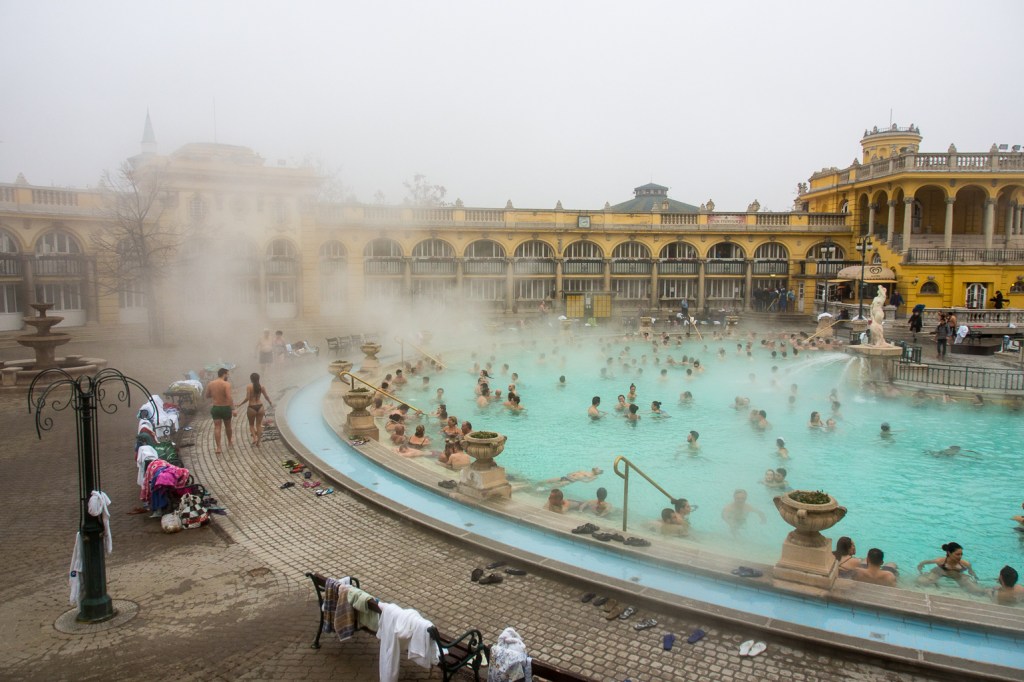
Széchenyi Baths in Budapest, Hungary

I’ve only been to Hungary once, back in 1977. One of my happiest times alone with my father was the two of us visiting Budapest’s Széchenyi (SAY-chen-yee) baths and chatting for hours in the thermal pools. Of course, an opportunity gained can also be an opportunity lost. During that time, my mother went back to Felcsut in the Fehérmegye countryside, where she was raised as a young girl on a farm by her grandparents. I never did get to see Felcsut.

Although I spent so little time in Hungary, I am proud to say that I still somehow bear inside of me the seed of the Magyar culture and language. When I was a little boy in Cleveland, television was just coming in; so, living in a Hungarian neighborhood, I was blissfully unaware that the English language even existed. Until I showed up for kindergarten classes at Harvey Rice Elementary School.

That set off a whole chain of events, from moving to the suburbs, even though my father always yearned to be back in the old Buckeye Road neighborhood, to my majoring in English at an Ivy League school. But that is another story.

On Being a Troglodyte

I am viewed by some of my acquaintances as something of a cave man, mainly because I do not own a smart phone. When I looked at the technology, I saw several major disadvantages right off:

  • Tiny screens and bad eyesight don’t go well together. I usually wear distance glasses, and I would have to do a quick switch to reading glasses to be able to discern the images and text clearly.
  • I actually have a flip phone which I use for special occasions, but I was disturbed by suddenly being inundated by calls in Mandarin Chinese.
  • Thanks mostly to the 2024 election, I am inundated with text messages begging for donations—with the result that my cell phone is mostly off and rarely travels with me. I find it onerous to manage a whole lot of text messages.
  • Driving around Los Angeles, I am disturbed by drivers who are still texting when traffic signals change to green.
  • At my supermarket, the parking lot is 30% occupied by men and women who are fingering their smart phones, making it hard for legitimate shoppers to park.

Several years ago, my friend Mohan offered to present me with a free smart phone and was shocked that I refused on the grounds that it would make my everyday life more stressed and worrisome in every way.

I might be a cave man, but if so, I am a happy one. There are too many things that I love and that do not require so radical a change of life as the care and feeding of a smart phone.

The Cleveland Indians

Cleveland Municipal Stadium in 1993

They’re no longer called the Cleveland Indians. Now they’re called the Guardians, Guardians of what, I don’t know. I guess because you’re not supposed to call your team the Indians because of cultural appropriation, whatever that is.. But they’ll always be the Indians to me. My fraught relationship with them continued from the late 1950s to the early 1960s, when I left Cleveland to go to college.

The Cleveland Press, the cities Hearst-owned afternoon newspaper, got the bright idea of giving all straight-A students in the city seven pairs of baseball tickets, mostly to ill-attended afternoon games. As I could reliably get top grades every year after fourth grade, I got a lot of chances to see the Indians lose to a lot of teams. Except for 1959, when they almost won the American League pennant, but lost out to the Al Lopez’s Chicago White Sox,

On the team were such players as Rocky Colavito, Jim Piersall, Minnie Minoso, George Strickland, and Woody Held. Pitchers included Herb Score (before his career stumbled after he got hit in the face with a baseball), Jim “Mudcat” Grant, and Cal McLish.

Usually I went to the games alone or with a school friend, because my father was working as a machine tool builder at Lees-Bradner and Company. I would hop on the 56A bus at East 177th and Harvard and get off at Proispect and Ontario downtown. From there, it was a five or six block walk to Cleveland Municipal Stadium, which, as I understand it, is no more.

Just like my grade school (Saint Henry) and high school (Chanel High), which also are no more. Much of my history has been effectively wiped clean in the evil days that befell Cleveland around that time.

It was difficult as a child to follow a baseball team that usually lagged in the standings. But then, who has a 100% winning record? No one.

Becoming a Techie

Logo of System Development Corporation

I came to Southern California to become a graduate student in film at UCLA. After my first year as a student, I needed an income, as my parents weren’t able to foot the bill for me much longer. In March 1968, I visited the job counseling center on campus and applied for a job at a Santa Monica tech company called System Development Corporation, or SDC.

The job was for an interesting project. The Air Force’s Advanced Research Projects Agency (ARPA) had funded SDC’s Lexicography and Discourse project. The work done previously was to key in the complete contents of two dictionaries—the Merriam-Webster Seventh Collegiate Dictionary and the Merriam-Webster Pocket Dictionary—onto paper tape. Included were definitions, pronunciations, and etymologies. The paper tape had been converted to IBM punch cards, which were printed out. The printouts of the two dictionaries was in two piles that ran floor to ceiling of the office I was to use.

Interestingly, my predecessor in the position was murdered by a UCLA graduate student from the film department. I never was to find out who did it.

For the next couple of years, I proofread the transcriptions of both dictionaries and made corrections to the data files, which resided on a military AN/FSQ-32 computer whose parts were encased in epoxy so as to be able to survive a nuclear attack. Unfortunately, it had a single I/O channel, so that if a large number of users were logged in, as was the usual case, simple transactions took forever on the computer’s primitive time-sharing system.

If you are interested in finding out more about the project, you can see the document that described the project: Two Dictionary Transcripts and Programs for Parsing Them. Volume I. The Encoding Scheme, PARSENT and CONIX by Richard Reichert, John Olney, and James Paris (that’s me). It is still available from the Defense Technical Information Center (DTIC).

Incidentally, ARPA also created the Internet. It was originally designed to allow for uninterrupted communications between two points when certain key cities in between were destroyed by nuclear bombs.

My Cities: Hanover, NH

Main Street, Hanover, New Hampshire

It was hardly a city. When I was attending Dartmouth College between 1962 and 1966, there were no traffic lights at any of the intersections. There were a few thousand people, most of whom were directly or indirectly connected with the college.

When my parents drove back to Cleveland, I found myself alone for the first time in my life. Actually, it didn’t bother me as I thought it would. It was probably because my father and mother were going through a rough patch in their marriage, and I didn’t want to be back home for that. And I wasn’t really alone, because my roommate Frank Opaskar was a classmate from my high school.

In the end, we didn’t get along too well—for a strange reason. He slathered Noxzema on his face every night before going to bed, and I had the top bunk over him. Every night I drifted off to sleep in a noisome chemical fog. After two years, we parted company and I got a solo room.

Winters in Hanover were long and cold. The snow, once it fell, lasted all winter. (I wonder if it still does, what with global warming.) By the time March came along, you could see where every dog in Hanover had urinated. Spring was the worst time, because all that snow turned to slush. It was not until May that we could walk on the grass without our shoes making a sucking sound.

The town itself had a much loved grocery store called Tanzi’s and a number of restaurants. Early on, I gave up on the college dining hall and patronized only the restaurants. Farther down the street were the Dartmouth Bookstore and the Nugget Movie Theater, where I spent great gobs of time.

I remember the meatballs and spaghetti at Lou’s Restaurant, those few times he offered it as a special. And I had a lot of pizzas at Minichiello’s. I remember the Mom and Pop cooks there trying to get me to give their cute but clearly wild daughter sage advice about life, when what I really wanted was to be wild with her. Nothing came of it because, alas, I had not yet reached the age of puberty because my pituitary gland was being eaten up by a tumor which was operated on three months after I graduated.

Martine Is Back!

UCLA Santa Monica Medical Center

After spending some five days in a hospital room, Martine was finally discharged today. She feels good, and there is no longer an issue with low sodium levels in the blood. The medical name for this is hyponatremia. According to the Mayo Clinic website, signs and symptoms can include:

  • Nausea and vomiting
  • Headache
  • Confusion *
  • Loss of energy, drowsiness and fatigue *
  • Restlessness and irritability *
  • Muscle weakness, spasms or cramps *
  • Seizures
  • Coma

On Tuesday, Martine was suffering from four of these (marked above with asterisks). In the hospital, she was immediately put on intravenous electrolytes which, over the space of two days, restored her condition to normal. Then she was kept on for observation for a couple more days to make sure her blood levels were normal.

What caused this? Martine thought it was that she accidentally took a second dose of Pilocarpine 2% ophthalmic solution for glaucoma two hours after taking a first dose. Although one physician I talked to in the emergency room said this couldn’t be the cause, the literature accompanying the drug indicated that it was indeed possible.

Whatever the cause, I am convinced that the treatment was correct.

The human body is a strange and wonderful thing, and doctors are not infallible. We tread a narrow path over two abysses. Thankfully, Martine is okay for now.

Hiatus

Martine at the Zimmerman Automobile Driving Museum

I have not posted any blogs during the last three days because Martine was hospitalized on Tuesday. By accident she took a second dose of powerful glaucoma eye drops instead of the medication she intended on taking. The result was weakness, dehydration, and a host of other symptoms that required an ambulance trip to the UCLA Santa Monica Hospital where blood tests revealed that the sodium levels in her blood were dangerously low.

For two days, Martine was literally non compos mentis—not in her right mind. On Tuesday night, as she was waiting in a temporary patient treatment area for a hospital bed to be assigned to her, she was shaking like a leaf and was barely able to recognize me.

When I returned home, I was shattered. Was this the beginning of something critical, or possibly fatal? On Wednesday, she was slightly better as the hospital worked at raising the sodium level in her blood. But she was still not quite right in her mind: She kept attempting to get up to go to the bathroom while multiple tubes were connected to her body. She kept insisting “This is a free country!”

In the end, a licensed vocational nurse was delegated to keep her safely in bed. I visited her twice, but she forgot that I was there. Fortunately, yesterday and today saw a return to the Martine I knew and loved. Essentially, she is still in the hospital mainly for observation to make sure that her blood work stabilizes.

At home, I was too upset to read or write; so I have just watched the Paris Olympics endlessly.

It looks as if Martine will probably be discharged tomorrow. I hope so: I desperately want to return to our normal lives.

Comprachicos

Conrad Veidt in Paul Leni’s Film The Man Who Laughs (1928)

It all started in the elevator to the Trader Joe parking lot. Two odd women first commented that I looked like the actor Wilford Brimley, and then asked me why I didn’t smile. That set me off: I don’t particularly like to go around with a smile on my face, and I don’t think much of people who do. Were these frustrated dental assistants to go around accosting strangers for not airing their teeth?

Then I thought of one reason I didn’t like being all smiley. I remembered Victor Hugo’s novel The Man Who Laughs (1869), which was turned into a 1928 silent film by Paul Leni starring Conrad Veidt, better known as Major Strasser “of the Third Reich” in the film Casablanca (1942).

Well, anyway, the novel and film were about people called comprachicos who, as children, were mutilated to look pathetic so that their handlers can could use them for begging:

The Comprachicos, or Comprapequefios, were a hideous and nondescript association of wanderers, famous in the 17th century, forgotten in the 18th, unheard of in the 19th. They traded in children, buying and selling them, but not stealing them. They made of these children monsters. The populace must needs laugh, and kings too. The montebank is wanted in the street, the jester at the Louvre; the one is called a clown, the other a fool. By the artificial production of teratological cases the Comprachicos developed a science and practiced an art. They kneaded the features, stunted growth, and fashioned hunchbacks and dwarfs; the court fool was their specialty.

The Conrad Veidt character in the film was a child who was kidnapped and had a permanent smile carved on his face, which made him look pathetic. And that’s what comes to mind when people tell me to smile. I just don’t care to oblige them.

Wilford Brimley (1934-2020)

By the way, I look almost exactly like Wilford Brimley, except that his mustache was a little bigger than mine. Of course, I would prefer that strangers think I am a dead ringer for Brad Pitt, Robert Redford, Warren Beatty, or some other dolicocephalic heartthrob. But then, so it goes.

On Being a Slave to Technology

Something happened to me as I approached retirement age. I mean besides getting old. What I mean is that I began to feel highly critical about several technologies that were beginning to assume a dominant position in our society.

Touch Screen

Although I use an Amazon Kindle to read several books a month, I do not like the imprecision of touch screen interfaces—especially when I have to enter data without a large-sized keyboard. I do not have fingers that measure five millimeters across, so an onscreen keyboard is as difficult for me as using tweezers to move an anvil.

Smartphones

In addition to my dislike of touch screen interfaces, I find smartphones irritating in the extreme. I have a flip cellphone, but I don’t carry it around with me everywhere I go. For one thing, I will not answer the phone while driving, as I wish to continue living and operating an unwrecked car. My cellphone is for outcalling only, except by prior arrangement. Most of the time, it is powered off and sits comfortably on my computer desk.

The other thing is that I already have to carry around a number of things in my pockets:

  • An eyeglass case with reading glasses
  • A ballpoint pen
  • My wallet
  • My keys
  • Change for parking meters
  • Selected medications, including insulin for diabetes

E-Scooters

Why was this ever invented? I have already seen a half dozen nasty accidents involving e-scooters. And besides, I’ve always thought people looked silly operating them.

Artificial Intelligence (AI)

I know that we are living in a world where artificial intelligence is regarded as the coming thing. In my opinion, AI is a way of sacrificing truth for convenience. Please accept my assurance that I do not use AI in producing my blog posts. We have enough half truths and lies all around us without my adding any more to the mix.

GPS

Here I admit I’m on shaky ground. I do not have any GPS device in my car because I do not like to be distracted while driving. Also, I am still a bit skeptical about their accuracy, particularly while traveling in foreign countries. I suppose that for people who don’t know where they’re going, GPS can be a blessing of sorts.

The nice thing about being my age is that I can pick and choose which technologies to adopt. I do not have to turn myself into a rabid fanboy because Apple or some other tech giant is releasing a new product. I believe it was Alexander Pope who wrote the following couplet:

Be not the first by which the new are tried
Nor yet the last to lay the old aside.