Desert Interlude

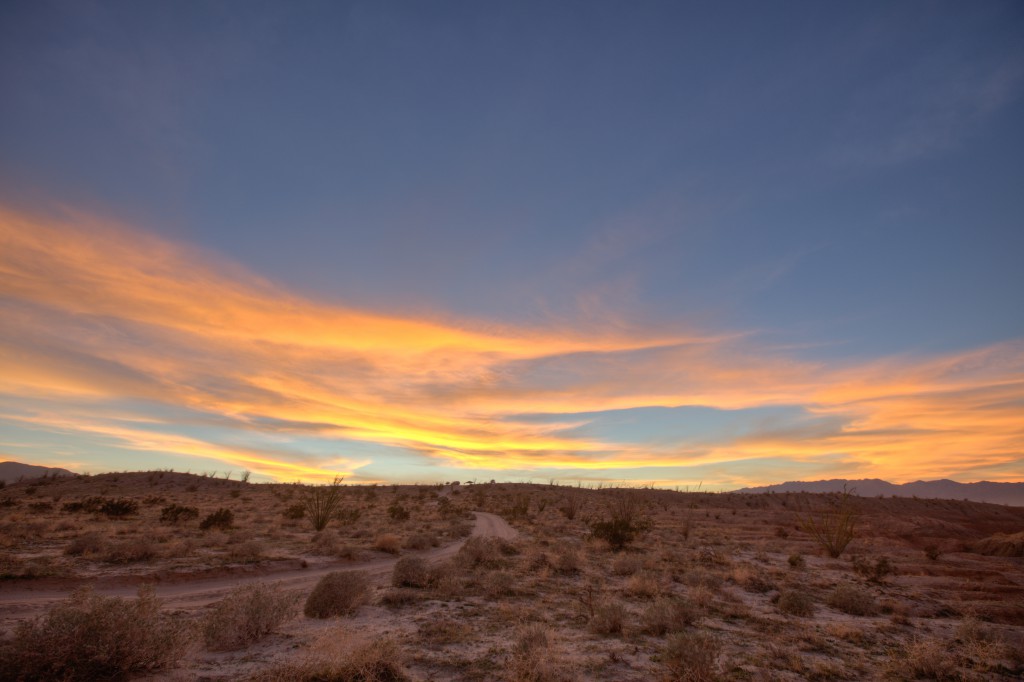
Sunset in the Anza-Borrego Desert

Sunset in the Anza-Borrego Desert

Before tax season gets too intense, Martine and I will spend a four-day weekend in Southern California’s Anza-Borrego Desert. Occupying the eastern third of San Diego County and stretching roughly from just south of Mount San Jacinto to the Mexican Border, the Anza-Borrego Desert State Park is the largest state park in the United States, and also one of the least known. And, for all its desolation, it is a place of surpassing beauty. Here one can actually sees stars at night—by the million.

If one goes at the right time of year, the desert can be a healing place. What is the right time of year? I would say from late October to late May. During the summer, temperatures can rise to 130 degrees Fahrenheit (or 54.5 degrees Celsius). Only emergency workers and German tourists try to brave the blast furnace heat of a desert summer.

As I do not have a notebook computer (nor do I want access to one at this time), I will not be blogging again until Sunday or Monday.


Zsofi Sebek Returns to Cleveland

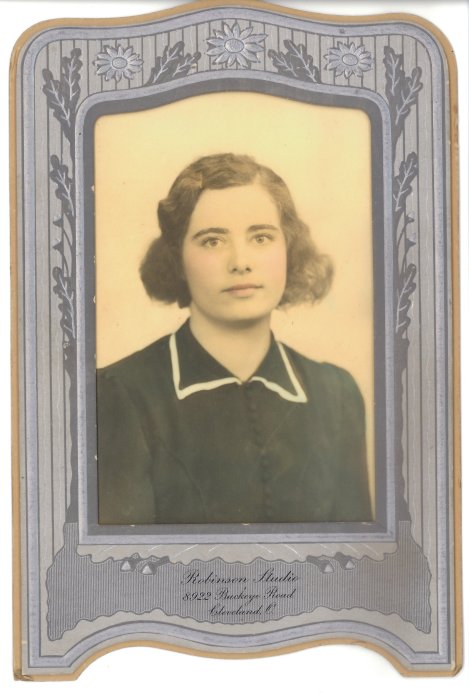
My Mother Before She Married

My Mother Before She Married

My mother was actually born in Cleveland, Ohio, but was raised by her grandparents, Daniel and Lidia Toth. Her own mother and father were too feckless to be trusted with the care of a child, and the mother eventually became an alcoholic and ended up at the State Mental Hospital in Pontiac, Michigan. Daniel and Lidia decided that it would be best to bring up their little Zsofi in the Old Country, so they went back to their little farmstead in Felcsut, just southwest of Budapest.

It was not until 1937, when Zsofi was nineteen, that the three returned to Cleveland. Hitler was threatening, and Austria had already fallen. So the Toths and Zsofi sailed on the Queen Mary from Cherbourg to Southampton, England, and from thence to New York. Below is the cover of the passenger list for that sailing:

The Title Page of the Passenger List

The Title Page of the Passenger List

And here, below, is my mother’s name on the passenger list:

Not Quite Spelled Right

Not Quite Spelled Right

The Cunard Lines people who signed her in misspelled her name, as if she were German. In Hungarian, the letter “s” by itself is pronounced as if it were “sh” or “sch” if you’re of the German persuasion.

One would think that my Mom was able to hit the ground running, inasmuch as she was born here. Not quite. She didn’t speak a word of English, and neither did my great grandparents Daniel and Lidia. She had to work as a maid and take night school classes in English before she was able to get hired for a better job. Years later, Mom got a professional certification by a humorous white lie on her application. When asked about her college education, she penciled in, “University of Hakapeszik.” That’s Magyar for “School of Hard Knocks.” P.S.: She got the job.

Osagyefo

O Brave New World!

O Brave New World!!

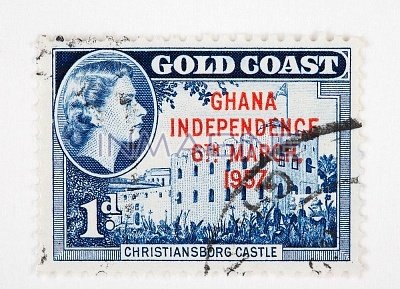
Like many American boys at the time, I was a “serious” stamp collector. The quotes are because I was enthusiastic, but I probably had nothing in my collection worth more than eighty cents. I remember going to a stamp show at one of the downtown Cleveland hotels where the big event was the release of stamps from a newly independent African country. The former Gold Coast was now Ghana.

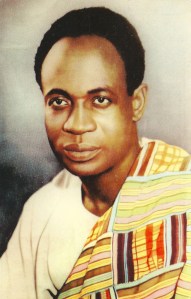
There were already several independent nations which had shed their colonial mantles by that time, including Egypt and Sudan. But that was “before my time.” I was frantic to find everything I could about the new nation, with its heroic leader, Kwame Nkrumah, who called himself the “Osagyefo” (see below).. In English, that meant “The Redeemer.”

Kwame Knrumah, the Osagyefo

Kwame Knrumah, the Osagyefo

I had been someone weary of all the British colonial stamps with their profile of Queen Elizabeth II, who at that time was certainly the cutest monarch with which I was acquainted, but I was ready for some novelty.

It didn’t take long for me to be disabused of the Osagyefo. Right around then, Egypt’s Gamel Abdel Nasser tried to rally the leaders of independent (and, presumably, soon to be independent) states to join his movement of non-aligned countries. As Nasser himself was leaning more and more toward the Communists (Oh Horrors!), it wasn’t long before I began to see him as a fellow traveler. Sure enough, after roiling the waters of West Africa for a few years with his increasingly authoritarian rule, he ended up in Romania, where he died in 1972.

Ghana was just the beginning of a rush to independence of former British colonies. After disillusionment with Nkrumah I became a bit more leery about wishing them well. But then I was only a twelve-year-old stamp collector. What did I know?


A Thai Christmas

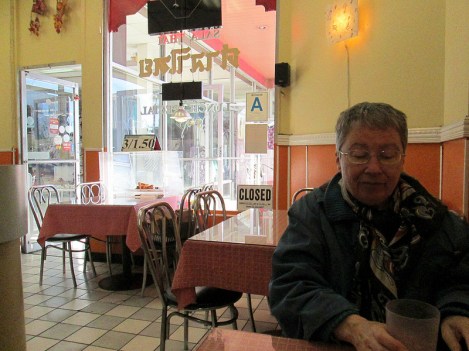
Martine at the Sala Thai in Chinatown

Martine at the Sala Thai in Chinatown

I had forgotten all about this photo. Although I cook four or five days a week, we didn’t have anything in the refrigerator on Christmas Day, so we had to go out to eat. Now on that Holiest of Holidays, most restaurants of the Euro-American variety are shut tight; so I suggested that we go to Chinatown, where we were sure to find some good restaurants that were open. (It kind of reminds me of that last scene in The Christmas Story, when the whole family goes out to have Peking Duck after the Bumpus’s dogs had demolished their dinner.) Martine and I have always been partial to a little Thai restaurant called the Sala Thai at the corner of Alpine and New High Streets. It is one of the rare Chinatown restaurants that sports an “A” health department inspection rating (see above). Once you step inside, though, it feels as if you were on a side street in Bangkok.

Fortunately, it was open. So while Martine has a chicken pad see ew with broccoli, I had some spicy fish filet with veggies. It was not quite what one thinks about for a holiday dinner, but it was good. Afterwards, we strolled through several souvenir shops and Chinese bakeries in the Chungking Plaza area.

That evening, we also had an interesting dinner experience. The only place we could find open was a Denny’s in Santa Monica. There was a long line—about three quarters of an hour—before we were seated. Apparently, both the waitstaff and the kitchen were short-handed, not having anticipated a high demand for their food on Christmas Day.

I was ready for New Year’s Day. I had cooked a big pot of a vegetarian curry for the week. It was Monica Dutt’s recipe for Gobi Alu aur Matar ki Tarkari, or, as it is also known, Curried Cauliflower, Potatoes, and Green Peas. I had bought some delicious (and spicy) tomato chutney and garlic pickle at India Sweets and Spices in Culver City the Saturday before, and added it to make a delicious entrée. The recipe can be found on page 126 of The Art of Indian Cooking (if you can find a copy of this now rare item).


Auld Lang Whatever

Time to Change Your Calendar

Time to Change Your Calendar

In the accounting profession, we are apt to view New Years Day with a jaundiced eye. It is the beginning of the 100-day Bataan death march that is tax season. For a while, we will have weekends. Then, at some point in February, we begin to work Saturdays. In March, Sundays are also added. That is in a high-rise building with no weekend air-conditioning, unless we pay for it. To add insult to injury, the two national holidays during this period—Martin Luther King Day and Presidents’ Day—are just two more workdays. (The company makes up the time lost later.)

Every year, our clients tend to be later and later in supplying us the information we need to file the returns, and gradually increasing pressure is applied between February 1 and April 15, until the last week is a nightmare of running around, making last-minute changes, and printing numerous copies of multiple hundred page returns.

Not a pleasant prospect.

So, auld lang whatever. Put up a new calendar, start paring away at your social life (such as it is), be sure to get some exercise, and read some good books.

Tarnmoor’s ABCs: Automobile

Me and My Nissan

Me and My Nissan


I was very impressed by Czeslaw Milosz’s book Milosz’s ABC’s. There, in the form of a brief and alphabetically-ordered personal encyclopedia, was the story of the life of a Nobel Prize winning poet, of the people, places, and things that meant the most to him. Because his origins were so far away (Lithuania and Poland) and so long ago (1920s and 1930s), there were relatively few entries that resonated personally with me. Except it was sad to see so many fascinating people who, unknown today, died during the war under unknown circumstances.

This blog entry is my own humble attempt to imitate a writer whom I have read on and off for thirty years without having sated my curiosity. Consequently, over the next few months, you will see a number of postings under the rubric “Tarnmoor’s ABCs” that will attempt to do for my life what Milosz accomplished for his. I don’t guarantee that I will use up all 26 letters of the alphabet, but I’ll do my best. This is a reprint from a Blog.Com posting from 2009, but I had to give it up at that time. This time, I will try to complete my alphabet.

For starters, here is Milosz’s take on a thing that has also assumed some importance in my life: the automobile:

Surely the automobile was invented in order to make a mockery of those pessimists who predicted that the number of horses would grow exponentially and that cities would choke to death from the stench of horse excrement. From Kiejdany county, in which there was a single automobile (Count Zabiello’s), I was catapulted into California [Milosz taught at Berkeley], where the automobile is just the same as electricity and bathrooms. I am not nostalgic for the good old days. I lived amidst filth and stench without being aware of it. And I belonged to the so-called upper social strata. The Wilno [today’s Vilnius] of my school years had cobblestone streets and only a couple of neighborhoods had sewers. One can imagine the mountains of garbage and excrement in Wilno during the Romantic era. It would be worthwhile to describe the female readers of La Nouvelle Héloïse [an influential work by Rousseau] not from above, but from below: f\rom the perspective of their chamber pots (where were they emptied?), their underpants (they didn’t wear any), and their gymnastic contortions while washing.

Now I rather doubt that most environmentalists would consider some of these factors when they rue the effect of the automobile on our civilization. No doubt, the internal combustion engine is both a boon and a bane to us, as the mercury in our thermometers creeps up from year to year. Here we are, thinking we have broken the Earth—at least until another Krakatoa-style volcanic explosion or major meteor or asteroid strike shows us the real face of catastrophe.

I, on the other hand, would like to talk about the automobile from another point of view. I came to it rather late in my life. As I have written earlier, I had a pituitary tumor in my youth that has had repercussions on my health extending to the present. Starting in the 1970s, I had to take a blood pressure medication called Catapres that resulted in a narcoleptic response every time I traveled in a car or bus. I had to postpone driving for many years, at least until a more efficacious medication was found.

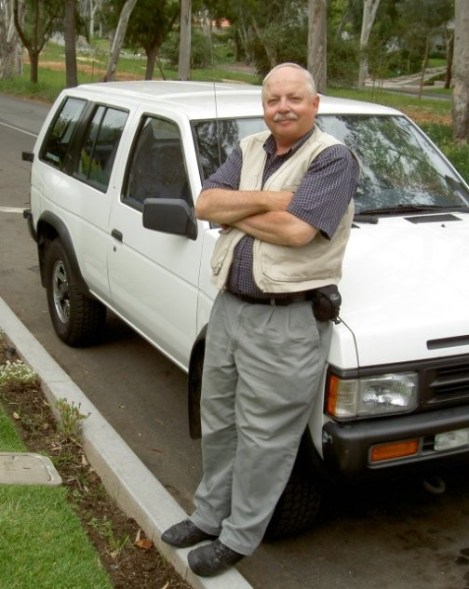
Then, in 1985, at the age of forty, I finally got my drivers license and purchased a four-cylinder Mitsubishi Montero, which lasted for ten years. Then I bought the 1994 Nissan Pathfinder (see photo above) which I am still driving today. I am like Yeats’s Irish airman for whom “a lonely impulse of delight drove to this tumult in the clouds.”

No one loves heavy traffic. Southern California is, unfortunately, a cacopolis with regards to driving. Ah, but then there is nothing like setting off at 4:00 am, before the first hint of sunrise, and dashing through the empty freeways of Los Angeles to the deserts of the Southwest or along the coast to the beauties of the Central Coast and points north. When I can choose my time, driving is sheer pleasure.

That’s why I think that the next step for mankind is not the bus and the bicycle, but another type of vehicle powered by a different source of energy. When it does not become a nightmarish experience, as it so often does, driving could be one of the great pleasures of life.
“Little Jimmy Drew This”

I Was Always Into Drawing Castles in the Air

I Was Always Into Drawing Castles in the Air

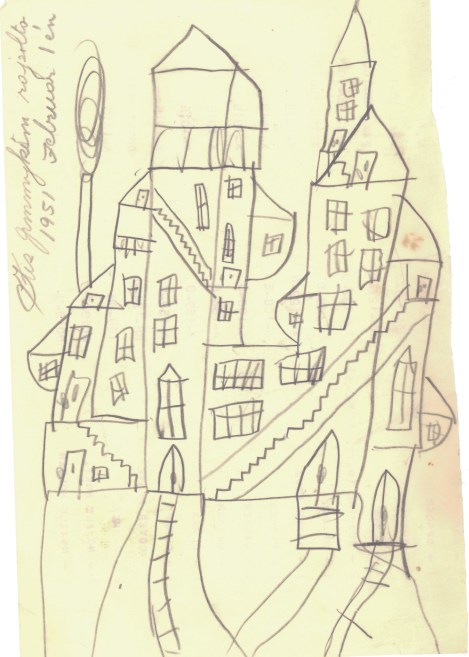
When my mother died in August 1998, I spent a whole day going through old photographs and other memorabilia relating to Mom, Dad, my brother, and myself. In the end, I think I barely scratched the surface; but I was not able to spend more time at the task. One of the things I rescued from the trash was this drawing of a castle I made at the age of six.

In the upper left-hand corner, Mom wrote in Hungarian, “Little Jimmy drew this 1951 February 1.” At the time, she was pregnant with my brother Dan, who was born on April 5. We were living at 2814 East 120th Street in the Buckeye Road Hungarian neighborhood on Cleveland’s East Side. Already, I had gotten into trouble at school for not speaking English, so by this time my Dad was probably looking into getting a house in the suburbs so that I could become a regular Americano.

What does this drawing say about me? If I were a psychologist, no doubt it would speak volumes. I always had grandiose visions which were fueled by the stories my Mom told me, either of her own invention or from children’s books she took out of the library next to my school (Harvey Rice Elementary) on East 116th Street. According to one website about interpreting children’s drawings:

Children who draw fortresses or castles want to communicate their feelings of power and richness. But they may also be creative kids who love to create imaginary friends with whom they have long conversations or games. These children are full of fantasy and creativity but they generally have problems at school because they get easily immersed in their imaginary worlds.

That sounds about right to me, actually. Thanks to my Mom, mine was a richly imaginative world. Perhaps that’s why I write these blogs. I want to share my imagination with the world, or at least a small corner of it.

A Merry Christmas to All

Wreath at Grier Musser Museum

Wreath at Grier Musser Museum

A Merry Christmas to all who happen on this website today! Although Southern California is bright and sunny today, with the temperature expected to reach record highs, I know that much of the country is mired in stormy weather. Regardless of the weather, may today be an oasis of peace and happiness for you and everyone you know.


Christmas in Cleveland

Me at the Age of Ten (or Thereabouts)

Double Trouble

Here I am at the age of ten or thereabouts. At the time, I was a student at St. Henry’s School on Harvard Avenue in Cleveland. My enjoyment of Christmas at the time depended on whether the people buying me gifts wanted to please my parents—or whether they wanted to please me. I remember asking my Mom’s friend Edith Antal to buy me comic books instead of clothes, which she graciously (and I think gratefully because of the price) did. Some people, such as my maiden Aunt Margaret—we called her Nana—bought me clothes all the time. Best of all was my Uncle Emil, who would give me a twenty-dollar bill. After being sworn to buy something useful, like clothes, I would gleefully buy something I wanted instead.

We would spend every Christmas Eve at my Uncle’s house in Novelty, Ohio. My Dad and my uncle, being identical twins, were inseparable. It was a long ride down Kinsman Road to Route 306 in Geauga County, where we would take a left and then a right on Marden Drive. There my Uncle Emil had a ranch house which he designed himself. I remember a long dark corridor leading to the bedrooms. There we all were: My Mom and Dad, Uncle Emil, Aunt Annabelle, Nana, and my cousins Peggy and Butch. While the adults talked about things that were of little interest to me, my cousins and I would shoot pool in the basement.

Ohio Route 306

Ohio Route 306

Then we would go up for dinner, which was never as good as what we got at home: Aunt Annabelle always preferred convenience to quality. Then we would exchange gifts in the living room. As long as I got my twenty, I was happy. When the gifts were all clothing, I was miserable. In any case, I was usually in pain by that time because of my allergies. My uncle had a cat and dog to which I reacted violently. I would sneeze and develop an asthmatic wheeze, while my eyes itched and watered.

This whole thing was re-enacted so often that I never really had any great expectations of Christmas as a holiday. My Uncle never came over to our house on East 176th Street because he was the wealthier of the two brothers, being the owner of the Metal Craft Spinning Company in the Flats downtown, and rather liked playing the baronial lord and master. It was all right, because I liked my uncle. He was often funny, while my Dad took things too seriously. The sad thing was that, being twins, they died within months of each other in 1985-86 of the same medical conditions.


Cellphone Hell Is … Other People

Another Technical Innovation That Has Overstayed Its Welcome

Another Technical Innovation That Has Overstayed Its Welcome

We’ve all seen it. That shit-eating grin and the walkie-talkie walk that says, “I have somebody with whom to carry on a meaningless conversation—and you don’t!” And now the FAA and FCC have okayed the use of mobile phones on planes. Is this a good thing? For every call that actually has to be made, there will be half a thousand stating “We’re in the air over Kansas right now” and “We’ve just landed at ORD and are taxiing to our gate.”

Then there will be the fake business calls just to make the caller look important. I can just imagine the guy at the other end, “What are you saying, Jason? You don’t own any stock, and last I heard you were in bankruptcy proceedings.” Of course, we never hear the tired, slighty pissed off voice at the other end of the line, just the mock triumphalism of the caller.

There are several ways of fighting these self-important a-holes who force you to listed to their bloviating:

  1. Sneeze all over them without covering your mouth.
  2. Spill part of your drink on them and offer to pay their dry-cleaning bill, giving them a false name, address, and telephone number.
  3. Read out loud from your book, making occasional significant gestures in their direction, as if it were all for their benefit.

In the end, I suspect this will not become a major problem, if only because most people are virulently against it. In today’s news, two airlines have come out against allowing cell calls on flights: Delta and JetBlue. If any other airlines join them, I may well vote with my feet, choosing only airlines that place restrictions on the nefarious habit.

It would be nice we could do something about that other noise-making nuisance on long flights: crying babies and whining small children. But on humanitarian grounds, I think I’ll just shut up for now.