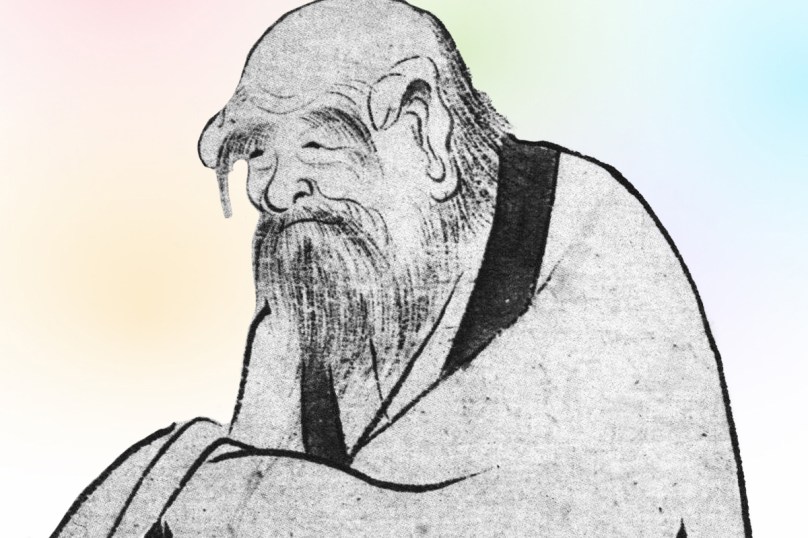
Chuang Tzu and the Butterfly

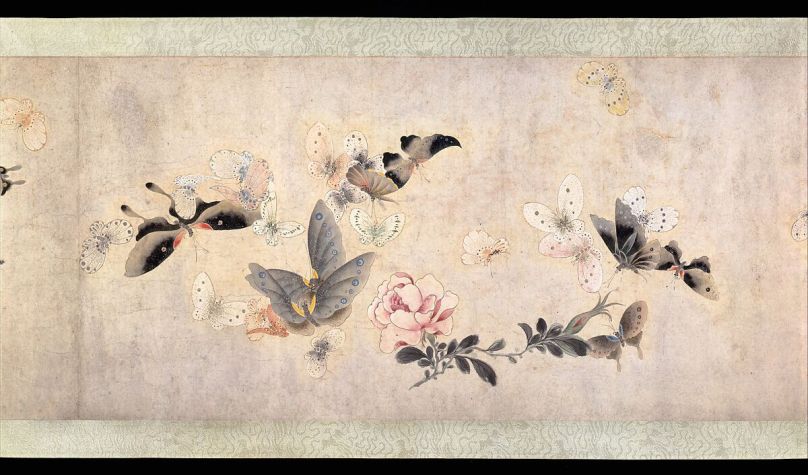
The two greatest poets of T’ang China were Tu Fu (712-770 CE) and Li Po (701-762 CE). The following poem by Li Po is one of the most profound he ever wrote. The Chuang Tzu (4th century BCE) referred to was the Taoist philosopher and follower of Lao Tzu. Forget all this detail: The following poem speaks for itself.

Chuang Tzu and the Butterfly

Chuang Tzu in dream became a butterfly,
And the butterfly became Chuang Tzu at waking.
Which was the real—the butterfly or the man ?
Who can tell the end of the endless changes of things?
The water that flows into the depth of the distant sea
Returns anon to the shallows of a transparent stream.
The man, raising melons outside the green gate of the city,
Was once the Prince of the East Hill.
So must rank and riches vanish.
You know it, still you toil and toil,—what for?

Mexican Rules

Benito Juarez Airport in Mexico City

I was reading Oliver Sacks’s Oaxaca Journal—a book I do not recommend you read unless you are a botanist—when I came across this passage which reminded me of past trips to Mexico:

“What gate do we go from?” everyone is asking. “It’s Gate 10,” someone says. “They told me it was Gate 10.”

“It’s Gate 3,” someone else says, “It’s up there on the board, Gate 3.” Yet another person has been told we are leaving from Gate 5. I have an odd feeling that the gate number is still, at this point, indeterminate. One thought is that there are only rumors of gate numbers until, at a critical point, one number wins. Or that the gate is indeterminable in a Heisenbergian sense, only becoming determinate at the final moment (which, if I have the right phrase, “collapses the wave function”). Or that the plane, or its probability, leaves from several gates simultaneously, pursuing all possible paths to Oaxaca..

. . . . . . . . . . . . . . . . . . . . . . . . . . . . . . . . . .

This reminds me of a trip my brother and I took to Mexico in 1979. We flew into Mexico’s Benito Juarez Airport and were to take a connecting flight to the misnamed city of Villahermosa. Not only was the gate uncertain, not only was the time uncertain, but whether the flight would take place at all was uncertain. (You can read more about it here.) This was a interesting lesson in traveling under Mexican rules.

This was no longer the precise Anglo-Saxon world we had just left behind. There was uncertainty everywhere. If you let it bother you, you will mot enjoy your vacation. If, on the other hand, you take it as a “Heisenbergian” event and hang in there to see how it all sorts out, you not only win but you learn an interesting lesson that, in the end, you can take back home with you.

Lessons from a Spider

Orb Weaver Spider in Its Web

Probably the most famous lesson learned from a spider weaving its web is of Robert the Bruce, King of Scotland, who, hidden in a cave, marveled at a spider’s persistence in completing its web. Supposedly, it inspired him to attack the English at Bannockburn in 1314 and win a decisive victory. American naturalist Loren Eiseley learned a very different lesson watching an orb spider weaving its web. The following quote comes from his collection of essays entitled The Unexpected Universe.

For example, I once received an unexpected lesson from a spider.

It happened far away on a rainy morning in the West. I had come up a long gulch looking for fossils, and there, just at eye level, lurked a huge yellow-and-black orb spider, whose web was moored to the tall spears of buffalo grass at the edge of the arroyo. It was her universe, and her senses did not extend beyond the lines and spokes of the great wheel she inhabited. Her extended claws could feel every vibration throughout that delicate structure. She knew the tug of wind, the fall of a raindrop, the flutter of a trapped moth’s wing. Down one spoke of the web ran a stout ribbon of gossamer on which she could hurry out to investigate her prey.

Curious, I took a pencil from my pocket and touched a strand of the web. Immediately there was a response. The web, plucked by its menacing occupant, began to vibrate until it was a blur. Anything that had brushed claw or wing against that amazing snare would be thoroughly entrapped. As the vibrations slowed, I could see the owner fingering her guidelines for signs of struggle. A pencil point was an intrusion into this universe for which no precedent existed. Spider was circumscribed by spider ideas; its universe was spider universe. All outside was irrational, extraneous, at best, raw material for spider. As I proceeded on my way along the gully, like a vast impossible shadow, I realized that in the world of spider I did not exist…..

I began to see that among the many universes in which the world of living creatures existed, some were large, some small, but that all, including man’s, were in some way limited or finite. We were creatures of many different dimensions passing through each other’s lives like ghosts through doors.

The Real Thing

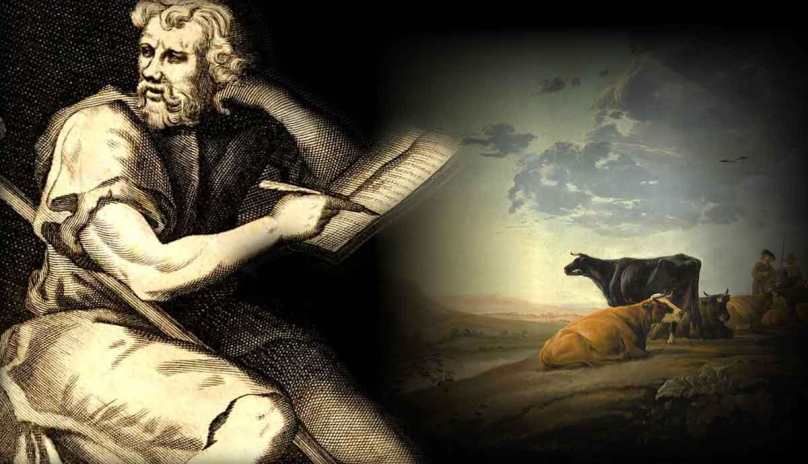
Roman Slave Turned Philosopher Epictetus

In my previous post, I mentioned three Roman Stoic philosophers. One of them was Epictetus (50-135 AD). Here are the opening paragraphs to his most famous work, The Enchiridion:

There are things which are within our power, and there are things which are beyond our power. Within our power are opinion, aim, desire, aversion, and, in one word, whatever affairs are our own. Beyond our power are body, property, reputation, office, and, in one word, whatever are not properly our own affairs.

Now the things within our power are by nature free, unrestricted, unhindered; but those beyond our power are weak, dependent, restricted, alien. Remember, then, that if you attribute freedom to things by nature dependent and take what belongs to others for your own, you will be hindered, you will lament, you will be disturbed, you will find fault both with gods and men. But if you take for your own only that which is your own and view what belongs to others just as it really is, then no one will ever compel you, no one will restrict you; you will find fault with no one, you will accuse no one, you will do nothing against your will; no one will hurt you, you will not have an enemy, nor will you suffer any harm.

Aiming, therefore, at such great things, remember that you must not allow yourself any inclination, however slight, toward the attainment of the others; but that you must entirely quit some of them, and for the present postpone the rest. But if you would have these, and possess power and wealth likewise, you may miss the latter in seeking the former; and you will certainly fail of that by which alone happiness and freedom are procured.

Seek at once, therefore, to be able to say to every unpleasing semblance, “You are but a semblance and by no means the real thing.” And then examine it by those rules which you have; and first and chiefly by this: whether it concerns the things which are within our own power or those which are not; and if it concerns anything beyond our power, be prepared to say that it is nothing to you.

Philosophy for Whom?

The Emperor Marcus Aurelius (121-180 AD)

Ever since I was a high school student, I pictured myself as studying philosophy and thereby improving my life. Very early on, I learned that most philosophers were too abstruse for the likes of me. I ran up against the likes of Kant, Heidegger, Sartre, Wittgenstein, and Hegel—and found myself considerably less smart than I thought. (However, I liked Sartre’s fiction and plays).

Recently I found myself drawn to the philosophers of ancient Greece and Rome. Now it seems that philosophy is several removes from everyday life. Read A. J. Ayer and Wittgenstein, and you’ll have no idea how to live your life. But read the ancient Stoics, and you can indeed feel better about your life.

Particularly interesting are the following Roman philosophers:

  • Lucius Annaeus Seneca (4 BC to 65 AD) practically ran the Roman Empire while he helped to educate the young Nero. Unfortunately, his pupil did not turn out well; and Nero ordered his tutor to commit suicide. Read in particular his Letters of a Stoic.
  • Epictetus (50-135 AD) was a former slave who wrote a very readable treatise entitled The Enchiridion.
  • Marcus Aurelius (121-180 AD) was the last of the benevolent Antonine emperors. (As great a philosopher as the father was, his son Commodus was one of the worst emperors.) The Meditations are a highly readable journal of Marcus Aurelius’s thoughts while ruling a large part of the known world.

The amazing thing about the works of these Stoic philosophers is that they are relevant and highly readable today. Much more so than most of the present day philosophers.

13 Principles for 2025

I don’t usually post to this blog from e-mails I have received. Today is an exception. The e-mail is from Ragnar Tómas Hallgrimsson, a journalist writing for The Iceland Review. In it, he writes:

The end of the year is a time to reflect: to weigh what went well over the past 12 months – and what went poorly, and to revise one’s rules for life. In the spirit of the season, here is an updated list of my principles. (In case you need ideas.)

What are your principles?

1 Begin each day with the thought: “What if this was the last time …?”

A cliché to be sure, but the additional caveat from thinker Sam Harris: “because one day it will be,” adds a measure of urgency. What if this really was your final ride down the stream of consciousness (with the people whom you love most?) How would you spend it?

2 You can work on a problem – but you cannot worry about it.

Worrying is the most useless “implement” in the toolbox of man. When confronted with a difficult problem, break it down into small, manageable steps – and then schedule those steps for tomorrow.

3 Every misfortune must be conceived of as an opportunity.

Arguably the hardest principle to follow. How in the world is one supposed to reframe an unexpected traffic jam as a brilliantly disguised opportunity?

4 Keep a record of your days and thoughts with a diary.

Even the mind, with all its stubborn complacency, will be forced to reckon with its mistakes and bad habits when confronted with them daily in written form.

5 If something upsets you, set a stopwatch for 24 hours.

Negative thoughts are like trains: once they start rolling, they’re harder and harder to stop – even if they have no basis in reality. One becomes irritated by a person, starts justifying that irritation, and keeps layering on arguments. If one makes the mistake of voicing these thoughts while the narrative train is at full speed, one usually regrets it.

6 Exercise every day, or, at least every other day.

Good physical health provides a solid foundation for good mental health. Negative emotions are like unfaltering assassins – but a moving target is hard to hit.

7 Put your stamp on all things.

People only remember the things you did YOUR way.

8 Music, every day.

Nothing teases out the important emotions like music, which is stoicism’s twin sibling. Stoicism mitigates and reframes difficult but unwanted emotions; music strengthens desired but muted emotions.

9 Be slow to anger, quick to forgive.

Being upset with people who behave irrationally or inconsiderately is futile. Their behaviour harms them most of all. If people were capable of better behaviour, they’d act better.

10 Be honest, speak plainly, and, for God’s sake – avoid emojis.

Emojis are the hieroglyphics of a civilisation in decline.

11 Restore balance to that which you offset.

Strive to leave the world in a better place than you found it. No matter which corner of the world you currently occupy.

12 There is but one law: be better than you were yesterday.

In the immortal words of Barack Obama: “Better is good,” and you can’t judge better without measurement (“if you can’t measure it, you can’t improve it”). Work hard.

13 Work is a means of coping – nothing more.

Life’s about coexisting with problems: doing just enough each day to keep them at bay. The game is lost when you start dwelling on problems, letting them distract you from the grandeur of life. (An American banker famously didn’t take a single day off from work, only to lose everything in the 1873 financial crash. A few days off wouldn’t have prevented the crash – but they might have changed his life.

The above principles make a hell of a lot more sense than most New Years’ resolutions. By the way, if you are ever interested in visiting Iceland, I highly recommend The Iceland Review. It is an attractive quarterly magazine with outstanding articles and photography, and, yes, it is written in English.

Tao Te Ching #2

The Taoist sage Lao Tzu (floruit BCE 500), author of the Tao Te Ching, is one of those figures at the nexus of three great religions: Taoism, Buddhism, and Confucianism. Below is Sam Hamill’s translation of the second section of the Tao Te Ching, as printed in the Shambala Library edition of The Poetry of Zen:

Beauty and ugliness have one origin.
Name beauty, and ugliness is.
Recognizing virtue recognizes evil.

Is and is not produce one another.
The difficult is born in the easy,
long is defined by short, the high by the low.
Instrument and voice achieve one harmony.
Before and after have places.

That is why the sage can act without effort
and teach without words,
nurture things without possessing them,
and accomplish things without expecting merit:

only one who makes no attempt to possess it
cannot lose it.

this and That

No, the lower-case “t“ in the above title is not an error. It is explained by Polish/Ukrainian philosopher and author Sigizmund Krzhizhanovsky (1887-1950) in a 1918 essay entitled “Argo and Ergo.”

All the things in my world I divide into these and Those.

These have worn out my eyes; they have rubbed my hands sore; they are covered with layers of my touches; they surround me, chafing my very eyes, my skin, they are all right here and here. I know them to the finest flexure—point—mark; they have all been counted and recounted.

Whereas Those things: are not within my grasp, my eye cannot reach, but I believe: they are the essence: beyond all distances, outside all tangencies, where lines of sight have come to an end and colors faded away.

To think is to transpose things: from these into Those, from Those into these.

Some people rejoice if, having taken this thing right here at hand, they can remove it to That: we shall call them this-into-Thaters. This sort of person is usually drawn to poetry, music, and so on. People who would rather, on reaching for Those distant things, bring them as close as possible to eye and brain, we shall call That-into-thisers: their minds, attracted by science, by the exactitude of definitions, like to “reveal”mysteries and “discover” secrets,

The Butterfly Dream

Zhuangzi, also known as Chuang Tzu, was a Chinese sage who lived around the 4th Century BC. There is a famous parable of his in which he talks about dreaming he was a butterfly. It is a simple parable that requires no explanation:

Zhuangzi’s Butterfly Dream Parable

Once upon a time, I, Zhuangzi, dreamt I was a butterfly,
fluttering hither and thither,
to all intents and purposes a butterfly.

I was conscious only of my happiness as a butterfly,
unaware that I was Zhuangzi.

Soon I awakened,
and there I was,
veritably myself again.

Now I do not know whether I was then a man dreaming I was a butterfly,
or whether I am now a butterfly,
dreaming I am a man.

Between a man and a butterfly,
there is necessarily a distinction.

The transition is called the transformation of material things.

Probably the only line that requires an explanation is the last one. I rather like the translation of the last line shown on this website: “This is called ‘Things Change.´”

Live Content

No, It Doesn’t Have To Be This Picturesque

The title of this post is deliberately misleading. I could mean the adjective “live” with a long “i” followed by the noun “CONtent,” with the accent on the first syllable; but what I really mean is the verb “live” with a short “i” followed by the adjective “conTENT,” with the accent on the second syllable. English is a very confusing language, but then life is confusing, too.

If you look at the images related to contentment in Google, you get a lot of nice scenery with people assuming various yoga-like pastures. If I were to sit like the woman in the above picture, I would be in considerable pain within two minutes. At my advanced age, I just don’t have the flexibility.

Besides, I’m not talking about contentment as seen by the chief gurus of our culture. I am thinking more of what G. K. Chesterton had in mind when he wrote his essay entitled “The Spice of Life”:

But it is much more important to remember that I have been intensely and imaginatively happy in the queerest because the quietest places. I have been filled with life from within a cold waiting room in a deserted railway junction. I have been completely alive sitting on an iron seat under an ugly lamppost at a third-rate watering place. In short, I have experienced the mere excitement of existence in places that would commonly be called as dull as ditch-water.

That I think, is the right idea. I rather like the idea of being content in a doctor’s office or at a bus stop or in a supermarket line. It actually doesn’t matter where, and it doesn’t have to be pretty. And it’s cheap: You don’t even need to buy a special wardrobe to practice it.