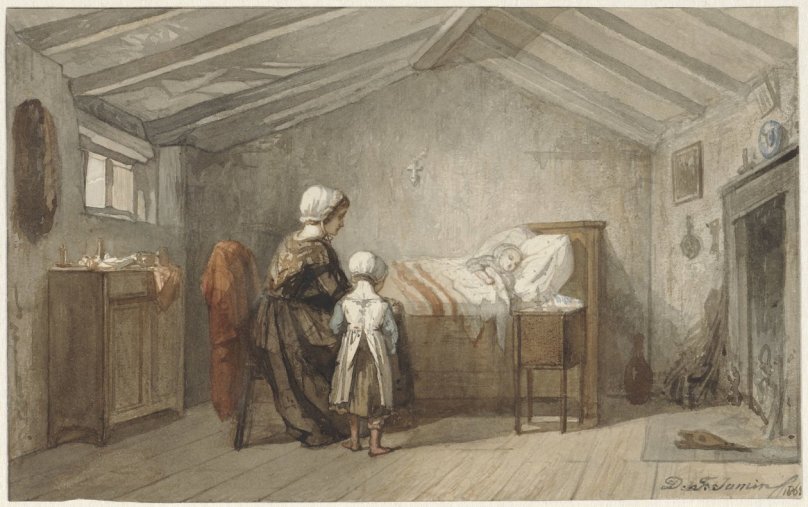
Mother and Daughter by the Sickbed of a Child by Diederik Franciscus Jamin
The above sketch from Amsterdam’s Rijks Museum pretty much describes how I spent most of this week. Something I ate on Tuesday violently disagreed with me, so in addition to the usual messy food poisoning symptoms, I was totally prostrated. Picture Martine at my side feeding me endless glasses of water to avoid dehydration along with hydrocortisone to make up for my body’s inability to produce adrenaline. Without the hydrocortisone, I was likely to die.
To avoid concentrating on the messy details, I would like to present a poem by Robert Louis Stevenson I remember from when I was a boy of ten sleeping in my parents’ bed while I was sick and they were at work. Half the time, my great-grandmother was around to feed me. It presents a very vivid picture of illness seen from the point of view of a child.
The Land of Counterpane
When I was sick and lay a-bed, I had two pillows at my head, And all my toys beside me lay, To keep me happy all the day.
And sometimes for an hour or so I watched my leaden soldiers go, With different uniforms and drills, Among the bed-clothes, through the hills;
And sometimes sent my ships in fleets All up and down among the sheets; Or brought my trees and houses out, And planted cities all about.
I was the giant great and still That sits upon the pillow-hill, And sees before him, dale and plain, The pleasant land of counterpane.
Every time I read a poem by Walt Whitman (1819-1892), I kick myself for not being more familiar with his work. Therefore I resolve to read his collection Leaves of Grass in the coming year. The following short poem is one of my favorites:
A Noiseless Patient Spider
A noiseless patient spider, I mark’d where on a little promontory it stood isolated, Mark’d how to explore the vacant, vast surrounding, It launched forth filament, filament, filament, out of itself. Ever unreeling them, ever tirelessly speeding them.
And you O my soul where you stand, Surrounded, detatched, in measureless oceans of space, Ceaselessly musing, venturing, throwing, seeking the spheres to connect them. Till the bridge you will need be form’d, till the ductile anchor hold, Till the gossamer thread you fling catch somewhere, O my soul.
I had never read any of Sherman Alexie’s poems before, Wedged in between the short stories in his collection War Games were a number of poems, the most interesting of which is this one at the start of the book:
The Limited
I saw a man swerve his car And try to hit a stray dog, But the quick mutt dodged Between two parked cars
And made his escape. God, I thought, did I just see What I think I saw? At the next red light,
I pulled up beside the man And stared hard at him. He knew that’d I seen His murder attempt,
But he didn’t care. He smiled and yelled loud Enough for me to hear him Through our closed windows:
“Don’t give me that face Unless you’re going to do Something about it. Come on tough guy,
What are you going to do?” I didn’t do anything I turned right on the green He turned left against traffic.
I don’t know what happened To that man or the dog, But I drove home And wrote this poem.
Why do poets think They can change the world? The only life I can save Is my own.
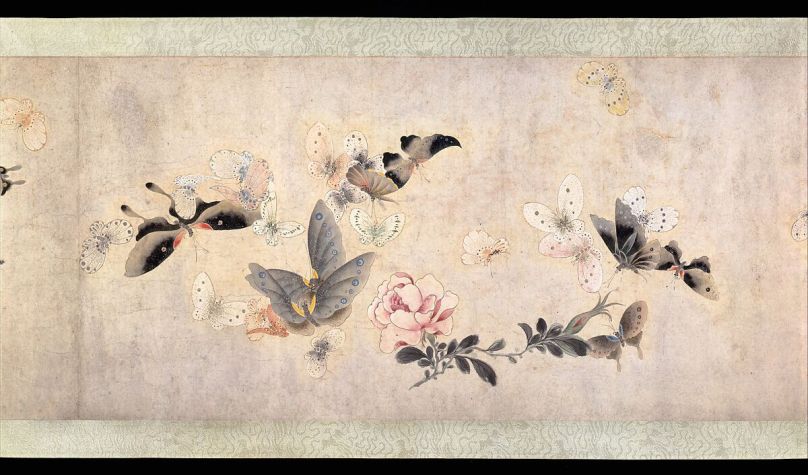
The two greatest poets of T’ang China were Tu Fu (712-770 CE) and Li Po (701-762 CE). The following poem by Li Po is one of the most profound he ever wrote. The Chuang Tzu (4th century BCE) referred to was the Taoist philosopher and follower of Lao Tzu. Forget all this detail: The following poem speaks for itself.
Chuang Tzu and the Butterfly
Chuang Tzu in dream became a butterfly, And the butterfly became Chuang Tzu at waking. Which was the real—the butterfly or the man ? Who can tell the end of the endless changes of things? The water that flows into the depth of the distant sea Returns anon to the shallows of a transparent stream. The man, raising melons outside the green gate of the city, Was once the Prince of the East Hill. So must rank and riches vanish. You know it, still you toil and toil,—what for?
There are times when H. P. Lovecraft’s poetry comes across as overripe. But when the subject is Edgar Allan Poe, it seems more appropriate.
Above is the cottage in the Bronx where Poe lived with his young wife Virginia Clemm (married at age 13 to the 27-year-old writer) in the Bronx. I remember visiting it with my mother sometime early in the 1960s.
Where Once Poe Walked
Eternal brood the shadows on this ground, Dreaming of centuries that have gone before; Great elms rise solemnly by slab and mound, Arched high above a hidden world of yore. Round all the scene a light of memory plays, And dead leaves whisper of departed days, Longing for sights and sounds that are no more.
Lonely and sad, a specter glides along Aisles where of old his living footsteps fell; No common glance discerns him, though his song Peals down through time with a mysterious spell. Only the few who sorcery’s secret know, Espy amidst these tombs the shade of Poe.
By the way, notice that the initial letters in each line together spell out EDGAR ALLAN POE.
One of my favorite American poets is a member of the Muscogee (Creek) Native American Nation, who has served three terms as poet laureate of the United States. Her poetry is simply magical, as the following sample shows:
Don’t Bother the Earth Spirit
Don’t bother the earth spirit who lives here. She is working on a story. It is the oldest story in the world and it is delicate, changing. If she sees you watching she will invite you in for coffee, give you warm bread, and you will be obligated to stay and listen. But this is no ordinary story. You will have to endure earthquakes, lightning, the deaths of all those you love, the most blinding beauty. It’s a story so compelling you may never want to leave; this is how she traps you. See that stone finger over there? That is the only one who ever escaped.
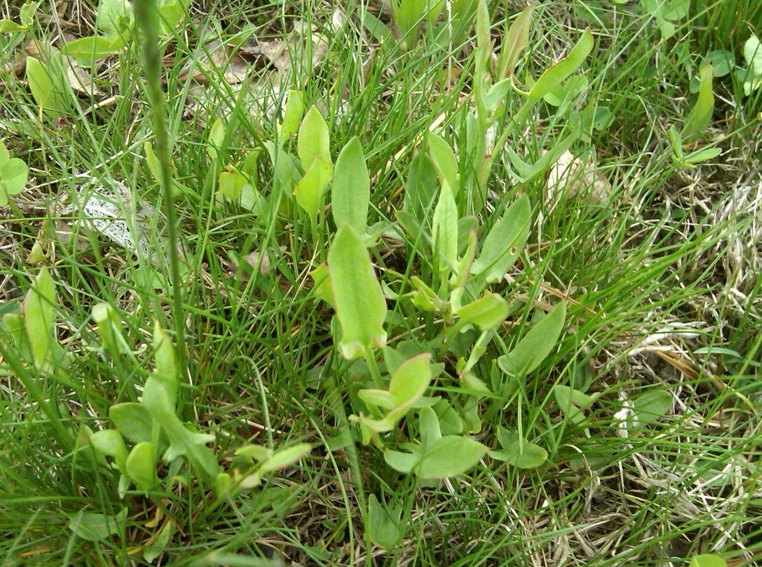
I used to subscribe to the New York Review of Books in print form, but I got lazy about reading the issues. Yet I saved all of them and am now reading them, mostly when I go out by myself to lunch. Today, at a local Egyptian Restaurant in Culver City, I read this poem by Diane Seuss in an issue dated June 23, 2022. It’s called “Weeds.”
Weeds
The danger of memory is going to it for respite. Respite risks entrapment. Don’t debauch yourself by living in some former version of yourself that was more or less naked. Maybe it felt better then, but you were not better. You were smaller, as the rain gauge must fill to the brim with its full portion of suffering.
What can memory be in these terrible times? Only instruction. Not a dwelling.
Or if you must dwell: The sweet smell of weeds then. The sweet smell of weeds now. An endurance. A standoff. A rest.
One of Many Anglo-Saxon Edwards Who Preceded the Conquest
The English language has a long history. We don’t have any samples of what the English spoke during the Roman occupation. In fact, it was not until the Angles, Saxons, and Jutes crossed the Channel into Britain that we have the bare bones of a literature. Today, I present one of the great Anglo-Saxon poems.
If you want to hear the poem in the original Anglo-Saxon of the Dark Ages, you can do so by checking out this YouTube site. It is a far, far cry from the language we speak today.
Here is “The Wanderer” in a modern translation from the Poetry Foundation:
The Wanderer
Always the one alone longs for mercy, the Maker’s mildness, though, troubled in mind, across the ocean-ways he has long been forced co stir with his hands the frost-cold sea, and walk in exile’s paths. Wyrd is fully fixed.
Thus spoke the Wanderer, mindful of troubles,
of cruel slaughters and dear kinsmen’s downfall: “Often alone, in the first light of dawn, I have sung my lament. There is none living to whom I would dare to reveal clearly my heart’s thoughts. I know it is true that it is a nobleman’s lordly nature to closely bind his spirit’s coffer, hold fast his treasure-hoard, whatever he may think. The weary mind cannot withstand wyrd, the troubled heart can offer no help, and so those eager for fame often bind fast in their breast-coffers a sorrowing soul, just as I have had to take my own heart— Often wretched, cut off from my own homeland, far from dear kinsmen—and bind it in fetters, ever since long ago I hid my gold-giving friend in the darkness of earth, and went wretched, winter-sad, over the ice-locked waves, sought, hall-sick, a treasure-giver, wherever I might find, far or near, someone in a meadhall who might know my people, or who would want to comfort me, friendless, accustom me to joy. He who has come to know how cruel a companion is sorrow for one with few dear friends, will understand: the path of exile claims him, not patterned gold, a winter-bound spirit, not the wealth of earth. He remembers hall-holders and treasure-taking, how in his youth his gold-giving lord accustomed him to the feast—that joy has all faded.
And so he who has long been forced to forego
his lord’s beloved words of counsel will understand: when sorrow and sleep both together often bind up the wretched exile, it seems in his mind that he clasps and kisses his lord of men, and on his knee lays hands and head, as he sometimes long ago in earlier days enjoyed the gift-throne. But when the friendless man awakens again and sees before him the fallow waves, seabirds bathing, spreading their feathers, frost falling and snow, mingled with hail, then the heart’s wounds are that much heavier, longing for his loved one. Sorrow is renewed when the memory of kinsmen flies through the mind; he greets them with great joy, greedily surveys hall-companions—they always swim away; the floating spirits bring too few familiar voices. Cares are renewed for one who must send, over and over, a weary heart across the binding waves.
And so I cannot imagine for all this world
why my spirit should not grow dark when I think through all this life of men, how suddenly they gave up the hall-floor, mighty young retainers. Thus this middle-earth droops and decays every single day; and so a man cannot become wise, before he has weathered his share of winters in this world. A wise man must be patient, neither too hot-hearted nor too hasty with words, nor too weak in war nor too unwise in thoughts, neither fretting nor fawning nor greedy for wealth, never eager for boasting before he truly understands; a man must wait, when he makes a boast, until the brave spirit understands truly where the thoughts of his heart will turn.
The wise man must realize how ghastly it will be
when all the wealth of this world stands waste, as now here and there throughout this middle-earth walls stand blasted by wind, beaten by frost, the buildings crumbling. The wine halls topple, their rulers lie deprived of all joys; the proud old troops all fell by the wall. War carried off some, sent them on the way, one a bird carried off over the high seas, one the gray wolf shared with death—and one a sad-faced man covered in an earthen grave. The Creator of men thus destroyed this walled city, until the old works of giants stood empty, without the sounds of their former citizens.
He who deeply considers, with wise thoughts,
this foundation and this dark life, old in spirit, often remembers so many ancient slaughters, and says these words: ‘Where has the horse gone? where is the rider? where is the giver of gold? Where are the seats of the feast? where are the joys of the hall? O the bright cup! O the brave warrior! O the glory of princes! How the time passed away, slipped into nightfall as if it had never been! There still stands in the path of the dear warriors a wall wondrously high, with serpentine stains. A storm of spears took away the warriors, bloodthirsty weapons, wyrd the mighty, and storms batter these stone walls, frost falling binds up the earth, the howl of winter, when blackness comes, night’s shadow looms, sends down from the north harsh hailstones in hatred of men. All is toilsome in the earthly kingdom, the working of wyrd changes the world under heaven. Here wealth is fleeting, here friends are fleeting, here man is fleeting, here woman is fleeting, all the framework of this earth will stand empty.’
So said the wise one in his mind, sitting apart in meditation.
He is good who keeps his word, and the man who never too quickly shows the anger in his breast, unless he already knows the remedy a noble man can bravely bring about. It will be well for one who seeks mercy, consolation from the Father in heaven, where for us all stability stands.
A Word of Explanation
The following discussion is taken from the Octavia Randolph website:
Wyrd is an Old English noun, a feminine one, from the verb weorthan “to become”. It is related to the Old Saxon wurd, Old High German wurt, Old Norse urür. Wyrd is the ancestor of the more modern weird, which before it meant odd or unusual in the pejorative sense carried connotations of the supernatural, as in Shakespeare’s weird sisters, the trio of witches in MacBeth. The original Wyrd Sisters were of course, the three Norns, the Norse Goddesses of destiny.
Wyrd is Fate or Destiny, but not the “inexorable fate” of the ancient Greeks. “A happening, event, or occurrence”, found deeper in the Oxford English Dictionary listing is closer to the way our Anglo-Saxon and Norse forbears considered this term. In other words, Wyrd is not an end-point, but something continually happening around us at all times. One of the phrases used to describe this difficult term is “that which happens”.
Czeslaw Milosz was born in Eastern Europe the same year as my father was born. Only, Elek Paris was no poet; and Czeslaw Milosz was one of the greatest poetic voices of his century. For many years, he lived in the United States and taught at Berkeley. He won the Nobel Prize for Literature in 1980 and died in his native Poland in 2004.
Note that the title of the following poem ends with a question mark:
Ars Poetica?
I have always aspired to a more spacious form that would be free from the claims of poetry or prose and would let us understand each other without exposing the author or reader to sublime agonies.
In the very essence of poetry there is something indecent: a thing is brought forth which we didn’t know we had in us, so we blink our eyes, as if a tiger had sprung out and stood in the light, lashing his tail.
That’s why poetry is rightly said to be dictated by a daimonion, though it’s an exaggeration to maintain that he must be an angel. It’s hard to guess where that pride of poets comes from, when so often they’re put to shame by the disclosure of their frailty.
What reasonable man would like to be a city of demons, who behave as if they were at home, speak in many tongues, and who, not satisfied with stealing his lips or hand, work at changing his destiny for their convenience?
It’s true that what is morbid is highly valued today, and so you may think that I am only joking or that I’ve devised just one more means of praising Art with the help of irony.
There was a time when only wise books were read, helping us to bear our pain and misery. This, after all, is not quite the same as leafing through a thousand works fresh from psychiatric clinics.
And yet the world is different from what it seems to be And we are other than how we see ourselves in our ravings. People therefore preserve silent integrity, thus earning the respect of their relatives and neighbors.
The purpose of poetry is to remind us how difficult it is to remain just one person, for our house is open, there are no keys in the doors, and invisible guests come in and out at will.
What I’m saying here is not, I agree, poetry, as poems should be written rarely and reluctantly, under unbearable duress and only with the hope that good spirits, not evil ones, choose us for their instrument.
From childhood’s hour I have not been As others were—I have not seen As others saw—I could not bring My passions from a common spring— From the same source I have not taken My sorrow—I could not awaken My heart to joy at the same tone— And all I lov’d—I lov’d alone— Then—in my childhood—in the dawn Of a most stormy life—was drawn From ev’ry depth of good and ill The mystery which binds me still— From the torrent, or the fountain— From the red cliff of the mountain— From the sun that ’round me roll’d In its autumn tint of gold— From the lightning in the sky As it pass’d me flying by— From the thunder, and the storm— And the cloud that took the form (When the rest of Heaven was blue) Of a demon in my view—








 Tarnmoor
You must be logged in to post a comment.