Smile, You’re on Candid Camera!

The “Face” on the Underside of a Manta Ray

The “Face” on the Underside of a Ray

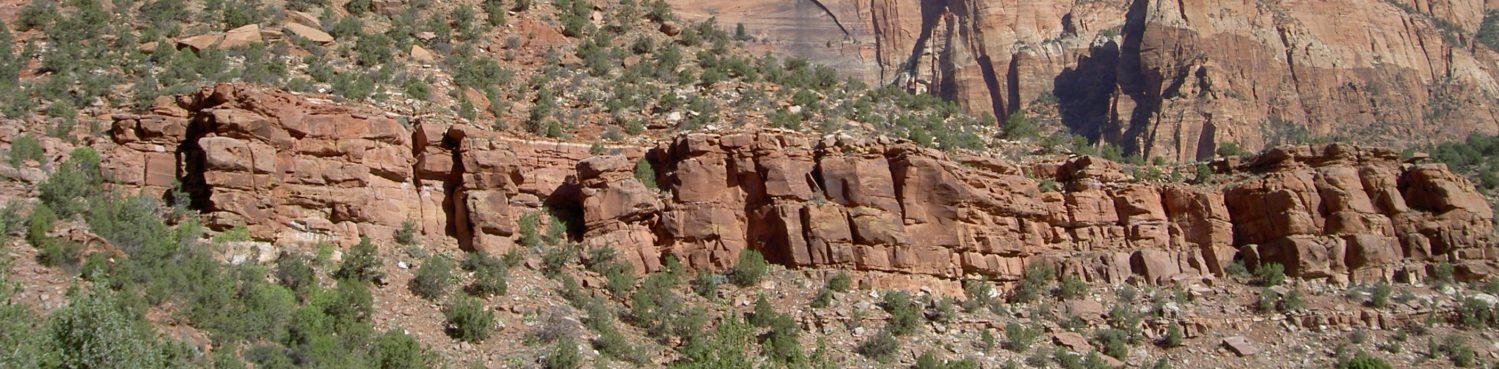
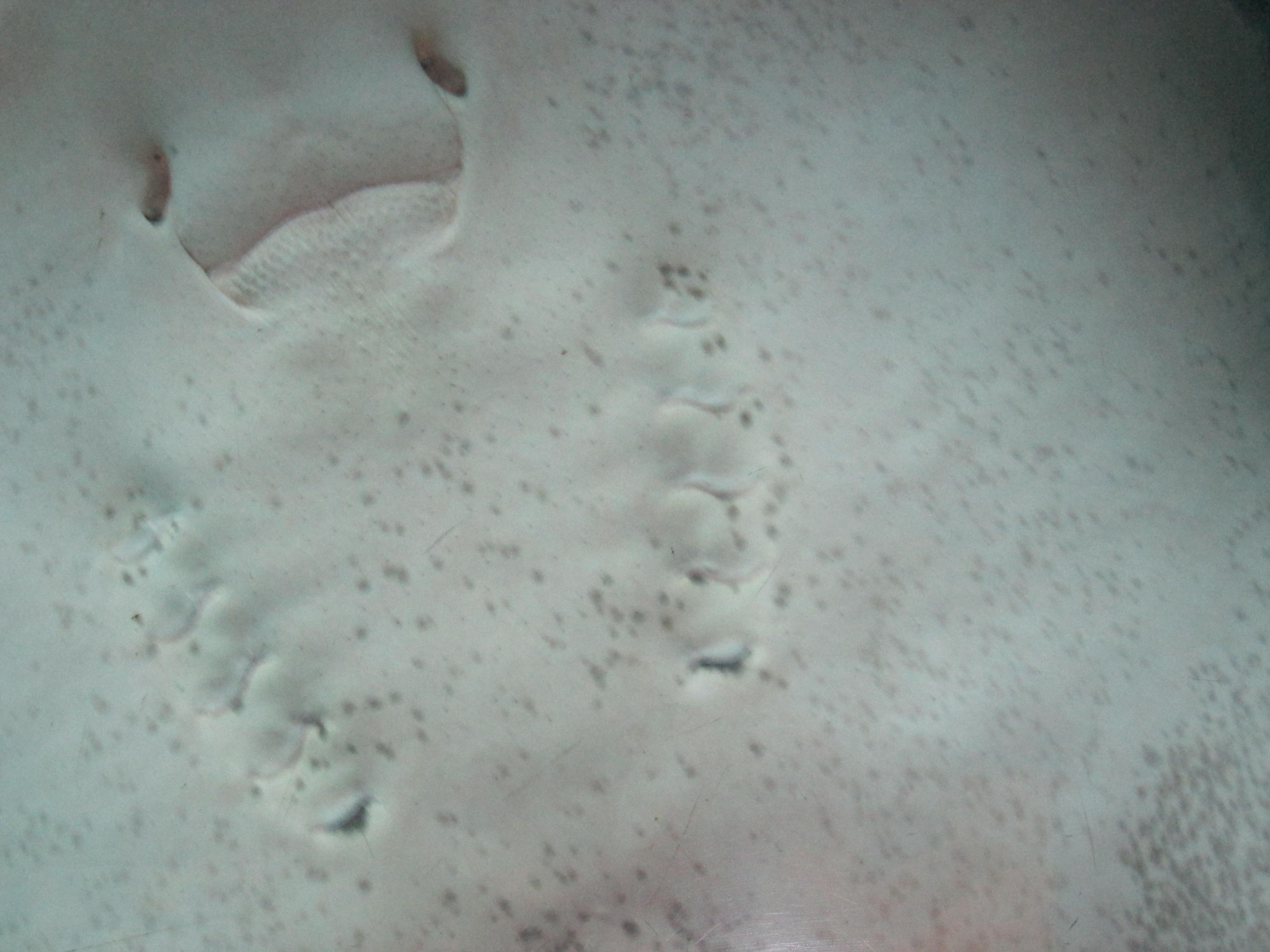
There are so many strange forms of life under the sea, and the rays are one of the strangest. At the Aquarium of the Pacific in Long Beach, I ran my fingers across the velvety back of one of them. Then, in one of the large mixed tanks, I saw what looked like a smile on the underside of another one (illustrated above). In the tanks, they tended to glide over the sandy bottom, making me wonder whether they are scavengers.

In all, the Aquarium has only a few hundred different species of sea and shore life, but few of them are anywhere near familiar to me. There are odd staring moray eels, fish that look like floating vegetation, birds with tongues shaped like short straws, and giant daddy-longleg-like spidery crabs. While Martine were there in the morning—before the strollers and their glazed-eyed pushers arrived in force—we had a good chance to see the exhibits are marvel at their strangeness.

If I had another life to live, I would consider being a marine biologist. One of the most underrated American travel books I have ever read is John Steinbeck’s expedition with a marine biologist friend from Monterey to Mexico. It is called The Log from the Sea of Cortez.


Eager Beavers

In South America, the Friendly Beaver Is an Enemy

In South America, the Friendly Beaver Is an Enemy

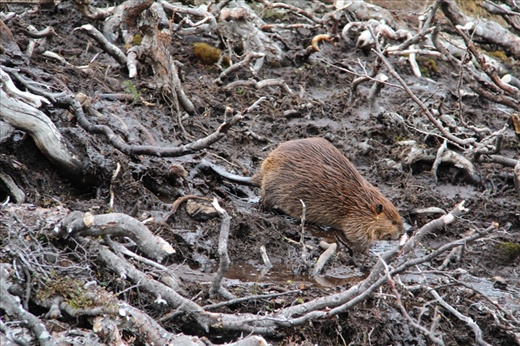
About seventy-five years ago, someone thought it would be a great idea to introduce beavers to Tierra del Fuego, at the southernmost tip of South America, so that it could be hunted for its fur. The 20 beavers brought over from Manitoba in 1940 have now multiplied to 150,000—even outnumbering the 134,000 human residents of the area.

As is usually the case, the well-intentioned people who introduced the beavers did not consider the vastly different ecosystem. The dams built by the invaders do not help the ecosystem as wetlands do not form due to the type of flora, and the forests of native Nothofagus trees are being destroyed by the beavers, which have no native predators. Residents of Patagonia are afraid of the species’ spread northward, as they have no difficulties crossing salt water on their trek to the mainland.

Seeing the devastation wrought by the busy little rodents in Tierra del Fuego, New Zealand has prohibited the introduction of the beaver under its Hazardous Substances and New Organisms Act of 1996.


Smurov Is Alive—and Dead!

First, You Have to Understand About Schrödinger’s Cat

First, You Have to Understand About Schrödinger’s Cat

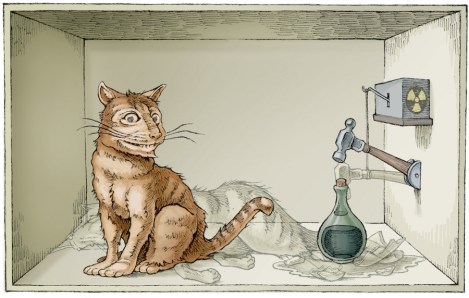
Vladimir Nabokov in his 1930 novelette The Eye seems to have anticipated Austrian physicist Erwin Schrödinger’s famous thought experiment of 1935. According to Wikipedia, it goes as follows:

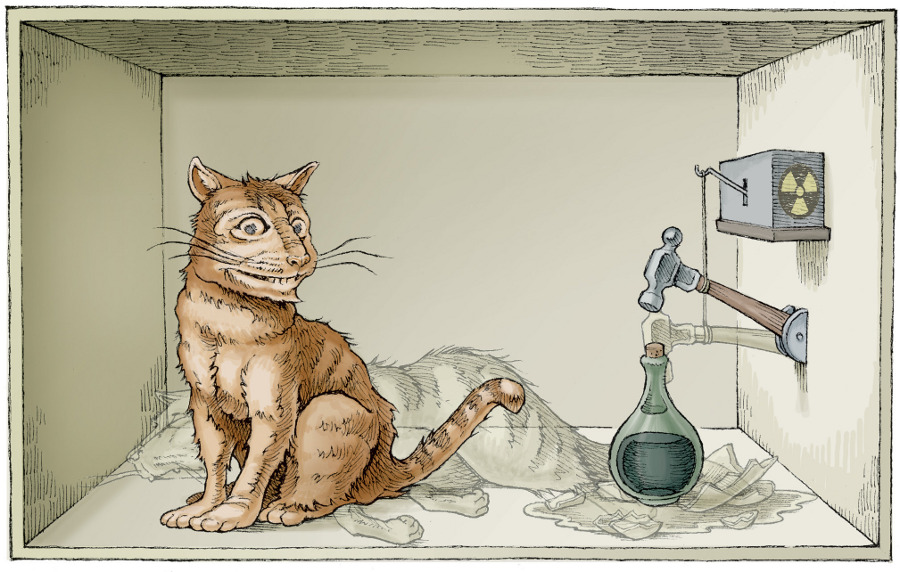
Schrödinger’s cat: a cat, a flask of poison, and a radioactive source are placed in a sealed box. If an internal monitor detects radioactivity (i.e. a single atom decaying), the flask is shattered, releasing the poison that kills the cat. The Copenhagen interpretation of quantum mechanics implies that after a while, the cat is simultaneously alive and dead. Yet, when one looks in the box, one sees the cat either alive or dead, not both alive and dead. This poses the question of when exactly quantum superposition ends and reality collapses into one possibility or the other.

Naturally, most people do not entertain the notion of being alive and dead at the same time.  Yet in The Eye, the narrator Smurov commits suicide at the very beginning after having been ignominiously caned by the husband of his mistress Matilda. The rest of the story consists of Smurov investigating his own life among the Russian emigré population of Berlin, finding that he is roundly disliked by most everyone.

So, the question arises: Is Smurov alive or dead? Or is Smurov both alive and dead? (Or could the narrator be unreliable, having missed his heart with the revolver bullet?)

In an article in the May 2, 2015, issue of The New Scientist, Douglas Heaven speculates:

For [Physicist John Archibald] Wheeler, this meant the universe couldn’t really exist in any physical sense—even in the past—until we measure it. And what we do in the present affects what happened in the past—in principle, all the way back to the origins of the universe. If he is right, then to all intents and purposes the universe didn’t exist until we and other conscious entities started observing it.

Sound crazy? Then try this one on for size. Another interpretation of quantum mechanics is Hugh Everett’s many worlds hypothesis, which posits that everything that could happen has and does, in an infinite number of universes. Every time you make a decision, the universe splits in two, with you in one branch and an alternative you in the other, living the other possibility. The universe you occupy is, in some sense, an individual universe of your own making.

This idea is enough to give anyone a reality check. “My natural inclination is to be a realist,” says Chris Timpson, a philosopher of physics at the University of Oxford. “But if you’re going to be a realist about the quantum world then you’re left with a world that is very peculiar.” So peculiar, in fact, that the idea that it only exists because of us seems almost sensible.

There now, I’ll leave it up to you to decide whether Smurov is alive or dead or both. It all depends on your understanding of quantum mechanics in any universe you appear to be inhabiting at the moment, whatever THAT means!


Ring of Fire

The Volcano Sabancay: Erupting Again

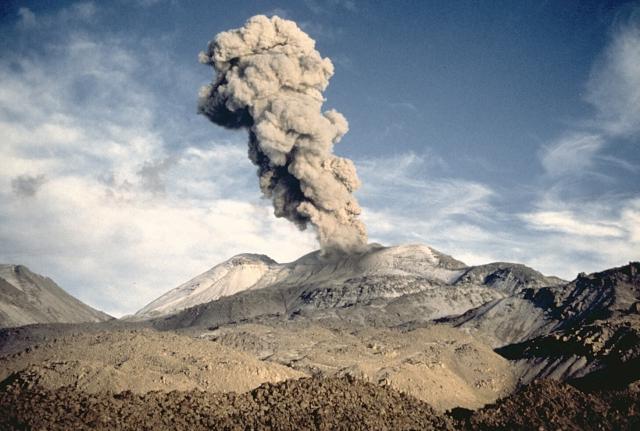
The Volcano Sabancaya: Erupting Again

The Pacific Ring of Fire stretches from Indonesia and the Southwest Pacific in a massive arc around Asia, North America, down to the West Coast of South America. According to Peru This Week, this zone “is the site of 85% of global seismic activity caused by friction between shifting tectonic plates.”

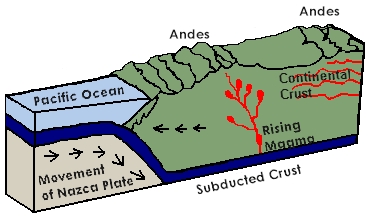
In South America, the culprit is the Nazca Plate, which borders the Pacific side of the continent, and which features a convergent boundary subduction zone and the South American Plate, which action has formed the Andes. Hardly a day passes by when I don’t hear of another earthquake in Peru (usually in the Richter 4.0-5.5 range); and hardly a month passes by without a new volcanic eruption. Today, it is reported that Sabancaya (see above) in the State of Arequipa has begun to spew ash. If it continues, I will probably be there to see it in person next month at this time.

Below is an illustration of how the Nazca Plate (in light brown) subducts the South America Plate (in green), thereby causing all these dire events (and, by the way, over the millennia, causing much of the beauty of the Andes as well):

The Nazca Plate Takes a Dive, Wrinkling the Face of the Earth

The Nazca Plate Takes a Dive, Wrinkling the Face of the Earth

Last year, I visited Iceland, through which runs the boundary between the Eurasian Plate and the North American Plate, resulting in several dozen active volcanoes and frequent earthquakes. In fact, the boundary runs right through the middle of Thingvellir National Park, where it is expanding the size of Iceland (and the park) year by year.

What is it with me and volcanoes? Is it because I live in multiply cross-faulted Southern California with its own history of earthquakes? Maybe in future I should visit Krakatoa and Mount Vesuvius?


Gliese 832c

Could It Be the Closest Inhabitable Exoplanet?

Could It Be the Closest Inhabitable Exoplanet?

From NASA comes a photo comparing Earth with the planet Gliese 832c. According to the Astronomy Picture of the Day website:

This planet is only 16 light years away—could it harbor life? Recently discovered exoplanet Gliese 832c has been found in a close orbit around a star that is less bright than our Sun. An interesting coincidence, however, is that Gliese 832c receives just about the same average flux from its parent star as does the Earth. Since the planet was discovered only by a slight wobble in its parent star’s motion, the above illustration is just an artistic guess of the planet’s appearance—much remains unknown about Gliese 832c’s true mass, size, and atmosphere. If Gliese 832c has an atmosphere like Earth, it may be a super-Earth undergoing strong seasons but capable of supporting life. Alternatively, if Gliese 832c has a thick atmosphere like Venus, it may be a super-Venus and so unlikely to support life as we know it. The close 16-light year distance makes the Gliese 832 planetary system currently the nearest to Earth that could potentially support life. The proximity of the Gliese 832 system therefore lends itself to more detailed future examination and, in the most spectacularly optimistic scenario, actual communication—were intelligent life found there.

Since Neil deGrasse Tyson very effectively demonstrated that none of the other planets or planetoids in our solar system is inhabitable, I guess I’ll have to cancel my vacation plans for the Big Red Spot on Jupiter. (You really should see the video clip that comes with this link: He’s really quite good.)

By the way, you’ll notice in the above quote that NASA fudged a bit on the “photo” of Gliese 832c. If you’ll look closely you’ll see Spain, France, and North Africa through the clouds. I guess the point was to make Gliese 832c a more welcoming destination than, say, Syria, Pakistan, the Gaza Strip, or anywhere Ken Ham chooses to call home.

Serendipity: A Re-Discovery

Loren Eiseley (1907-1977)

Loren Eiseley (1907-1977)

Have you ever laid something precious aside and, years later, suddenly be reminded of it? Then, going back to it, you find it was not only as good as you ever thought it was, but even better.The last book I read by Loren Eiseley was The Man Who Saw Through Time, about Sir Francis Bacon, back in 1990. Then I saw a blog by Fred Runk, whose perceptive comments you may have encountered in this space, quoting and commenting on a poem by Eiseley. It seemed as if a vortex formed around my head, in which I saw the waste of nearly a quarter century without once having encountered one of my favorite writers. I am making up for lost time by reading The Star Thrower, his last book, with essays on nature and science and a few of his early poems.

There is something small and humble about Eiseley as he examines nature and our place in it. Survival of the fittest?

A major portion of the world’s story appears to be that of fumbling little creatures of seemingly no great potential, falling, like the helpless little girl Alice, down a rabbit hole or an unexpected crevice into some new topsy-turvy realm…. The first land-walking fish was, by modern standards, an ungainly and inefficient invertebrate. Figuratively, he was a water failure who had managed to climb ashore on a continent where no vertebrates existed. In a time of crisis he had escaped his enemies…. The wet fish gasping in the harsh air on the shore, the warm-blooded mammal roving unchecked through the torpor of the reptilian night, the lizard-bird launching into a moment of ill-aimed flight, shatter all purely competitive assumptions. hese singular events reveal escapes through the living screen, penetrated, one would have to say in retrospect, by the ‘overspecialized’ and the seemingly ‘inefficient,’ the creatures driven to the wall.

In another essay, he talks about how life on our planet would have failed if it weren’t for the birth of flowers and everything that came in their train. At another time, we see him playing with an unafraid young fox with a pile of bones and selecting one and handing it to him. In yet another essay, we see him watching while an unusual squirrel manages to climb a post that had a wrap-around funnel protecting the food left for birds.

This is not BIG nature. It is all little nature with a lot of very BIG implications. Eiseley is a wonderful essayist and poet, deserving not only of scientific fame, but literary fame as well. It is no accident that the Introduction to The Star Thrower was written by an admirer named W. H. Auden.

In future, I will write more about Eiseley. Having rediscovered him, I cannot let him down.

Uh Oh! More Bad News!

The Spiral M31 (Andromeda) Galaxy With Our Moon in the Foreground

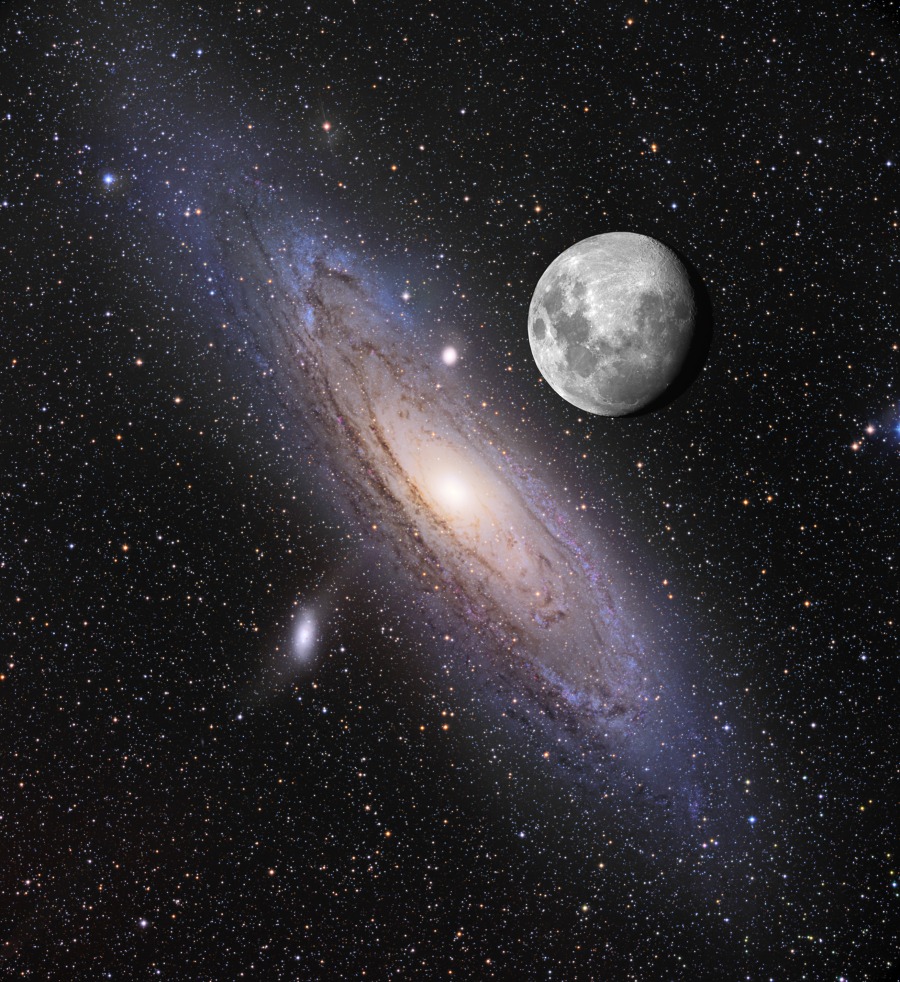
The Spiral M31 (Andromeda) Galaxy With Our Moon in the Foreground

As if we didn’t already have enough troubles, the Andromeda (M31) Galaxy is set to collide with our Milky Way Galaxy. But then, as I am told, there’s no point in crying over spilt Milky Way.

According to CBS News, two neutron stars in M31 just collided. By “just,” of course, we mean two million years ago—which is more than 400 times longer than when Ken Ham thought the universe was created. It took that long for the light of the collision to reach our telescopes. The CBS News website has a neat animation of what the collision with our galaxy could look like.

In case you’re upset about this adversely affecting your weekend plans, let me assure you that the event is between two and four million years in the future:

But there is nothing to worry about, [Astronomer Dennis Overbye] noted, because long before that, the Earth will have entered the solar system’s “hot zone” and become too hostile to sustain human life, so no one [that we could recognize, in any case] will be around to experience the collision.

By then Ken Ham will have been resolved into the two or three molecules that make up his brain.


The New Normal

Transitioning to—What?

Transitioning to—What?

As Zadie Smith writes in The New York Review of Books in an April 3, 2014 article entitled “Elegy for a Country’s Seasons”:

Sing an elegy for the washed away! For the cycles of life, for the saltwater marshes, the houses, the humans—whole islands of humans. Going, going, gone!

There is little doubt that our earth is changing, such that the next generation may not recognize the patterns that make for our own daily existence. Glaciers will be all but gone. Tornadoes, polar vortexes, hurricanes, typhoons, and giant storm cells will cover new parts of the globe. I for one will not say authoritatively that we are at fault or that we can prevent or even mitigate it, but I will try to do my part as if we can.

I do not profess to understand the psyche of climate change deniers. Suffice it to say that they will change their minds soon or die wrapped in a veil of profoundest ignorance. This actually has nothing to do with politics: It’s about the Earth, Our Mother. She’s entering a menopausal phase that will affect virtually everyone on the planet.

Zadie Smith continues:

Oh, what have we done! It’s a biblical question, and we do not seem to be able to pull ourselves out of its familiar—essentially religious—cycle of shame, denial, and self-flagellation. That is why (I shall tell my granddaughter) the apocalyptic scenarios did not help—the terrible truth is that we had a profound, historical attraction to apocalypse. In the end, the only thing that could create the necessary traction in our minds was the intimate loss of the things we loved.

Have we as a species ever turned our back on a powerful new technology? I can think of only a single example: When 16th Century Portuguese traders tried to sell the Japanese rifles, the Samurai opted to stick instead with their swords. Their whole military culture was predicated on the blade and their knowledge of how to wield it.

Maybe we should have stuck with the horse.


It Wasn’t Us, Was It?

The Red Spot on Jupiter Is Beginning to Disappear

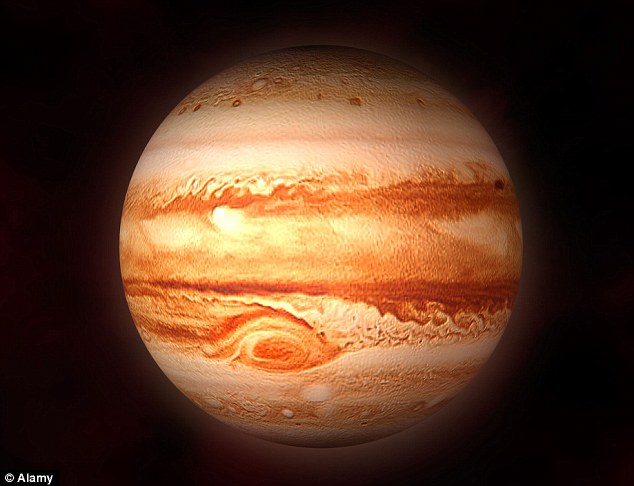
The Great Red Spot on Jupiter Is Beginning to Disappear

What with the glaciers shrinking and the ozone hole growing ever larger, we are dismayed to learn that the Great Red Spot on Jupiter is likewise beginning to shrink. In the late 19th Century, it was estimated to be 25,500 miles wide. Beginning in 2012, it’s less than half that size, now only 10,250 miles across. According to CBS News:

Michael Wong, a scientist at the University of California, Berkeley, told The Associated Press that the spot is a mystery. Astronomers don’t know why it’s red or shrinking, or what will happen next. If this pace continues, in 17 years the spot could be gone. Or it could stop at a smaller size.

The Great Red Spot is actually a giant storm, perhaps the planetary equivalent of a Polar Vortex. If the storm vanishes, will we be up to our ears in displaced Jupiterians? Will the giant planet wobble out of orbit and come crashing down into our part of the Solar System? Or is it an environmental phenomenon that has nothing to do with us and wouldn’t affect us for the next several million years? No one knows.

Perhaps our space program can enlist some volunteers to land on the harsh ammoniac surface of the planet and suss things out. I know several hundred people in Washington, DC who would be perfect for the job.