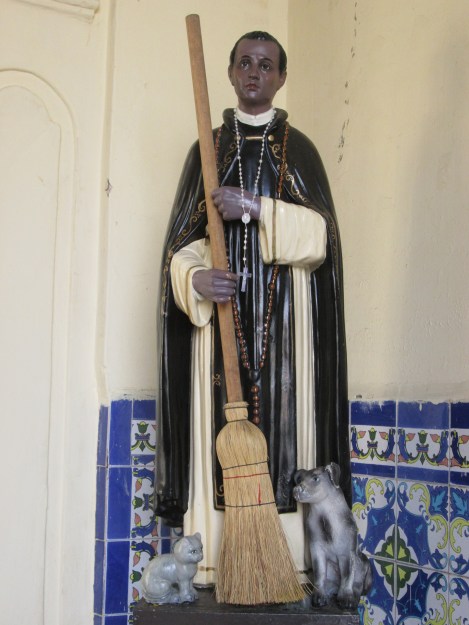
St. Martin de Porres
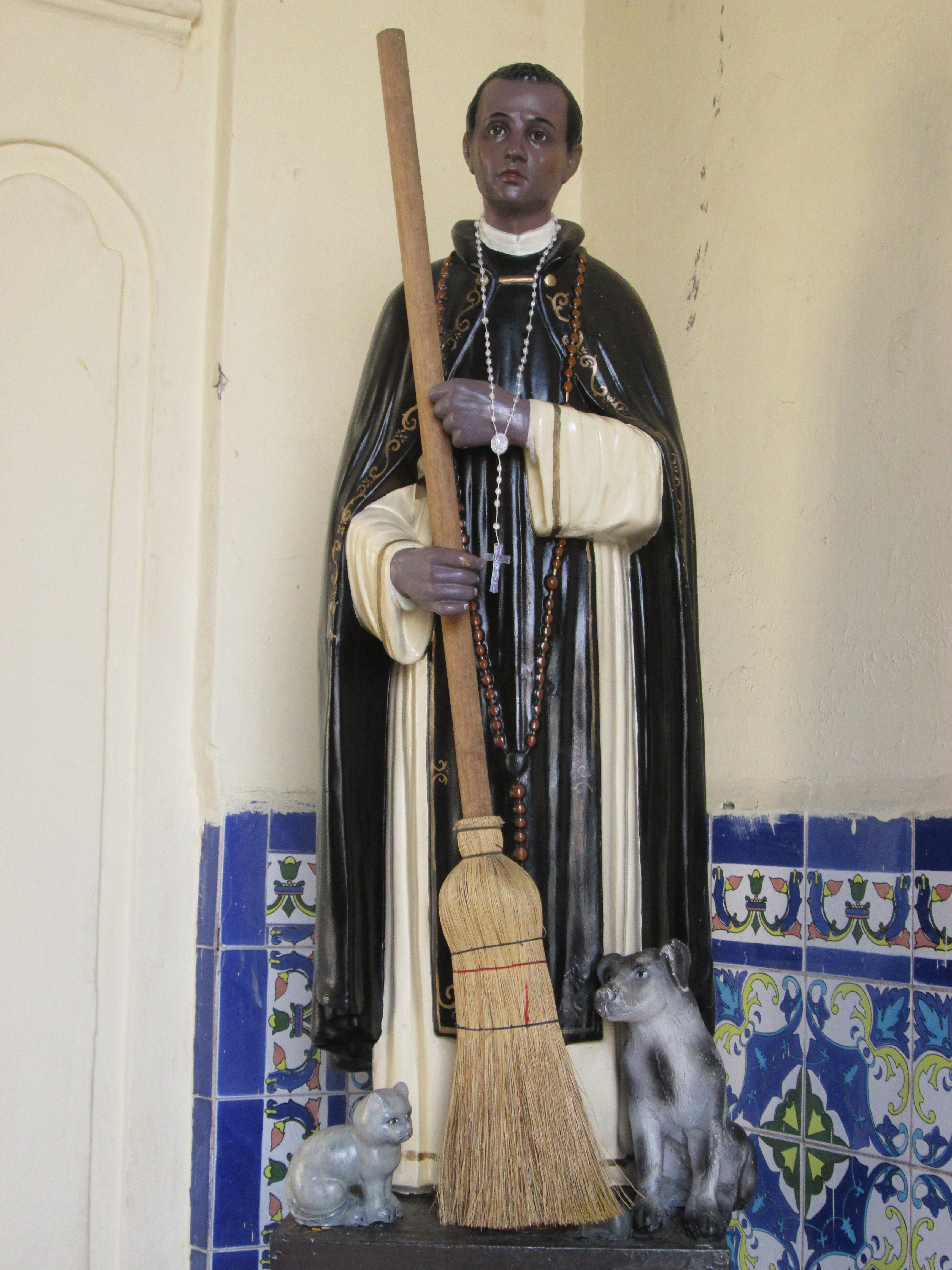
He is usually depicted in the garb of a Dominican lay brother, holding a broom, and with a dog, a cat, and a mouse at his feet. St. Martin de Porres is one of my favorite saints. My memories of him go back to grade school, years before Pope John XXIII canonized him in 1962.
The following is taken from Ricardo Palma’s Peruvian Traditions and tells the story of his three pets:
And from the same dish
ate a dog, a cat and a mouse.
With this couplet we come to the end of an account of the virtues and miracles attributed to Friar Martín de Porres. It was actually a broadside that was circulated in Lima about the year 1840 for the purpose of celebrating in our cultured and very religious capital city the solemn activities related to the beatification of this miracle worker.
This holy man, Friar Martín, was born on December 9, 1579, the natural son of the Spaniard Don Juan de Porres, Knight of Alcántara, and of a Panamanian slave. When he was still very young little Martín was taken to Guayaquil, where in a school in which the teacher made good use of the whip, he learned to read and write. Two or three years later his father and Martín returned to Lima and the boy was placed as an apprentice, learning the trade of barber and bloodletter in a barbershop on Malambo Street.
Martín wasn’t very adept with the razor and the lancet and this kind of work didn’t appeal to him so he opted for another career—that of sainthood, for in those days the career of a saint was just as legitimate a profession as any other. He took the habit of a lay brother at the age of twenty-one in the Monastery of San Domingo and remained there until he died in the odor of sanctity on November 3, 1639.
While he lived, and even after death, our countryman Martín de Porres performed miracles on a wholesale scale. He performed miracles as easily as others compose verses. One of his biographers (I don’t remember if it is Father Manrique or Doctor Valdés) says that the Prior of the Dominicans had to prohibit his continuing to perform miracles or milagrear (forgive me the use of the word). And to prove how deeply rooted in Martín the spirit of obedience was, on one occasion while he was passing a mason working on some scaffolding the worker fell a distance of some twenty-five to thirty feet. But while he was still in mid-air Martín stopped his fall—and there was the man suspended above the ground. The good Friar shouted, “Wait a moment, brother,” and the mason remained in the air until Martín returned with permission from his superior to complete the miracle.
That’s a doozy of a little miracle, don’t you agree? Well, if you think that one is great, wait until you read the next one.
The Prior sent the extraordinary lay brother on an errand to purchase a loaf of sugar for the infirmary. Perhaps he didn’t give Martín sufficient money to buy the white refined type so he returned with a loaf of brown sugar.
“Where are your eyes, Brother Martín,” said the Father Superior. “Can’t you see that it is so dark that it’s more like unrefined sugar?”
“Don’t get upset, Reverend Father,” answered Martín slowly. “All we have to do is wash this loaf of sugar right away and everything will be fine.”
Without allowing the Prior to argue the point the Friar submerged the loaf of sugar in the water in the baptismal font, and when he pulled it out it was white and dry.
Hey! Don’t make me laugh! I have a split lip!
Believe it or make fun of it. But let it be known that I don’t put a dagger at anyone’s breast forcing him to believe. Freedom must be free, as a newspaperman of my country once said. And here I note that because I had intended to speak of mice under Martín’s jurisdiction, I went off on a tangent and forgot what I was doing. That’s enough for the prologue; let’s get right down to business and see what happened to the mice.
* * *
Friar Martín de Porres had a special predilection for mice, unwelcome guests who came for the first time, it appears, with the Conquest, because until the year 1552 no mention of them was made. They arrived from Spain in a boat carrying codfish that had been sent to Peru by a certain Don Gutierre, Bishop of Palencia. Our Indians gave them the name hucuchas, which means creatures that came from the sea.
During the time that Martín was serving as a barber a mouse was still considered a curiosity, for the mouse population had just begun to multiply. Perhaps it was during that period that he began to concern himself with the welfare of the little animals, seeing in them the handiwork of God; that is to say he could see a relationship between himself and these small beings. As a poet put it:
The same time that God took to create me
He also took to create a mouse,
or perhaps two, at the most.
When our lay brother served as a male nurse in the Monastery the mice overran everything and made a nuisance of themselves in the cells, the kitchen and the refectory. Cats, which made their presence known in 1537, were scarce in the city. It is a documented fact that the first cats were brought by Montenegro, a Spanish soldier who sold one in Cuzco for 600 pesos to Don Diego de Almagro, the Elder.
The friars were at their wits’ end with the invasion of the little rodents and invented various kinds of traps to catch them, but with little success. Martín put a mouse trap in the infirmary and one rascal of a mouse who was inexperienced, attracted by the odor of some cheese, found himself trapped. The lay brother freed him from the trap, and then placing him in the palm of his hand said to him, “On your way, little brother, and tell your companions not to bother the friars in their cells. From now on all of you stay in the garden and I promise to take food to you every day.”
The ambassador complied with his mission and from that moment the mob of mice abandoned the cloister and took up residence in the garden. Of course Martín visited them every morning carrying them a basket of leftovers and other food and they would come to meet him as if they had been summoned by a bell.
In the cell Martín kept a cat and a dog. Through his efforts he had succeeded in having them live together in fraternal harmony, to such an extent that they both ate from the same dish.
One afternoon he was watching them eat in holy peace when suddenly the dog growled and the cat arched its back. What had happened was that a mouse had dared to stick its nose outside of its hole, attracted by the smell of the food in the dish. When Martín saw the mouse he said to the dog and cat, “Be calm, creatures of God. Be calm.” He then went over to the hole in the wall and said, “Come on out, brother mouse, have no fear. It appears that you are hungry; join in with the others. They won’t hurt you.” And speaking to the dog and cat he added, “Come on, children, always make room for a guest; God provides enough for the three of you.”
And the mouse, without being invited, accepted the invitation, and from that day on it ate in love in the company of the cat and dog.
And…, and…, and… A little bird without a tail? What nonsense!
34.052234
-118.243685








You must be logged in to post a comment.