


I have had surgery three times in my life. The major one was removal of my pituitary gland, which was eaten up by a benign tumor. Then I had my left hip replaced with a titanium joint due to severe osteoarthritis. Finally, I had cataract surgery in both eyes. All three procedures markedly improved my life. (It helped that I was very picky about my doctors.)
Home » southern california (Page 12)
Category Archives: southern california
Breakfast


The day starts with a leisurely breakfast, including Indian black tea with honey and a squeeze of lime. Absolutely essential.
Mindful Meditation
Daily writing prompt
Are there things you try to practice daily to live a more sustainable lifestyle?


Yes: Mindful Meditation. Learning to place oneself in what is, not what you want it to be.
Deliciosity


Its a five-way tie: Icelandic plokkfiskur (potato and cod stew); Southern Thai jungle curry with fish; Cantonese Chinese pumpkin stir-fry; Japanese salmon skin sushi; and Italian bucatini carbonara.
Outfit
Daily writing prompt
If you were forced to wear one outfit over and over again, what would it be?


Work shirts and pants. They last longer.
Spirituality

The question makes it seem as if spirituality were something apart from my life. If spirituality is a stranger to you, your life is impoverished to say the least.
To Begin With …


To begin with, I am deeply skeptical of most self-care claims. In the end, I tend not to stray too far from the middle path, going for variety more than super-foods and trendy exercise regimens.
Thai Town Adventure

The Jitlada Restaurant in L.A.’s Thai Town
One of the things I love most about Los Angeles are all the nationalities with their delicious cuisine. Today, Martine, my brother Dan, and I drove to the Jitlada Restaurant in East Hollywood’s Thai Town. It’s located in a downmarket L-shaped streetcorner mall with obvious parking problems. I’d been to the restaurant twice before—each time having a memorable meal.
Third time’s a charm. My spicy jungle curry with catfish and eggplant was spicy enough to burn a hole in concrete, and my brother’s scallops with eggplant was superb. Because she can’t handle spicy, Martine had chicken satay and a mango smoothie. For desert we all had different coconut ice cream preparations.
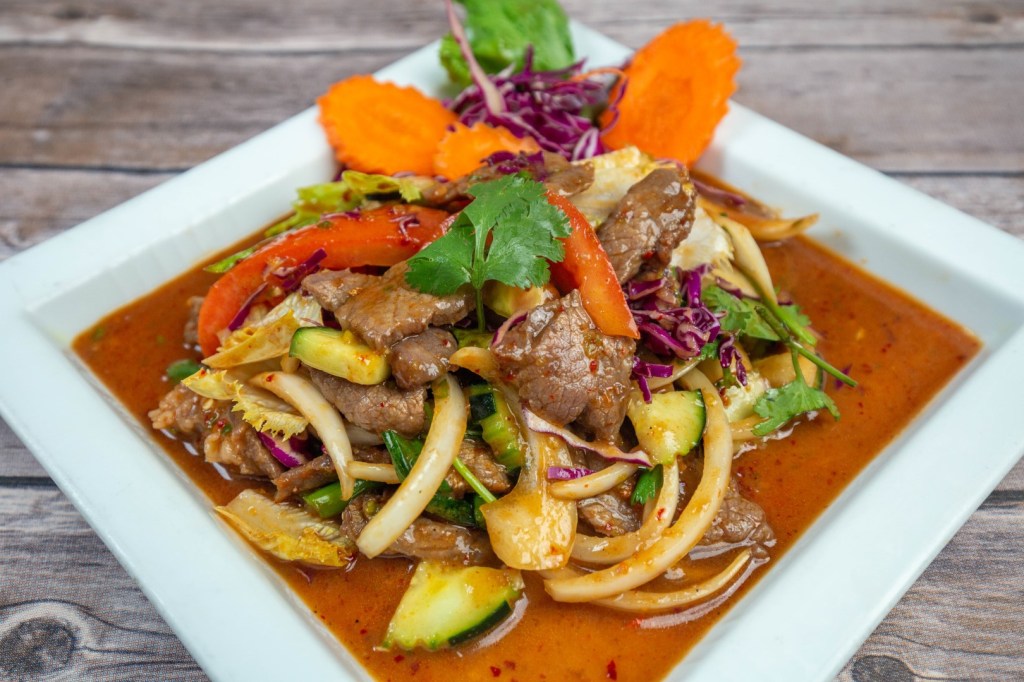
A typical Jitlada Curry
You may think you’ve had Thai food before, but owner Jazz Singsanong’s Southern Thai cuisine is the real thing. Not for nothing does the Jitlada appear year after year in all the lists of the best restaurants in Los Angeles. It now even sports a mention from the Michelin Guide. It easily deserves sit and more.
There are two menus, a green one where you can specify how spicy you want your dish, and a white menu which is spicy whether you will or not. Irrespective of your food tolerances, you can have a supremely satisfying meal at Jitlada.
If you’re interested you should take a look at the menu.
Magyar Étel
Daily writing prompt
Which food, when you eat it, instantly transports you to childhood?


Since I was raised in a Hungarian family, I would have to say Magyar Étel (Hungarian Food), such as stuffed cabbage, stuffed peppers, cabbage noodles, kólbasz sausage, and an endless variety of fresh, delicious, homemade soups. And then there was the pastry ….
First Crush


I was only about four or five years old when I fell hard for Joycey, like me a Hungarian in the Buckeye Road Hungarian neighborhood. Just to show you how sophisticated a lover I was at the time, I was particularly entranced by the crooks of her knees.


You must be logged in to post a comment.