Whitewater

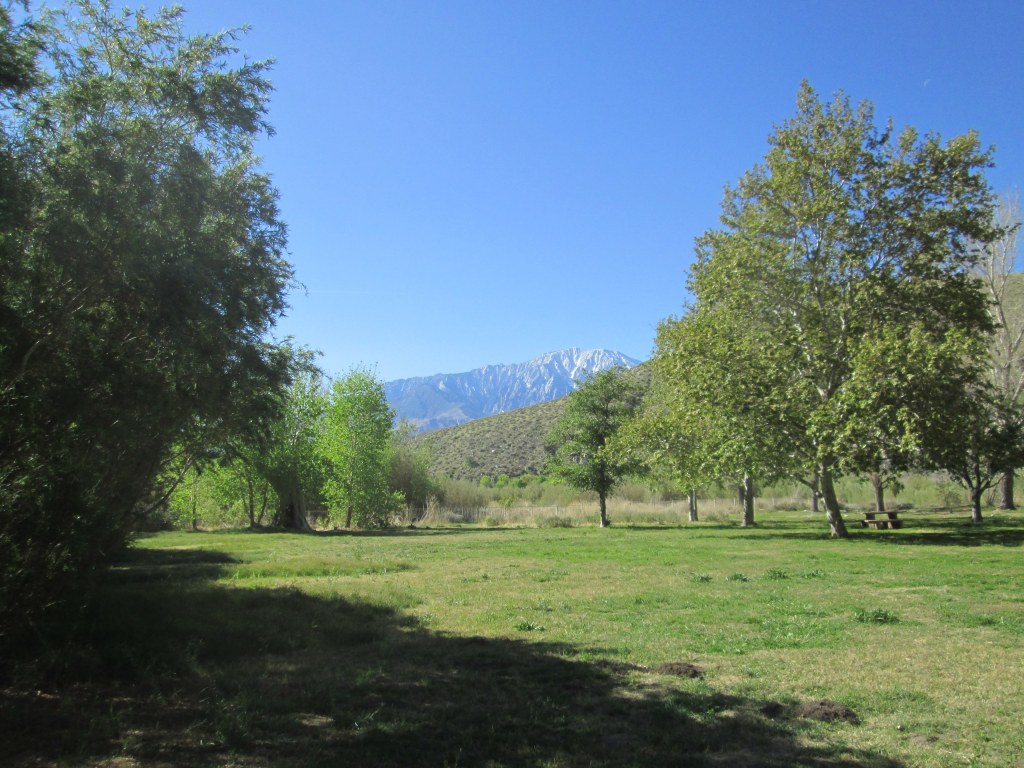
The Whitewater River Near the Campground

On Sunday, my brother Dan suggested we visit the Whitewater Preserve. Now I was familiar with the desolate Whitewater exit off the I-10, all bleached rocky desert. But apparently, head uphill from the exit and one comes upon one of those little green paradises one often finds in desert canyons.

The altitude of the part of the Whitewater Preserve we visited was at 2,223 feet (678 meters). Whereas the floor of the desert was around 90° Fahrenheit (31° Celsius), the temperature at the visitor center was in the mid 70s (around 24° Celsius).

My brother took the above picture from his smartphone. The water is from the Whitewater River, which flows from Mount San Gorgonio and ends up, when not absorbed by the aquifer underlying the Coachella Valley, in the Salton Sea.

The Whitewater Preserve is part of the Sand-to-Snow National Monument, comprising parts of Southern San Bernardino County and Northern Riverside County.

Over the next few days, I will share with you some of the photographs I took there—the very last photographs from my trusty Canon PowerShot A1400 (R.I.P.).

Desert X 2025

Sculpture “The Living Pyramid” by Dénes Ágnes

I returned today from a long weekend visiting my brother Dan in the Coachella Valley. Saturday began on a dubious note: We visited an installation of the Desert X 2025 art show at Summerlands in Rancho Mirage. Since the artist was the Hungarian-born Dénes Ágnes, we expected great things, being self-professed Hungarians ourselves.

What we saw was a plywood pyramid painted white, planted with native desert plants, that is on view at Summerlands until May 11, 2025. Ah, well, I guess not all Hungarian art works are great.

I was reminded of Maya pyramids in Yucatán that were not rebuilt by archeologists, such as this pyramid I photographed at Sayil in the Puuc Highlands in January 2020:

Maya Pyramid at Sayil

Another point of comparison is one of English artist Frederick Catherwood’s engravings in the 1841 classic by John Lloyd Stephens, Incidents of Travel in Central America, Chiapas and Yucatán:

The Castillo at Chichén Itzá Engraved by Frederick Catherwood

I guess I’m too much in love with the impressive Maya ruins in Mexico and Central America to accept Dénes’s “The Living Pyramid” with anything other than a shrug. Nice try, but no cigar.

Playing Havoc With the Weather

An Old Relief Map of Southern California

I remember from my early days in Cleveland, whatever happened to one side of the city also happened to the other sides. That’s because Cleveland was, if not as flat as a pancake, pretty darn flat. In fact the highest elevation in the whole State of Ohio is 1,549 feet (472 meters).

Compare that with Los Angeles County where I live. When I look out my front door, I can see the Santa Monica Mountains just a few miles north of me, where the highest elevation is 3,111 feet (948 meters) at the curiously named Sandstone Peak. Curiously named because it actually isn’t sandstone. And there is one peak in the San Gabriel Mountains—Mount San Antonio, aka Mount Baldy—which rises to 10,064 feet (3,069 meters).

When the news gives the regional weather report, it has to differentiate between several different weather zones:

  • Coastal (where I live)
  • Los Angeles basin
  • Valleys (San Fernando and San Gabriel)
  • Mountains
  • “Inland Empire” (San Bernardino and Riverside)
  • Lower desert
  • Upper desert

If the forecasters warn of an upcoming rainstorm, we in the coastal region might see only a few stray drops, while the San Gabriel Mountains might have a foot of snow dumped on their peaks.

So any “all-purpose” one-line weather forecast for Los Angeles is pretty meaningless. Los Angeles County is pretty big—4,084 square miles or 12,310 square kilometers, exceeded in area by only eight States. So if you’re flying into LAX from the East, you might want to check out Weather.Com or the National Oceanic and Atmospheric Administration (NOAA) website—provided that the Musk-Rat doesn’t gut it.

Two Auto Museums Bite the Dust

Martine Sitting in a Classic Corvette

I was dismayed to find that two superb auto museums closed down in 2024. In both cases, the museums grew out of personal car collections. When the museum founders passed on to that garage in the sky, both museums started to run into hard times.

The first was the Mullin Automotive Museum in Oxnard with its Bugattis and Art Deco paintings and furniture which closed in February 2024.

Hitting closer to home was the closure in October of the Zimmerman Automobile Driving Museum in El Segundo. There was a time when we visited the museum every few weeks. Martine loved it because they concentrated on American cars and because they allowed visitors to sit behind the wheel. She was particularly fond of a classic Corvette illustrated above.

There is an excellent article in Hemmings.Com about the Zimmerman Museum’s frantic attempts to raise cash after Stanley Zimmerman died in 2020. The article contains some excellent photos of the museum’s holdings.

Museums based on private collections have a high mortality rate. They are like restaurants, which, especially after the Covid-19 lockdown, are dropping like flies.