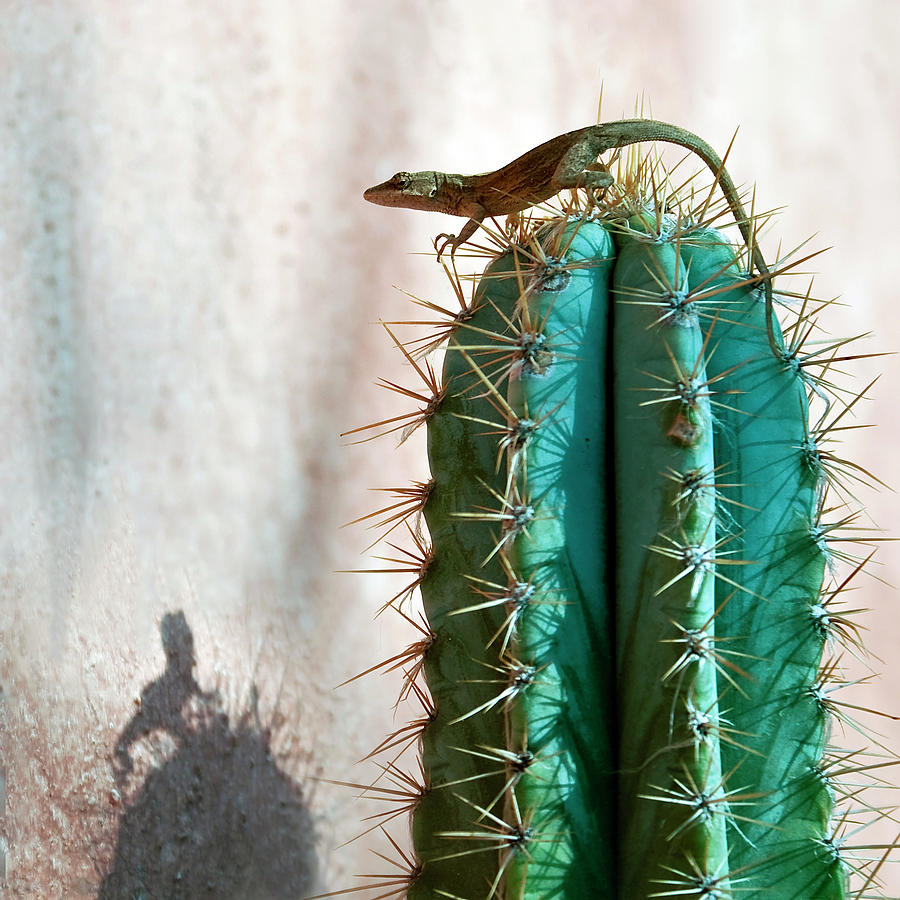
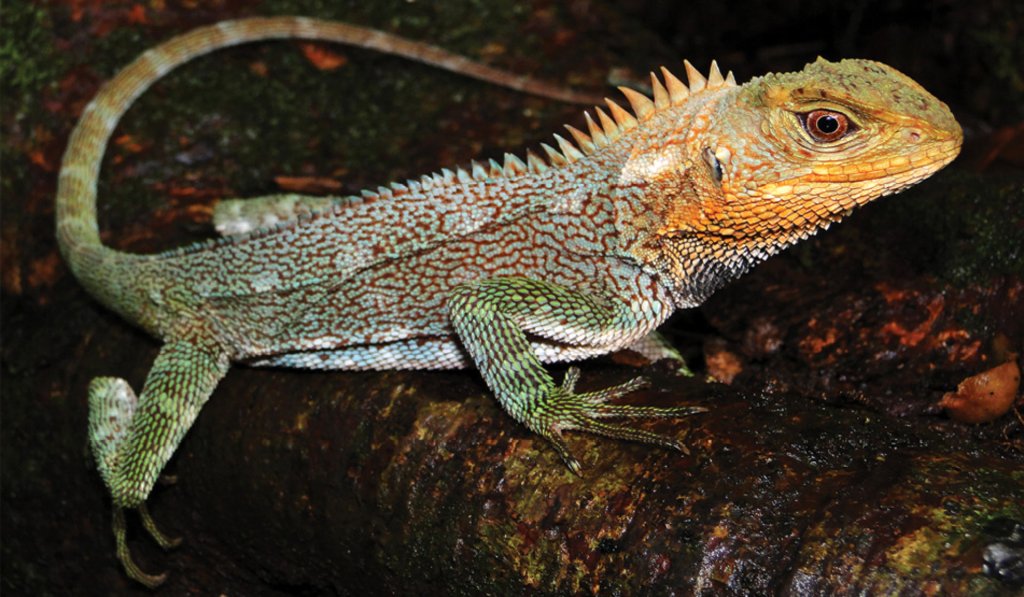
As the heat dome over the Western US continues, I continue to make like a lizard. Unlike a lizard, however, I seek shady cool places rather than sunny rocks or cacti for my perch. Today, I even went to see a movie: Bullet Train with Brad Pitt was no winner—but at least I sat for three hours in air-conditioned comfort while the people outside the theater looked decidedly wilted.
My dinners lately were very appropriate to a desert dweller. Several days ago, I went to the Persian market across the street and purchased Persian lavash flatbread, French feta cheese, and Turkish pickled vegetables (2 varieties). For breakfast today, I made two quesadillas with flour tortillas, Monterey Jack cheese, and pickled rajas de jalapeño. Despite the hot morning, I had my usual cup of hot Indian black tea with honey and a squeeze of lime.
Tomorrow, while Martine braves the dead hot air of downtown LA, I will probably make my way once again to Burton W. Chace Park in Marina Del Rey to catch stray breezes while reading O. A. Bushnell’s 1963 novel Molokai, about the Hawaiian leper colony. During that time I will constantly hydrate myself with mineral water to keep from getting dehydrated.
With the continuing heat dome over Southern California, Martine and I took a chance and went to the Long Beach Greek Festival at the Assumption of the Blessed Virgin Church. Although it was as hot as Hades, I’m glad we went. The food was good, there were tons of tasty Greek pastries, and the church itself was outstanding.
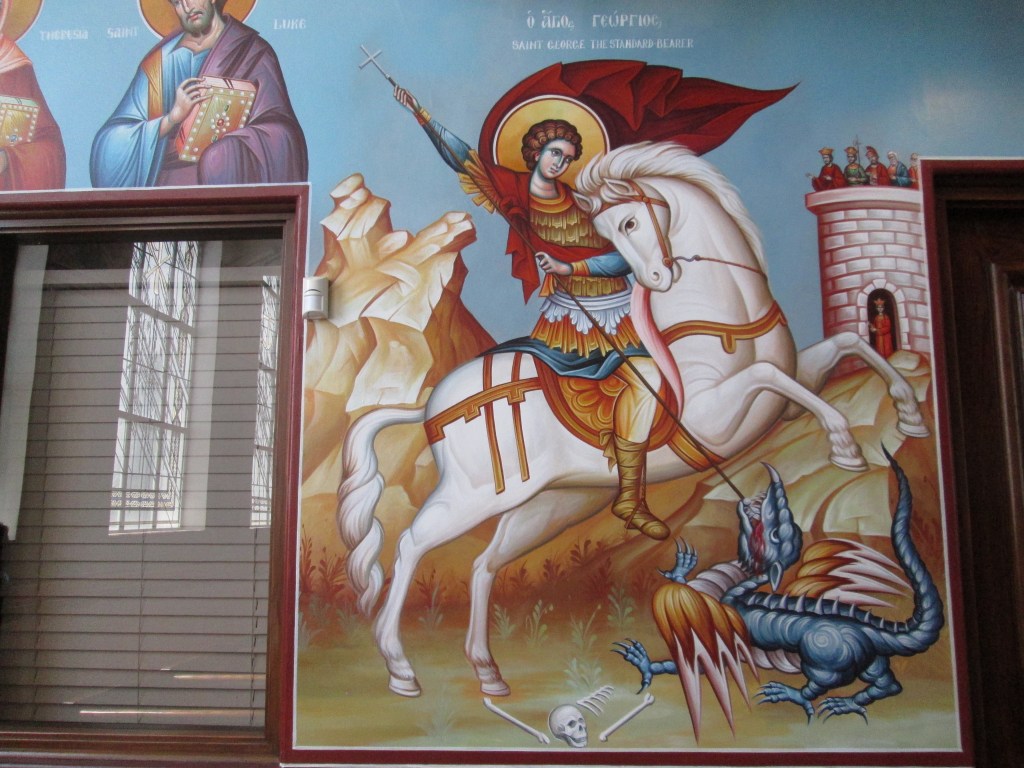
The church was not as wealthy as Saint Sophia in downtown L.A. or Saint Nicholas in Northridge, but it was beautifully painted with what seemed to be hundreds of saints and angels. And, unlike many Greek Orthodox churches, most of them were identified in both Greek and English.
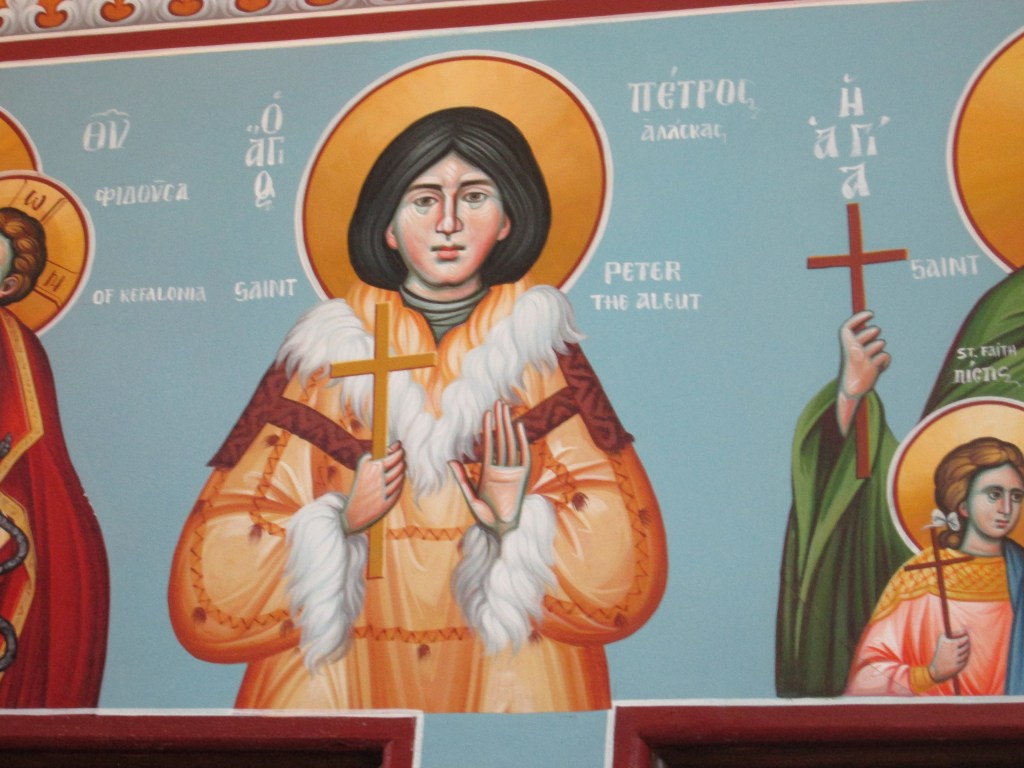
There were a few surprises, the most prominent one being an Eskimo—actually an Aleut—called Saint Peter the Aleut:
Saint Peter the Aleut, aka Cungagnaq
For an Aleut to be a Greek Orthodox martyr requires a leap of faith. And for Cungagnaq, it came in 1815 when the Spanish, who were uneasy about the Russian occupation of Alaska, captured him near San Francisco and had him put to death at the instigation of some Catholic priests who were upset that he was a heretic. Read about it on Wikipedia.
Just about every square inch of the Assumption of the Blessed Virgin church was covered with images of Christ, Mary, and the saints and angels. The effect was quite stunning. Martine and I spent an hour studying the sacred images.
I might be an indifferent lapsed Catholic, but the simplicity and sincerity of the church held my respect and even awe.
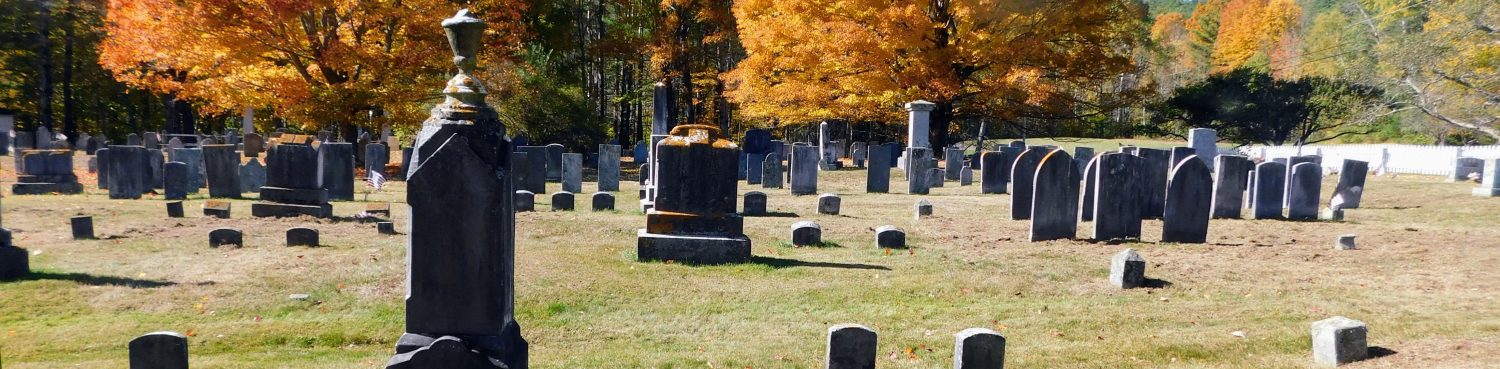
I have discovered that the best way to survive a hot spell in Southern California is to make like a lizard. We have neither insulation nor air conditioning in the 75-year-old apartment in which we live. All day long, the hot sun heats up the building, and the building holds the heat until just before dawn. We have fans, but use them primarily in the evening, when the inside temperature spikes.
So how does one make like a lizard? For starters, don’t be in much of a hurry—about anything. While Martine went downtown, where it is even hotter, I drove to Trader Joe’s in the Marina, put together a simple picnic lunch, and parked at the end of Mindanao Way at Chace Park. At the peninsula on which the park sits, there is always a cool breeze, a breeze that suddenly disappears a few hundred feet inland.
I sat in a shaded pavilion at a picnic table, ate my lunch, and re-read Ernest Hemingway’s Green Hills of Africa. I managed to be comfortable while, in the next pavilion, a group of loud ex-con types were laughing and shouting. They made a snarky comment about my straw hat, which did not faze me because a good straw hat from Latin America is also part of making like a lizard.
Am I beginning to resemble a lizard? I don’t think so, not yet anyhow. What’s more, I have no interest in sitting atop a rock in the hot sun as lizards are wont to do. The species to which I belong seeks the shade.
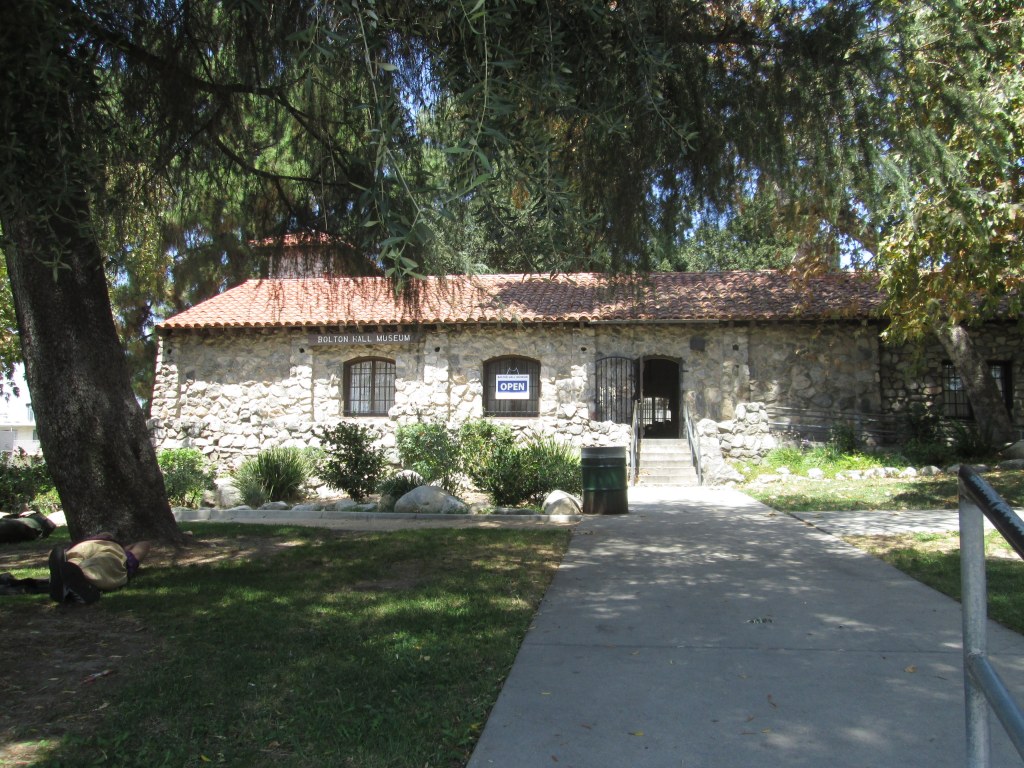
Bolton Hall, Clubhouse of Los Terrenitos (“Little Landers”)
Bolton Hall was named after a man called Bolton Hall. It was built in 1913 in Tujunga as the clubhouse of a utopian community called Los Terrenitos, or Little Landers. It was one of two communities inspired by the teachings of William E. Smythe. (The other was at San Ysidro, just across the fence from Tijuana, Mexico.)
According to a prospectus issued by Smythe in 1913:
The Little Lander is his own boss. His notion is not an acre nor half an acre, but “so much land as one individual or family can use to the highest advantage without hiring help.” No landlords or tenants, no employers or hired hands! Men work lovingly for themselves, while the best of them work but grudgingly for others. In moments of exaltation the Little Lander loves to think of himself as the Spiritual Man of the Soil—the man who works in conscious partnership with God in finishing the world. His own man on his own place, he works more in the spirit of the artist than of the farmer.
Bolton Hall Clubhouse As It Was in the Beginning
Any agricultural surplus from the small plots was donated to a cooperative: “The wagon calls to collect his vegetables, fruit, flowers, eggs, poultry—whatever he has to sell—and ship it to town, where it is received by the market manager and disposed of direct to consumers…..”
In many ways, the Little Landers were kin to the Distributists in England who followed the writings of G.K. Chesterton and the Catholics influenced by Leo XIII’s 1891 encyclical Rerum Novarum. Unfortunately, like almost all utopian communities, the Little Landers of Los Angeles lasted only for a few years. In 1917, Little Landers Incorporated was disestablished for failure to pay taxes. By 1925, almost all of the original settlers had left.
Unfortunately, the soil of the Tujunga area was not conducive to farming, so the dreams of small-plot farming did not come to pass, not here anyway.
Today all that remains is the Bolton Hall Clubhouse, which is a fascinating museum of local life. Martine and I spent an afternoon chatting with the docents inside the stone building, which was surprisingly cool considering the external temperature (90º Fahrenheit or 32º Celsius).
If you have any feeling for the area in which you live, I recommend supporting small local museums, which usually have fascinating stories to tell of the people who first settled an area and how their descendants fared.
Today I took a walk along the Venice Boardwalk. I could swear that I actually heard a couple of people speaking English. There was French, German, and something that sounded vaguely Slavic. And that was in addition to the frequently heard Spanish.
My destination was Small World Books, near the corner of Pacific and Windward (under the Venice sign above). If you’ve ever seen Orson Welles’s film Touch of Evil (1958), you will remember the colonnades meant to be a sleazy Mexican border town. Except now it’s all tattoo parlors, T-shirts, surfboard and bicycle rentals, food take-out places., and Hippie paraphernalia.
When I first visited the Boardwalk, I was put off by all the Hippie associations and suggestions of violence. After all, the Manson Family was in residence there in the 1960s. (But them, so was Jim Morrison of The Doors.) That’s still part of the Venice scene, but I’ve come to terms with it. If anyone tries to sell me a rap music CD recorded by a local garage band, I’ll just answer pleasantly in Hungarian and continue on my way.
Venice was the creature of a developer named Abbot Kinney who founded the community in 1905, complete with canals, gondoliers, and bath houses. And there was also an amusement park jutting out on a large pier (Pacific Ocean Park), Some of the canals still exist and are another pleasant walk,
At Small World Books, I bought books by Roberto Bolaño and Salman Rushdie.
Whenever the summer heat of Los Angeles becomes too unbearable, I pick up the book I am reading and head to my magic peninsula, Burton Chace Park, which is surrounded on three sides by the boats in Marina Del Rey.
There is a Hungarian expression from my youth that aptly describes this week’s weather: dög meleg, or, in English, damned hot. Although the temperature has been in the low 80s Fahrenheit, the humidity has generally been over 50%, and there has been no cooling breeze.
Even when the area even a few hundred feet inland is like a blast furnace, there, for some reason, always a cooling sea breeze blowing at Chace Park. Unfortunately, the secret is out, especially on the weekends. Even if it can get crowded, it’s always nice to have a respite from the dög meleg.
The title of this post comes from Samuel Taylor Coleridge’s “The Rime of the Ancient Mariner”:
The fair breeze blew, the white foam flew,
The furrow followed free:
We were the first that ever burst
Into that silent sea.
Family On Summer Beach Vacation Run Out Of Sea Towards Camera
Ah yes, Paradise on Earth. As a people, we have traditionally viewed summer beach vacations as the closest one could get to Heaven while alive. When I first came out to California in the late 1960s, I thought so, too. While working part-time at System Development Corporation in Santa Monica, I spent many afternoons lying on a towel and reading steamy fiction like Lawrence Durrell’s Alexandria Quartet.
The water was fun to a certain extent, but I was never a board or body surfer, though I went in often enough to be savaged by the occasional rough wave. Also, I tended to burn—especially as I had no one to slather my back with sun tan lotion.
While I live only two miles from the beach at Santa Monica, I don’t spend time there any more, unless I take a walk on the boardwalk connecting Santa Monica to Venice. Part of the reason is that the water is more polluted than ever, especially because we are only 20-30 miles (32-48 km) from the nation’s largest port, where freighters and tankers regularly foul the waters with petrochemical waste.
So when Martine and I go to Hawaii in a couple months, are we planning for any beach time? Not really. Although the waters at Waikiki are less polluted, the sun is stronger; and we both have fair skin. We are more interested in visiting Honolulu as a destination rather than trying to live in a pharmaceutical commercial.
I suppose if we lived east of the Mississippi, we would yearn for sunshine; but, living in Southern California, we have sunshine on most days of the year. In fact, September tends to be one of the hottest months of the year in Los Angeles. So we are likely escaping even hotter (albeit drier) weather at home.
It was Mark Twain who said, “Golf is a good walk spoiled.” All across the United States, Europe, and the world there are some 40,000 golf courses, The average 18-hole golf course covers some 150 acres. At 640 acres in a square mile, that means that some 9,375 square miles (24,281 square kilometers) across the planet are dedicated to golf courses—approximately the area of the State of Massachusetts.
That’s a fair-sized piece of land. What makes the statistic interesting is that golf is on the decline, at least in the United States. According to one source, “The number of core American golfers (those playing eight rounds or more per year) has fallen between three and 4.5 percent every year since 2006.”
The Three Stooges at the Golf Course
If that trend continues, I see a giant land rush forming to convert golf courses into expensive subdivided real estate.
In fact, in the news there is a big kerfuffle about a dispute between the PGA and Saudi Arabia’s LIV, which is making inroads on the PGA’s monopoly. You can read about it here.
So don’t spend too much money on golf clubs and golf fashions. They may not be around much longer.
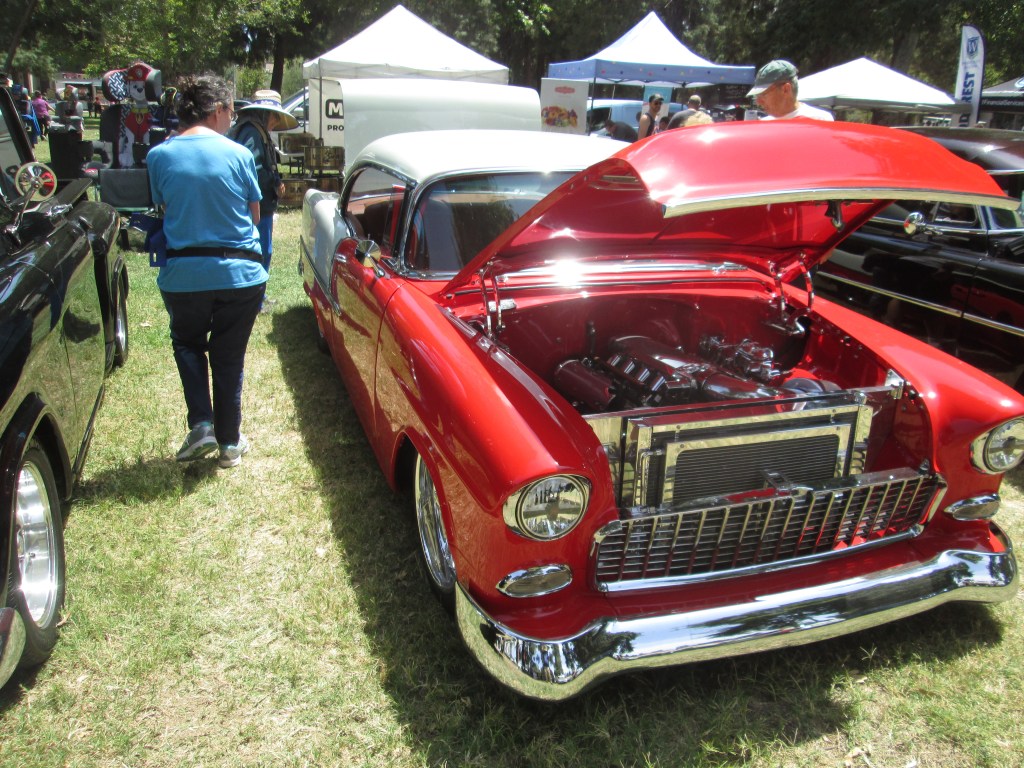
Today, Martine and I went with our friend Jeanie to the VTAC Car Show at Warner Center Park in Woodland Hills. VTAC is short for the Valley Traffic Advisory Council, an agency of the Los Angeles Police Department. In addition to various police vehicles, such as a police helicopter, several search-and-rescue vehicles, and a K-9 unit, there were hundreds of mostly classical Detroit cars that were immaculately polished and cared for by their collector/owners.
Although the weather was cool and cloudy near our West LA apartment, Woodland Hills was sunny and warm—but fortunately not hot. We strolled around for a couple of hours talking to police officers and car owners.
Poster for the Car Show
One positive aspect of Los Angeles’s car culture is that there are a lot of car shows around the city, and even a number of automobile museums. And now during a time when so many cars look alike, it is amazing to consider that for many years the design of automobiles was like a fine art. I love my Subaru Forester, but it won’t win any beauty contests, as good a car as it is.
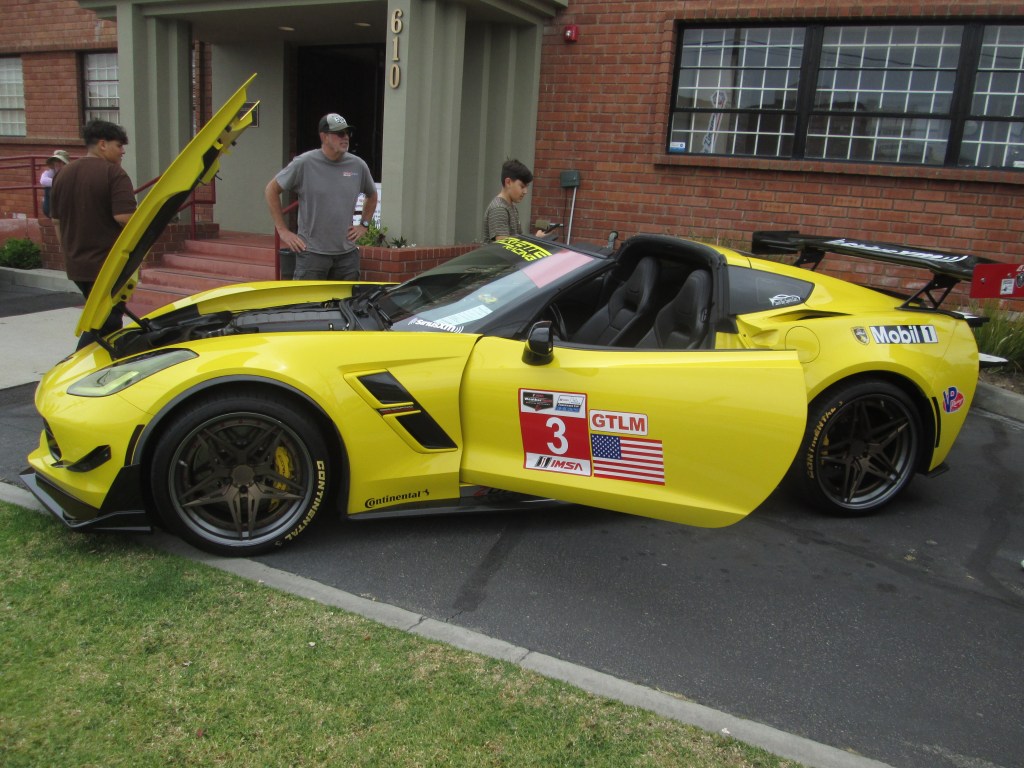
On Saturday, Martine and I went to the Zimmerman Automobile Driving Museum (ZADM) in El Segundo. Martine has always loved Corvettes, especially the classic models of the 1960s.
There were over sixty Corvettes on view, surrounded by Corvette aficionados and the cars’ affable collector/owners. Martine loved talking to the owners about how much she hates bucket seats, and how they should bring back bench seats. That’s not terribly likely to happen because, as one of the owners remarked, you need bucket seats if you are racing on a slalom course (which is not something Martine is likely to do).
The ZADM has become a meeting place for collectors with show cars of various models. I(n a couple of weeks, they will have another show on B-Body cars, which were manufactured by GM originally for Buick and Oldsmobile before spreading to their other makes and models.








You must be logged in to post a comment.