Monsoon Monday

Mexican Monsoon Clouds Over Arizona

Mexican Monsoon Clouds Over Arizona

Generally speaking, it doesn’t rain in Southern California between March and December. The only exception is when we catch the northern edge of a Mexican monsoon, as we did yesterday and today. When we stepped out of the Albertson’s Supermarket yesterday around 2 pm, Martine and I were surprised to see the ground was wet and our car was covered with droplets. “Oh great!” I thought. “This’ll be another dirty drizzle that craps up my car windshield.”

It was more however. In nearby Venice, a young man died when he was struck by lightning, and ten people were hauled off to the hospital. While waiting for our friends Bill and Kathy to arrive, we heard thunder. Then, this morning, one of my co-workers from Redondo Beach said that she had lost her power three times during the night and that there was frequent lightning. Neither Martine nor I experienced anything like that in West Los Angeles,  only about twelve miles north of her.

One would think that the rain—such as it was—would at least ameliorate our dire drought conditions. No such luck! The rain evaporated within minutes, leaving behind only a sticky and uncomfortable humidity.

It reminds me of Florida. My mother moved to a senior condo in Hollywood several years after my father died in 1985. I would visit her from time to time, but I could never find a comfortable season. Every time I stepped off a plane in Florida, I felt as if I were being hit in the face with a big wet towel; and that feeling would persist the whole time of my visit.

I could never be comfortable in a humid climate. The summers in Cleveland were, I thought, dreadful. When a Peruvian acquaintance suggested I visit the jungle area around Iquitos, I begged off quickly. The humidity is bad enough, but the mosquitoes and tropical diseases were more than I could stand. Don’t forget, I like to take vacations in places like Iceland, Patagonia, and the Andes.
Listening to Irish Music

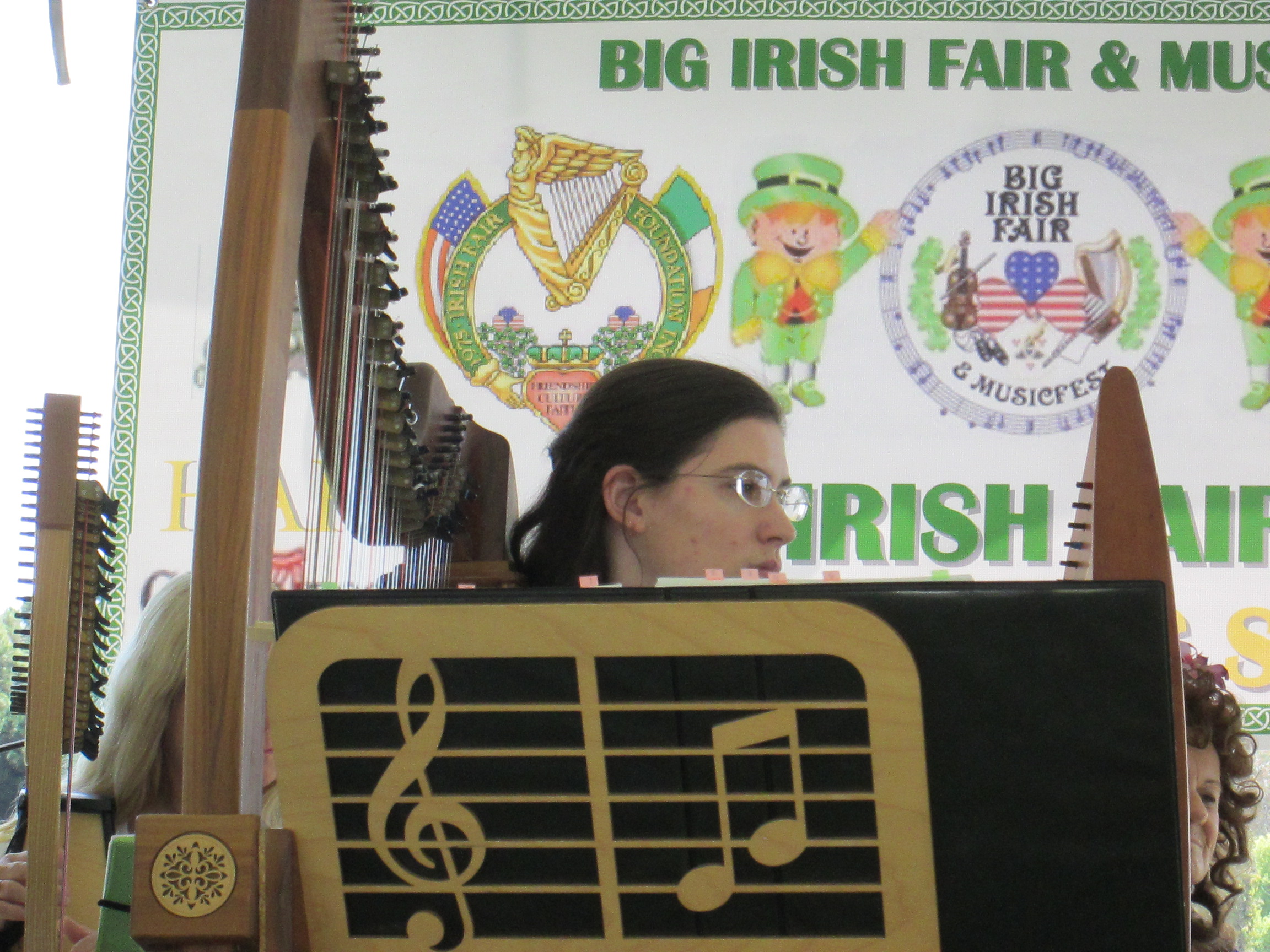
Playing the Celtic Harp

Playing the Celtic Harp

The Big Irish Fair that Martine and I attended last Sunday was mainly for the music (and not to be catapulted into the afterlife by a rampaging sheep—about which see yesterday’s post). Martine and I spent most of our time listening to Celtic harp solos and ensemble playing by a group primarily from Orange County. Soloists included Dennis Doyle and Joanna Mell, who were excellent. Martine was particularly eager to listen to attend as she had never heard any live before. And I enjoyed it as much as she did.

Kathy Sierra and Maggie Butler of Golden Bough

Kathy Sierra and Maggie Butler of Golden Bough

On the same stage where the harps were played, there was also a talented trio from Modesto that performs Celtic music under the name of Golden Bough. I couldn’t get a good photo of all three playing at the same time, so I inadvertently cut out the multi-talented Paul Espinoza. In addition to playing the harp, they also played half a dozen other instruments in their concert of music from Ireland, Scotland, Brittany, and Spanish Galicia. I was impressed at the fact that they kept their end up for more than an hour and a half without taking a break and with no diminution of quality.

Irish Stepdancing

Irish Stepdancing

Finally, because I am a dirty old man at heart, I convinced Martine to watch the Irish stepdancing competition so that I could stare at the young legs of the bewigged teen dancers. I do not profess to understand the popularity of stepdancing. (It doesn’t hold a candle to Hungarian folk dancing, such as practiced in L.A. by the Kárpátok Hungarian Folk Ensemble—though I may be prejudiced—but the young Irish girls did have cute legs.)

There was also a lot of bagpiping, but nothing close to the standard of what we heard in Scotland.

Death by Charging Sheep?

Bad Dog!

Bad Dog!

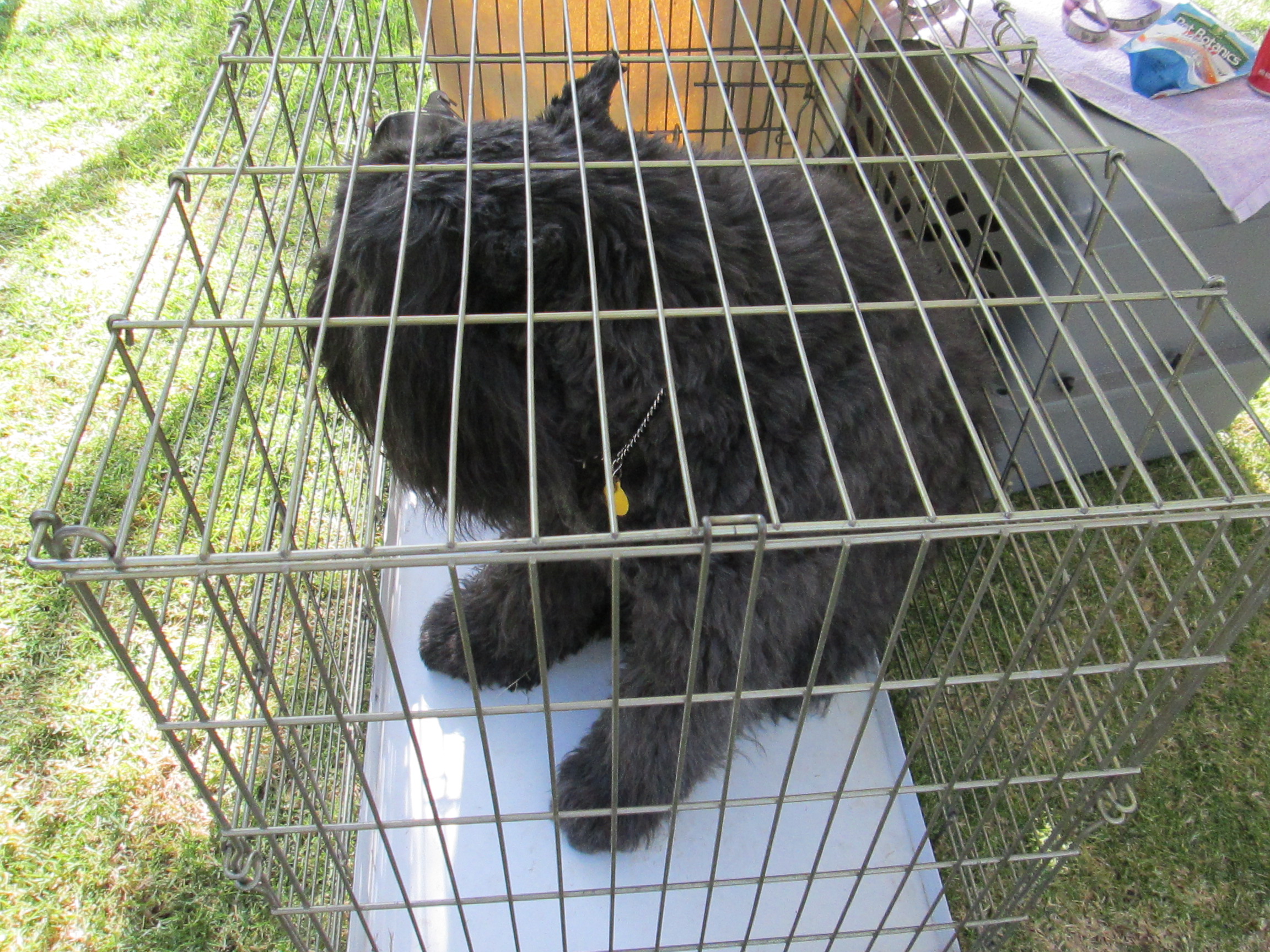
Yesterday, Martine and I went to a large Irish Fair held at El Dorado Park in Long Beach. Thanks to an extremely fine perception of space, I was missed by a fraction of an inch by a charging sheep during the sheepherder dog demonstration.There I was, standing on the sidelines between two tents when, suddenly, someone let the Bouvier des Flandres out of his cage (above), and he charged the sheep, sending them scattering at top speed in all directions. Although the Bouvier was at the show, he was not yet trained to herd sheep without representing a threat to them. The upshot was, I saw my life pass in front of my eyes while being charged by one of the sheep. Before I knew it, all of them had disappeared behind a line of port-a-potties.

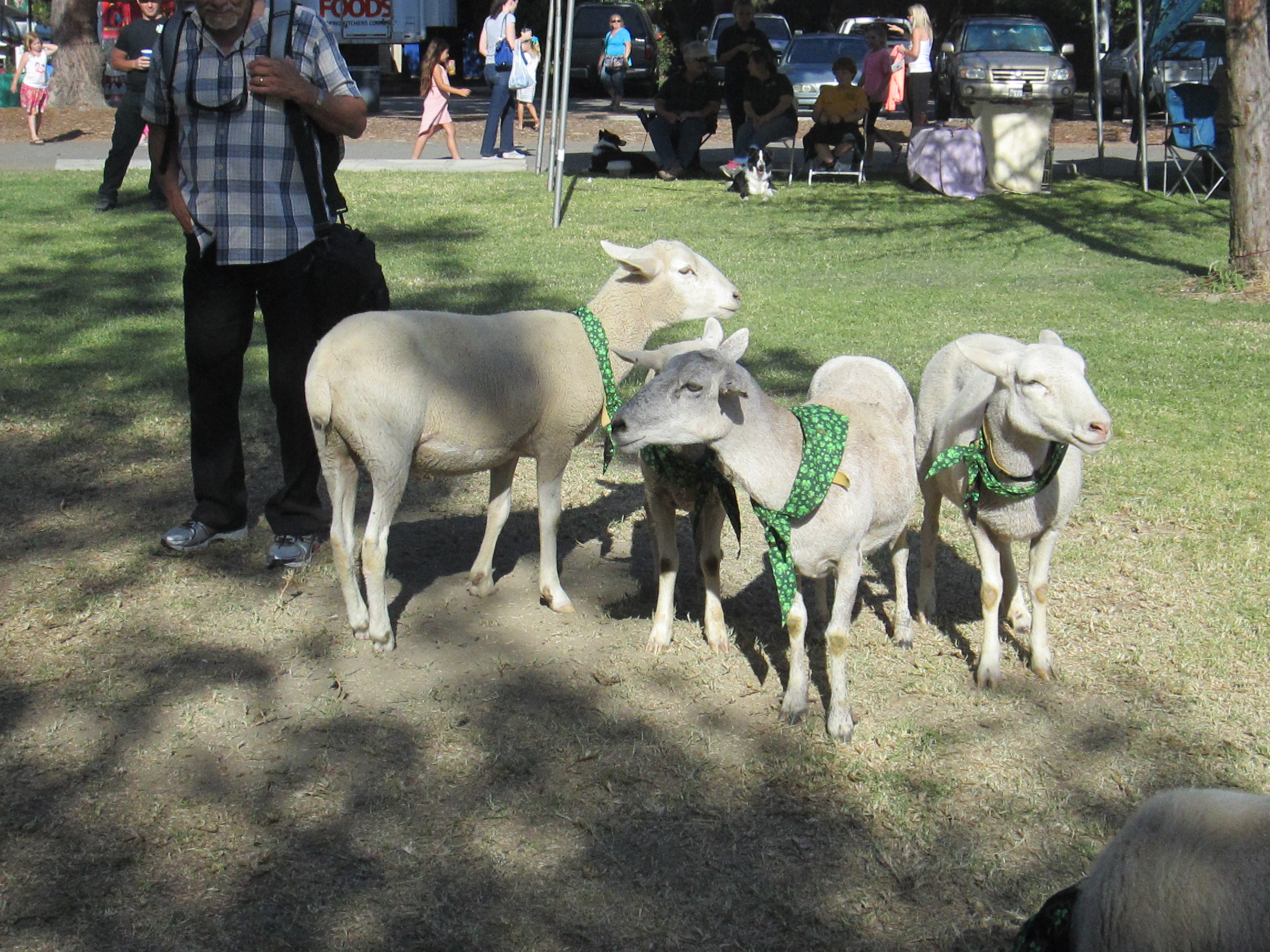
Within ten minutes, however, the real trained sheep dogs had rounded up the miscreant lambchops (see photo below) and brought them back to the demonstration area. The Bouvier was likewise found and promptly caged.

One of These Sheep Came Close to Head-Butting Me into the Next World

One of These Sheep Came Close to Head-Butting Me into the Next World

In the end, I found the sheepherding demonstration so interesting that I forgot my former peril. The music at the fair was great (more about that later). The only thing I didn’t like was the food. I never thought of cajun franks, funnel cakes, and kettle corn as being particularly Irish. There wasn’t a trace of lamb stew in evidence, nor even baked tatties. But that’s to be expected when there was a single caterer who brought along a fleet of highly miscellaneous food trucks.

Shaky Town

The Aftermath of the 5.1 La HabraQuake

The Aftermath of the 5.1 La Habra Quake

In Citizens Band (CB) radio parlance, Los Angeles is called Shaky Town because of our earthquakes. It’s even in the C. W. McCall song “Convoy” that marked the apogee of the whole CB craze in the 1970s. (I suppose that’s marginally better than the truckers’ parlance for San Francisco: Gay Bay.)

We have been shaking often, but in a small way, ever since the quake swarm began a couple of weeks ago. The actual shaking was not great where we live, because we are some 25 miles from the epicenter, but there is always that sickening few seconds when you wonder whether the intensity is going to ramp up into something more devastating, like the 1971 Sylmar or 1994 Northridge catastrophes. But all that’s happened to me so far is that three or four books have fallen off their overcrowded shelves.

The activity has been along the La Puente Fault, which runs from downtown south and then east. I believe it’s the same fault that was in play for the 1987 Whittier Narrows quake, which I had the good fortune to miss because I was camping in New Mexico at the time. But because it touches downtown, the emergency officials are concerned it may knock down a skyscraper or two—maybe even City Hall.

There have been so many hundreds of aftershocks that I am beginning to think we dodged the bullet this time. When there are so many aftershocks, it’s unlikely any of them can be viewed as fore-shocks, or even five-shocks—or worse.


It’s Like … Whatever

You’ll Never Guess the Most Frequently Used Word

You’ll Never Guess the Most Frequently Used Word

Today I had to work in an un-air-conditioned high rise on a day when the temperature rose into the 90s. Midway through, I took a break and walked over to the UCLA campus, where I had lunch and hung out in the student bookstore for a while. Along the way (it was one mile in each direction), I heard snippets of a lot of conversations. You’ll never guess what the most frequently used work was. It was, like, like.

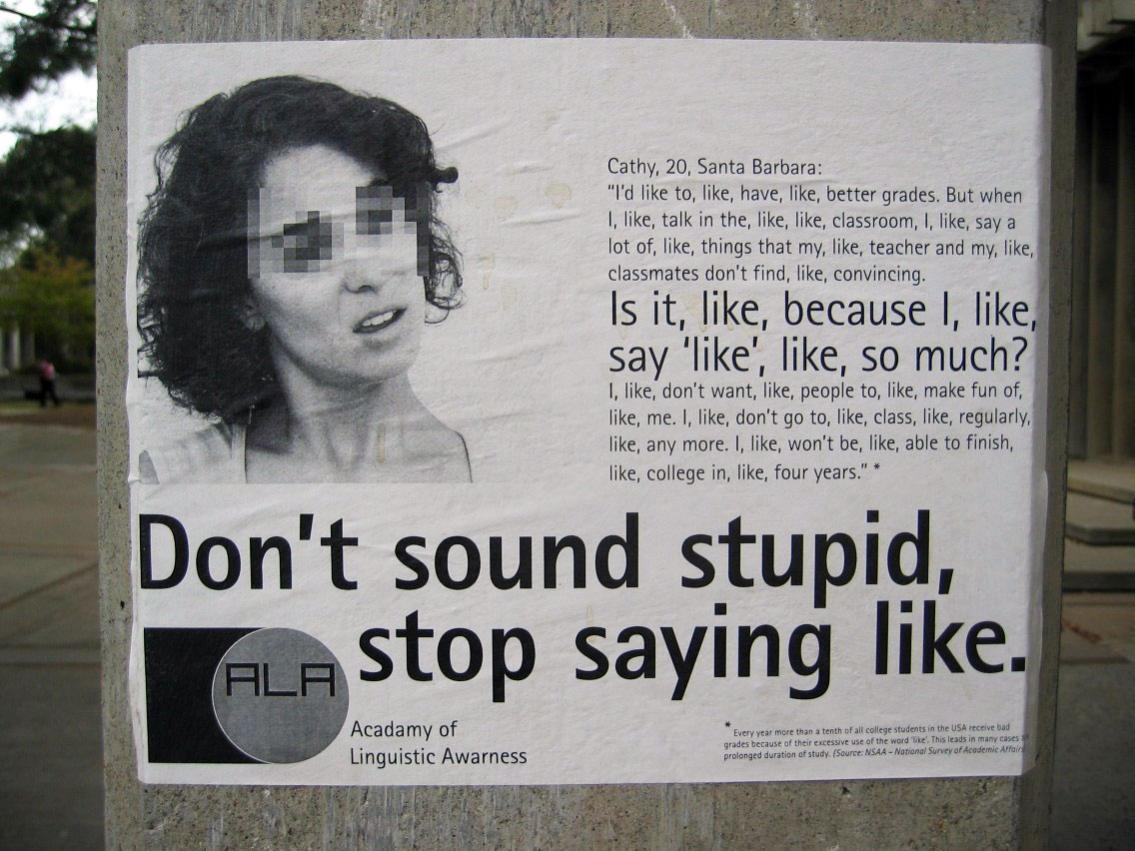
Let’s get Bill O’Reilly involved in this, because it looks as if there is a concerted attack by young women on the verb “to be.” Nothing any more is, it is “like.” It’s much worse than the War on Christmas or the Amphibious Assault on Arbor Day. When was it that young women realized they they weren’t anything in particular, just “like” something. The similes multiply so much that it resembles this at times:

Is Moon Unit Zappa to Blame for All This?

Is Moon Unit Zappa to Blame for All This?

By the way, note the misspelling of the word “Academy” in the lower left of the above illustration. That’s what happens when one starts over-using the word “like.” A certain level of brain rot takes place, and it spreads to other areas. I think it all started with Moon Unit Zappa singing “Valley Girl” back in 1982. Almost overnight, young women adopted the idiom:

Like, OH MY GOD! (Valley Girl)
Like-TOTALLY (Valley Girl)
Encino is like SO BITCHEN (Valley Girl)
There’s like the Galleria (Valley Girl)
And like all these like really great shoe stores
I love going into like clothing stores and stuff
I like to buy the neatest mini-skirts and stufl
It’s like so BITCHEN cuz like everybody’s like
Super-super nice…
It’s like so BITCHEN..,

On Ventura, there she goes
She just bought some bitchen clothes
Tosses her head ’n flips her hair
She got a whole bunch of nothin’ in there.

Yep, it sure sounds like “a whole bunch of nothin’ in there.” Wonder what they sound like in philosophy class trying to discuss something, like, really PROFOUND. Oh, like whatevah!

Bird of Paradise

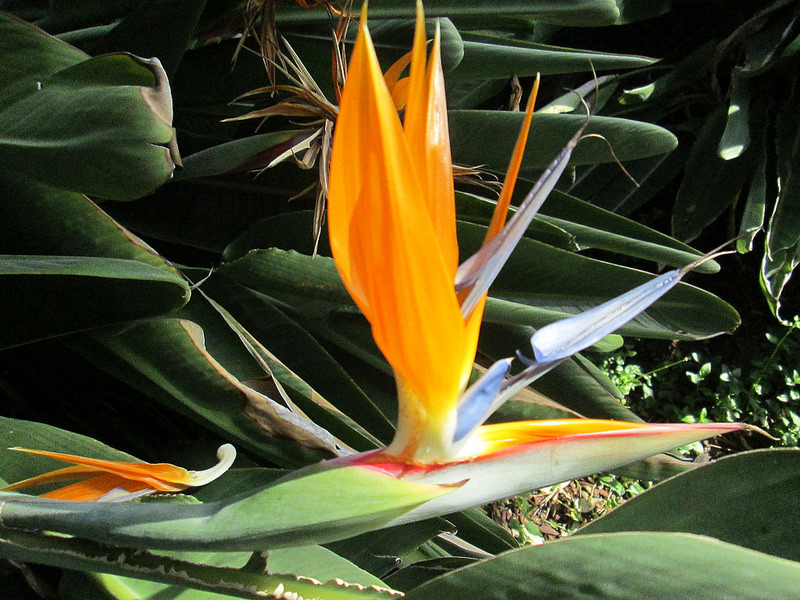
Bird of Paradise at Los Angeles Arboretum

Strelitzia reginae at Los Angeles Arboretum

Even before I came to Los Angeles for the first time in 1966, I could identify the Bird of Paradise, or Strelitzia reginae. For me, it always represented the exoticism of the tropics. It went with all those palm trees and other flora that one never found in Cleveland or New Hampshire. There is a funny thing about those exotic plants, including the Bird of Paradise. Whereas Eastern plants are more tactile, the palms and flowers in Southern California are not friendly to the touch.

That is especially true of palm trees. When I found out that rats like to live in palm trees, I lost all interest in touching them. As for the Bird of Paradise, which is actually an import from South Africa, where it is called the Crane Flower, it has no inviting scent, nor is it soft and approachable. It’s like many succulents, many of which are interesting looking, but do not reward close scrutiny.

Sometimes I wonder if the people in Los Angeles resemble the local plant life in that regard. We’re all from somewhere else, like the Bird of Paradise, but we’re hard tom get to now. There is a certain feeling of noli me tangere. (Do not touch!)

Attack of the Killer Fungus

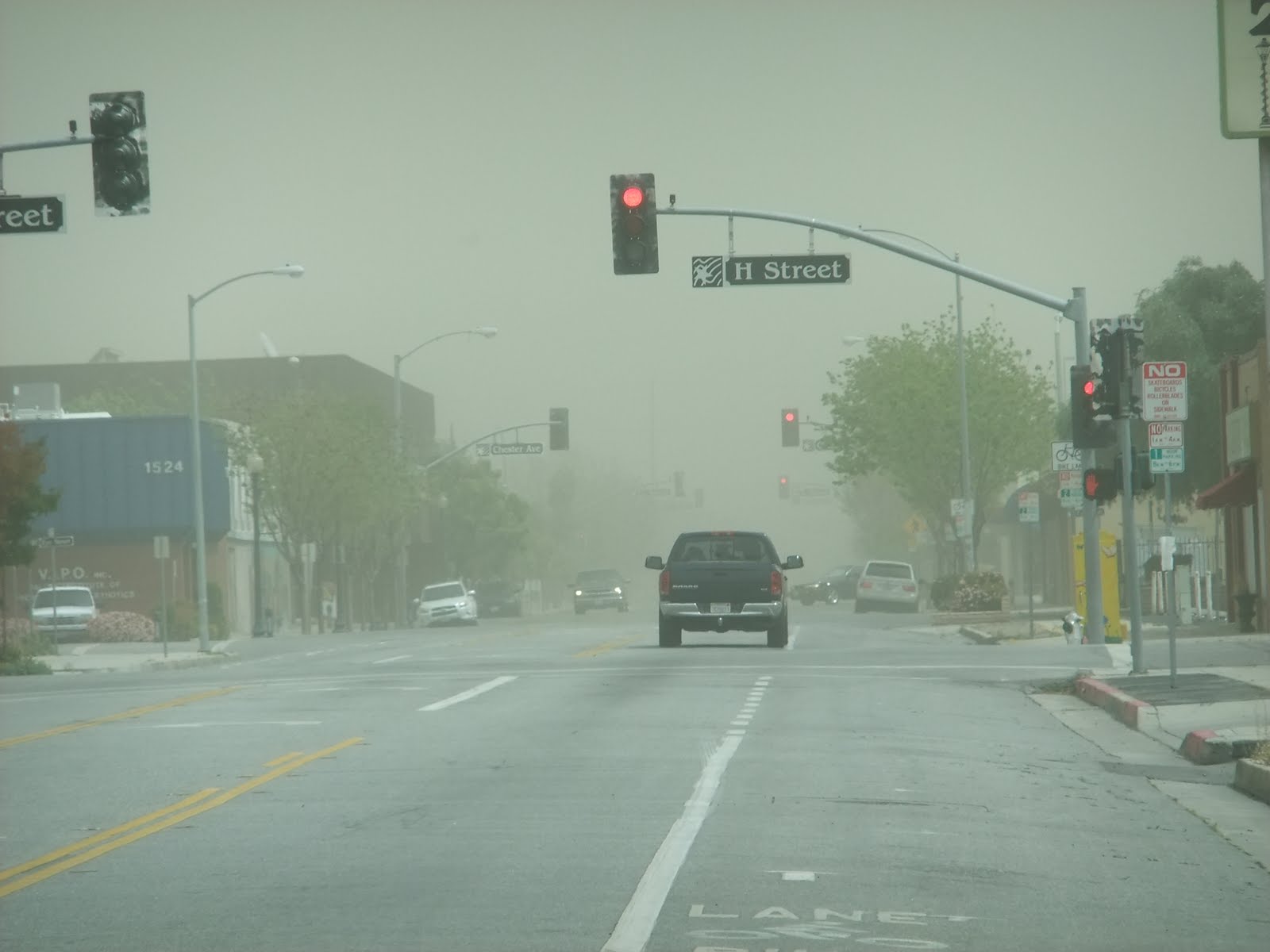
Bakersfield in a Windstorm

Bakersfield in a Windstorm

I have always felt that, as long as I’ve lived in the American Southwest, I’ve never wanted to live somewhere that had the word “Valley” in its name. After reading Dana Goodyear’s article entitled “Devil Dust” in the January 20, 2014 issue of The New Yorker, I find that I have better reasons for saying this than ever before. The culprit is a deadly fungus that dwells in the soil called Coccidiotes immitis, which causes a disease for which there is no cure called coccidioidomycosis, better known as Valley Fever:

C. immitis is adapted to lodge deep: its spores are small enough to reach the end of the bronchioles at the bottom of the lungs. We can breathe them in, but we can’t breathe them out. Once in the lung, the spore circles up into a spherule, defined by a chitinous cell wall and filled with a hundred or so baby endospores. When the spherule is sufficiently full, it ruptures, releasing the endospores and stimulating an acute inflammatory response that disrupts blood flow to the tissue and can lead to necrosis. The endospores, each of which will become a new spherule, travel through the blood and lymph systems, allowing the cocci to spread, as one specialist says, “anywhere it wants.” In people with weakened immune systems, cocci can take over.

Unfortunately, cocci, as it’s called, is endemic throughout the desert Southwest, as well as the desert portions of Central and South America. When there is  building, farming, clearing, or drilling activity, it gets stirred up and transported by the hot winds that characterize the deserts of the New World.

From 1998 to 2011, the Centers for Disease Control reported a 1,000% increase in the number of reported cases. The sad thing is that, because the more temperate areas are unaffected, there is less likelihood of a pharmacological solution to the disease. I’m sure that scientists in Europe and the Eastern part of the United States would prefer to find solutions to diseases that are much more widely disseminated.

So consider me a lifelong non-dweller in the valleys of California. I don’t care how cheap the housing is!


Tarnmoor’s ABCs: Earthquakes

Earthquake Fissure in Road

Earthquake Fissure in Road

I was very impressed by Czeslaw Milosz’s book Milosz’s ABC’s. There, in the form of a brief and alphabetically-ordered personal encyclopedia, was the story of the life of a Nobel Prize winning poet, of the people, places, and things that meant the most to him. Because his origins were so far away (Lithuania and Poland) and so long ago (1920s and 1930s), there were relatively few entries that resonated personally with me. Except it was sad to see so many fascinating people who, unknown today, died during the war under unknown circumstances.

This blog entry is my own humble attempt to imitate a writer whom I have read on and off for thirty years without having sated my curiosity. Consequently, over the next few months, you will see a number of postings under the rubric “Tarnmoor’s ABCs” that will attempt to do for my life what Milosz accomplished for his. I don’t guarantee that I will use up all 26 letters of the alphabet, but I’ll do my best.

If there is any natural phenomenon that frightens me, I would have to say it is earthquakes. During my years in Southern California, I have lived through two big ones: The Sylmar earthquake on February 9, 1971 (Richter 6.6) and the Northridge earthquake of January 17, 1994 (Richter 6.7).

On Friday, we had a small tremor centered on nearby Marina Del Rey. It was only a 3.2, but I acted as if it were just the start of a much bigger shake. Sitting in my library reading Proust, I dropped the book, jumped clear over the hassock and headed to the hallway just outside my bathroom to brace myself for what (perhaps) was to come. It didn’t. In the meantime, Martine peered around the corner and asked what was wrong. Did she feel the quake? Yes, but it was only a tiny one. But there I was, standing in the doorway with my heart racing, preparing myself for the worst.

The origins of my fear go back to 1994, when I used to sleep on an improvised futon in my living room. It was around 4:30 am when the earth began to shake in the darkness of the pre-dawn hours. Lights flashed whenever a nearby transformer exploded. Things were falling down from the walls and shelves, and some of them even rolled to where I was lying in terror as the sounds and smells and shaking had incapacitated me. What happened immediately after, I don’t recall because I actually lost my memory. All I know was that I was picked up by the police several hours later carrying two gallon jugs of purified water on Santa Monica Boulevard with blood flowing down my right leg.

Little by little, my terror subsided, only to be ramped up again with each aftershock. The damage caused by the quake was substantial: some nearby buildings were askew, and my kitchen had to be cleaned up with a shovel.

Ever since then, I do not go to bed without laying out all my clothes for the next day on a chair between the bedroom and the front door. Walking barefoot on broken glass and crockery is not a pleasant experience. So even now, a small temblor is capable of bringing back the terror, for however short a time.


Front Lawns and Drought

Where Does Our Obsession With Front Lawns Come From?

Where Does Our Obsession With Front Lawns Come From?

There is something wrong with our obsession with front lawns. Other than serving to set back a house a little further from the noise of the street, what purpose does it serve? Kids don’t play on front lawns so much as they do with back yard lawns. (Actually, in this era of video games, they are not likely to play outside at all.) Yet it seems that manicuring a front lawn is one of the badges of middle class life in the suburbs.

We are now experiencing a terrible drought in California, probably the worst in recent history. Although we are now between rainstorms after receiving a good drenching last night, we are so far from normal that March would have to be the wettest on record to move the water gauge any appreciable amount. Perhaps now is the time to consider front yards that are more in line with the flora of our tropical savanna climate, such as succulents and other xerophytic plants that typically grow in desert regions. As a simple matter of aesthetics, I don’t see why a green lawn such as the one shown above is preferable to a mix of desert plants, which can be quite beautiful, especially when they flower.

Please note that my comments are directed more to the apparently decreasing rainfall of the American Southwest than to other parts of the country, where desertification is less of an issue. If you are currently under water, feel free to sow those grass seeds wherever you can.


The Great Drought of 2014

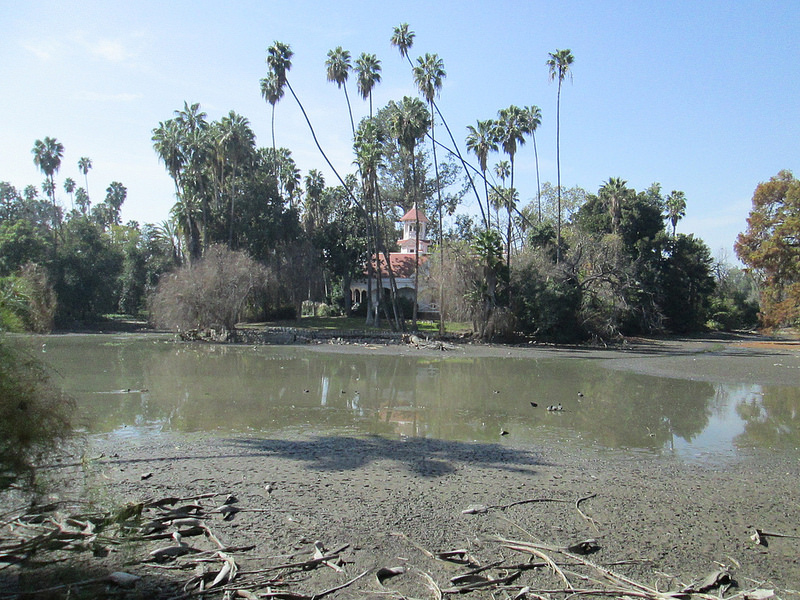
Baldwin Lake—Now a Mudhole

Baldwin Lake—Now a Giant Mudhole

The California drought of 2014—the worst recorded in the State’s history—was brought home quite suddenly to Martine and me when we visited the Los Angeles Arboretum today. Baldwin Lake, which in normal years looks so beautiful (see photo below) is now a giant mudhole. Typically, the lake is fed from runoff from current rainfall, of which, for iall intents and purposes, there has been none this year.

Migrating ducks and geese still made it a stopover, and Martine was ready for them with some day-old bread. But the fish in the lake looked as if they were gasping for breath. It was heartbreaking.

Baldwin Lake in Better Times

Baldwin Lake in Better Times

We still had a good time at the Arboretum. The Canada Geese were actually not too proud to accept Martine’s bread, The mallards and squirrels also came up to her for handouts.

I am hoping that our drought will eventually come to an end. I would hate to think that Los Angeles would become like Chile’s awful Atacama Desert, where there is almost no measurable rain over an entire century.