A Cultural Treasure

Liao Chiung-Chih, the Embodiment of Taiwanese Opera

Liao Chiung-Chih, the Embodiment of Taiwanese Opera

Today, Martine and I did something a little different. The Taiwan Academy had a film, presentation, and performance by the star of the Taiwanese Opera, Liao Chiung-Chih. Most of the presentation was in the Taiwanese dialect, but it didn’t matter, because I was enthralled from start to finish. Ms. Liao was phenomenal: I have never seen anyone with her extraordinary control of voice and movement. After a short film, she demonstrated several vocal singing styles, followed by a library of hand, foot, and torso gestures—and this at the age of approximately eighty.

While we did not understand a word of the language, we appreciated an artistry that goes far beyond anything that performers in the West are called upon to demonstrate. Ms. Liao kept me on the edge of my seat for two hours. There was a translator with a microphone, but still many sentences got lost. It almost didn’t matter, however, because the actress’s talent was so apparent that it almost obviated the need for translation.

At the end, of her presentation, Two performers from the Taiwan Opera, Chang Meng-I (below right) and Hwang Yea-Rong (below left), acted a sequence from one of the most famous operas in the genre, The Butterfly Lover. Based on a folktale some 1,600 years old, the opera can be traced to the Jin Dynasty. It has become the Chinese equivalent of Romeo and Juliet, with their star-crossed lovers, Liang Shanbo and Zhu Yingtai.
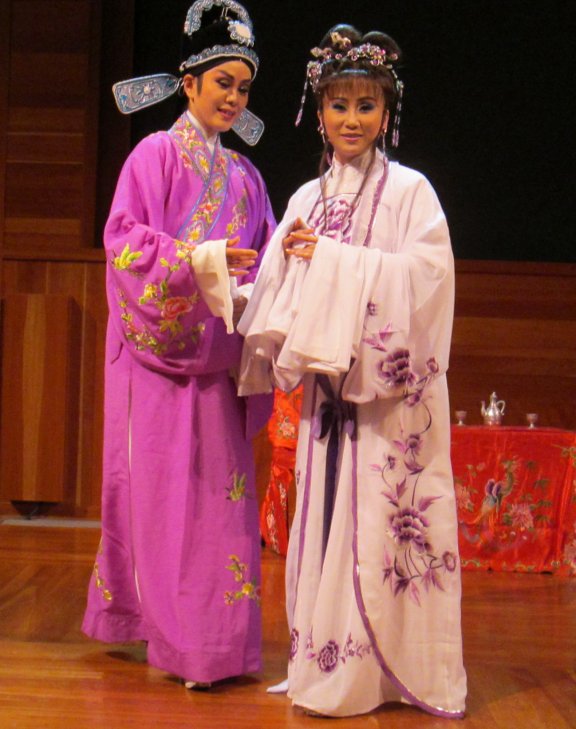
Two Taiwanese Opera Performers Dressed for a Scene from The Butterfly Lover

Two Taiwanese Opera Performers Dressed for a Scene from The Butterfly Lover

Originally, I thought I was going to have to work on taxes today, but I got a last-minute reprieve. So we took the bus to the main branch of the Los Angeles Library downtown, where the performance was held in the Mark Taper Auditorium. Sponsoring the event was the Taiwan Academy, which has opened a branch in Los Angeles.

Below is a photo of Liao Chiung-Chih made up as a character in the Taiwan Opera:

This Woman Is Eighty Years Old?

This Woman Is Eighty Years Old?
Some Kewpie Dolls for You

Kewpie Dolls at Grier Musser Museum

Kewpie Dolls at Grier Musser Museum

I had always heard of kewpie dolls before, but today was the first time I saw some of them. Apparently, they were originally a comic strip character invented by Rose O’Neill back in 1909. Their popularity took a number of forms, and they were popular and well-known through the 1940s. I always associated them with game prizes given at carnivals.

If you look closely, you will see my hands wrapped around my Canon PowerShot A1400 reflected in a mirror behind the dolls. Martine and I had paid another visit to the Grier Musser Museum, where there was an exhibit of antiques relating to Valentine’s Day, Chinese New Year, and Black History Month.

Afterwards, we had a nice conversation with Ray and Susan Tejada, who own the museum and live on the premises. Visitors to their special Sunday tours are treated to cookies and punch, which Martine loves.


Cuddly-Looking, But Don’t Touch!

Backlit Cholla Cactus

Backlit Cholla Cactus

It’s hard to believe that Martine and I left for the Anza Borrego Desert two weeks ago today. Thanks to the multiple daily crises of a tax season, it’s almost as if it never happened. Except, the desert does something to me: Somehow I feel better able to tolerate the mess and the tension. Last year, I wanted to leave for a few days to the Owens Valley—another prime desert locale—but we couldn’t find the time.

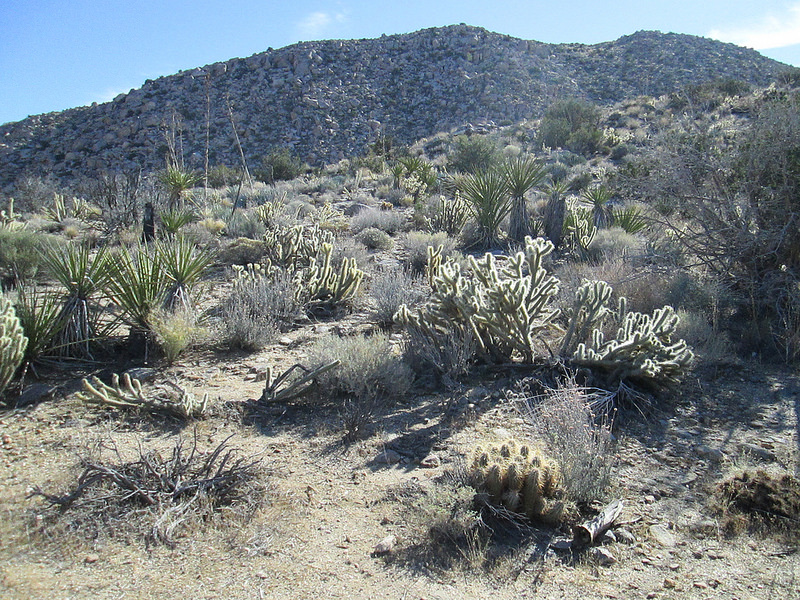
One of the most beautiful plants in the deserts of California is the cholla cactus. It is also one of the most deadly, because its spines are slightly barbed. They detach easily if one brushes against the plant and can usually be removed safely only with the help of a comb.

There are many different species of the Cylindropuntia genus, including the aptly named teddy bear cholla and the jumping cholla (the latter because the spines seem almost to jump at you).

When backlit, cholla cactus plants are luminescent, as in the picture above.


On the Butterfield Overland Trail

Reconstructed Vallecito Stage Station

Reconstructed Vallecito Stage Station

Along the edges of the Anza Borrego State Park are a couple of San Diego County Parks on Highway S-2: One is the Vallecito Regional Park and, a little further down the road, a natural hot springs park at Agua Caliente. After taking our hike down to what remains of the Butterfield Stage Route at Box Canyon, we headed to Vallecito for lunch.

At Vallecito is a reconstruction of the original stage station that served as a place to rest and change horses on the Butterfield Overland Trail between 1858 and 1861. One traveler in 1859 referred to the station as being located in “a beautiful green spot—a perfect oasis in the desert.” (In fact, it’s the first real green spot on the trail west of Yuma, Arizona.) And so it was for Martine and me. We picked out a shady picnic table and reached into our bags for the groceries we had bought that morning in Borrego Springs, looked around at the exhibits in the stage station, and hung around until we were ready for our next hike.

The Butterfield Overland Trail was in use for such a short time primarily because of the Civil War. The route between San Antonio, Texas, and San Diego went through too much Confederate territory; and, besides, a transcontinental railroad was already in the works. Once that was completed in 1869, stagecoaches were on their way out, at least for long distance transport.

One of the few descriptions of the experience of stage travel comes from Mark Twain in Roughing It (1859), which tells of a journey by stagecoach between Missouri and Carson City, Nevada Territory:

Our coach was a great swinging and swaying stage, of the most sumptuous description—an imposing cradle on wheels. It was drawn by six handsome horses, and by the side of the driver sat the “conductor,” the legitimate captain of the craft; for it was his business to take charge and care of the mails, baggage, express matter, and passengers. We three were the only passengers, this trip. We sat on the back seat, inside. About all the rest of the coach was full of mail bags—for we had three days’ delayed mails with us. Almost touching our knees, a perpendicular wall of mail matter rose up to the roof. There was a great pile of it strapped on top of the stage, and both the fore and hind boots were full. We had twenty-seven hundred pounds of it aboard, the driver said—“a little for Brigham, and Carson, and ’Frisco, but the heft of it for the Injuns, which is powerful troublesome ’thout they get plenty of truck to read.”

Looking for the Way Down

Error
This video doesn’t exist

“Well, How the Hell Did They Get Through Here, Then? … They Couldn’t Have!”

Apparently, my Canon PowerShot A1400 camera can shoot videos—especially when I don’t recall ever hitting the Record button. Here, you can see Martine and my attempt to get down to the remnants of the Butterfield Stage Route as it cut through Earthquake Valley in Anza Borrego. We were walking along the edge of Highway S-2 looking for a trail that would lead us down to the bottom of the canyon. Unfortunately, there did not look to be any easy way, considering that we didn’t have our hiking staffs with us, and that Martine was not wearing hiking shoes.

Eventually, we got down there by a commodious vicus of recirculation, but by then I had discovered that my camera was shooting video.

Anza Borrego is a do-it-yourself type of hiking locale. Trails are not as well marked as in the national Parks, and sometimes they are not marked at all. You just turn off the road and look for what might be a trail. Sometimes you find one. Sometimes you don’t. No matter: The whole place is magical.

The REAL Old West

The Main Room of the Julian Pioneer Museum

The Main Room of the Julian Pioneer Museum

One of our favorite things to do in small towns in the West is to hunt up the local historical museum. Julian, California, was no exception. Our first full day in Anza Borrego, Martine and I slowly wound our way up the Banner Grade to the small mountain town that sits at the 5,000 foot (or 1,524 meter) level in a pine forest. It was a nippy day on top of the mountain, so we were delighted to find the Julian Pioneer Museum on Highway 78 right near the center of town, where we received a warm welcome.

It was cluttered, but with things redolent of the past and sometimes with a long historical pedigree. For instance, there were several bookcases with glass doors that belonged to President Ulysses S. Grant. He had sent them to his son in San Diego. Some of them found their way to Julian. There was also a chair that belonged to Pio Pico, the last Mexican governor of California, and a very worn pocket knife that once belonged to Zachary Taylor. On the rafters were taxidermy specimens of the local bird and mammal wildlife. There were carriages, a huge (the largest West of the Mississippi, it is claimed) collection of homemade lace, and the tools of the trade for several of the early professions in this Old West town.

Although it was forbidden to take pictures in the interior, I asked permission to take the above photo from the foyer.

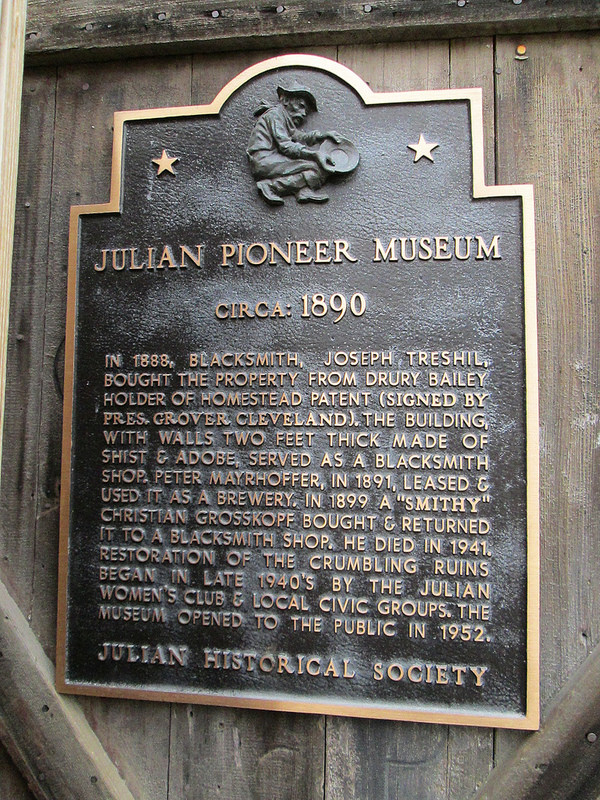
Originally, the building was a blacksmith shop built of the native Julian Schist back in 1890 (see bronze commemorative plate below), then a brewery, before once again becoming a blacksmith shop before winding up a ruin that was restored to become a museum back in 1952.

Commemorative Plaque Outside the Museum

Commemorative Plaque Outside the Museum

The Julian Historical Society did such a good job putting together the collections that I rank it with my two favorite California historical museums: the Laws Railroad Museum in California’s Owens Valley near Bishop and the Eastern California Museum, also in the Owens Valley, in Independence, right opposite the house of late writer Mary Austin, whose The Land of Little Rain is a California classic.

Much of what has been written about the Old West comes under the heading of “printing the legend” (q.v. John Ford’s The Man Who Shot Liberty Valance), but there is plenty to see that is real and fascinating. The Julian Pioneer Museum is one of those places.

And while you’re in Julian, don’t forget to drop in at Miner’s Diner for lunch and at one of the local bakeries for a great piece of apple pie.

Cooking with the Kumeyaay

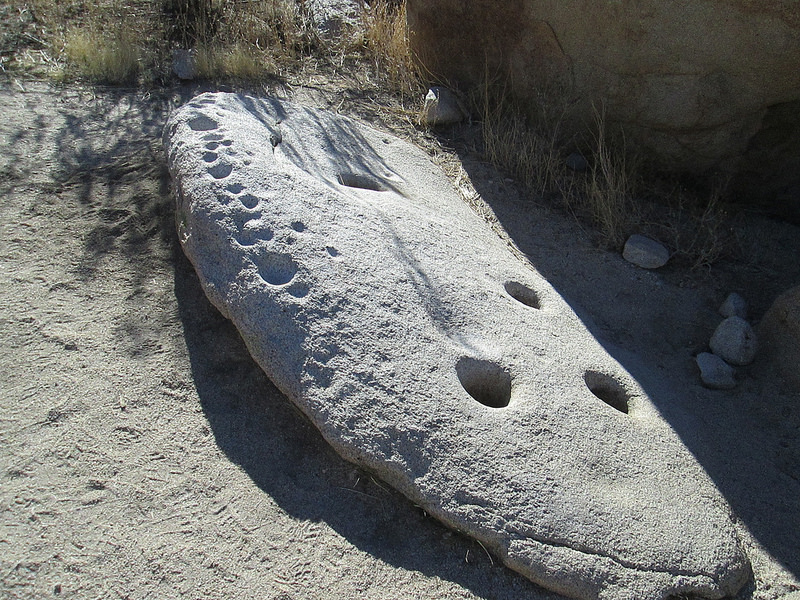
Morteros at Kumeyaay Village Site in the Blair Valley

Morteros at Kumeyaay Village Site in the Blair Valley

It’s maybe not what you or I would like to eat, but the Kumeyaay Indians of the Anza Borrego Desert managed to survive in a highly hostile environment eating roasted yucca leaves, cakes made with the flour of ground piñon pines, and whatever else they could concoct with the highly limited plant life of the area. The Blair Valley about four miles in from Highway S22 contains an unusual concentration of plant life (see photo below).

Kumeyaay women would find a rock to use as a mano (grindstone) and grind various edible cactus and juniper parts against rocks until depressions formed in them. These depressions (as shown above) were referred to as morteros. The Mortero Trail in the Blair Valley leads to a nicely sheltered “kitchen” area where there are numerous morteros and cupules (vertical morteros, probably for ceremonial purposes).

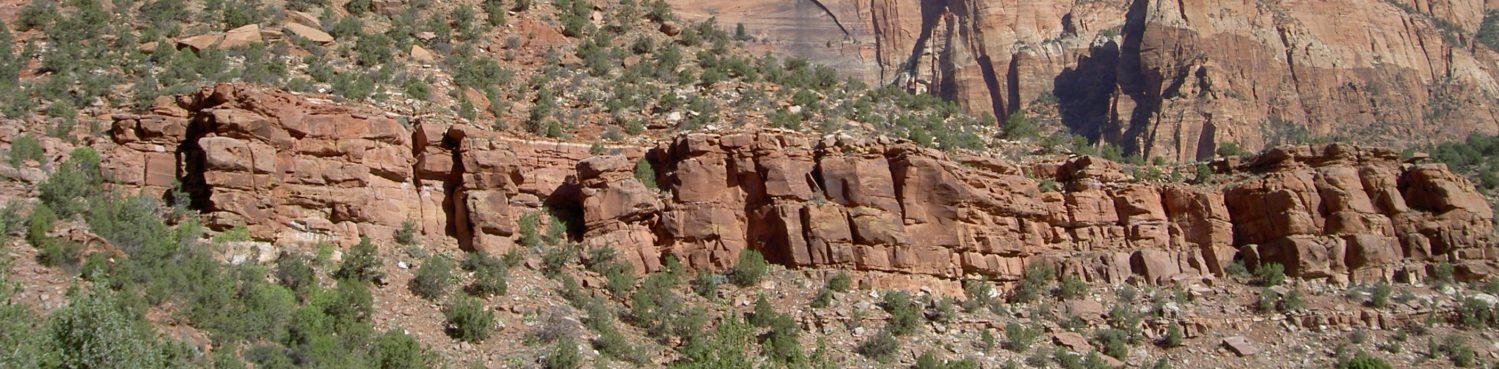
Lush Hillside in the Immediate Vicinity of the Kumeyaay Village Site

Lush Hillside in the Immediate Vicinity of the Kumeyaay Village Site

Sometimes I wonder what use the tribe made of the creosote bushes and cholla cacti that seem to predominate in the area, but my knowledge only goes so far. Suffice it to say that the Kumeyaay still survives as a tribe in several reservations in California and Mexico’s State of Baja California.

Martine did not like the trail very much, because the pamphlet describing sights along the way was incomplete due to vandalism or some other reason. I loved it and felt that the Kumeyaay village site was probably the most beautiful corner of the whole Anza Borrego desert region.


Reading in the Desert

Our Patio at the Borrego Valley Inn

Our Patio at the Borrego Valley Inn

Martine and I have just returned from four days in the Anza Borrego Desert, the largest contiguous state park in the United States. Compared to the larger National Parks, it is something of a poor orphan; but there is much to be seen. The only problem is it’s very much a do-it-yourself experience. The trails are not very well marked. On Friday, we took what we thought was the Narrows Trail off State Route 78, only to find that there was no clearly defined trailhead, no clearly defined trail, and a plethora of steps leading off in every direction. On Saturday we had better luck. Nonetheless, I even enjoyed our missteps.

Because she lived in Twenty Nine Palms for three years working at the Naval Hospital there, Martine does not value the desert as much as I do: I would not live there, but I find that a visit there helps clarify my mind and brings a sense of peace.

Shown above is our private patio at the Borrego Valley Inn in Borrego Springs. On the table are my two Kindles and a tall glass of ice water. I finally managed to finish reading Tony Judt’s massive Postwar: A History of Europe Since 1945, and I made a large dent in Junot Diaz’s The Brief Wondrous Life of Oscar Wao. While Martine watched television, I read hundreds of pages after returning from our day trips. The combination of exercise and reading concentrates the mind nicely.

In the days to follow, I will write several postings about our desert experiences.


Laser Light

Extreme Brightness

Extreme Brightness

The month of January is Southern California’s rainiest month. Usually. But not this year. So far, we have been treated to an endless round of Santa Ana winds and low humidity (around 10%). Right now, it’s about 85° Fahrenheit (that’s about 30° Celsius). If the temperature didn’t drop sharply at night, we would all be sweltering.

I just got back from lunch. The heat in this arid weather isn’t quite so uncomfortable as the laserlike light of the sun. It makes me wish I wore my baseball hat or some other brimmed headgear to protect my eyes. Although I wear photo optic glasses, they don’t provide sufficient protection from the sun’s fierceness. Years ago, I used to have super-dark prescription sunglasses. I’m beginning to think I should see my optometrist for another pair of those.

By Rail to the Past

Selected Gems amnd Minerals

Selected Gems and Minerals

I should have written this post last Sunday, when Martine and I took Los Angeles’s relatively new Expo Light Rail Line to the Natural History Museum, just south of the University of Southern California. We go there, on the average, once every year or two. It was good that we went last week because the Traveling the Silk Road exhibit was still running (it goes until April 13). It was well worth spending an hour or two to see.

It was fun taking the Expo Line because parking at the museum has always been a bit of a drag. Even though we had to catch the line at its temporary terminus in Culver City, we look forward to its extension westward to the beach in Santa Monica. There will be a station just one mile south of where we live, and it will take us all the way downtown and a number of interesting stopping points in between. It will run roughly along the line of Exposition Boulevard, where once the old Pacific Red Car ran in the days when Southern California was better served by public transportation. (If you’ve ever seen the 1988 cartoon/live action feature Who Framed Roger Rabbit?, you know what happened to the Red Car line.)

Triceratops on the Loose!

Triceratops on the Loose!

Of the museum’s permanent exhibits are the dinosaur hall (see above) and the gems and minerals (see illustration at top). There are other exhibits of note, but it would take two days to see them all. Also noteworthy are the exhibits of stuffed North American and African mammals, and a California history exhibit, which deserves to be seen by more visitors. After tax season, I wouldn’t mind checking out the collections again.

My favorite Natural History Museum program of all time was back in 2002, when they had an exhibit and a program of lectures about the Vikings. This was just after my 2001 trip to Iceland, and I was still buzzed—plus I got a chance to meet Jesse L. Byock, Professor of Old Norse and Medieval Scandinavian at UCLA, and Gisli Sigurðsson of the Árni  Magnússon Institute in Rekjavík (whose exhibit on “Vikings and the New World” I had seen at the Culture House in Rekjavík just months before). That was the high point of my relationship with the Natural History Museum: I even became a member for a year or two. Since then, I have been waiting and watching for another special event so in line with my interests.