Attack of the Killer Fungus

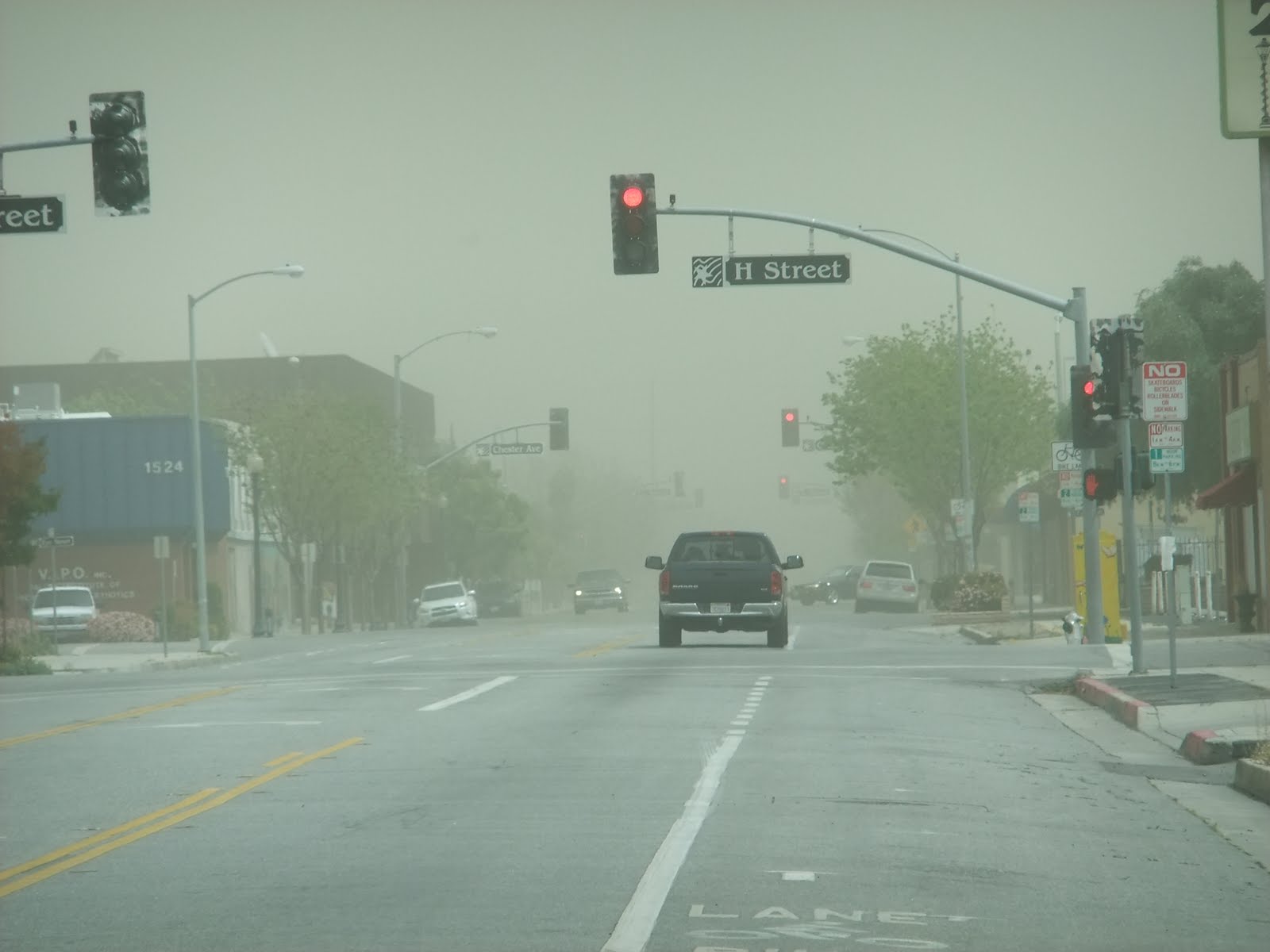
Bakersfield in a Windstorm

Bakersfield in a Windstorm

I have always felt that, as long as I’ve lived in the American Southwest, I’ve never wanted to live somewhere that had the word “Valley” in its name. After reading Dana Goodyear’s article entitled “Devil Dust” in the January 20, 2014 issue of The New Yorker, I find that I have better reasons for saying this than ever before. The culprit is a deadly fungus that dwells in the soil called Coccidiotes immitis, which causes a disease for which there is no cure called coccidioidomycosis, better known as Valley Fever:

C. immitis is adapted to lodge deep: its spores are small enough to reach the end of the bronchioles at the bottom of the lungs. We can breathe them in, but we can’t breathe them out. Once in the lung, the spore circles up into a spherule, defined by a chitinous cell wall and filled with a hundred or so baby endospores. When the spherule is sufficiently full, it ruptures, releasing the endospores and stimulating an acute inflammatory response that disrupts blood flow to the tissue and can lead to necrosis. The endospores, each of which will become a new spherule, travel through the blood and lymph systems, allowing the cocci to spread, as one specialist says, “anywhere it wants.” In people with weakened immune systems, cocci can take over.

Unfortunately, cocci, as it’s called, is endemic throughout the desert Southwest, as well as the desert portions of Central and South America. When there is  building, farming, clearing, or drilling activity, it gets stirred up and transported by the hot winds that characterize the deserts of the New World.

From 1998 to 2011, the Centers for Disease Control reported a 1,000% increase in the number of reported cases. The sad thing is that, because the more temperate areas are unaffected, there is less likelihood of a pharmacological solution to the disease. I’m sure that scientists in Europe and the Eastern part of the United States would prefer to find solutions to diseases that are much more widely disseminated.

So consider me a lifelong non-dweller in the valleys of California. I don’t care how cheap the housing is!


Tarnmoor’s ABCs: Earthquakes

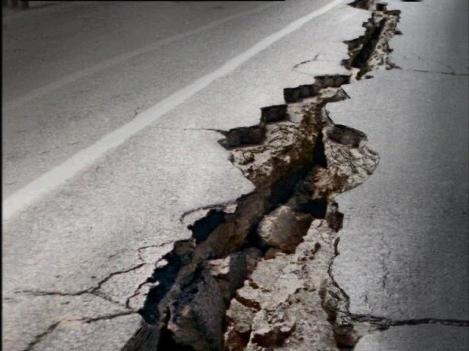
Earthquake Fissure in Road

Earthquake Fissure in Road

I was very impressed by Czeslaw Milosz’s book Milosz’s ABC’s. There, in the form of a brief and alphabetically-ordered personal encyclopedia, was the story of the life of a Nobel Prize winning poet, of the people, places, and things that meant the most to him. Because his origins were so far away (Lithuania and Poland) and so long ago (1920s and 1930s), there were relatively few entries that resonated personally with me. Except it was sad to see so many fascinating people who, unknown today, died during the war under unknown circumstances.

This blog entry is my own humble attempt to imitate a writer whom I have read on and off for thirty years without having sated my curiosity. Consequently, over the next few months, you will see a number of postings under the rubric “Tarnmoor’s ABCs” that will attempt to do for my life what Milosz accomplished for his. I don’t guarantee that I will use up all 26 letters of the alphabet, but I’ll do my best.

If there is any natural phenomenon that frightens me, I would have to say it is earthquakes. During my years in Southern California, I have lived through two big ones: The Sylmar earthquake on February 9, 1971 (Richter 6.6) and the Northridge earthquake of January 17, 1994 (Richter 6.7).

On Friday, we had a small tremor centered on nearby Marina Del Rey. It was only a 3.2, but I acted as if it were just the start of a much bigger shake. Sitting in my library reading Proust, I dropped the book, jumped clear over the hassock and headed to the hallway just outside my bathroom to brace myself for what (perhaps) was to come. It didn’t. In the meantime, Martine peered around the corner and asked what was wrong. Did she feel the quake? Yes, but it was only a tiny one. But there I was, standing in the doorway with my heart racing, preparing myself for the worst.

The origins of my fear go back to 1994, when I used to sleep on an improvised futon in my living room. It was around 4:30 am when the earth began to shake in the darkness of the pre-dawn hours. Lights flashed whenever a nearby transformer exploded. Things were falling down from the walls and shelves, and some of them even rolled to where I was lying in terror as the sounds and smells and shaking had incapacitated me. What happened immediately after, I don’t recall because I actually lost my memory. All I know was that I was picked up by the police several hours later carrying two gallon jugs of purified water on Santa Monica Boulevard with blood flowing down my right leg.

Little by little, my terror subsided, only to be ramped up again with each aftershock. The damage caused by the quake was substantial: some nearby buildings were askew, and my kitchen had to be cleaned up with a shovel.

Ever since then, I do not go to bed without laying out all my clothes for the next day on a chair between the bedroom and the front door. Walking barefoot on broken glass and crockery is not a pleasant experience. So even now, a small temblor is capable of bringing back the terror, for however short a time.



Front Lawns and Drought

Where Does Our Obsession With Front Lawns Come From?

Where Does Our Obsession With Front Lawns Come From?

There is something wrong with our obsession with front lawns. Other than serving to set back a house a little further from the noise of the street, what purpose does it serve? Kids don’t play on front lawns so much as they do with back yard lawns. (Actually, in this era of video games, they are not likely to play outside at all.) Yet it seems that manicuring a front lawn is one of the badges of middle class life in the suburbs.

We are now experiencing a terrible drought in California, probably the worst in recent history. Although we are now between rainstorms after receiving a good drenching last night, we are so far from normal that March would have to be the wettest on record to move the water gauge any appreciable amount. Perhaps now is the time to consider front yards that are more in line with the flora of our tropical savanna climate, such as succulents and other xerophytic plants that typically grow in desert regions. As a simple matter of aesthetics, I don’t see why a green lawn such as the one shown above is preferable to a mix of desert plants, which can be quite beautiful, especially when they flower.

Please note that my comments are directed more to the apparently decreasing rainfall of the American Southwest than to other parts of the country, where desertification is less of an issue. If you are currently under water, feel free to sow those grass seeds wherever you can.


The Great Drought of 2014

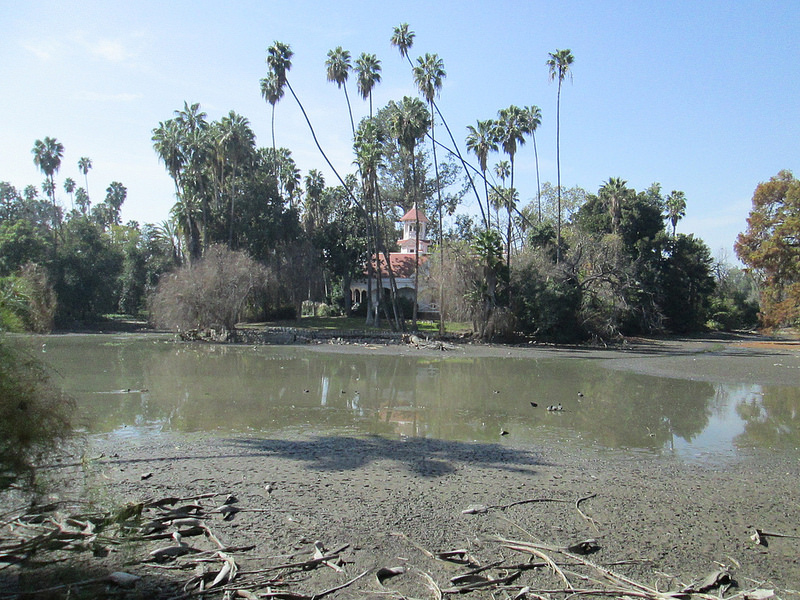
Baldwin Lake—Now a Mudhole

Baldwin Lake—Now a Giant Mudhole

The California drought of 2014—the worst recorded in the State’s history—was brought home quite suddenly to Martine and me when we visited the Los Angeles Arboretum today. Baldwin Lake, which in normal years looks so beautiful (see photo below) is now a giant mudhole. Typically, the lake is fed from runoff from current rainfall, of which, for iall intents and purposes, there has been none this year.

Migrating ducks and geese still made it a stopover, and Martine was ready for them with some day-old bread. But the fish in the lake looked as if they were gasping for breath. It was heartbreaking.

Baldwin Lake in Better Times

Baldwin Lake in Better Times

We still had a good time at the Arboretum. The Canada Geese were actually not too proud to accept Martine’s bread, The mallards and squirrels also came up to her for handouts.

I am hoping that our drought will eventually come to an end. I would hate to think that Los Angeles would become like Chile’s awful Atacama Desert, where there is almost no measurable rain over an entire century.


A Cultural Treasure

Liao Chiung-Chih, the Embodiment of Taiwanese Opera

Liao Chiung-Chih, the Embodiment of Taiwanese Opera

Today, Martine and I did something a little different. The Taiwan Academy had a film, presentation, and performance by the star of the Taiwanese Opera, Liao Chiung-Chih. Most of the presentation was in the Taiwanese dialect, but it didn’t matter, because I was enthralled from start to finish. Ms. Liao was phenomenal: I have never seen anyone with her extraordinary control of voice and movement. After a short film, she demonstrated several vocal singing styles, followed by a library of hand, foot, and torso gestures—and this at the age of approximately eighty.

While we did not understand a word of the language, we appreciated an artistry that goes far beyond anything that performers in the West are called upon to demonstrate. Ms. Liao kept me on the edge of my seat for two hours. There was a translator with a microphone, but still many sentences got lost. It almost didn’t matter, however, because the actress’s talent was so apparent that it almost obviated the need for translation.

At the end, of her presentation, Two performers from the Taiwan Opera, Chang Meng-I (below right) and Hwang Yea-Rong (below left), acted a sequence from one of the most famous operas in the genre, The Butterfly Lover. Based on a folktale some 1,600 years old, the opera can be traced to the Jin Dynasty. It has become the Chinese equivalent of Romeo and Juliet, with their star-crossed lovers, Liang Shanbo and Zhu Yingtai.

Two Taiwanese Opera Performers Dressed for a Scene from The Butterfly Lover

Two Taiwanese Opera Performers Dressed for a Scene from The Butterfly Lover

Originally, I thought I was going to have to work on taxes today, but I got a last-minute reprieve. So we took the bus to the main branch of the Los Angeles Library downtown, where the performance was held in the Mark Taper Auditorium. Sponsoring the event was the Taiwan Academy, which has opened a branch in Los Angeles.

Below is a photo of Liao Chiung-Chih made up as a character in the Taiwan Opera:

This Woman Is Eighty Years Old?

This Woman Is Eighty Years Old?

Some Kewpie Dolls for You

Kewpie Dolls at Grier Musser Museum

Kewpie Dolls at Grier Musser Museum

I had always heard of kewpie dolls before, but today was the first time I saw some of them. Apparently, they were originally a comic strip character invented by Rose O’Neill back in 1909. Their popularity took a number of forms, and they were popular and well-known through the 1940s. I always associated them with game prizes given at carnivals.

If you look closely, you will see my hands wrapped around my Canon PowerShot A1400 reflected in a mirror behind the dolls. Martine and I had paid another visit to the Grier Musser Museum, where there was an exhibit of antiques relating to Valentine’s Day, Chinese New Year, and Black History Month.

Afterwards, we had a nice conversation with Ray and Susan Tejada, who own the museum and live on the premises. Visitors to their special Sunday tours are treated to cookies and punch, which Martine loves.


Cuddly-Looking, But Don’t Touch!

Backlit Cholla Cactus

Backlit Cholla Cactus

It’s hard to believe that Martine and I left for the Anza Borrego Desert two weeks ago today. Thanks to the multiple daily crises of a tax season, it’s almost as if it never happened. Except, the desert does something to me: Somehow I feel better able to tolerate the mess and the tension. Last year, I wanted to leave for a few days to the Owens Valley—another prime desert locale—but we couldn’t find the time.

One of the most beautiful plants in the deserts of California is the cholla cactus. It is also one of the most deadly, because its spines are slightly barbed. They detach easily if one brushes against the plant and can usually be removed safely only with the help of a comb.

There are many different species of the Cylindropuntia genus, including the aptly named teddy bear cholla and the jumping cholla (the latter because the spines seem almost to jump at you).

When backlit, cholla cactus plants are luminescent, as in the picture above.


On the Butterfield Overland Trail

Reconstructed Vallecito Stage Station

Reconstructed Vallecito Stage Station

Along the edges of the Anza Borrego State Park are a couple of San Diego County Parks on Highway S-2: One is the Vallecito Regional Park and, a little further down the road, a natural hot springs park at Agua Caliente. After taking our hike down to what remains of the Butterfield Stage Route at Box Canyon, we headed to Vallecito for lunch.

At Vallecito is a reconstruction of the original stage station that served as a place to rest and change horses on the Butterfield Overland Trail between 1858 and 1861. One traveler in 1859 referred to the station as being located in “a beautiful green spot—a perfect oasis in the desert.” (In fact, it’s the first real green spot on the trail west of Yuma, Arizona.) And so it was for Martine and me. We picked out a shady picnic table and reached into our bags for the groceries we had bought that morning in Borrego Springs, looked around at the exhibits in the stage station, and hung around until we were ready for our next hike.

The Butterfield Overland Trail was in use for such a short time primarily because of the Civil War. The route between San Antonio, Texas, and San Diego went through too much Confederate territory; and, besides, a transcontinental railroad was already in the works. Once that was completed in 1869, stagecoaches were on their way out, at least for long distance transport.

One of the few descriptions of the experience of stage travel comes from Mark Twain in Roughing It (1859), which tells of a journey by stagecoach between Missouri and Carson City, Nevada Territory:

Our coach was a great swinging and swaying stage, of the most sumptuous description—an imposing cradle on wheels. It was drawn by six handsome horses, and by the side of the driver sat the “conductor,” the legitimate captain of the craft; for it was his business to take charge and care of the mails, baggage, express matter, and passengers. We three were the only passengers, this trip. We sat on the back seat, inside. About all the rest of the coach was full of mail bags—for we had three days’ delayed mails with us. Almost touching our knees, a perpendicular wall of mail matter rose up to the roof. There was a great pile of it strapped on top of the stage, and both the fore and hind boots were full. We had twenty-seven hundred pounds of it aboard, the driver said—“a little for Brigham, and Carson, and ’Frisco, but the heft of it for the Injuns, which is powerful troublesome ’thout they get plenty of truck to read.”

Looking for the Way Down

Error
This video doesn’t exist

“Well, How the Hell Did They Get Through Here, Then? … They Couldn’t Have!”

Apparently, my Canon PowerShot A1400 camera can shoot videos—especially when I don’t recall ever hitting the Record button. Here, you can see Martine and my attempt to get down to the remnants of the Butterfield Stage Route as it cut through Earthquake Valley in Anza Borrego. We were walking along the edge of Highway S-2 looking for a trail that would lead us down to the bottom of the canyon. Unfortunately, there did not look to be any easy way, considering that we didn’t have our hiking staffs with us, and that Martine was not wearing hiking shoes.

Eventually, we got down there by a commodious vicus of recirculation, but by then I had discovered that my camera was shooting video.

Anza Borrego is a do-it-yourself type of hiking locale. Trails are not as well marked as in the national Parks, and sometimes they are not marked at all. You just turn off the road and look for what might be a trail. Sometimes you find one. Sometimes you don’t. No matter: The whole place is magical.

The REAL Old West

The Main Room of the Julian Pioneer Museum

The Main Room of the Julian Pioneer Museum

One of our favorite things to do in small towns in the West is to hunt up the local historical museum. Julian, California, was no exception. Our first full day in Anza Borrego, Martine and I slowly wound our way up the Banner Grade to the small mountain town that sits at the 5,000 foot (or 1,524 meter) level in a pine forest. It was a nippy day on top of the mountain, so we were delighted to find the Julian Pioneer Museum on Highway 78 right near the center of town, where we received a warm welcome.

It was cluttered, but with things redolent of the past and sometimes with a long historical pedigree. For instance, there were several bookcases with glass doors that belonged to President Ulysses S. Grant. He had sent them to his son in San Diego. Some of them found their way to Julian. There was also a chair that belonged to Pio Pico, the last Mexican governor of California, and a very worn pocket knife that once belonged to Zachary Taylor. On the rafters were taxidermy specimens of the local bird and mammal wildlife. There were carriages, a huge (the largest West of the Mississippi, it is claimed) collection of homemade lace, and the tools of the trade for several of the early professions in this Old West town.

Although it was forbidden to take pictures in the interior, I asked permission to take the above photo from the foyer.

Originally, the building was a blacksmith shop built of the native Julian Schist back in 1890 (see bronze commemorative plate below), then a brewery, before once again becoming a blacksmith shop before winding up a ruin that was restored to become a museum back in 1952.

Commemorative Plaque Outside the Museum

Commemorative Plaque Outside the Museum

The Julian Historical Society did such a good job putting together the collections that I rank it with my two favorite California historical museums: the Laws Railroad Museum in California’s Owens Valley near Bishop and the Eastern California Museum, also in the Owens Valley, in Independence, right opposite the house of late writer Mary Austin, whose The Land of Little Rain is a California classic.

Much of what has been written about the Old West comes under the heading of “printing the legend” (q.v. John Ford’s The Man Who Shot Liberty Valance), but there is plenty to see that is real and fascinating. The Julian Pioneer Museum is one of those places.

And while you’re in Julian, don’t forget to drop in at Miner’s Diner for lunch and at one of the local bakeries for a great piece of apple pie.