Cooking with the Kumeyaay

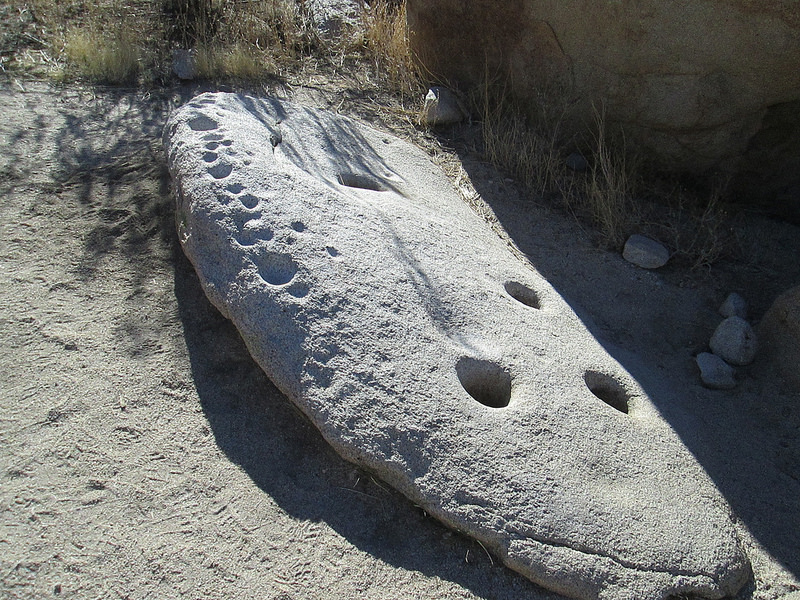
Morteros at Kumeyaay Village Site in the Blair Valley

Morteros at Kumeyaay Village Site in the Blair Valley

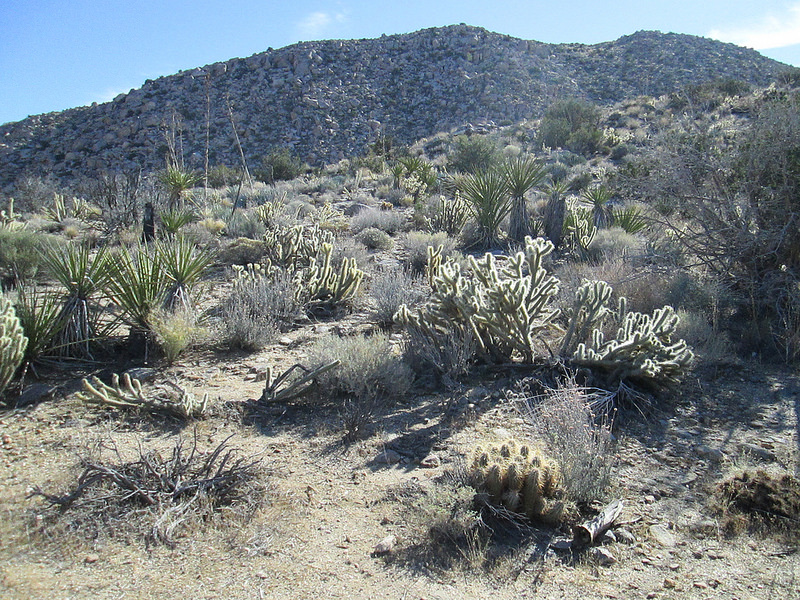
It’s maybe not what you or I would like to eat, but the Kumeyaay Indians of the Anza Borrego Desert managed to survive in a highly hostile environment eating roasted yucca leaves, cakes made with the flour of ground piñon pines, and whatever else they could concoct with the highly limited plant life of the area. The Blair Valley about four miles in from Highway S22 contains an unusual concentration of plant life (see photo below).

Kumeyaay women would find a rock to use as a mano (grindstone) and grind various edible cactus and juniper parts against rocks until depressions formed in them. These depressions (as shown above) were referred to as morteros. The Mortero Trail in the Blair Valley leads to a nicely sheltered “kitchen” area where there are numerous morteros and cupules (vertical morteros, probably for ceremonial purposes).

Lush Hillside in the Immediate Vicinity of the Kumeyaay Village Site

Lush Hillside in the Immediate Vicinity of the Kumeyaay Village Site

Sometimes I wonder what use the tribe made of the creosote bushes and cholla cacti that seem to predominate in the area, but my knowledge only goes so far. Suffice it to say that the Kumeyaay still survives as a tribe in several reservations in California and Mexico’s State of Baja California.

Martine did not like the trail very much, because the pamphlet describing sights along the way was incomplete due to vandalism or some other reason. I loved it and felt that the Kumeyaay village site was probably the most beautiful corner of the whole Anza Borrego desert region.


Reading in the Desert

Our Patio at the Borrego Valley Inn

Our Patio at the Borrego Valley Inn

Martine and I have just returned from four days in the Anza Borrego Desert, the largest contiguous state park in the United States. Compared to the larger National Parks, it is something of a poor orphan; but there is much to be seen. The only problem is it’s very much a do-it-yourself experience. The trails are not very well marked. On Friday, we took what we thought was the Narrows Trail off State Route 78, only to find that there was no clearly defined trailhead, no clearly defined trail, and a plethora of steps leading off in every direction. On Saturday we had better luck. Nonetheless, I even enjoyed our missteps.

Because she lived in Twenty Nine Palms for three years working at the Naval Hospital there, Martine does not value the desert as much as I do: I would not live there, but I find that a visit there helps clarify my mind and brings a sense of peace.

Shown above is our private patio at the Borrego Valley Inn in Borrego Springs. On the table are my two Kindles and a tall glass of ice water. I finally managed to finish reading Tony Judt’s massive Postwar: A History of Europe Since 1945, and I made a large dent in Junot Diaz’s The Brief Wondrous Life of Oscar Wao. While Martine watched television, I read hundreds of pages after returning from our day trips. The combination of exercise and reading concentrates the mind nicely.

In the days to follow, I will write several postings about our desert experiences.


Laser Light

Extreme Brightness

Extreme Brightness

The month of January is Southern California’s rainiest month. Usually. But not this year. So far, we have been treated to an endless round of Santa Ana winds and low humidity (around 10%). Right now, it’s about 85° Fahrenheit (that’s about 30° Celsius). If the temperature didn’t drop sharply at night, we would all be sweltering.

I just got back from lunch. The heat in this arid weather isn’t quite so uncomfortable as the laserlike light of the sun. It makes me wish I wore my baseball hat or some other brimmed headgear to protect my eyes. Although I wear photo optic glasses, they don’t provide sufficient protection from the sun’s fierceness. Years ago, I used to have super-dark prescription sunglasses. I’m beginning to think I should see my optometrist for another pair of those.

By Rail to the Past

Selected Gems amnd Minerals

Selected Gems and Minerals

I should have written this post last Sunday, when Martine and I took Los Angeles’s relatively new Expo Light Rail Line to the Natural History Museum, just south of the University of Southern California. We go there, on the average, once every year or two. It was good that we went last week because the Traveling the Silk Road exhibit was still running (it goes until April 13). It was well worth spending an hour or two to see.

It was fun taking the Expo Line because parking at the museum has always been a bit of a drag. Even though we had to catch the line at its temporary terminus in Culver City, we look forward to its extension westward to the beach in Santa Monica. There will be a station just one mile south of where we live, and it will take us all the way downtown and a number of interesting stopping points in between. It will run roughly along the line of Exposition Boulevard, where once the old Pacific Red Car ran in the days when Southern California was better served by public transportation. (If you’ve ever seen the 1988 cartoon/live action feature Who Framed Roger Rabbit?, you know what happened to the Red Car line.)

Triceratops on the Loose!

Triceratops on the Loose!

Of the museum’s permanent exhibits are the dinosaur hall (see above) and the gems and minerals (see illustration at top). There are other exhibits of note, but it would take two days to see them all. Also noteworthy are the exhibits of stuffed North American and African mammals, and a California history exhibit, which deserves to be seen by more visitors. After tax season, I wouldn’t mind checking out the collections again.

My favorite Natural History Museum program of all time was back in 2002, when they had an exhibit and a program of lectures about the Vikings. This was just after my 2001 trip to Iceland, and I was still buzzed—plus I got a chance to meet Jesse L. Byock, Professor of Old Norse and Medieval Scandinavian at UCLA, and Gisli Sigurðsson of the Árni  Magnússon Institute in Rekjavík (whose exhibit on “Vikings and the New World” I had seen at the Culture House in Rekjavík just months before). That was the high point of my relationship with the Natural History Museum: I even became a member for a year or two. Since then, I have been waiting and watching for another special event so in line with my interests.

This Bud’s for You

Camellia Buds at Descanso Gardens

Camellia Buds at Descanso Gardens

Today, in the dead of winter, Martine and I visited Descanso Gardens in La Cañada-Flintridge. There wasn’t much to see, except perhaps a foretaste of things to come. Usually by this time the camellias are in full bloom, but this has been the driest rainy season on record thus far, with less than an inch of rain over the last six months. The number of camellia blossoms was way below normal, but there were a few nice blossoms, and quite a few buds (such as the above) waiting for better conditions.

Sometimes I wonder what the global climate change has in store for Southern California. Will we become like the Atacama Desert of Chile and Peru, where the annual rainfall is measured in millimeters? And this while the Eastern, Southern, and Midwestern parts of the country are suffering from record precipitation!

The Rose Garden was surrounded by a fence to protect the bushes from hungry mule deer that find their way into the gardens and devour up to twenty pounds of plants a day. There didn’t seem to be many, if any, roses; so any damage the deer might do would be mostly to future plants.

Even in a dry season, Descanso was beautiful. It contains the largest camellia forest in North America, shaded by some of the most spectacular oaks on the West Coast. We watched the koi form patterns, as if they were ink strokes in God’s own pictographic language. What He was communicating, I don’t know, but it looked nice.

Koi at Descanso

Koi at Descanso

An Angelic Christmas

Angels at L.A.’s Grier Musser Museum

Angels at L.A.’s Grier Musser Museum

There are actually three angels in this picture: Reflected in the mirror between the two angel statuettes is Martine. This afternoon, we visited the Grier Musser Museum near downtown L.A. to see their annual display of Christmas-related decorations and figures. We enjoy seeing what Rey and Susan Tejada have collected and arranged for display at their antiquarian Queen Anne style house and museum on Bonnie Brae Street.

But first, we ate at Langer’s Deli which is nearby at the corner of 7th and Alvarado, just cater-corner from MacArthur Park. It is incongruous to find a classic Jewish deli in the middle of the Pico-Union Central American neighborhood. Just when it seemed that it might be fading away like so many Los Angeles landmarks, the opening of the MTA Red Line brought customers from other parts of town, though they are no longer open in the evenings. Martine has not been feeling good all week due to a flare-up of her irritable bowel syndrome; and this was the first day she could eat anything other than bananas, rice, apple sauce, and toast. (She calls it the B.R.A.T. diet.)

After we toured the museum along with six other guests, we sat down to punch and cookies in the kitchen and chatted for a couple of hours. Over the years, Rey and Susan have become good friends of ours. We enjoy the museum, which always holds surprises for us, and we enjoy their company.

Afterwards, we drove back the slow way, right down Wilshire Boulevard so that Martine could see the holiday decorations in Beverly Hills before we did the turn-off toward West Los Angeles via Santa Monica Boulevard.

It was a good day and made me think that this would be a good Christmas for us. As I hope it will likewise be for all my readers.


She Could Be Someone’s Mummy

Hellenistic Mummy Burial Mask of a Young Woman

Hellenistic Mummy Burial Mask of a Woman

Rather than joining the throngs at the shopping centers for Black Friday, Martine and I visited the Getty Villa in Malibu. Not to be confused with the Getty Center off the San Diego Freeway, the Getty Villa is primarily a museum of the ancient world, concentrating on Greece and Rome.

The big draw today, however, was the Cyrus Cylinder, a cuneiform clay cylinder distributed by the Emperor Cyrus in 539 B.C. upon the occasion of the conquest of Babylon. The museum was crowded with Persian families visiting one of the most important historical milestones in their country’s history. The cylinder is shown below:

Cyrus Cylinder

Cyrus Cylinder

We tend to ignore ancient history because, well, it’s “ancient history.” What we don’t take into account is the often startling realism of portraiture, particularly by the Romans and Hellenistic Greeks. Shown at the top is a painted fabric mask applied to a mummy of a woman who died around the Fourth Century A.D. Several of the exhibit halls are filled with uncomplimentary busts of Roman emperors and commoners. One classic example is a somewhat sinister bust of Caligula, and another of a bearded old man. Roman coins, for example, make no attempt to “photoshop” their emperors with a more beautiful or imposing face. Being realists, the Romans wanted the plebs to know what their leaders really looked like.

Because we get four days off for Thanksgiving Weekend, I have usually made a reservation at the Villa for the day after Thanksgiving. Unfortunately, the idea seems to have caught on. Especially toward the end of the afternoon, the place was jammed. No matter, there is a serenity about art that has lasted for two thousand odd years. Will ours be venerated two thousand years from now? I think not.


No matter, we had a great time strolling through the

The Long Exhale

Yes, It’s All About My Nose

Yes, It’s All About My Nose

No, that’s not my nose: It looks too young. The picture is of a hijacked schnozzola. Today I’m channeling the great Eighteenth Century Scottish novelist Tobias Smollett. “Smelfungus” is the nickname that Laurence Sterne gave to Smollett after his grumbling descriptions in Travels Through France and Italy. Even more memorable, to my mind, are some of his descriptions in The Expedition of Humphry Clinker. Here, hero Matt Bramble describes a discussion about the health-giving waters at Bath:

I was t’other day much diverted with a conversation that passed in the Pump-room, betwixt him and the famous Dr L—n, who is come to ply at the Well for patients. My uncle was complaining of the stink, occasioned by the vast quantity of mud and slime which the river leaves at low ebb under the windows of the Pumproom. He observed, that the exhalations arising from such a nuisance, could not but be prejudicial to the weak lungs of many consumptive patients, who came to drink the water. The Doctor overhearing this remark, made up to him, and assured him he was mistaken. He said, people in general were so misled by vulgar prejudices that philosophy was hardly sufficient to undeceive them. Then humming thrice, he assumed a most ridiculous solemnity of aspect, and entered into a learned investigation of the nature of stink. He observed, that stink, or stench, meant no more than a strong impression on the olfactory nerves; and might be applied to substances of the most opposite qualities; that in the Dutch language, stinken signifies the most agreeable perfume, as well as the most fetid odour, as appears in Van Vloudel’s translation of Horace, in that beautiful ode, Quis multa gracilis, &c.—The words fiquidis perfusus odoribus, he translates van civet & moschata gestinken: that individuals differed toto coelo in their opinion of smells, which, indeed, was altogether as arbitrary as the opinion of beauty; that the French were pleased with the putrid effluvia of animal food; and so were the Hottentots in Africa, and the Savages in Greenland; and that the Negroes on the coast of Senegal would not touch fish till it was rotten; strong presumptions in favour of what is generally called stink, as those nations are in a state of nature, undebauched by luxury, unseduced by whim and caprice: that he had reason to believe the stercoraceous flavour, condemned by prejudice as a stink, was, in fact, most agreeable to the organs of smelling; for, that every person who pretended to nauseate the smell of another’s excretions, snuffed up his own with particular complacency; for the truth of which he appealed to all the ladies and gentlemen then present: he said, the inhabitants of Madrid and Edinburgh found particular satisfaction in breathing their own atmosphere, which was always impregnated with stercoraceous effluvia: that the learned Dr B—, in his treatise on the Four Digestions, explains in what manner the volatile effluvia from the intestines stimulate and promote the operations of the animal economy: he affirmed, the last Grand Duke of Tuscany, of the Medicis family, who refined upon sensuality with the spirit of a philosopher, was so delighted with that odour, that he caused the essence of ordure to be extracted, and used it as the most delicious perfume: that he himself (the doctor) when he happened to be low-spirited, or fatigued with business, found immediate relief and uncommon satisfaction from hanging over the stale contents of a close-stool, while his servant stirred it about under his nose; nor was this effect to be wondered at, when we consider that this substance abounds with the self-same volatile salts that are so greedily smelled to by the most delicate invalids, after they have been extracted and sublimed by the chemists.—By this time the company began to hold their noses; but the doctor, without taking the least notice of this signal, proceeded to shew, that many fetid substances were not only agreeable but salutary; such as assa foetida, and other medicinal gums, resins, roots, and vegetables, over and above burnt feathers, tan-pits, candle-snuffs, &c. In short, he used many learned arguments to persuade his audience out of their senses; and from stench made a transition to filth, which he affirmed was also a mistaken idea, in as much as objects so called, were no other than certain modifications of matter, consisting of the same principles that enter into the composition of all created essences, whatever they may be: that in the filthiest production of nature, a philosopher considered nothing but the earth, water, salt and air, of which it was compounded; that, for his own part, he had no more objections to drinking the dirtiest ditch-water, than he had to a glass of water from the Hot Well, provided he was assured there was nothing poisonous in the concrete. Then addressing himself to my uncle, ‘Sir (said he) you seem to be of a dropsical habit, and probably will soon have a confirmed ascites: if I should be present when you are tapped, I will give you a convincing proof of what I assert, by drinking without hesitation the water that comes out of your abdomen.’—The ladies made wry faces at this declaration, and my uncle, changing colour, told him he did not desire any such proof of his philosophy: ‘But I should be glad to know (said he) what makes you think I am of a dropsical habit?’ ‘Sir, I beg pardon (replied the Doctor) I perceive your ancles are swelled, and you seem to have the facies leucophlegmatica. Perhaps, indeed, your disorder may be oedematous, or gouty, or it may be the lues venerea: If you have any reason to flatter yourself it is this last, sir, I will undertake to cure you with three small pills, even if the disease should have attained its utmost inveteracy. Sir, it is an arcanum, which I have discovered, and prepared with infinite labour.—Sir, I have lately cured a woman in Bristol—a common prostitute, sir, who had got all the worst symptoms of the disorder; such as nodi, tophi, and gummata, verruca, cristoe Galli, and a serpiginous eruption, or rather a pocky itch all over her body. By the time she had taken the second pill, sir, by Heaven! she was as smooth as my hand, and the third made her sound and as fresh as a new born infant.’ ‘Sir (cried my uncle peevishly) I have no reason to flatter myself that my disorder comes within the efficacy of your nostrum. But this patient you talk of may not be so sound at bottom as you imagine.’ ‘I can’t possibly be mistaken (rejoined the philosopher) for I have had communication with her three times—I always ascertain my cures in that manner.’ At this remark, all the ladies retired to another corner of the room, and some of them began to spit.—As to my uncle, though he was ruffled at first by the doctor’s saying he was dropsical, he could not help smiling at this ridiculous confession and, I suppose, with a view to punish this original, told him there was a wart upon his nose, that looked a little suspicious. ‘I don’t pretend to be a judge of those matters (said he) but I understand that warts are often produced by the distemper; and that one upon your nose seems to have taken possession of the very keystone of the bridge, which I hope is in no danger of falling.’ L—n seemed a little confounded at this remark, and assured him it was nothing but a common excrescence of the cuticula, but that the bones were all sound below; for the truth of this assertion he appealed to the touch, desiring he would feel the part. My uncle said it was a matter of such delicacy to meddle with a gentleman’s nose, that he declined the office—upon which, the Doctor turning to me, intreated me to do him that favour. I complied with his request, and handled it so roughly, that he sneezed, and the tears ran down his cheeks, to the no small entertainment of the company, and particularly of my uncle, who burst out a-laughing for the first time since I have been with him; and took notice, that the part seemed to be very tender. ‘Sir (cried the Doctor) it is naturally a tender part; but to remove all possibility of doubt, I will take off the wart this very night.’

There is no chance that I can outdo Smollett on this score, but I’ll do my best. Ever since Ronald Reagan’s “Mo[u]rning in America,” the streets of Los Angeles have become crowded with mentally unbalanced homeless. There’s one such of indeterminate age who occupies a bus bench on Westwood Boulevard and builds a fort around himself consisting of silverfish-laden old cushions and shopping carts filled with various items of detritus. As he has not bathed since the 1980s, he is surrounded by a pungent cloud of indeterminate size. Usually, I can avoid inhaling within thirty feet of him; but today I got a whiff of him after I ended a long exhale while passing him. Fifty-sixty feet! Yechhh! Yes, I feel sorry for him: I just don’t particularly feel like breathing in his vicinity.

I don’t know if there is any cause/effect relationship, but I got a nosebleed after lunch while blowing my nose. The onset of winter weather in Los Angeles means that the air is getting much drier. That, plus possibly the bum-effluvia, made me blow a capillary.

With luck, there will be no more nose news this week, except perhaps for the smell of turkey and all the fixings tomorrow.

Have a Happy Thanksgiving!


Ginza West

Christmas Tree at Japanese Village Shopping Center

Christmas Tree at Japanese Village Plaza

Before ascending the foothills to visit my friend Bill Korn in his Altadena mountain fastness, Martine and I stopped in Little Tokyo for lunch. As usual, we ate at the Suehiro Cafe on First Street. Both of us had bento box lunches (the Okonomi Plate) with miso soup and a choice of optional mains and sides as shown on the menu. Then we walked over to the Kinokuniya Bookstore on Weller Court where—miraculously—I didn’t buy any books or samurai films on DVD. Then, we went over to the Yamazaki Bakery at the Japanese Village Plaza. As a diabetic, I was only able to watch as Martine bought some tiramisu for herself and strawberry cream puffs for Bill and Kathy Korn.

Had we the time and inclination, we could also have visited several other adjacent Japanese shopping centers, two Buddhist temples, dozens of gift shops and food stores, and the Japanese-American National Museum. There is also the Japanese American Cultural & Community Center, where one delirious day I once saw four consecutive Raizo Ichikawa films, including one of the now hard-to-see Kyoshiro Nemuri samurai films directed by Kazuho Ikehiro.

Immersing ourselves in another culture is one of the most fun things to do in Los Angeles. My interest in the Southern California Japanese began early, in 1967, when I lived in a little Japanese neighborhood off Sawtelle Boulevard in West Los Angeles. Around the same time, I started going by bus to the Toho La Brea Theater to see Hiroshi Inagaki’s Samurai trilogy and all the latest films from Akira Kurosawa. As I made more friends in the film department at UCLA, I discovered four other Japanese cinemas in the area: the Kokusai and Sho Tokyo (both running films exclusively from Daiei Studios), the Kabuki (Shochiku Studios), and the Linda Lea (Tohei). We used to eat at the old Ichiban Cafe at the corner of First Street and San Pedro Street.

Japanese Magazines at the Kinokuniya Bookstore

Japanese Magazines at the Kinokuniya Bookstore

There are a number of other ethnic neighborhood concentrations in Southern California. The largest are probably the Mexican neighborhood in “East Los” (East Los Angeles) and Boyle Heights; the sprawling Koreatown along Olympic Boulevard as it approaches downtown; and Little Saigon in Orange County. Then there are the Central Americans in Pico-Union, the Armenians in Glendale, and the Russians in Hollywood and West Hollywood. And those are just the ones I’ve visited!

Boardwalk Empire

No, Not Atlantic City: Try the Left Coast

No, Not Atlantic City: Try the Left Coast

Today I did my Marina Del Rey/Venice Boardwalk walk, about five miles in all. The final destination was Small World Books, where I found a copy in Spanish of Jorge Luis Borges’s Poesias Completas.While I drank a lemonade, I shot the above photograph of a bicycle rental shop across the alley from my table. In the meantime, several guys tried to sell me CDs recorded by their garage hip hop band. Once again, I told them I bought only music from dead white guys who wore powdered wigs.

Another guy try to divert me to the medical marijuana “doctor” he was working for, saying it was all legal. Having a whole medical delivery system based on a single remedy is like having separate shops for aspirin, Vicodin, acetaminophen, and Prozac.My only answer was a shrug followed by, “Sorry, I don’t need it”—with the implication that I am even now as trippy as they come.

I like the Venice Boardwalk. It remains so incredibly seedy and picturesque. Today there were half a dozen food catering trucks with various specialties parked in a circle, as if they expected Red Indians on paint horses to attack them with bows, arrows, and war whoops. I passed on them, as I had a lunch date with Martine at Jerry’s Deli in Marina Del Rey.

You can always tell the people from out of town. They’re always snapping cellphone pictures of things I take for granted, like lifeguard stations and sidewalk vendors.

The weather was utterly delightful: Sunny and high seventies.