Musical Madeleine

LAPD Emerald Society Piper

LAPD Emerald Society Piper

You’ve probably heard about Marcel Proust’s triggering of his memory by eating French cookies known as madeleines. Well, since I’m diabetic, I have to use something else to trigger my memories. In that department, I find that, for me, nothing works better than music.

The police bagpipe player (above) was practicing a song that suddenly hit me between the eyes. I walked up to her and startled her by asking the name of the song she was playing. One of her colleagues answered for her with something that sounded like “Saigon.” He mentioned that it was played in a movie called Empire something. That’s when it all came back to me: The song is called “Suo Gân,” which means lullaby in Welsh. The movie is Steven Spielberg’s Empire of the Sun (1989), based on J.G. Ballard’s autobiographical novel of the same name about spending World War Two as a child in a Japanese concentration camp near Shanghai.

I love the song. You can watch it on YouTube performed by the Kings College Choir.

My Favorite Spielberg Film

My Favorite Spielberg Film

I’ve seen Empire of the Sun several times and even read Ballard’s book. There is something incredibly beautiful about so many Welsh songs that I plan to write a posting about some of my favorites in the next week or so. If you feel starved to hear some now, watch the film How Green Was My Valley (1941), which features some beautiful examples.

What exactly did hearing a few notes from “Suo Gân” do for me when I heard them played by a police bagpiper at last Sunday’s Irish Fair in Long Beach? It sent me back to Wales, which I visited twice in the 1970s. Welsh is the most musical language I have ever heard; and I loved wandering around listening to people speak in places like Betws-y-Coed, Conwy, and Abergavenny.

Although I am a person of words and literature, music strikes me at my innermost core—even when I hear just a few notes.


Oh, No! Not Again!

Chile’s Calbuco Volcano in Eruption

Chile’s Calbuco Volcano in Eruption

It’s getting to be downright monotonous. Four years ago, when Martine and I were planning our trip to Argentina, we had originally decided to included San Carlos Bariloche on the eastern slope of the Andes on our itinerary. But then, a Chilean volcano decided to trash the whole area. Here’s what I wrote at that time:

It looks like some sort of ghastly aviation accident, doesn’t it? But no, what you are seeing above [actually below, in this posting] is a grounded aircraft in San Carlos de Bariloche covered in volcanic ash from the eruption of the Puyehue-Cordon Caulle volcanic complex in neighboring Chile. Not only was the airport at Bariloche closed for lack of visibility, but the ash drifted eastward over the South Atlantic by Trelew and Puerto Madryn.

I have just named three of my main destinations for our upcoming trip to Argentina five months from now. No doubt the eruptions will cease soon, if they have not already done so.

One thing we can expect is that there will be a lot more blowing dust and ash given the prevailing winds in Patagonia and the huge amount of ash generated by the eruption.

Our plan is to go to Bariloche via one of the few remaining long-haul passenger railways in Argentina, the Tren Patagonico connecting Viedma with Bariloche. Viedma is five hours north of Puerto Madryn by bus, so we’ll have the opportunity of seeing more of the Atlantic coast between the two cities.

Plane Covered with Ash at Bariloche’s Airport

Plane Covered with Ash at Bariloche’s Airport

Well, the eruptions from Cordon Caulle kept going until several states along the Eastern Andes were declared a disaster zone. So we skipped Bariloche and went to El Calafate instead, which did not disappoint.

Now the Chileans are doing it again to me, with Calbuco in eruption. And, of course, I am planning once again to visit Bariloche in November. I can only hope that this particular event does not last as long as the one four years ago. So far, the only area in Argentina that has been affected is around Neuquén, several hours to the north of where I’ll be.

I just noticed that the ash has already made its way to Buenos Aires, closing all international flights from Ezeiza airport.

The Buenos Aires Herald has included a great video shot by a Chilean tourist at the moment Calbuco blew its top. You can find it by clicking here.

Just Icing My Shoulders

My Blogs Will Be Back Soon

My Blogs Will Be Back Soon

With luck, my home computer will be back online tomorrow. As for tonight, I’ll just ice my shoulders, thank you! I’m not having much of a pain problem with my fracture—except when I’m trying to sleep. Then it throbs and various pains emerge along my arms and legs. Not at all pleasant! A week from today, the orthopedist will see me again and rule on my progress, if any.

2014 in review

The WordPress.com stats helper monkeys prepared a 2014 annual report for this blog.

Here’s an excerpt:

The concert hall at the Sydney Opera House holds 2,700 people. This blog was viewed about 13,000 times in 2014. If it were a concert at Sydney Opera House, it would take about 5 sold-out performances for that many people to see it.

Click here to see the complete report.

Where Did the Other 80% Go?

The Altar of La Merced Church in Lima

The Altar of La Merced Church in Lima

According to John Hemming’s excellent history, The Conquest of the Incas, only 20% of the gold went to the King of Spain. Where did the rest go? Pizarro and the conquistadores probably got the lion’s share, but after visiting dozens of Peruvian churches, I am beginning to think that the Church came in for a huge windfall, if not sooner, then later. You can see it at the Cathedral and San Pedro in Lima, in addition to the Church of the Company in Arequipa and the massive Cathedral in Cusco.

The first church I visited in Lima was La Merced on Jirón de la Union, whose altar is shown above. As I visited more and more churches, I saw the tons of gold and silver lavishly displayed, so much so that many of them are victims of larceny, such as the church at Maca at Colca Canyon. (Although stripped of much of its gold, it still looks impressive to me.) In the nearby church at Coporaque, I discovered a motion detector that tracked my movements in the nave with an audible beep.

Nowhere have I ever seen such a display of wealth. It is no surprise that many of the churches, such as the Cathedral at Cusco, have security personnel to protect the churches’ wealth.

There was another side to the splendor of the great Peruvian churches.

The Birthplace and Chapel of St. Martin de Porres in Lima

The Birthplace and Chapel of St. Martin de Porres in Lima

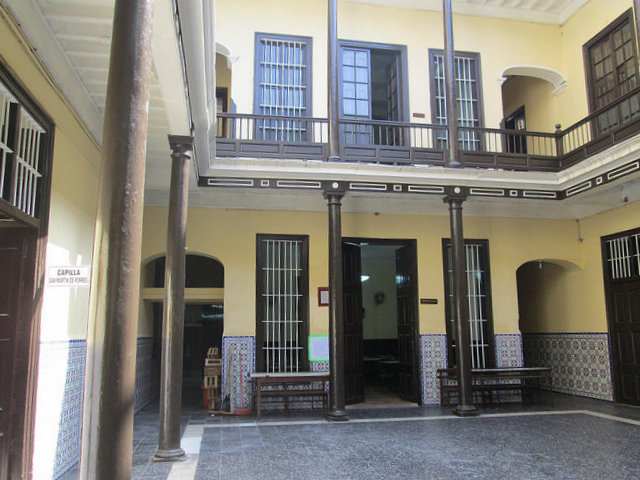
On Callao near the intersection with Tacna is the birthplace and chapel of St. Martin de Porres. The chapel is tiny (you can see the sign by the leftmost door) and contains only a prie dieu and a statue of the saint, along with a bin for prayer requests and another for contributions. The building also contains doctors’ offices and a cafeteria for the elderly poor of the neighborhood. In fact, when I was waiting for the building to open at 2:30 pm, I shared the doorway with one of the volunteers, a sweet lady who spoke little English, which added to my little Spanish, managed to allow us to communicate. Needless to say, I made a contribution.

I neglected to say that St. Martin de Porres was black and a descendent of slaves. The stories about his life have a certain sweetness to them, and he is much loved by the people of Lima.


Victor Hugo on Balzac’s Death

How Honoré de Balzac died:

Dagny's avatarLa Comedie Humaine by Balzac

The Death of Balzac
By Victor Hugo

On the 18th of August, 1850, my wife, who had been during the day to see Mme. de Balzac, told me that Balzac was dying. I hurried to him.

M. de Balzac had been suffering for eighteen months from hypertrophy of the heart. After the revolution of February he went to Russia, and there married. Some days before his departure I met him in the boulevard. He was then complaining, and breathing noisily. In May, 1850, he returned to France, married, rich, and dying! When he arrived, his legs were already swollen. Four doctors held a consultation. One of them, M. Louis, told me on the 6th of July, “He has not six weeks to live.” It is the same disease that killed Frederic Soulie.

On August 18th my uncle, General Louis Hugo, was dining with me. As soon as the table was…

View original post 1,411 more words

“Don’t Read Books!”

Chinese Scroll

Chinese Scroll

Don’t read books!
Don’t chant poems!
When you read books your eyeballs wither away,
leaving the bare sockets.
When you chant poems your heart leaks out slowly
with each word.
People say reading books is enjoyable.
People say chanting poems is fun.
But if your lips constantly make a sound
like an insect chirping in autumn,
you will only turn into a haggard old man.
And even if you don’t turn into a haggard old man,
it’s annoying for others to have to hear you.

It’s so much better
to close your eyes, sit in your study,
lower the curtains, sweep the floor,
burn incense.
It’s beautiful to listen to the wind,
listen to the rain,
take a walk when you feel energetic,
and when you’re tired go to sleep.

—Yang Wan-li (1127-1206), “Don’t Read Books!”

It Was Ever Thus

Agora

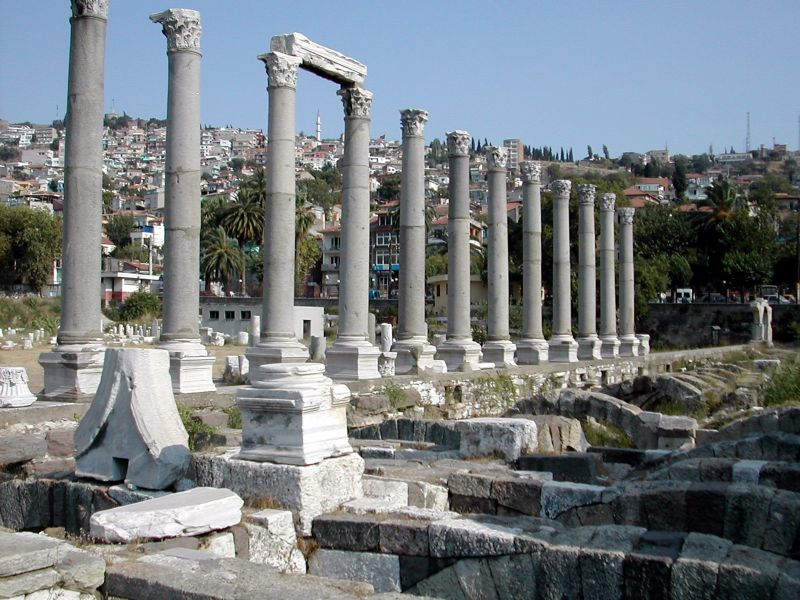
Agora

But as for merchants, their holdings are increased by false oaths, and the art of becoming rich is to show contempt toward the gods, and they sail to every city, doing this evil, lying, deceiving, and misleading. And whoever knows how to do this best will come away richest.—Libanius (4th Century A.D.), Progymnasmata: Comparationes

A Philosophical Conundrum

It’s Called “The Ship of Theseus”

It’s Called “The Ship of Theseus”

I got this puzzle from The Futility Closet, which I have decided to add to my links:

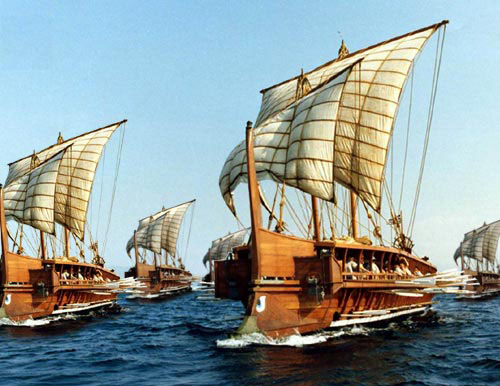
Suppose we have a complete wooden ship, and one day we replace one of its wooden planks with an aluminum one. Most people would agree that the ship survives this operation; that is to say, its identity remains unchanged. But suppose that we then replace a second plank, and then a third, until our wooden ship is made entirely of aluminum. Is this the same ship that we started with? If not, when did it change?

Thomas Hobbes adds a wrinkle: Suppose that, as we did all this refurbishing, someone had gathered up all the discarded wooden planks and used them to assemble a second ship. What are we to make of this? “This, without doubt, had also been the same numerical ship with that which was at the beginning; and so there would have been two ships numerically the same, which is absurd.”

And philosopher Roderick Chisholm adds another: “Let us suppose that the captain of the original ship had solemnly taken the vow that, if his ship were ever to go down, he would go down with it. What, now, if the two ships collide at sea and he sees them start to sink together? Where does his duty lie — with the aluminum ship or with the reassembled wooden ship?”


“Stupidity of the Vilest Kind”

Dick Cheney

Dick Cheney

You are wedded to stupidity, my fine friend, of the vilest kind; you are impeached of this by your own words, out of your own mouth; and this, it seems, is why you dash into politics before you have been educated. And you are not alone in this plight, but you share it with most of those who manage our city’s affairs… Plato: Alcibiades