Frenchness

French Girl

French Girl

Now, “Frenchness” may seem to be an intolerably vague idea, and it smells of related notions like Volksgeist that have acquired a bad odor since ethnography became polluted with racism in the 1930s. Nonetheless, an idea may be valid even if it is vague and has been abused in the past. Frenchness exists….[I]t is a distinct cultural style; and it conveys a particular view of the world—a sense that life is hard, that you had better not have any illusions about selflessness in your fellow men, that clear-headedness and quick wit are necessary to protect what little you can extract from your surroundings, and that moral nicety will get you nowhere. Frenchness makes for ironic detachment. It tends to be negative and disabused. Unlike its Anglo-Saxon opposite, the Protestant ethic, it offers no formula for conquering the world. It is a defense strategy, well suited to an oppressed peasantry or an occupied country.—Robert Darnton, The Great Cat Massacre and Other Episodes in French Cultural History

“Power Without Wisdom Collapses Beneath Its Own Weight”

Jan Amos Komensky

Jan Amos Komensky

Almost three hundred and fifty years ago, one of the greatest minds of the Renaissance and the founder of modern pedagogy, Jan Amos Komensky (Comenius) wrote in a letter to the Prefects of the Dutch Navy:

“Your homeland has entrusted you with its bounty, that you protect it against all foreign foes, but you must not be ignorant of the art of defending it from foes within, to wit, the obscuring of the mind, loosening of morals and desecration of life. And not only protect it for the present time but also to take wise care how in the future the generations that will rise after you, your sons, may successfully protect the happy state you have prepared for them and then pass it on to their offspring until the end of time. It is therefore necessary that you bequeath to them not only the strength and determination to maintain it themselves but also wise counsel, otherwise power without wisdom collapses beneath its own weight.”

How is wise counsel being passed on within the family, the school, the mass media or the other institutions concerned with it in some way?—Ivan Klíma, Between Security and Insecurity

Merricat Introduces Herself

The Opening Lines of the Book

The Opening Lines of the Book

My name is Mary Katherine Blackwood. I am 18 years old, and I live with my sister Constance. I have often thought that with any luck at all I could have been born a werewolf, because the two middle fingers on both my hands are the same length but I have had to be content with what I had. I dislike washing myself, and dogs, and noise. I like my sister Constance, and Richard Plantagenet, and Amanita phalloides, the death-cup mushroom. Everyone else in my family is dead.—Shirley Jackson, We Have Always Lived in the Castle

The Lion’s Share

Lion
Lion

A lion, an ass, and a fox entered into a partnership whereby they would share in common whatever they caught by hunting. When they got their prey, the lion ordered the ass to divide it. Stupid as he was, the ass divided it into three equal parts. Wherefore at once the lion, outraged that he was made equal with the others, attacked the ass and tore him to pieces. The fox was left; the lion ordered her to make the division anew; she gave almost all of the prey to the lion, keeping for herself only a few meager scraps. The lion approved the division and asked the fox who had taught her the art of dividing. The fox answered, “The fate of the ass.”—Erasmus, Adages

Umm, Texas …

Rep Blake Farenthold (R-TX)

Rep Blake Farenthold (R-TX)

It is a well established fact that America only tolerates Texas because it has oil and Austin and probably something else of value that I can’t think of off the top of my head. Let’s see …. nope … I got nothin’. But there are times when Texas gets on our last nerve (to be fair, that is usually reserved for Florida) and we just shake our heads and start to wonder if maybe Mexico would be willing to take Texas back if we can find the receipt in a drawer somewhere , and even if we  have to pay a 15% restocking fee.

I know I’d chip in.

Which brings us to  Texas’s own Blake Farenthold (R-Golden Corral), who barely squeaked into office in his first go-around, but then his district was redrawn (moar whitez, less brownz) and now he will hold his seat until the End Times, who is here to explain that America’s disabled vets need to suck it up and take one for the team and that they should rub some dirt on it and put whatever skin they didn’t leave behind on the battlefield into the game when it comes to “sacrifice”.—TBogg

Unmoved by Crowds

Not for Me

Not for Me

I belong to that class of unhappy people who are not easily affected by crowd excitement. Too often I find myself sadly unmoved in the midst of multitudinous emotion. Few sensations are more disagreeable. The defect is in part temperamental, and in part due to that intellectual snobbishness, that fastidious rejection of what is easy and obvious, which is one of the melancholy consequences of the acquisition of culture. How often one regrets this asceticism of the mind! How wistfully one longs to rid oneself of the habit of rejection and selection, and to enjoy all the dear, obviously luscious, idiotic emotions without an after-thought. And indeed, however much we may admire the Chromatic Fantasia of Bach, we all of us have a soft spot somewhere in our minds that is sensitive to “Roses in Picardy.” But the soft spot is surrounded by hard spots, the enjoyment is never unmixed with critical disapprobation. The excuses for working up a communal emotion, even communal emotion itself, are rejected as too gross. We turn from them as a cenobite of the Thebaid would have turned from dancing girls or a steaming dish of tripe and onions.—Aldous Huxley, Complete Essays, Vol. I.

To Each According to His Needs

Llama

Llama

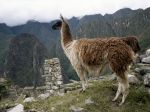
A similar arrangement prevailed with respect to the different manufactures as to the agricultural products of the country. The flocks of llamas, or Peruvian sheep, were appropriated exclusively to the Sun and to the Inca. Their number was immense. They were scattered over the different provinces, chiefly in the colder regions of the country, where they were intrusted to the care of experienced shepherds, who conducted them to different pastures according to the change of season. A large number was every year sent to the capital for the consumption of the Court, and for the religious festivals and sacrifices. But these were only the males, as no female was allowed to be killed. The regulations for the care and breeding of these flocks were prescribed with the greatest minuteness, and with a sagacity which excited the admiration of the Spaniards, who were familiar with the management of the great migratory flocks of merinos in their own country.

At the appointed season, they were all sheared, and the wool was deposited in the public magazines. It was then dealt out to each family in such quantities as sufficed for its wants, and was consigned to the female part of the household, who were well instructed in the business of spinning and weaving. When this labor was accomplished, and the family was provided with a coarse but warm covering, suited to the cold climate of the mountains,—for, in the lower country, cotton, furnished in like manner by the Crown, took the place, to a certain extent, of wool,— the people were required to labor for the Inca. The quantity of the cloth needed, as well as the peculiar kind and quality of the fabric, was first determined at Cuzco. The work was then apportioned among the different provinces. Officers, appointed for the purpose, superintended the distribution of the wool, so that the manufacture of the different articles should be intrusted to the most competent hands. They did not leave the matter here, but entered the dwellings, from time to time, and saw that the work was faithfully executed. This domestic inquisition was not confined to the labors for the Inca. It included, also, those for the several families; and care was taken that each household should employ the materials furnished for its own use in the manner that was intended, so that no one should be unprovided with necessary apparel. In this domestic labor all the female part of the establishment was expected to join. Occupation was found for all, from the child five years old to the aged matron not too infirm to hold a distaff. No one, at least none but the decrepit and the sick, was allowed to eat the bread of idleness in Peru. Idleness was a crime in the eye of the law, and, as such, severely punished; while industry was publicly commended and stimulated by rewards.—William H. Prescott, History of the Conquest of Peru


 

The Nature of the Soul

Cicero

Cicero

It’s impossible to locate an earthly origin of souls. There’s nothing mixed or compounded in souls, they’re not earth or made of earth. They’re not even moist or airy or fiery. There’s nothing in these elements that accounts for the power of memory, mind or thought, that recalls the past, foresees the future or comprehends the present. These faculties are divine; you won’t find a way for them to get to man except from god. The natural power of the soul is therefore unique, distinct from the usual and familiar elements. Whatever it is that thinks, knows, lives and grows must be heavenly, divine, and therefore eternal. And god, who is recognized by us, can only be recognized by a mind that is free and unencumbered, distinct from any mortal compound, sensing all and setting all in motion, itself endowed with eternal movement. The human mind consists of the same element, the same nature.—Marcus Tullius Cicero, Consolation

Art and Courage

Opening Oneself Up to Create Art

Opening Oneself Up to Create Art

The reader walks away from real art heavier than she came to it. Fuller. All the attention and engagement and work you need to get from the reader can’t be for your benefit; it’s got to be for hers. What’s poisonous about the cultural environment today is that it makes this so scary to try to carry out. Really good work probably comes out of a willingness to disclose yourself, open yourself up in spiritual and emotional ways that risk making you look banal or melodramatic or naive or unhip or sappy, and to ask the reader really to feel something. To be willing to sort of die in order to move the reader, somehow. Even now I’m scared about how sappy this’ll look in print, saying this. And the effort actually to do it, not just talk about it, requires a kind of courage I don’t seem to have yet. … Maybe it’s as simple as trying to make the writing more generous and less ego-driven.—David Foster Wallace, Conversations with David Foster Wallace


Spiritual Testing

Machu Picchu

Machu Picchu

What gives value to travel is fear. It is the fact that, at a certain moment, when we are so far from our own country (a French newspaper acquires incalculable value. And those evenings when, in cafés, you try to get close to other men just to touch them with your elbow.) We are seized by a vague fear, and an instinctive desire to go back to the protection of old habits. This is the most obvious benefit of travel. At that moment we are feverish but also porous, so that the slightest touch makes us quiver to the depths of our being. We come across a cascade of light, and there is eternity. That is why we should not say that we travel for pleasure. There is no pleasure in traveling, and I look upon it more as an occasion for spiritual testing. If we understand by culture the exercise of our most intimate sense—that of eternity—then we travel for culture. Pleasure takes us away from ourselves in the same way as distraction, in Pascal’s use of the word, takes us away from God. Travel, which is like a greater and a graver science, brings us back to ourselves.—Albert Camus, Notebooks 1935-1942