Not far from the Hawaii State Capitol sits the Iolani Palace, home of the monarchs of the Kingdom of Hawai’i from Kamehameha III in 1879 until the overthrow of the monarchy under Queen Lili’uokalani by a group of American merchants in 1893.
As I prepare to go to Hawaii in a week or so, I am conscious once again that the United States ruthlessly stepped on the rights of the Hawaiian people just so that a cabal of American merchants could have their way. On this trip, I plan to read Queen Lili’uokalani’s autobiography. For eight months, the Queen was imprisoned in one of the second floor bedrooms until she was tried by a military tribunal on some trumped-up charge.
It was like the U.S. and the American Indians all over again. Fortunately, there were no massacres by the cavalry in this instance, though the takeover was no less final—and unjust.
As I mentioned in my post yesterday, Martine and I are headed back to Honolulu for another visit. Looking back at last year’s pictures, I noticed that Martine looked genuinely happy in most of them. Returning to L.A., Martine has had a difficult year—especially when she broke her wrist in two places after a fall at home. And recovery has been painfully slow, especially since the cast which she war was too tight and affected her ability to bend her fingers once it was removed.
Although I would probably be happier traipsing off to Latin America, Martine’s happiness matters to me; and I can certainly enjoy myself in Hawaii provided I stay away from most mainland tourists of the luau-frequenting variety.
We will be staying at the same hotel we stayed in last year, the Malia. Last year, it was a hotel in the Outrigger chain; now, it is the Waikiki Malia, apparently no longer part of a chain. It is not exactly on the beach, but that is no matter to us as we are not beach types. We prefer the corner of Kuhio and Lewers because of its convenient access to public transportation.
The big success story of last year’s trip was our discovery of the Honolulu bus system, the best we have seen in any American city. As senior citizens, we picked up a Senior Citizens discount Holo card, which enables us to unlimited rides for the entire month of September for $20.00 US for each of us. Compare that with high car rental fees and hotel parking rates of up to $50-60 US per night.
Amazingly, the Honolulu buses go not only all around the city, but along the Southeast (Hanauma Bay, Hawaii Kai), the Windward Coast (Kailuka, Kaneohe, La’e), the North Shore (Waimea, the Banzai Pipeline), and Central O’ahu (the Dole Pinapple Plantation). Where we would need a car would be the Leeward Coast (Ko Olina) and certain trailheads on mountain trails. If you’re thinking of going to Hawaii on a budget, I firmly recommend the public transportation and a non-luxury-priced hotel, preferably on Kuhio Avenue.
We booked our trip through the Southern California Auto Club, which I also recommend.
In November 2011, Martine and I spent two and a half weeks in Argentina, plus a few days in Colonia del Sacramento, just across the River Plate from Buenos Aires. With a population of three and a half million people, Buenos Aires was at times a bit much for Martine, especially when she had to ride the crowded buses and subways.
So I planned in advance for a mini-vacation from the crowds of Buenos Aires by taking a ferry across the Plate to Colonia del Sacramento in nearby Uruguay. Colonia is, in fact, where Porteños (that’s what the residents of Buenos Aires call themselves) go when the big city is too much for them.
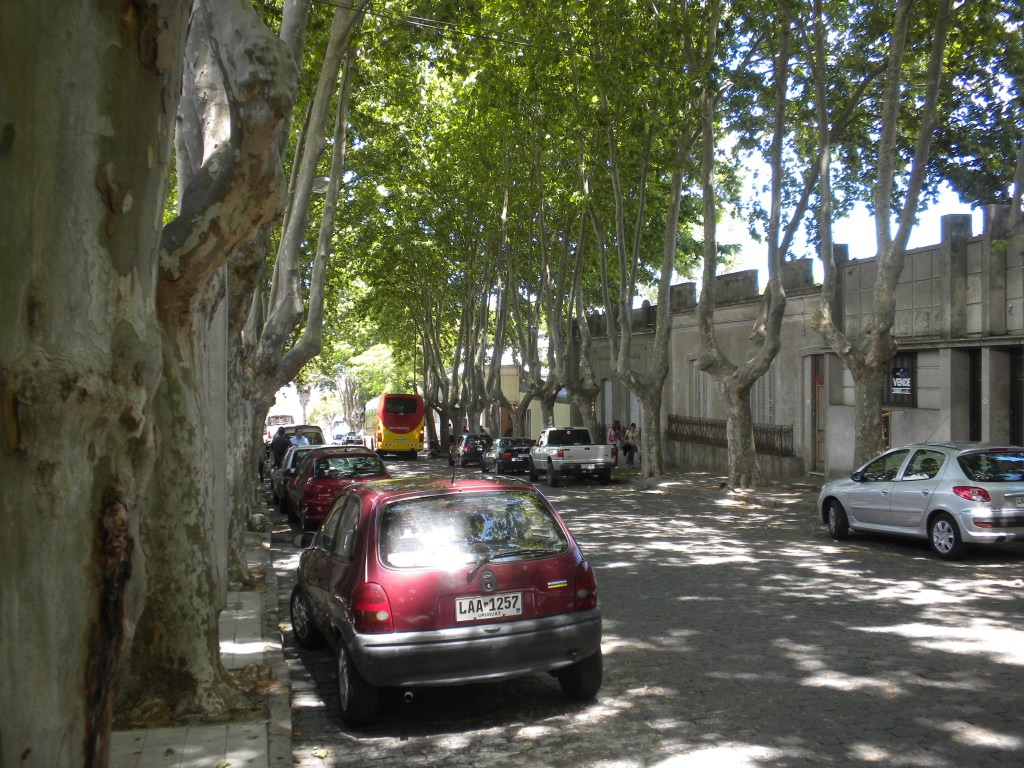
With only 27,000 people, Colonia is a 17th century town founded by Brazil. The streets are mostly all cobblestone, and there are a half dozen small pokey museums that are good for about an hour each.
A Tasty Restaurant Within Sight of the Atlantic
As a getaway, Colonia del Sacramento was a roaring success. We stayed at an old bed & breakfast that was at least three hundred years old. We lazily trod the cobblestones going from sight to sight, and eating some tasty steak dinners. We went back to Buenos Aires for one day before catching a flight to Patagonia, which is an entirely different story.
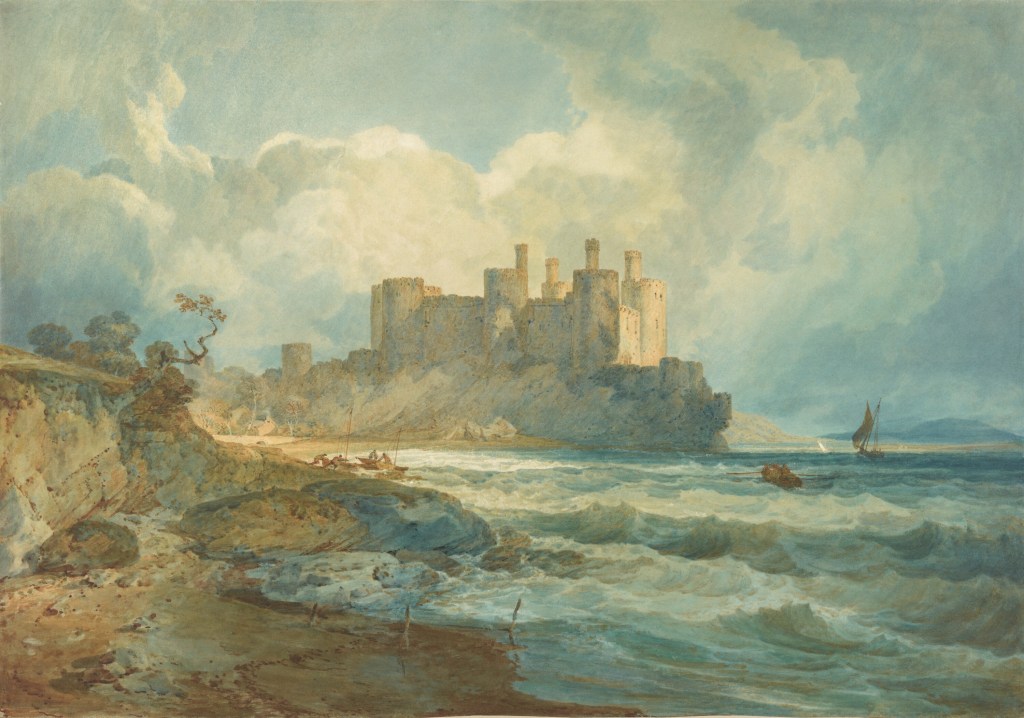
“Conway Castle, North Wales” as Painted by Joseph Mallord William Turner (1798)
Back in 1976, I visited Britain after making some money selling a script idea. One of the places I stayed was Betws-y-Coed, from which I could visit several beauty spots in North Wales. One of them was Conwy [sic] Castle. I was elated to see at the Getty Center J M W Turner’s rendition of Conway Castle, which is what the English called it.
The Getty website describes the painting:
On a dramatic, rocky area of the northern coast of Wales looms the late medieval Conway Castle. It towers over a stormy bay while fisherman struggle to pull their boats ashore. Caught in this uproaring of the sea, the tiny figures of fishermen in their boat convey a sense of humans’ barely significant place in the order of the universe.
The Welsh landscape exerted a strong hold on Joseph Mallord William Turner, and he made several sketching trips there in the 1790s. In this early Romantic painting, Turner represented the dramatic effects of natural light, allowing sunshine breaking through the clouds to illuminate the castle and the coast beyond.
The castle was built by Edward I—the evil king in Mel Gibson’s Braveheart played by Patrick McGoohan—between 1283 and 1287. It was one of a number of fortifications he built in his effort to subdue the Welsh. Here’s what it looks like today:
Totems at Quw’utsun’ Cultural and Conference Center in Duncan, BC (2004)
The First Nations tribes of the Pacific Northwest have created a unique art form in the totem pole. They are truly multipurpose. According to Wikipedia:
The carvings may symbolize or commemorate ancestors, cultural beliefs that recount familiar legends, clan lineages, or notable events. The poles may also serve as functional architectural features, welcome signs for village visitors, mortuary vessels for the remains of deceased ancestors, or as a means to publicly ridicule someone. They may embody a historical narrative of significance to the people carving and installing the pole. Given the complexity and symbolic meanings of these various carvings, their placement and importance lies in the observer’s knowledge and connection to the meanings of the figures and the culture in which they are embedded.
Interestingly, totem poles till being carved. In Port Alberni on Vancouver Island, I took this picture of a First Nations member carving a new totem pole.
Carving a New Totem Pole
I hope to take a trip to Southeast Alaska and visit the totem poles in Ketchikan, Prince of Wales Island, and other locations. Instead of taking a cruise, I prefer to fly to Ketchikan and travel using the oceangoing ferries of the Alaska Marine Highway. That way, Martine and I can concentrate on seeing the sights—and not schmoozing with cruise ship passengers.
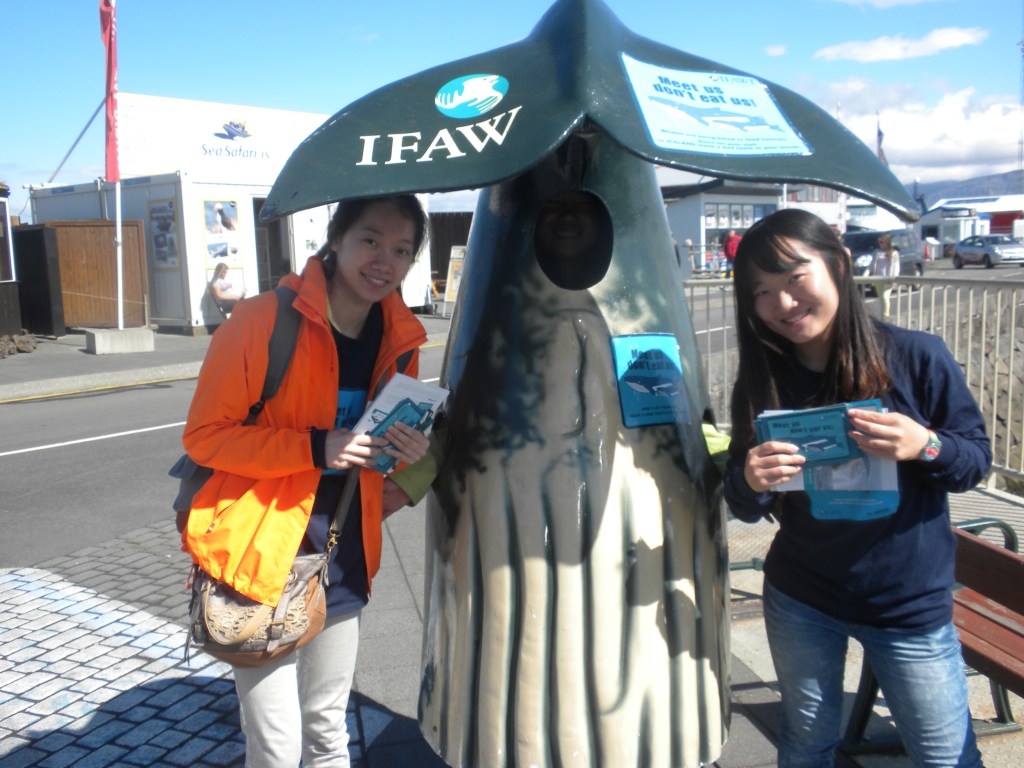
I had just landed in Iceland. Because I was eight hours ahead of Pacific Time (Los Angeles), I decided to hang out at Reykjavík Harbor for several hours and go to bed around midnight Iceland time. I was met by two cute Japanese girls who were collecting funds for the International Fund for Animal Welfare (IFAW), specifically to save the whales. At that time (2013), Iceland was one of two countries which hunted whales for food. The other was Japan.
In the U.S., only Native Americans are allowed to hunt whales, and the average number of kills is 300-500 Belugas and 40-70 Bowhead a year.
I was happy to contribute to the protection of the whales. And while I was in Iceland, I did not eat any whale meat, though I saw it in several markets.
Fortunately, I was able to keep my eyes open until 8 AM Los Angeles time and did not suffer from jet lag in the subsequent days. Flying back to California was, alas, a different story.
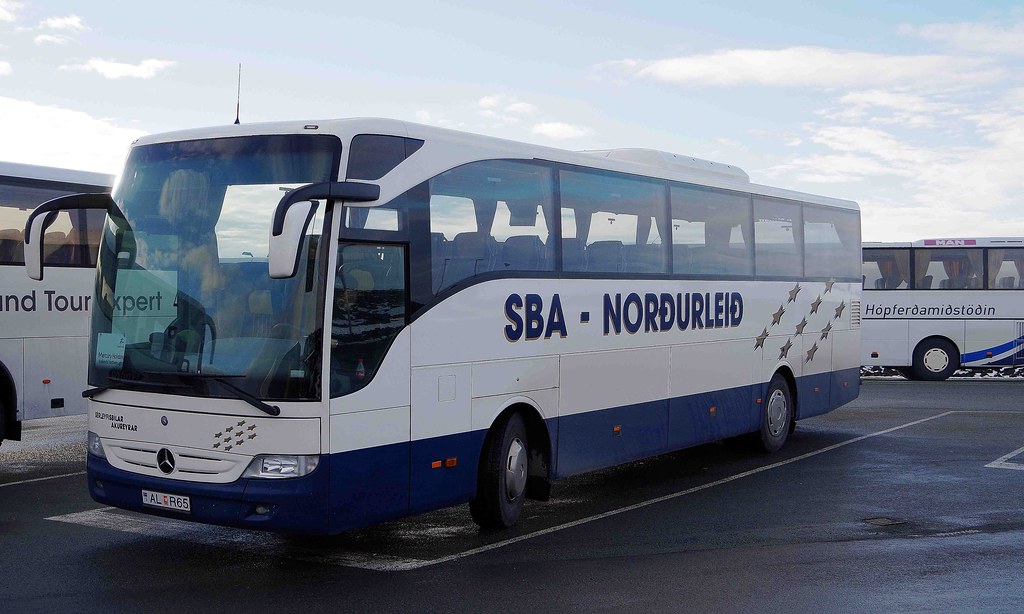
In 2001 when I traveled to Iceland, I purchased a bus ticket for one-way travel along the famous ring road that manages to hit most of the top sights on the volcanic island. I started by taking a bus to Akureyri through the center of Iceland through what is known as the Kjölur Route. From there, I traveled by bus along to Ring Road to Lake Mývatn, Egilsstaðir, Höfn, Kirjubærclaustur, Hvollsvöllur, Selfoss, and on into Reykjavík.
The majority of the population of Iceland lives along the Ring Road. There are no cities in the whole country that are not either on or close to the coast. As for the unpopulated interior, there are only two roads, the Kjölur Route and the Sprengisandur Route, and no towns of any size. In fact, no towns at all.
The Bus to Akureyri Along the Kjölur Route
When I returned to Iceland in 2013, I spent some time in the Northwest in Isafjordur, as I had skipped the entire Westfjords area on my previous visit.
When you get out of the city, Iceland is a country of waterfalls, rainbows, volcanoes, and geysirs. From one point of view, much of it is a wasteland; but, if so, it is a beautiful one.
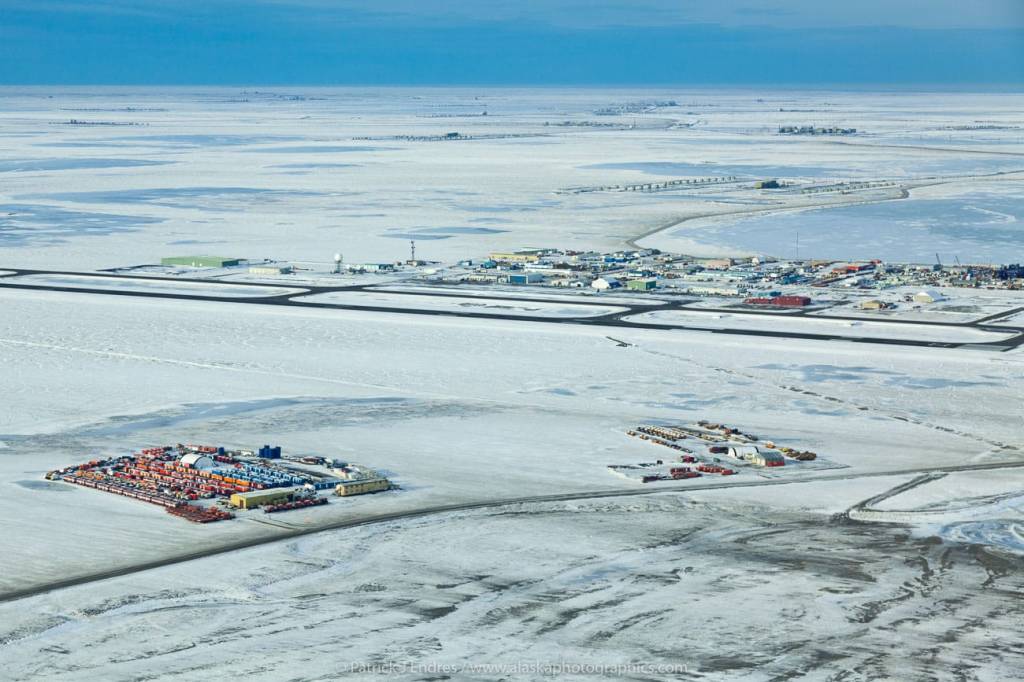
It’s not exactly the northernmost point in the United States: That honor belongs to Barrow (aka Utqiagvik), which is probably a more interesting town because of its links to Iñupiat culture. Deadhorse, Alaska, is probably better known as Prudhoe Bay, the starting point of the Trans-Alaska Pipeline System, which sends crude oil flowing 800 miles to Valdez, Alaska, from where it is transshipped via tanker to refineries around the world.
To me, the interesting thing about Deadhorse is not that it’s a company town (owned by Alyeska Pipeline Service Company), but that there is daily bus from Fairbanks to Deadhorse via the Dalton Highway, which was formerly called the North Slope Haul Road. Once one leaves the “suburbs” of Fairbanks, there are only three populated areas along the route:
Coldfoot at Mile 175 (Population: 34)
Wiseman at Mile 188 (Population: 12)
Deadhorse at Mile 414 (Population: 25 Permanent and 3,500-5,000 Seasonal)
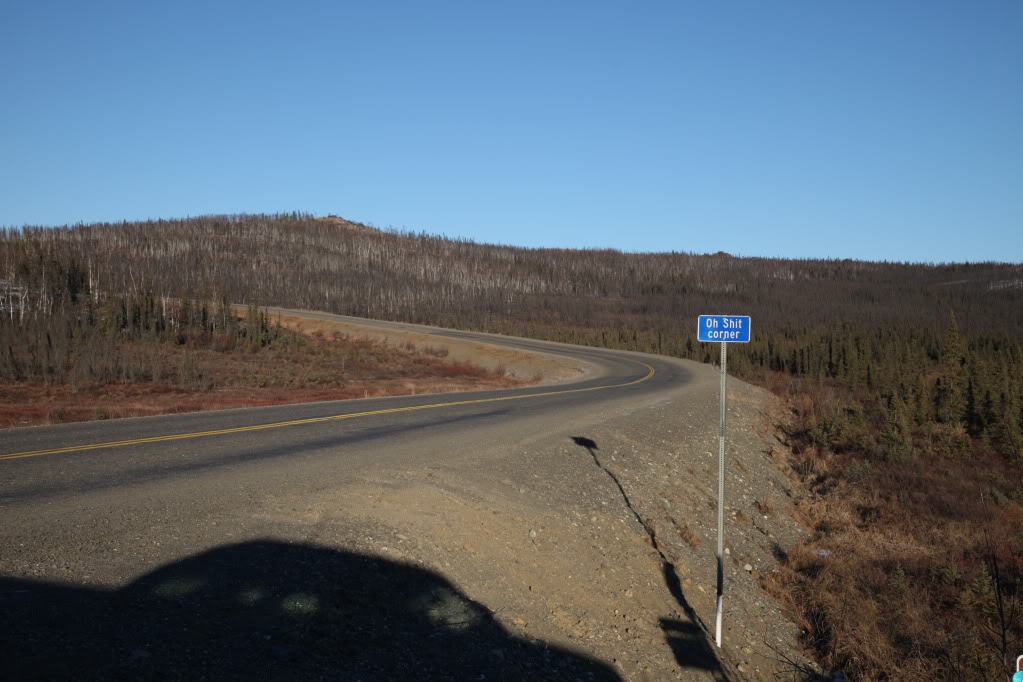
There are a number of sights along the way. Below, for example, is Oh Shit Corner at Mile 126:
More seriously, the highway passes by the Gates of the Arctic National Park and the Brooks Range, with occasional polar bear sightings as one approaches the end of the road.
If you are interested in seeing this wild part of the country, you can take the Dalton Highway Express to Deadhorse. It’s an all-day trip, though you won’t lack for company, Upwards of 150-250 trucks per day take the same road. Food and accommodations are available in Coldfoot, Wiseman, and Deadhorse. It’s more scruffy than luxurious, and you will be mostly in the company of Alyeska pipeline workers. Oh, and you’ll see a lot of the pipeline, because it pretty much follows the highway for its entire length.
Is It Possible to Drive All the Way the South America? Not Quite!
Let’s see: Just hop in your car and start heading south until you get to Tierra del Fuego. It would be the trip of a lifetime except for one thing: There is a 66-mile gap between Yaviza, Panama and Turbo, Colombia where there are no roads. According to Wikipedia:
Roadbuilding through this area is expensive and detrimental to the environment. Political consensus in favor of road construction collapsed after an initial attempt failed in the early 1970s, resuming in 1992 only to be halted by serious environmental concerns. As of 2022, there is no active plan to build the missing road.
Below is a rough map of the area:
This is the only place on the Pan-American Highway where there are no roads. If you wanted to take that long drive south, you would have to either fly over the Darien Gap or take a boat. Or you can take a dangerous hike of some four days through the nastiest jungle in the Western Hemisphere and risk coming down with Mogo on the Gogogo or some other tropical disease.
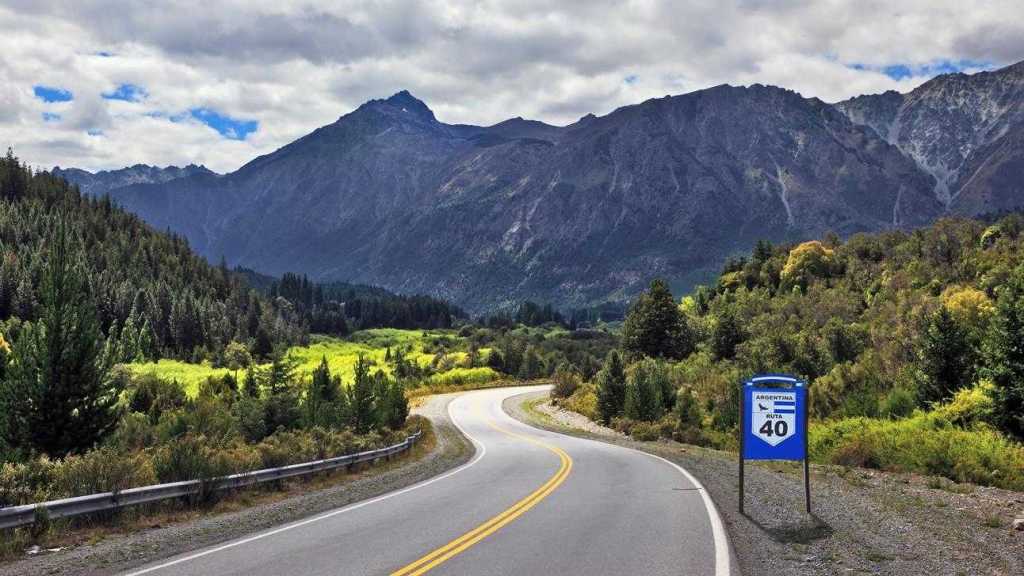
Like the Chile’s Carretera Austral, Argentina’s Ruta Cuarenta (Route 40) is another of the great South American highways. It runs for 3,246 miles (5,224 km) from the northern tip of Argentina where it meets the altiplano of Bolivia all the way to Cabo Virgenes, the most southerly point on the South American mainland. It doesn’t include Tierra del Fuego which is on an island.
Although I have never been on the Carretera Austral, I have ridden Ruta 40 between Neuquén and San Carlos Bariloche in 1995. Both highways are practically up against the Andes. Where Coyhaique is the only large town on the Chilean highway, Ruta 40 goes through Cafayate, Mendoza, San Carlos Bariloche, Esquel, Rio Turbio, and Rio Gallegos on its way to the large Magellanic Penguin sanctuary by Cabo Virgenes. To go further south in Argentina, one has to take a Chilean ferry across the Straits of Magellan before crossing over to Ruta 3 to Rio Grande and Ushuaia.
There are stretches of the highway south of Rio Negro Province that are not yet paved, being the windy deserts of Patagonia. Even so, a good part of the southern highway is the only land route from Chile’s Villa O’Higgins to Puerto Natales. In addition, there are Argentinian buses plying the route
I would love to take Ruta 40 along its entire length, but I would require an SUV, at least two spare tires, and an auto mechanic. Oh, and for certain areas, a guide. Alas, I am too old and poor to be able to indulge in this travel dream of mine.










 Tarnmoor
You must be logged in to post a comment.