The Flip Side

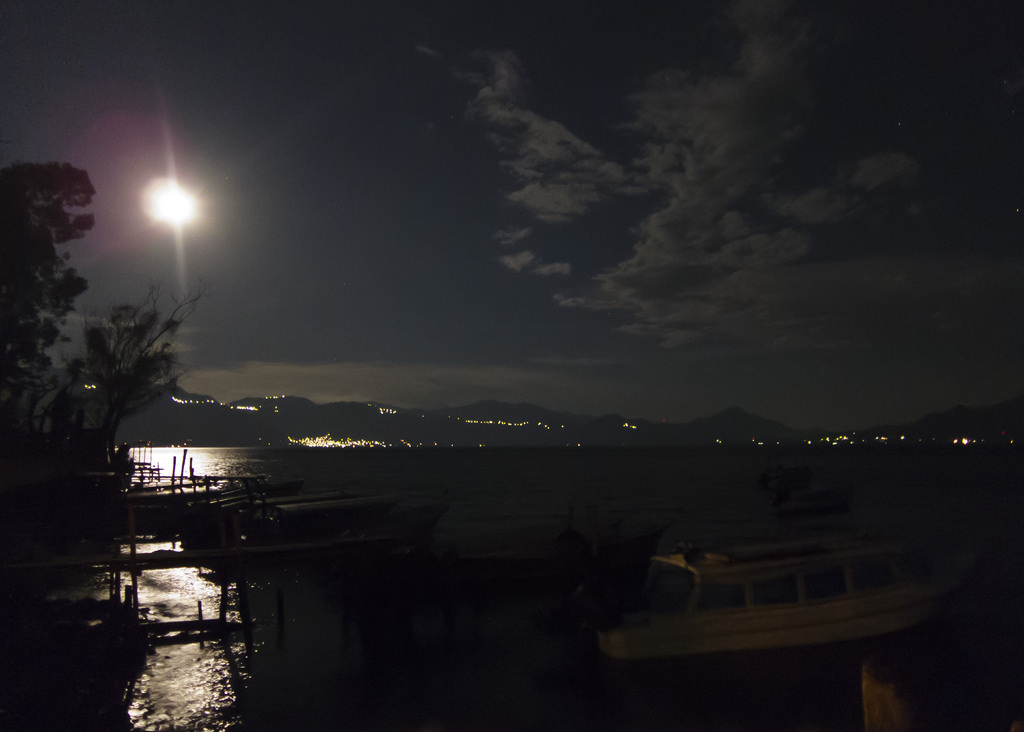
Lago de Atitlán at Night

My type of vacation is not all beer and skittles. Sometimes it’s downright anxiety provoking, especially when it comes to transportation issues. I wanted very much to see the market at Chichicastenango, but the ATITrans shuttle from Panajachel left only at 8:00 AM on Thursdays and Sundays. But I was staying at Santiago Atitlán, which is connected to Pana pretty much only via boat. (There is a road, but it is susceptible to hijacking.) I got sweats in the middle of the night worrying about whether I could make the connection.

So I arranged at the Posada de Santiago for a launch to pick me up at the hotel’s private dock at 6:00 AM, which gave me two hours to get to the ATITrans office via fast launch and tuk-tuk. The hotel assured me that the deal was done, for a mere 250 quetzales (roughly $32.00). At 5:15 AM, without my breakfast (the restaurant opened at 7:00 AM), I wended my way in the dark down the trail to the dock, which was fortunately well lit. At six sharp, I heard the launch and saw the headlights growing larger.

The ATITrans Office in Panajachel with List of Shuttle Destinations

They were right on time. We headed out before sunrise at high speed. It seemed we spent as much time in the air as on the surface of the lake. It was my bad luck that all four launch rides on the lake were on windy days with many whitecaps in evidence. But we made it to the public dock in Pana in three quarters of an hour. Fortunately, the tuk-tuks were already up and about, so I got to ATITrans with an hour to spare.

Fortunately, there was a fresh orange juice vendor setting up right across Calle Santander from me, so I had something of a breakfast after all. And in the end, I got to Chichicastenango in good time.
 

Garifuna Guatemala

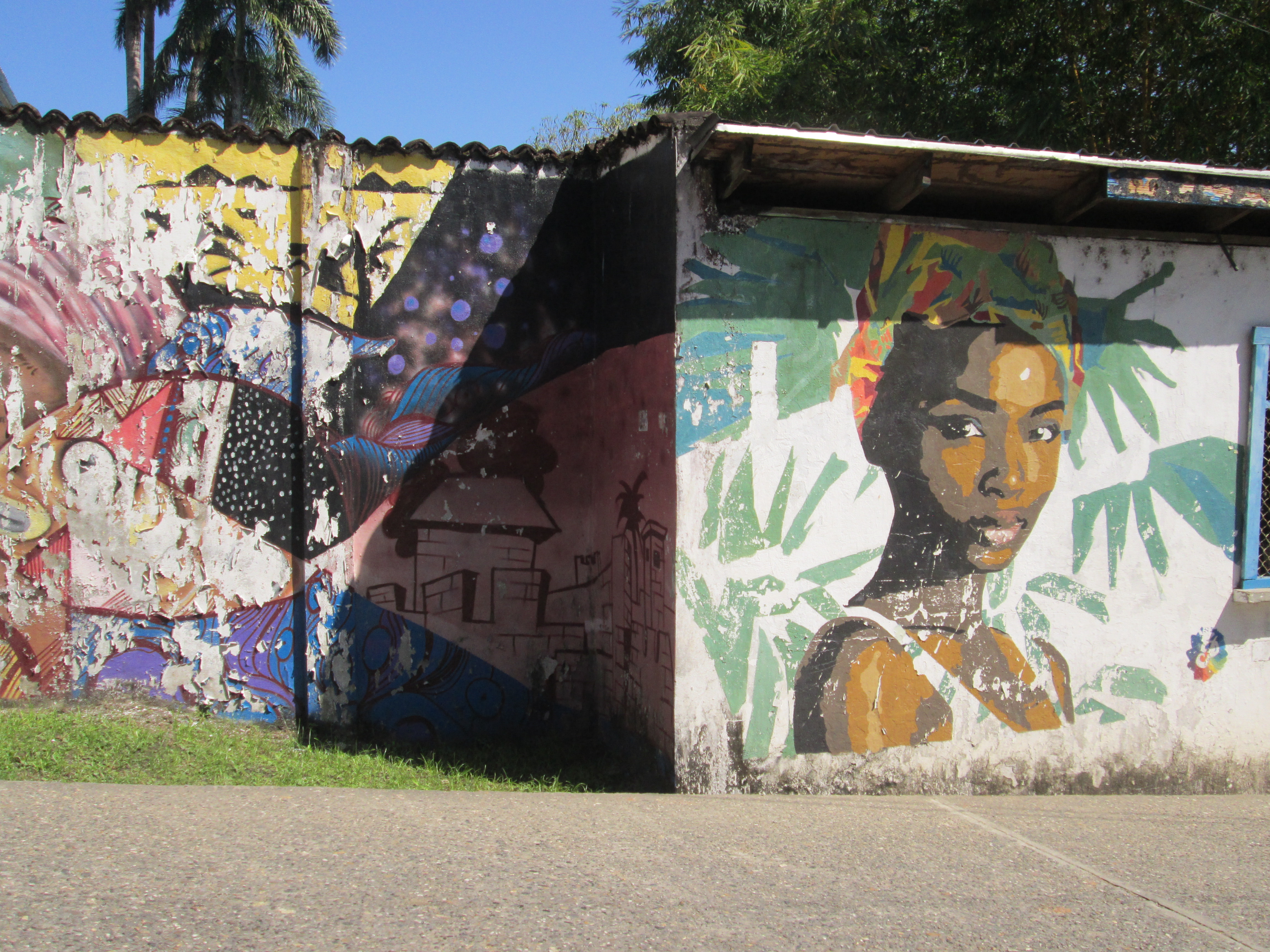
Wait a Minute. Are We in Jamaica?

There are odd little corners of Guatemala where the normal culture does not prevail. I am thinking specifically of Livingston, Guatemala, where the majority population is still Maya, but where there is a significant black population.

After the British won the Seven Years’ War and took control of the Lesser Antilles. They sorted through the population of the island of St .Vincent: The inhabitants who were darker were banished by the victors to Roatán off the coast of Honduras. The inhabitants who were more Indian or Carib in appearance were allowed to stay. Over time, the banished blacks spread throughout the Caribbean coasts of Belize, Guatemala, Honduras, and Nicaragua. Currently, no roads lead to Livingston: Access is only by boat or shank’s mare.

The so-called Garifuna spoke an Arawakan language with elements of French, English, and Spanish.

Philip Flores, a Local Garifuna Guide

From Rio Dulce, I took an ASOCOLMORAN launch toward the river mouth and through the area known as El Golfete to the Caribbean port of Livingston. There I met with Philip Flores, a guide and local leader of the Garifuna population, and had an interesting conversation with him—in English. Philip had been to the U.S. and Europe and was well-versed not only in the ways of his community, but of the world at large.

We started out by sparring over how much each of us knew. Most tourists don’t know much about the places they visit. On the other hand, I usually read a pile of books about my chosen destinations, so I am not the usual tabula rasa. In the end, I found that much of what he had to say was interesting, so I had no problem in just listening. In the end, I gave him some money to be used for his work with local children.

If you should find yourself in Livingston, I suspect that Philip will be there to meet your boat.


Visiting the Maya Gods

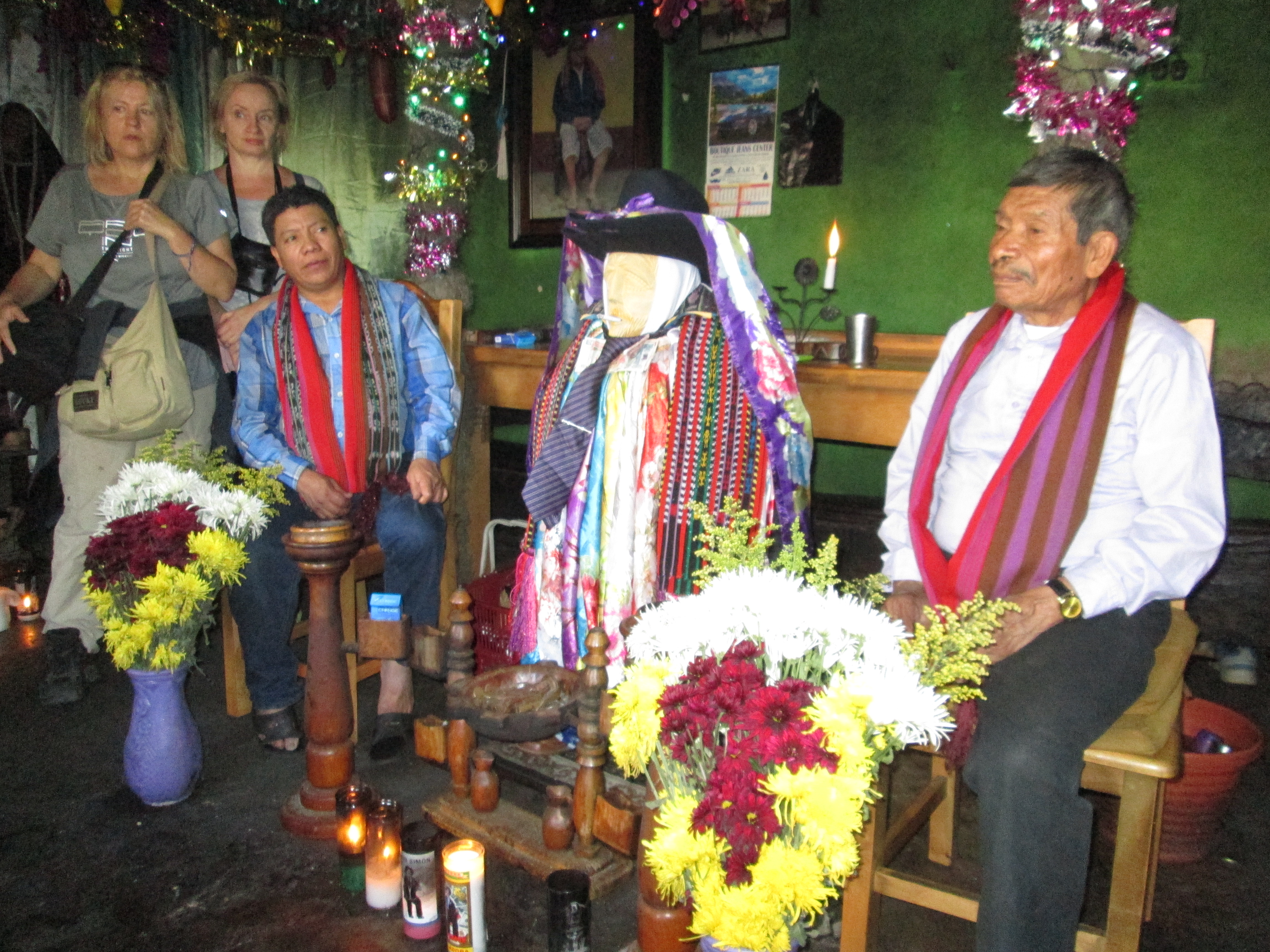
Maximón Flanked by Members of His Cofradía in Santiago Atitlán

I have some heterodox beliefs regarding God and the gods. I believe that God exists but wears many masks, appearing as Jesus, Allah, the gods of the Hindu pantheon, depending on the different types peoples around the Earth. I visited two Maya idols during my trip: Maximón in Santiago Atitlan and Pascual Abaj in Chichicastenango. I have written earlier about my intent to visit Maximón, in whose person are incorporated such figures as Judas Iscariot and the evil conquistador Pedro de Alvarado.

He is a Tzu’utujil Maya god of good and evil. During the day, a cigarette or cigar is kept burning between the idol’s lips, and he frequently imbibes rum or aguardiente (very high octane firewater). There is a brotherhood (cofradía) dedicated to taking care of the image of Maximón. Each year he occupies a different house belonging to one of the brotherhood.

I made an offering to the god, which was accepted by the cofradía and attached under the knot of his necktie as shown in the above picture. I asked him to aid me in the remainder of my trip to Guatemala and Honduras.

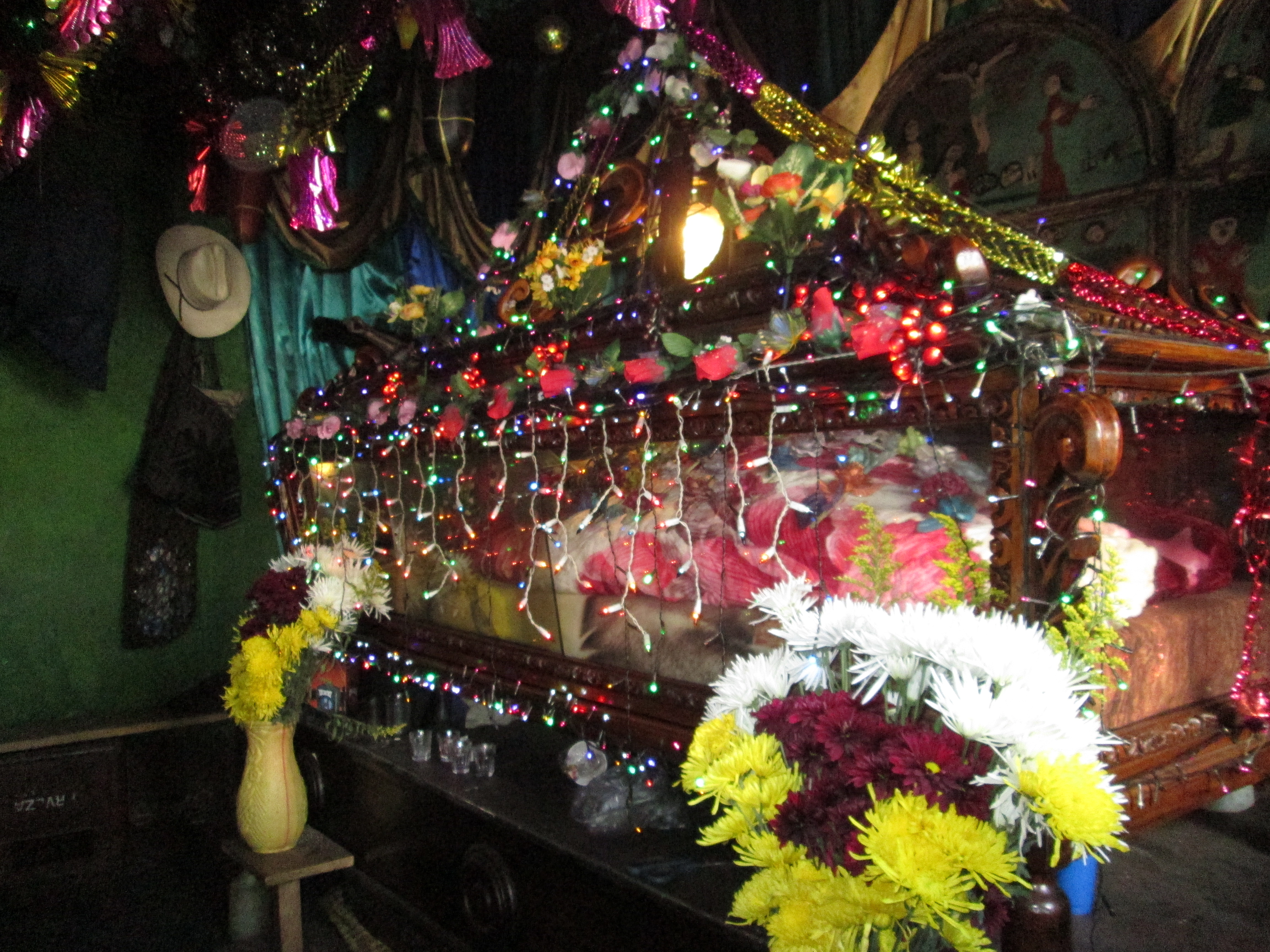
The Glass Coffin of Santa Cruz

Next to Maximón was a glass coffin containing an idol to Santa Cruz, who is in some unspecified way associated with Maximón.

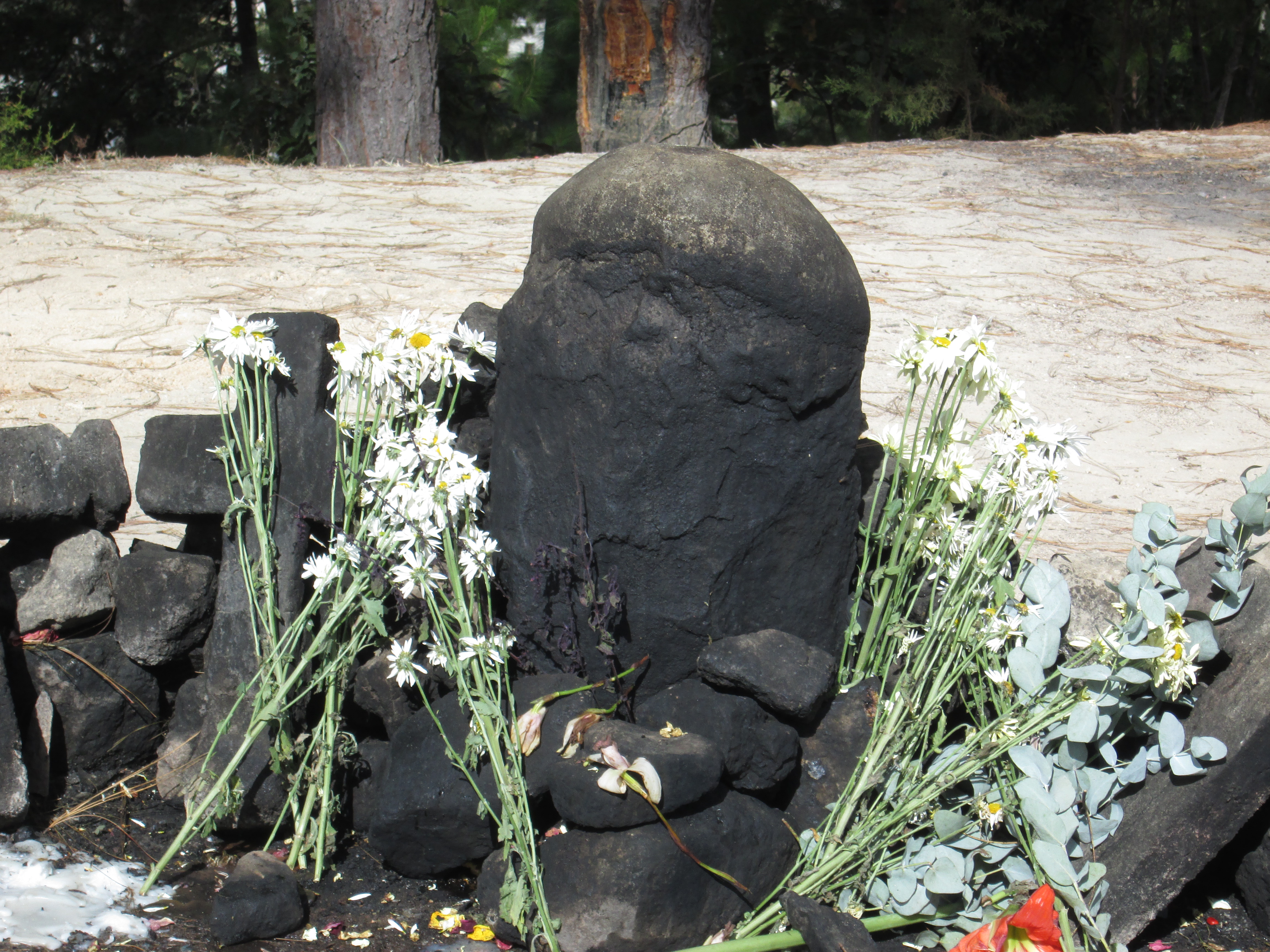
From Santiago Atitlán, I traveled to Chichicastenango in the mountains. There, with he help of a guide, I climbed a hill to the shrine of Pascual Ab’aj. What remains after members of Catholic Action damaged the idol in the 1950s is a dark featureless rock, probably of volcanic origin. I had a difficult time climbing the trail, which contains over twenty switchbacks. Fortunately, my Quiché Maya guide Juan took a knife and made a staff for me.

What Remains of the Idol of Pascual Ab’aj with Offerings

There were numerous cement bases where copal incense had been burned. At the time Juan and I visited the shrine, there were no celebrants or members of the cofradía in evidence.


Chicken Buses

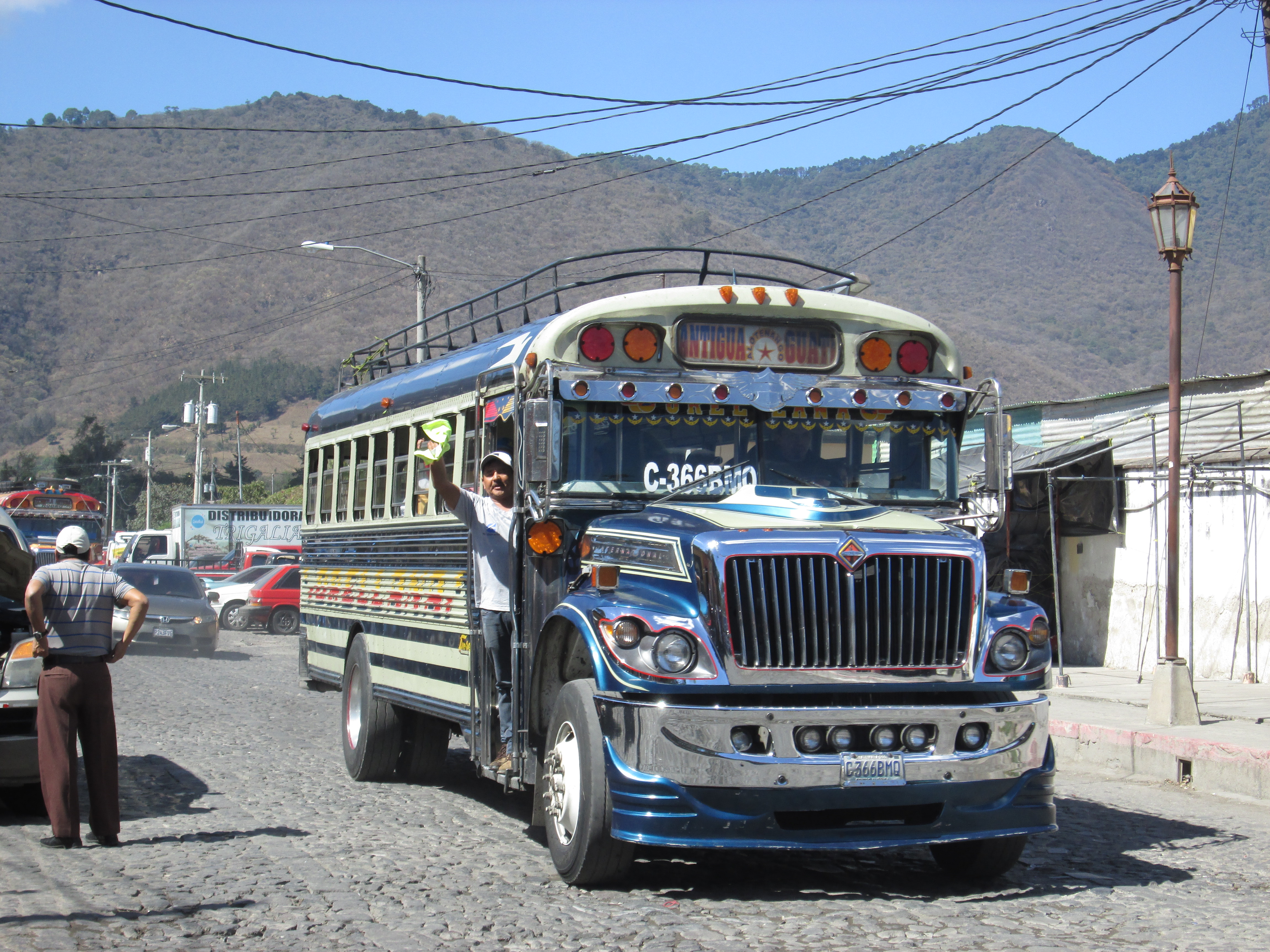
“Chicken Bus” with Conductor Hanging Out the Door

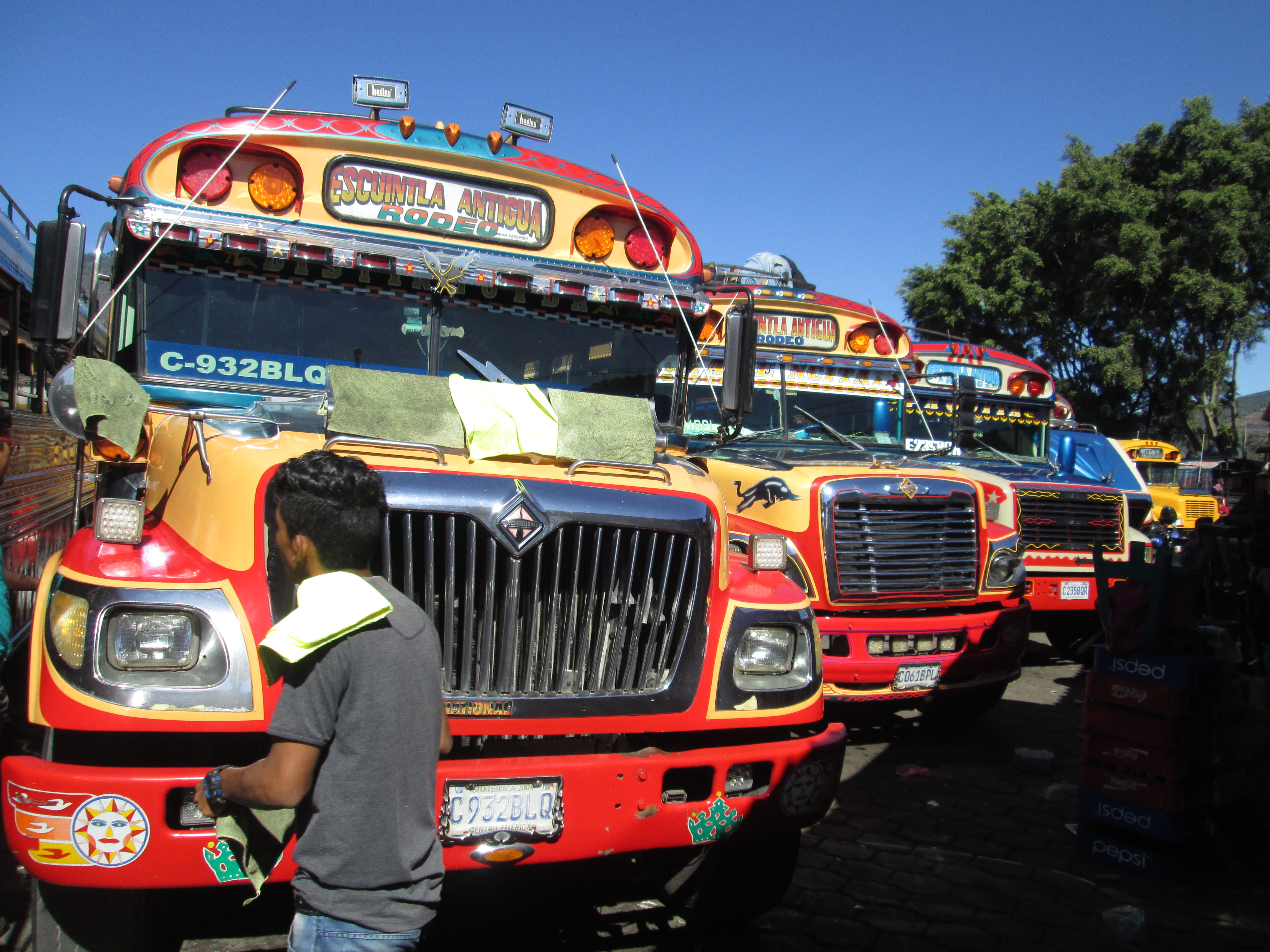
Old American school buses have a second life in Guatemala. They are imported, gussied up according to local taste, and converted into what are lovingly called chicken buses, because presumably the local Maya could transport pigs and chickens as well as themselves. They come with a driver and a conductor, who hangs out the front door as in the photo above, calling out the destination. Anyone could stop one of these second class buses by simply hailing it and climbing aboard. The conductor collects the fare and makes change, sometimes making the passenger wait until more fares are collected.

I did not take any chicken buses in Guatemala because of the potential for hold-ups and assorted violence. The guidebooks say to take tourist shuttles instead, even though they cost considerably more. Also, I do believe the language used by the driver and conductor is usually the local dialect of Mayan.

A Chicken Bus to Magdalena and Santa Lucia

There tend to be two, sometimes three, public transit options in the intercity market: chicken buses, tourist shuttles, and the (rare) first class bus that goes from point to point without picking up or discharging passengers on the way. (In a later post, I will tell you about my adventures careening through the jungle in a somewhat ratty first class bus.) The first class buses are usually for Ladinos; the chicken buses, for the locals; and tourist shuttles for Gringos.

Chicken Buses Lined up at Antigua’s Bus Terminal

I noticed that the numbers on the front or rear windows of buses (and some cars) merely repeat the license plate in larger letters (for the convenience of witnesses and the police?),

All the buses shown on this page were taken in Antigua near the second class bus terminal. The buses in Eastern Guatemala are different. But more about that later.

Time and Chance

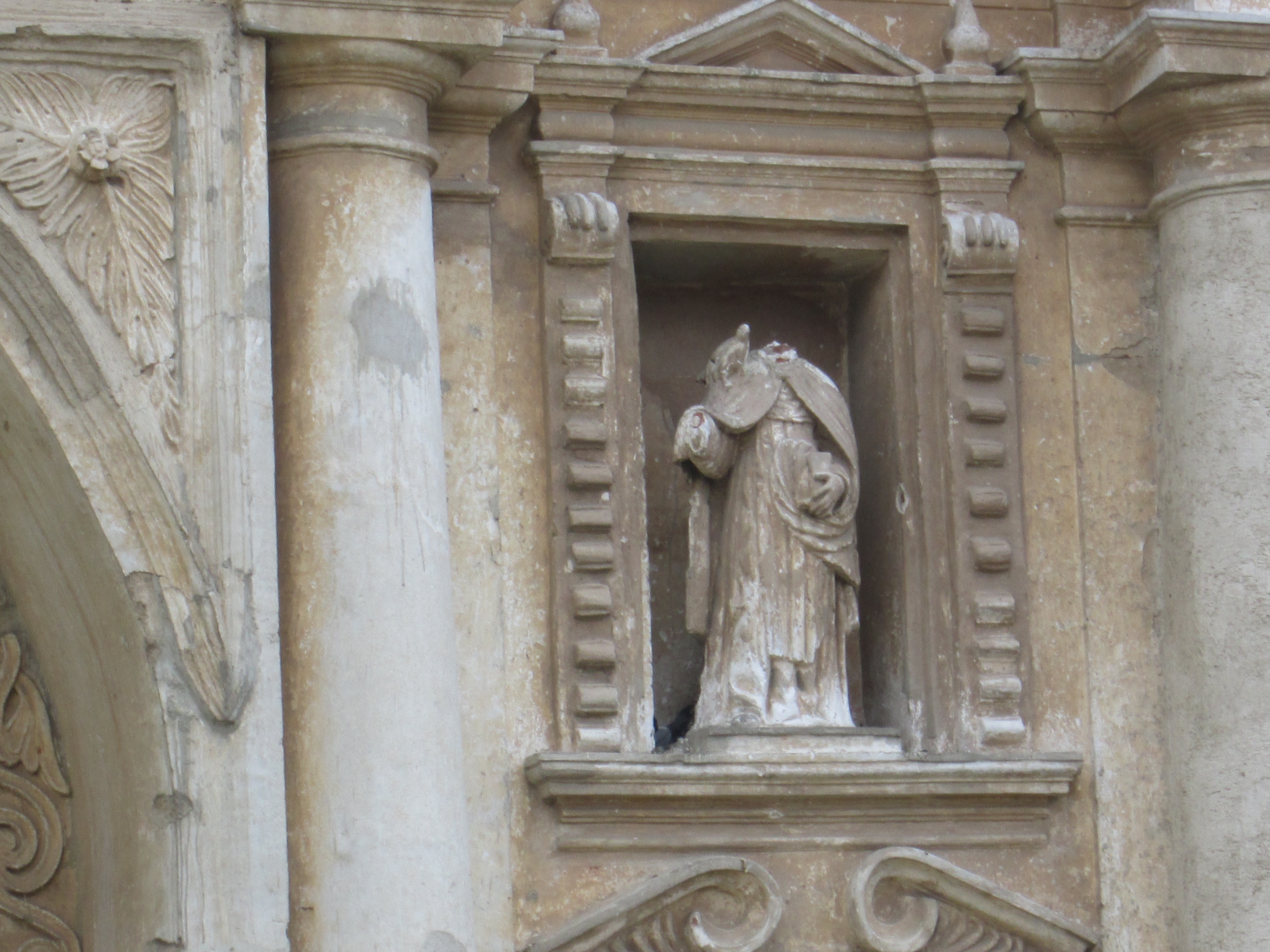
Statue Beheaded by the Santa Marta Earthquake of 1773

At 3:45 PM on July 29, 1773, a Richter 7.5 temblor struck the third capital of Guatemala, then called the Ciudad de Santiago de los Caballeros de Goathemalan. The city was filled with churches, monasteries, and convents. Half of the city’s religious were killed by the quake, and within a couple of years, the capital moved to its present-day location in the Valle de la Ermita, where it is known as Guatemala City.

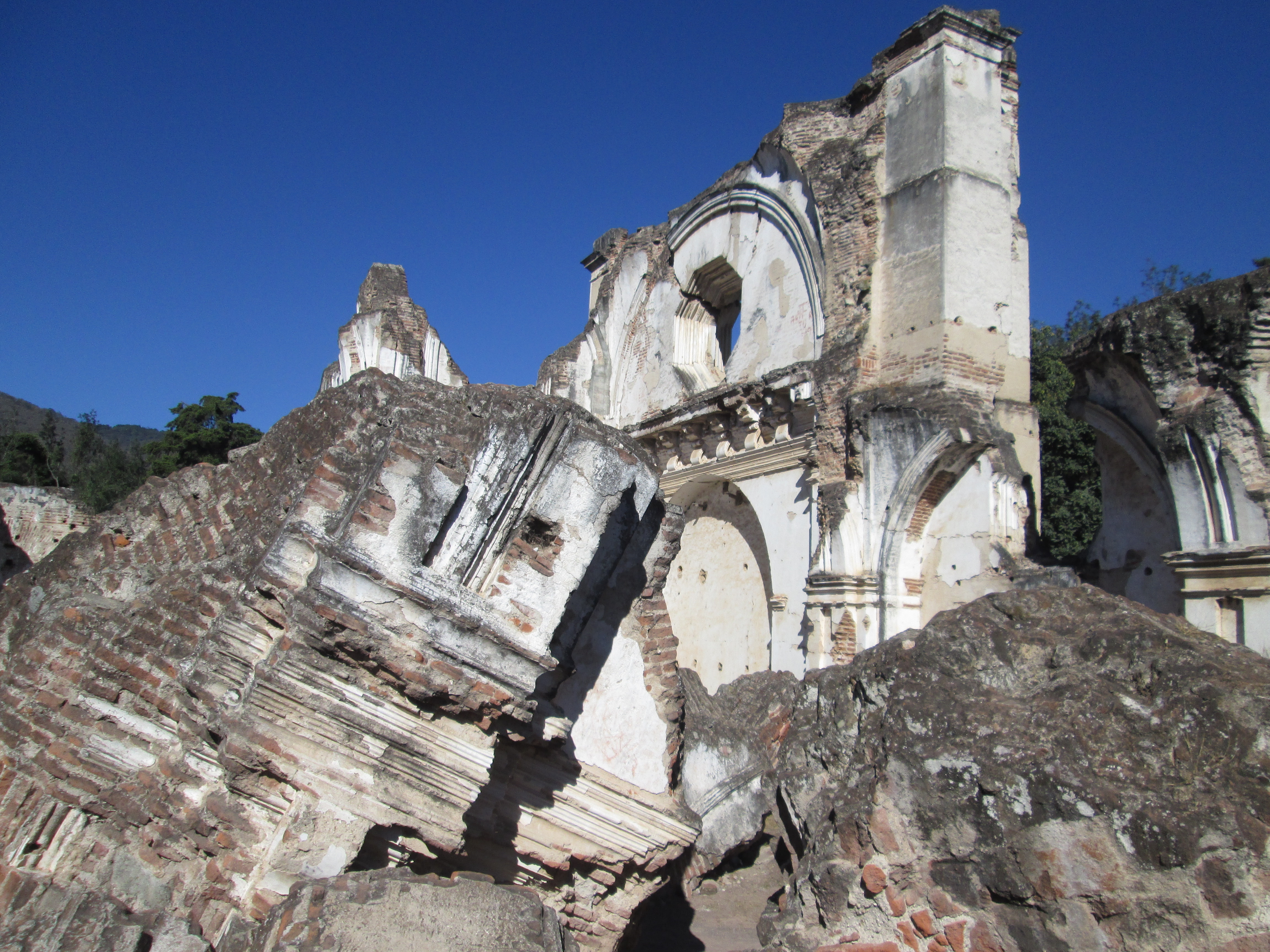
Nowhere was the devastation more apparent than the churches in the western half of the city now known as Antigua, especially the Church of the Recollects on 1a Calle Poniente. During my five-day stay in the city, I visited approximately a dozen ruined churches. None, however, made quite the impression on me as La Recolección.

Ruins of La Recolección in Antigua

The roof of the church had completely caved in, sending huge multi-ton masses of brick and concrete crashing to the floor. If any services were being held at the time, I find it hard to believe that there were any survivors. For all I know, there may still be skeletons under the masses of rubble.

While in Antigua, I called my brother in Palm Desert, California and described the chaos to him. Dan Paris, who has spent years building in earthquake country, told me that much of the disaster could have been avoided if only the Spanish had mixed straw with the concrete. The Maya, whose own houses were built based on a racial memory of thousands of years of shaking earth, did not suffer quite so much.

Not all the churches in Antigua were flattened by the Santa Marta quake of 1773. La Merced and San Francisco were two of the churches that managed to survive more or less intact, though the convent attached to La Merced was heavily damaged.

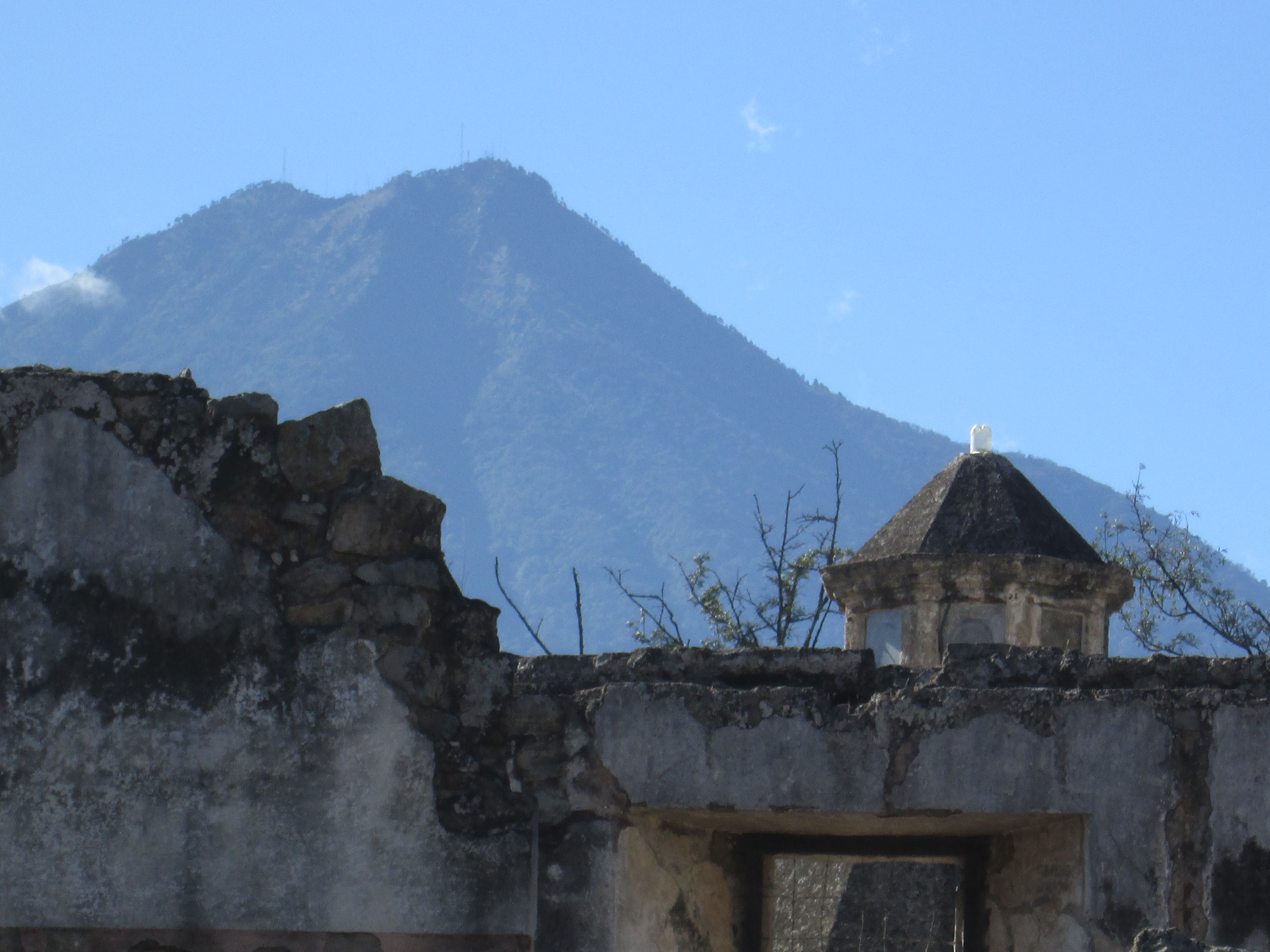
Ruins of La Recolección with Volcan Fuego in Background

It felt odd for me—who had traveled to Guatemala to see the ruins of ancient Maya cities—should have started my trip visiting the more recent ruins of Christianity. It made me feel as if the Christian ruins were, in their own way, equivalent to the Maya ruins, and that we are all subject to the vagaries of time and chance.


Tuk-Tuk? Nyuk-Nyuk!

An India Import: Auto Rickshaws, or Tuk-Tuks, from Bajaj Auto of Pune, the World Leader

If one travels to smaller towns in Central America, one is likely to travel around town in an auto-rickshaw, called a tuk-tuk from the sound of its engine. Above are two tuk-tuks parked near the public dock in San Juan la Laguna, on the shores of the Lago de Atitlán. In towns where taxicabs exist, they generally are more competitive, costing 5 or 10 quetzales instead of 20 or 30 quetzales (or more). As of today, the quetzal is worth 12.7 cents based on OANDA Corporation’s currency converter.

Riding a tuk-tuk is sort of fun, if you relish the experience of being puréed in a blender. Given the cobblestoned streets and the quick sideways maneuvers to avoid oncoming automotive traffic, you are likely to be tossed about a bit. And if you look closely, you won’t see anything that resembles a seat belt. You just have to hold on for dear life.

In Guatemala and Honduras, I have seen tuk-tuks with a driver and up to four passengers, three sitting in the back and one perched precariously next to the driver. But then, the Maya are not a large people. You can probably fit two American adults, max, in one of these three-wheeled wonders.

Tuk-Tuk Traffic in Panajachel

At first, I was afraid of trying to ride a tuk-tuk, until I found myself stranded at the eastern edge of Antigua. I was footsore from walking too many miles on rough cobblestones and narrow, dicey sidewalks, and I didn’t see any taxes passing by the Santo Domingo Museum, but a tuk-tuk stopped for me; and I was happy to take a load off my feet.

Back from Guatemala

At Santiago Atitlán with Volcan San Pedro in the Background

Last night, after an agonizing ninety minutes going through customs after a number of jumbo jets had disgorged over a thousand Chinese, I finally returned home. We wasted no time in going to sleep, as I was still on central time. The last day of my vacation was twenty-six hours long.

All in all, the trip was a success. I went everywhere I planned to go using a variety of transportation, including airplanes, tourist shuttles, tuk-tuks (more about these later), fast motorboats, buses, taxis, and at one point a hired car. My itinerary was as follows:

  • Los Angeles
  • Guatemala City
  • Antigua
  • Panajachel
  • Santiago Atitlán
  • Chichicastenango
  • Antigua again
  • Copán, Honduras
  • Rio Dulce
  • Flores/Santa Elena
  • El Remate
  • Guatemala City
  • Los Angeles

The toughest part, as I suspected in advance, was going between Copán and Rio Dulce. That’s where I hired a driver through a Honduran travel agency to drive me to Rio Dulce with a two-hour stopover at the ruins of Quirigua, which was on the way.

In the weeks to come, I will describe the vacation in some detail, as well as including a number of historical, cultural, and other observations as they come to mind.


Vacation Time

Where I Spend My First Five Nights

Tomorrow morning, I leave for Guatemala. I have a late morning flight which gets me to Guatemala City at 5:10 PM Central. At the La Aurora International Airport, I will try to convert dollars to quetzales (probably at felonious rates) and use some of the quetzales to get to me Antigua via shuttle bus. I will be spending my first five nights. My hotel is just past the Arco de Santa Catalina in the photo above, taking the first left. The volcano (Agua) is one of three surrounding the city.

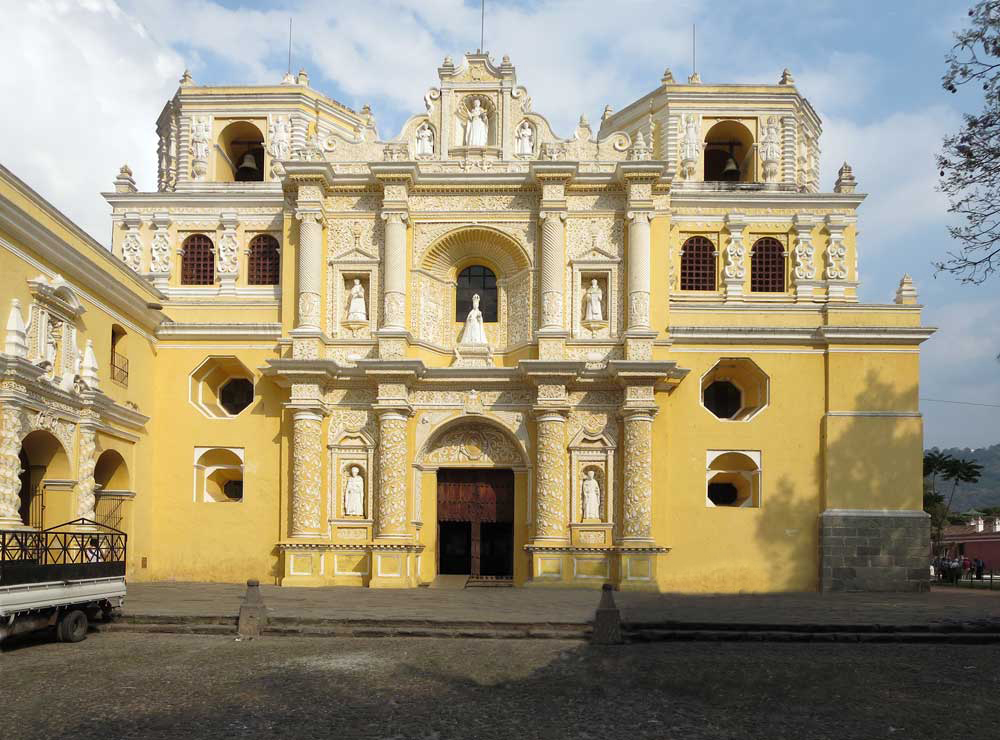
For about 200 years, Santiago served as the third capital of Spanish Guatemala, moving to the present capital after a devastating earthquake in the 18th century. To this day, many of the old Spanish churches exist only as façades backed up by ruins. Even some of the church ruins are spectacular (see below).

La Merced Church in Antigua

If this trip turns out to be like my South America vacations, I will enjoy looking at the old Spanish churches almost as much as the ancient ruins. I was surprised, especially in Peru, where the churches were actually more interesting than the Inca ruins. It was not unusual for me to attend Mass, sometimes twice in one day, just so I could spend more time gaping at the religious artwork.

I may post once or twice during my trip—minus photographs, because I will be using computers that will not allow me to load data—though my next regular post will be at the end of the month. Wish me luck!


Very Old Water

Lower Emerald Pool at Zion National Park

This is a re-post from the visit Martine and I made to the National Parks of Utah in 2007. Minor changes have been made to this post originally dated October 4, 2007.

We were on a walk and ride with one of Zion’s park rangers when we learned an interesting fact. As we stood at a viewpoint looking at little-visited Menu Falls, the ranger explained that the water seeping from the sandstone cliffs had taken a long journey from the top of the cliff down to where it descended to the Virgin River. In fact, it took 2,000 years.

When the water that poured out of the cliffs along their base appeared as rain on the Colorado Plateau, Caesar Augustus was Emperor of Rome and Jesus Christ still walked the earth.

The sandstone that formed the cliffs of Zion National Park was formed from massive dunes that once covered the area. Then the area was under water some 260 million years ago, part of prehistoric Lake Claron. Calcium carbonate from the water seeped down to the sand and helped cement it into sandstone, along with the massive weight of the lake itself, so that millions of years later, it served as a slow and massive sponge that soaked up rainfall and sent it on a long, slow journey until it reached the base of the cliff two millenia later.

Illustrated above is another one of those falls, at Lower Emerald Pool. In the extreme heat of Zion, Martine and I rested on a boulder with the deep shade and stray drops of cool (and very old) water helping us keep comfortable. The ranger had also mentioned that the sandstone purified the water in the process, but Martine and I had cool water in our canteens. I always take the precaution of leaving our canteens in the freezer so that we can be refreshed later in the day during our hikes.


An Encounter in the Desert

Acoma Sky City

It was our third day in Albuquerque. Martine and I were visiting the Indian Pueblo Cultural Center. While Martine wandered around looking at the exhibits, I stopped in front of a table covered with dozens of pieces of pottery that caught my eye. The artist was an Acoma Indian named Larry.

Now I had visited Acoma twice, and Martine, once. The Sky City pueblo shared with Old Oraibi on Third Mesa on the Hopi Reservation the distinction of being the two oldest continuously inhabited towns in North America. It sits atop a mesa closed to all but reservation traffic. One must take a bus from the Sky City Cultural Center and Ha’aku Museum to get to the top. Then, after taking the tour, one can take the bus back down or walk down a relatively easy trail.

I told Larry that we planned to visit Sky City in about a week or so, and that we had seen it before. I saw a pottery seed container bearing an image of a horned toad. Even though it was not cheap, I bought it because it was elegant. I explained to Larry that I liked to collect turtles and frogs because I, too, lived in the desert (9 inches of rain in a typical year); and turtles and frogs made me think of rain.

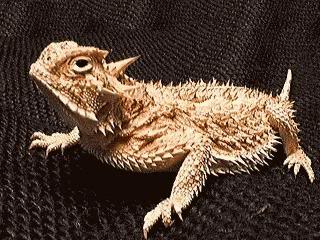
Horned Toad

This caught Larry’s attention. He recommended that when we next visited Sky City a week hence, we try to get a guide named Turtle.

As it turned out, Martine and I could not visit Sky City that next week: It was closed for a tribal religious ceremony. We were staying at the Sky City Casino on the Acoma Reservation, where I became ill. Martine had to drive me to the Indian Health Service clinic on the reservation, where I was fitted up with an IV with Solu-Cortef added. I got well quickly, as I wrote earlier.

Although we did not get to see Sky City during that trip, I felt in a strange way that I received a blessing of sorts while we stayed at the Casino. I even won a small amount of money.