A Short Season

Rental Car Sandblasted by Storm in Southeast Iceland

Rental Car Sandblasted by Storm in Southeast Iceland

We are now rapidly approaching the fall solstice. Curiously, tourists are still traveling around Iceland as if it were still summer. This last week, there was a fierce storm in East Iceland that led to tourists being stranded when wind, sand, and blowing rocks (yes!) broke windows and forced them to a halt. The following excerpt is from the Iceland Review website:

 “We were approaching Skaftafell when the wind picked up,” Marie Storm, who had been traveling in the region with her boyfriend since Friday, told Fréttablaðið. Squalls reached 30 to 40 meters per second [that’s between 67 and 89 miles per hour].

Storm said they decided to stop the car after the sandstorm blocked visibility completely. They waited in the car for several minutes. “Suddenly a rock flew through the window, which exploded over us.”

Sand blew nonstop into the car and glass was shattered over them, cutting their hands. The couple therefore decided to leave the car and seek shelter on the side of the road. “We couldn’t see anything and sand and rocks rained over us. We couldn’t even open our eyes.”

The couple called the emergency hotline 112, who contacted search and rescue squad Kári in Öræfi, who were driving around the region in an armored car, picking up stranded commuters. They arrived a half an hour later.

Storm described the wait as unbearable. “It was a complete nightmare. We were in shock. We thought we would die.” Their eyes hurt after the ordeal and so they are planning to seek medical attention.

She maintained that they hadn’t seen any signs indicating that the road was closed.

The Icelandic Road Administration’s light sign had read ófært (‘impassable’) in Icelandic. The administration now intends to replace that word with ‘closed’ to catch the attention of foreign tourists.

I was in this area toward the end of June. It is a narrow ribbon of road between the giant Vatnajökull glacier and the black sand beaches facing the Atlantic. Until global warming forced the glacier back several hundred yards in the last eighty years, it was not even possible for there to be a road. The nearness of the glacier and of the Atlantic leads to some truly horrific storms.

Iceland is a stunningly beautiful country which just happens to have some terrible weather during most months of the year. One cannot just assume that, because the weather is fine in your country of origin, the cruel Norse gods will let you off scot-free.

One interesting sidelight: Icelandic auto rentals do not insure for conditions such as those described above. Not only did the tourists wind up fearing for their lives, they will also end up paying through the nose for their poor judgment.
Thinking About Quebec

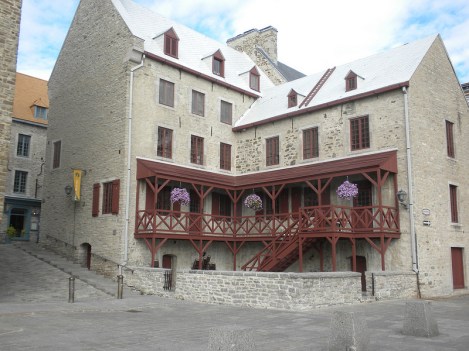
17th Century-Style Buildings by the Harbor in Quebec City

17th Century-Style Buildings by the Harbor in Quebec City

Today, Martine and I had dinner at a French Canadian restaurant in Westwood: Le Soleil on Westwood Boulevard. While I am dreaming of going to Peru, Martine would like to revisit the Province of Quebec and perhaps drive around a bit. It’s possible that I may yield to her: There is something about Quebec that draws out the Frenchwoman in her, and where else in North America can one feel so much like being in Europe?

What most people don’t know is that there is a part of Metropolitan France right off the south coast of Newfoundland. The islands of St. Pierre and Miquelon, a short ferry ride away from the town of Fortune, Newfoundland. The islands are all that remain of the extensive lands of New France lost to Britain in the French and Indian War. It is a little known fact that, during Prohibition, Chicago gangster Al Capone used the islands as a base for illegally importing wine and liquor into the United States. I don’t know if it’s feasible to include St. Pierre and Miquelon on a trip to Quebec, as they are many hundreds of miles apart; but perhaps some day….

I’m glad that Martine liked the Boeuf Bourguignon and Crême Brulée at Le Soleil. She tends to think that most French restaurants in L.A. are not sufficiently authentic, but this Quebecois restaurant seemed to have some of the real stuff.

Is Peru Next?

I Am Thinking of Visiting Peru Next

I Am Thinking of Visiting Peru Next

If my next vacation will be solo like my trip to Iceland, I think I will visit Peru some time next year. My first view of the Andes from Argentina in 2006 and 2011 have whetted my appetite for more, and where better to go than Peru, home of the Inca Empire?

If, on the other hand, Martine gets better or decides she can travel, I will probably pick a destination in the United States, such as Oregon and Washington. Unfortunately, Martine still can’t lift anything and spends a lot of time resting from back pain.

Since I have been fairly healthy, I will test myself at high altitudes. Will the dread soroche bring me down? If my destination is Peru, I will ascend the Andes slowly, going by way of Arequipa and other intermediate destinations before I reach the heights of Cuzco, Machu Picchu, and Lake Titicaca.


What I Will Remember Most

Under Attack by Arctic Terns

Under Attack by Arctic Terns

Now that I’ve been back from Iceland for six weeks now, what do I remember most about that remote and somewhat wild island? The place that keeps coming back to me are the West Fjords. Only some seven thousand people live on a large peninsula punctuated by basaltic ridges and broad fjords. It is quite possibly one of the most isolated parts of Europe, even though one can reach it from Reykjavík by bus in about eight hours.

Above is our little guide Thelma (which she pronounces as Talma) walking with a tourist surrounded by an angry cloud of arctic terns who are aggressively defending their nearby nests. I can understand them, in a way. It’s been a bad year for Icelandic birds, what with the puffins of Vestmannæyjar being unable to produce a bumper crop of little pufflings, and arctic terns likewise having problems due to global warming.

The Little Town of Isafjörður

The Little Town of Isafjörður

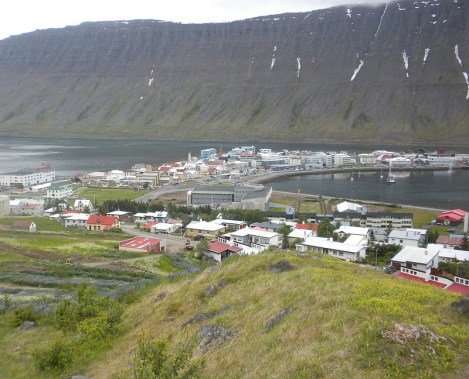
Not that I felt particularly warm in the West Fjords “capital” of Isafjörður” (shown above) which has only some two thousand inhabitants. It’s on a little sandy spit of one of Iceland’s largest fjords, and it is fully about ten degrees Fahrenheit colder than any other part of Iceland that I visited, with the exception of the glacier Vatnajökull.

Why does the image of the West Fjords stick with me so much? And not only with me, but with other travelers as well. Most of them go to backpacking to Hornstandir, a desolate peninsula with spectacular views jutting out into the Denmark Straits that separate Iceland from Greenland. I myself did not go there, but most of the European kids who stayed at the youth hostel made that their number one destination. I’d like to see it some time, but I doubt I am up for a multi-day trek with tent, sleeping bag, camp stove, and food.

No, I will remember the long bus rides on gravel roads past spectacular waterfalls and cute little villages like Thingeyri and Patreksfjörður. I will remember the bird cliffs at Latrabjarg, where a gale-force wind was trying to blow me to my death on the rocks several hundred feet below. I will remember the island of Vigur (top photo), where a single family ekes out a living gathering eider down and welcoming summer tourists with coffee, tea, and homemade cakes.

These places are all etched in my memory. The beauty will remain with me forever.

Lobster Town

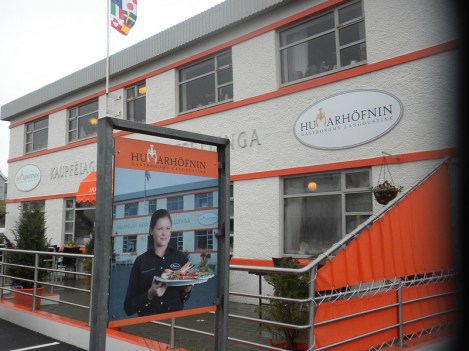
Lobster Restaurant in Höfn

Lobster Restaurant in Höfn

They’re not lobsters as we think of them in the United States or Canada, but the langoustine or Nephrops norvegicus (Norwegian Lobster) of Iceland is every bit as good. The Maine Lobster is a giant, but the langoustine fits the same great flavor into a smaller package.

The lobster capital of Iceland is the town of Höfn, which is pronounced very much like a hiccup. Let’s take it slowly: HOEP, with the oe sounding like the oe in French oeil, “eye.” And where did that “p” sound come from? It seems that, in Icelandic, certain diphthongs change the pronunciation of the first consonant. Just like the name of Iceland’s International Airport. It looks as if it should be pronounced KEFF-lah-vick, but it’s actually KEP-lah-vick or KEB-lah-vick, with the “f” sounded halfway between a “p” and a “b.” And if that confuses you, don’t bother going to Hafnarfjörður, or the elves will do evil things to your vocal chords.

Getting back to lobster, Höfn is a relatively recent town that owes its growth to its location midway between East Iceland and the towns of the Southwest, including Reykjavík and Selfoss. In addition, it has one of the better harbors in the Southeast, if a little treacherous because of shifting shoals. But it is spectacular to wake up in the shadow of Europe’s biggest glacier, Vatnajökull.

Also, for some reason, the langoustines are especially plentiful and tasty around Höfn. If you visit the place, as you should when coming to Iceland, be sure to try the langoustines. They are especially good at the Humarhöfnin Restaurant pictured above. And please don’t ask me to pronounce it.

You’ll Get There Strætoway

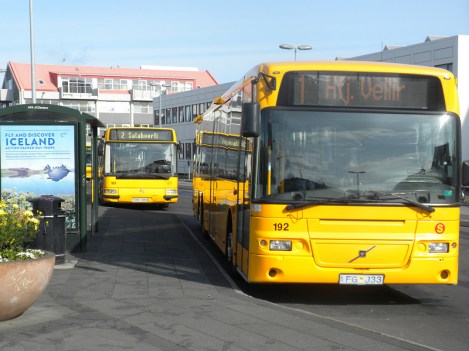
The Central Bus Terminal at Hlemmur

The Central Bus Terminal at Hlemmur

I’ve always thought that one of the most fun things about visiting a foreign country is using the local bus system, especially when it’s so well organized (as it usually is in Europe). It’s an altogether different proposition in Latin America and Asia, where it’s not easy to find out beforehand where a particular bus goes and how often.

Reykjavík’s Stræto (pronounced STRY-toe), on the other hand, is pretty easy to use. Their yellow buses go all over the capital, and schedules are readily available on the Internet—in English. There are a number of regional terminals, such as Mjódd, from which the Stræto long-distance buses depart for the south and west of Iceland. These are usually a better deal than using the Reykjavík Excursions buses with their preponderance of backpackers. Then there is Háholt in Mosfellsbær and Fjörður in Hafnarfjörður in the southern part of the “metroplex.” (The quotes are there because Reykjavík has only about 150,000 residents.)

Stræto Buses at Hlemmur

Stræto Buses at Hlemmur

The bus fare for Stræto local buses is over $3.00, but there are several ways one can save. For more tourists, I recommend getting the Reykjavík Welcome Card, which allows you unlimited free bus travel for 1, 2, or 3 days. Also included is free admission to museums and swimming pools in the area. One could also buy panes of bus tickets. Note that long-distance services charge additional tickets, and these can either be purchased in advance at bus terminals or via credit card from the driver.

One interesting feature of the yellow Stræto buses is a display of what the next stop is, together with the name pronounced in proper Icelandic. It’s a great way to learn how to pronounce what is a real tongue-twister of a language.


Fading from View

At Vatnajökull

At Vatnajökull

I have been back in Southern California for three weeks, and only now am I no longer dreaming about Iceland. It is time to get on with the rest of my life. From time to time, I will return with a post about Iceland, but it is no longer occupying the front and center position of my life. (Of course, I would dearly love to return and spend some more time in the Northeast of the island.)

In the above photo, I am standing at the tongue of Heinabergsjökull, one of the extensions of the gigantic Vatnajökull icecap, the third largest in the world after Antarctica and Greenland.

At the same time that Iceland is starting to fade from view, so is Vatnajökull itself. Over the last eighty years, the glacier has pulled back from the edge of the sea for several miles and shows signs of a further retreat. In the 1930s, if I were standing in the same position, there would be perhaps a hundred meters of ice below me (or above me).

What I hope will never fade from view are my memories: Iceland occupies a special place in my heart—along with Patagonia, the American Southwest, Yucatán, and the islands off the coast of Scotland. Visiting those places has, to a large extent, made me the person I am today. I went from being a little kid whose family was too poor to take him anywhere to a grown-up who has developed an insatiable itch for travel.

Who knows what the next few years will bring? My gaze is still skipping around the globe, looking for places that might interest me. And I hope that Martine can accompany me, because her presence and her sense of wonder make everything better.


Iceland Is for the Young

The Gamla Youth Hostel in Ísafjörður

The Gamla Youth Hostel in Ísafjörður

For some reason, I usually wind up staying at a youth hostel at least once on each vacation. In Iceland, it was because I delayed too long waiting for Martine’s health to improve before making my reservations. The impression I had was that not too many people traveled up north to the remote Westfjords. It turned out that I was wrong. Although I got two nights at the business-class Hotel Ísafjörður, my last two nights in the Westfjords were to be spent in a dorm room at the Gamla Guesthouse.

Now this brings up an interesting contradiction. Although I prefer to stay in a room myself with a made-up bed (a shared bathroom presents no particular difficulties for me), I always fear that my goods would be stolen by my fellow roommates. And, not only do I avoid talking to other tourists staying at the same hotel or guesthouse, I tend to make more friends with the young who stay in the hostels.

My roommates were a German couple and a French student named Jamie, all three of whom I grew to like—to the extent that I didn’t mind sharing information with them. (With American tourists dressed in their usual country-club resort togs, I usually answered all questions in Hungarian with a confused look on my face.)

The Westfjords were full of European backpackers looking for the weather to break so that they could catch a launch to the even more remote Hornstrandir area across the fjord. A hike there usually involved several days and could be ruined by the typically bad weather of the Westfjords.

So why did I like these young people so much? For one thing I admired their courage. I would never venture to carry a tend, sleeping bag, and several days of food on my bag with the threat of uncertain weather looming. For another, for the most part my fellow tourists at the Gamla Youth Hostel (shown above) were a congenial set of people. What I shared in common with them is that I had booked my trip myself and did a lot of preparation reading about the history and the culture. I even knew a fair bit about the Hornstrandir Peninsula, though I had to admit I was too old for its rigors.

In Iceland, there are two classes of accommodation, which can be roughly described as made-up bed accommodations and sleeping-bag accommodations. For the latter, a bed is provided—but without a pillow or cover. (I paid extra, because I knew what it was like to sleep in a stinky sleeping bag from past experience.) So I had what was, in essence, a made-up bed in a sleeping bag accommodation youth hostel. I got a few snarky looks from the management, but I succeeded in pointing out to them that Booking.Com, through which I made the reservation, said nothing about sleeping bags. And I was willing to pay the extra 1,700 kronurs for breakfast at the neighboring guesthouse under the same management, which was pretty good. (I especially liked the lumpfish caviar.)

Needless to say, I felt accepted even though I was by far the oldest person staying at the hostel.

1,017

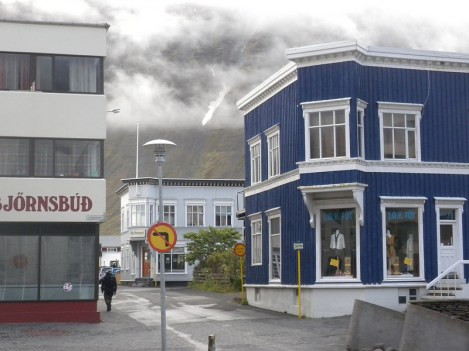
Downtown Ísafjörður in the Westfjords

Downtown Ísafjörður in the Westfjords

It took a while, but now I have all 1,017 photographs I took in Iceland (minus a few obvious nixies) available on Yahoo! Flickr. You can see them by clicking here.

Eventually, I will take the hundred or so best pictures, create title pictures and maps, and add a soundtrack. Then I’ll try to get some cloud space and store it there. At that point, I will let you know how to access it..

Every once in a while, you will see a dark vertical line at the right edge of the picture. That started happening when I accidentally dropped my camera on Austurstræti in Reykjavík. Now when I take a picture, the camera makes a funny noise and some, but not all, of the pictures have the dark line. Otherwise, they seem to be all right.


From Point A to Point B—Without Crowflies

Beautiful But Deadly

The Westfjords of Iceland have only some 7,000 residents. Although many formerly cinder-only roads are now paved, there are several very good reasons why visiting motorists outrageously underestimate the driving time between two points. For instance, let’s take the land route between Reykjavík and Isafjördur. As the crow flies, the distance only amounts to 222 kilometers; but, alas, there are no crowflies in Iceland.

If you insist on paved roads all the way, it takes between 6-7 hours to take the Ring Road and branch off north of Bogarnes to Route 61 via Holmavík. That part’s fairly straightforward, but then you have follow the fjords as they zig and zag along Isafjördurup for some three hours. That’s about 30 km (18 miles) of the air distance per hour. Check out this circuitous route:

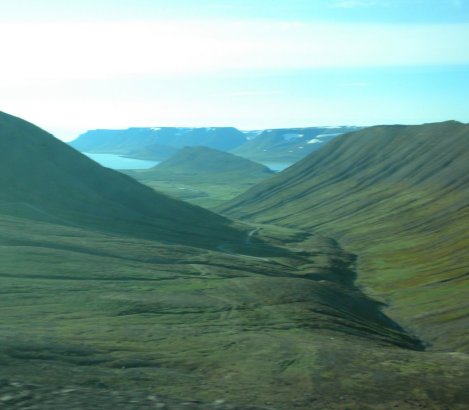
Check Out the Road South East of Isafjördur

Check Out the Road South East of Isafjördur to Holmavík

For over three hours from Isafjördur south, one must follow the contours of the fjords and of the giant basaltic hogbacks that stretch out like fingers and define them. Only at one point is there a bridge that cuts the distance—slightly.

A slightly faster option is to drive to Stykkisholmur and take the Baldur car ferry to Brianslækur, driving the 90% cinder Route 60 due north to Isafjördur. (The only benefit on this route is that one gets to see the falls at Dynjandi, which is one of the most lovely in all of Iceland.) It takes an hour less, but driving this road will take its toll on you in other ways. At the end is a spectacular tunnel between Þingeyri and Isafjördur. (Without that tunnel, I don’t know whether it is even possible to visit the southern part of the Westfjords without air transport.)

I suspect that many tourists just fly to the Westfjords and rent a car there.

Many long-distance buses in the Westfjords only run three days a week. The Sterna bus between Isafjördur and Holmavík on a Sunday was so full of backpackers and their impedimenta that there was barely room to get in or out.

But was it worth it? Yes, indeed. And I’d to it again!