Iceland 2001: Surviving the Fierce Winds

In a Land of Fierce Winds, Corrugated Steel Siding is Required

In a Land of Fierce Winds, Corrugated Steel Siding is Required

How windy is it in Iceland? For one thing, there are no tall trees on the island. The joke among the natives is the answer to the riddle, “What do you do if you’re lost in an Icelandic forest?” The answer: “Stand up!”

More of the land used to be forested, but centuries of sheep herding and gathering wood for charcoal and building had depleted the original forests. In the medieval sagas, most of which were written in the thirteenth century, much is made of who has the legal rights to claim driftwood that has washed up on the beach. (Cf. The Saga of Havard of Isafjord.)

One of the things I found most curious when I landed in Reykjavík were all the houses with painted corrugated steel siding. The above house is in Heimaey on the Westman Islands, but the general principle holds: Protect it with steel or the wind will blow your house in, if not away. The same goes for the roofs: A shingle roof would not last a month.

The painted corrugated siding does add quite a bit of color to a land which would otherwise tend toward the grey and gloomy. The following is a photo of the Bautinn, my favorite restaurant in Akureyri:
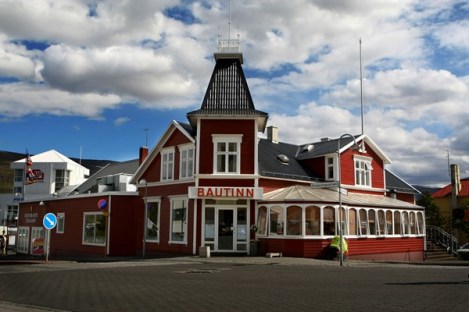
The Colorful Bautinn Restaurant in Akureyri

The Colorful Bautinn Restaurant in Akureyri

Whole neighborhoods in Reykjavík and other cities feature buildings whose siding has been painted in bright colors.
 

The Bus and Train Freak

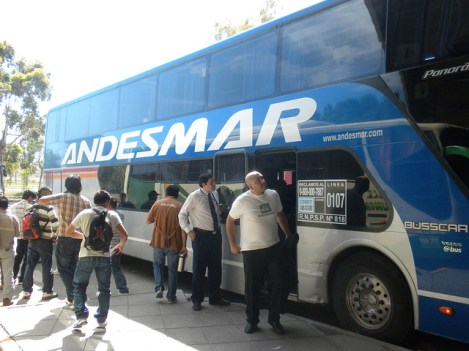
At the Bus Station in Trelew, Argentina

At the Bus Station in Trelew, Argentina

Here in the United States, our intercity ground transportation is the pits. Even Mexico has us beat, with buses they manufacture themselves. Of course, neither the U.S. nor Mexico are any good at railroads, with a few minor exceptions.

One thing about me that you may not know is that I am a transportation freak. I think about public transportation a lot. Two weeks ago, I suddenly woke up in the middle of the night remembering the bus company that took me in 2001 from Reykjavík to Akureyri via the Kjölur route across the desolate plateau that forms the center of the island. The bus I took was labelled Seydisfisbilar Akureyrar. (There may be a few diacritical marks missing: The line doesn’t show up on a present day Google search.).

The funny thing is that I could figure out bus and train schedules almost irrespective of what European language they’re written in. Asking questions and understanding the answers is an entirely different issue.

In Argentina, Martine and I rode long-distance buses between Puerto Madryn, Trelew, and Gaiman—mostly on the 28 de Julio line. They were so far and away better than anything Greyhound has in the field that I blush with shame. Even the verbal interface with the ticket agents in the above cities was relatively easy, until I found out that, on some routes, seating is assigned rather than being asiento libre (“sit where you please”).

When I am in Iceland, if I run into Straeto employees that either do not or will not speak English, I may run into a spot of trouble. But since 95% of Icelanders under the age of 70 speak English, that is pretty much a baroque fear.

As for Icelandic train schedules, there are none, primarily because no one ever built a passenger railroad to serve a sparsely populated island in the Arctic.


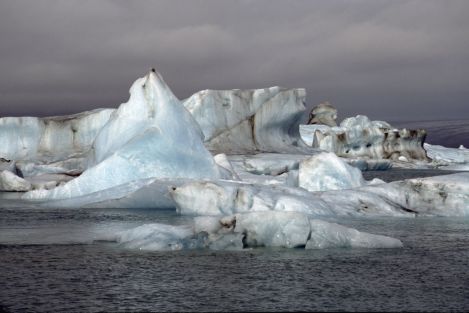
Iceland 2001: Jökulsárlón

The Glacial River Lagoon of Vatnajökull

The Glacial River Lagoon of Vatnajökull

About a week ago, I found my old Kodachrome slides of my 2001 trip to Iceland. I had them converted by Bel Air Camera in Westwood to JPEG format and copied onto a CD-ROM. Over the next couple of weeks, I will be interspersing my best Iceland 2001 pictures with my regular posts.

The above glacial lagoon is near the Southeast Corner of Iceland, between Höfn and Skaftafell. Iceland is called Iceland because that corner is occupied by Europe’s biggest and most deadly glacier, Vatnajökull. And that glacier is the first part of the island that comes into view when sailing aboard a Viking craft from Europe.

Beneath a heavy layer of glacial ice at Vatnajökull lies the volcano Grimsvötn.

Think of what happens when an active volcano that is covered by a glacier suddenly erupts. You have a phenomenon, unknown in the Continental United States, referred to by Icelanders as a Jökulhlaup, a sudden flood that forms from seemingly nowhere and rushes to the sea, destroying everything in its path. It is because of this phenomenon that Iceland did not have a permanent road connecting the Southeast of Iceland to the Southwest. The picture below shows the wreckage of a steel bridge not far from the lagoon above from the 1996 eruption of Grimsvötn:

Bridge Destroyed by 1996 Eruption of Grimsvötn

Ruins of Bridge Destroyed by 1996 Eruption of Grimsvötn

The lagoon of Jökulsárlón is one of the most popular tourist attractions in the area. The calved pieces of the glacier are all shades of blue and white. It is possible to take an amphibious boat ride among the floating chunks of ice, which I plan to do next month. The bus from Reykjavík to Höfn (and back) stops there for about thirty minutes to let all the shutterbugs have a go at it.

New Land

Islands Seen from Storhofdi Peninsula on Heimaey

Islands Seen from Storhofdi Peninsula on Heimaey

Geologically speaking, the Westmann Islands south of Iceland are brand spanking new. The most recent island in the group, Surtsey, suddenly rose up from the sea during a volcanic eruption in November 1963. Even fifty years later, access to the island is restricted to scientists and naturalists. Even Heimaey, the “Home Island” of the group, was enlarged by the world’s youngest volcano, Eldfell, which came into existence in January 1973, forcing the evacuation of the island.

As the result of a miraculous save by the Icelanders, who pumped cold seawater on the advancing lava forcing it to form an ever-higher berm that prevented the town from being more than one-third inundated. (The story is ably told by John McPhee in his book The Control of Nature.) On the other hand, two square kilometers of new land were created on the east side of the island.

The only fatality from Eldfell was a druggie who broke into an apothecary and was overcome by the fumes.

I will be spending three days and two nights on Heimaey in June. I plan to visit the Storhofdi Peninsula and photograph the puffins that congregate on the cliffs there.


Sumardagarinn Fyrsti

In Iceland, This Is the First Day of Summer

In Iceland, This Is the First Day of Summer

If you can find a place in Iceland that looks like this, let me tell you, my friend, you are not in Iceland. In today’s Iceland Review, there was a brief article about today’s being the first day of summer, or, in Icelandic, Sumardagarinn fyrsti. This holiday falls annually on the first Thursday following April 18 and is a bank holiday throughout the island. The article continues:

According to the science website of the University of Iceland, the first day of summer was also considered the first day of the year, which is why people used to count their ages, and their animals’ ages, in winters rather than years.

It was common to distribute summer gifts on Sumardagurinn fyrsti, four centuries before Christmas presents became a tradition, and the summer gift tradition is still practiced in some households. People celebrated with a feast, often finer than on Christmas Eve.

Farmers took a break from their hard work and children were allowed to play with their friends from the neighboring farms. The day was dedicated to young women and to children (it’s also known as Children’s Day). On this day young men would often reveal whom they fancied.

Another tradition on the First Day of Summer, called húslestur, involved people getting together and listening to readings from the Icelandic sagas, poems or other literature.

If the weather was summery, farmers would let their cattle and rams out, to allow the animals to greet summer, and to also entertain themselves by watching the animals play.

People used to go to mass on Sumardagurinn fyrsti until the mid-18th century when the inspectors of the Danish church authority discovered that mass was being held on this heathen day and banned the practice.

According to legend, people considered it a good sign if summer and winter ‘froze together’ (if there was frost on the last night before summer).

People would put a bowl filled with water outside to check whether it had frozen in the early hours of the next morning, before the morning sun could melt it. If the water had frozen, the summer would be a good one.

As I prepare for my vacation in Iceland, little stories like this help motivate me to learn even more about where I’m going. The idea of spending New Years Day reading sagas, poetry, and other great literature out loud is a welcome change from watching bowl games and merging with one’s inner couch.

Islands of Peace

The Church at Mission Santa Barbara

The Church at Mission Santa Barbara with Martine in the Foreground

The California Missions are probably the state’s best claim to a rich history going back to the eighteenth and nineteenth centuries. I find it nothing less than amazing that most if not all of Franciscan Father Junipero Serra’s missions are still in existence, after all the earthquakes, fires, and other disasters to which California is prone.

Mission Santa Barbara is one of four missions dedicated to converting and regimenting the Chumash Indians of the area (the others are La Purisima in Lompoc, Santa Ynez in Solvang, and San Buenaventura in Ventura). Although Father Serra was declared beatified by Pope John Paul II in 1988, there are still unresolved issues regarding mistreatment of the Indians. Each of the missions also contained Spanish military barracks for troops enforcing the political dictates of the Spanish Viceroys. So it is not uncommon to find stories where the Indians were both helped and repressed by the Missions and their dual religious and political functions.

Chumash Painting of St. Francis

Chumash Painting of St. Francis

Whatever really happened at these missions, today they are, collectively, a cultural treasure—islands of peace dotted along the California coast from San Diego to San Francisco Solano in Sonoma. I have visited perhaps ten of them so far and hope to see the rest of them eventually.

Martine and I visited Mission Santa Barbara (for the third or fourth time) on Saturday during our recent trip to the area.


Native Greenery

A Trail Through the Santa Barbara Botanic Garden

A Trail Through the Santa Barbara Botanic Garden

It’s remarkable how many of the plants we regard as being typical of California are actually imports. For instance, there is the jacaranda tree, which originally hails from Bolivia and Argentina, and the eucalyptus, an import from Australia.And it’s not only the trees, but also wildflowers, “weeds,” grasses, and other plants which came from elsewhere and spread like wildfire. Did you know, for instance, that the Tumblin’ Tumbleweed of song is actually called the Russian Thistle and comes from, you guessed it, the steppes of Eurasia.

On a hot Saturday last weekend, Martine and I took a circular trail through the Santa Barbara Botanic Garden, which is dedicated to preserving and promoting native California plants. We went through some forty ounces of cold Dasani water as we took every opportunity to sit down on shady benches and look around us.

We had tried to visit the Botanic Garden once before, but that was at the time of the Jesusita Fire of May 2009, which actually consumed part of the gardens. In fact, part of the gardens that were affected are shown in the photo above. In four years, the grasses and shrubbery bounced back quickly, though many of the tree trunks are scarred with burn marks.

The wilder parts of Southern California, such as the Botanic Gardens, which are in the foothills of the mountains around Santa Barbara, have a distinctive look and feel. They are not as “friendly” as Eastern forests. Mainly, that is because so many of the plants are somewhat prickly. In the spring at least, there is ample greenery everywhere; but once the fall months approach, much of it dries out and turns light brown until the next rainy season starts the whole cycle over again.

The road to the Botanic Gardens is tricky. You head uphill past the Santa Barbara Mission and take three or four roads to get to your destination. Fortunately, there are helpful directional signs along the way. Although the Gardens don’t get that many visitors, it is a worthwhile place to visit and good for soothing the soul of someone who has just survived a brutal tax season.


Penguin Feeding Time

Friday Afternoon Penguin Feeding

Friday Afternoon Penguin Feeding

I have always loved penguins. They are at one and the same time naive and well able to defend themselves with their razor-sharp beaks. The penguins on display at the Santa Barbara Zoo, which Martine and I visited last Friday, are Humboldt Penguins from around Peru, close to the Equator.

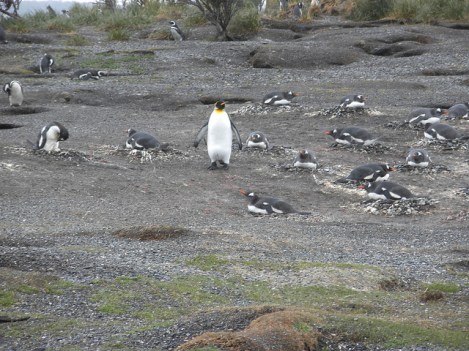
Never have I seen any emperor penguins, though I did see one disconsolate king penguin in Tierra Del Fuego in 2011 who got lost from his group and wound up with a colony of Magellanic and Gentoo Penguins on Isla Martillo in the Beagle Channel. (See picture below.)

Lost King Penguin in Argentina

Lost King Penguin in Argentina

That King Penguin was making a nuisance of himself by trying to mate with the smaller local penguins, who were having none of that particular type of miscegenation.

Why do Martine and I like the Santa Barbara Zoo instead of the much larger one at Griffith Park in Los Angeles? It seems that every time we go to the L.A. Zoo, they are undergoing major construction, forcing large crowds of people into narrow walkways past some upcoming future attraction. Until that future attraction arrives in the sweet by-and-by, we would be assailed by countless strollers wielded by desperate parents pushing their progeny through a surly mob. The future is nice, but I usually make my judgments based on the present.

There is some construction going on at the Santa Barbara Zoo, but it is small-scale compared to the pharaonic scale of L.A.

I’ve always loved zoos. We had a good time in November 2011 at the Buenos Aires Zoo, and I am toying with the idea of visiting the small Reykjavik Zoo in Iceland this June.

It was pretty hot the two days we were in Santa Barbara, but there are always a lot of shady benches for us to rest and re-hydrate ourselves.

The Last Time I Saw Hvolsvöllur

The Mountains Around the Markarfljót Valley

The Mountains Around the Markarfljót Valley

It was around the end of my 2001 trip to Iceland, one of the first days in the month of September. I was sitting around in my Reykjavík guesthouse paging through my Lonely Planet guide when I decided to check out the Saga Center in Hvolsvöllur. I walked over to the BSÍ bus station on Vatnsmýrarvegur and hopped on a bus to Hvolsvöllur, which is about an hour or two east of the capital.

It was before lunchtime, so I decided to walk around the town—really, it was just a village. I ook a wide loop around the area, seeing Icelandic schoolchildren in uniform being taken for a walk on this uncommonly nice fall day (fall starts early on the island that is Ísland). I saw a couple of pizza places, which looked interesting because for some reason Iceland makes really good pizza. (Good bread, good cheese—that’s more than half the battle.) In the end, I settled in at the gas station named after one of my literary heroes—Hliðarendi—and has a sandwich stuffed with hangikjöt, a tasty lunchmeat made with lamb..

Gunnar Hamundarson of Hliðarendi was one of the heroes of Njals Saga, that greatest of the medieval sagas. Outlawed by the AlÞing, he left his home in the Markarfljót Valley, but made the mistake of taking a look back. At once, he made the decision not to leave, because it the sight was so breathtakingly beautiful. He paid for this decision with his life.

Another View of the Area Around Hvolsvöllur

Another View of the Area Around Hvolsvöllur

The Saga Center in Hvolsvöllur was well worth visiting. It is, insofar as I know, one of only two museums in the world dedicated to a single work of literature, in this case Njals Saga. (The other one is in Borgarnes and is dedicated to Egil’s Saga.) The Saga Center was clearly a labor of love. I spent a couple of hours talking to a beautiful young Icelandic blonde who worked there. She was a very sweet lady who was suffering from some strange stomach ailment. I wonder whether she still works there.

That evening, I picked up my tattered Penguin paperback edition of Njals Saga and started re-reading it. In June, I will read it a third time. Why not? It is one of the greatest works to come out of the Middle Ages. I kept re-reading it until my plane landed in Los Angeles.

Travel Changes You

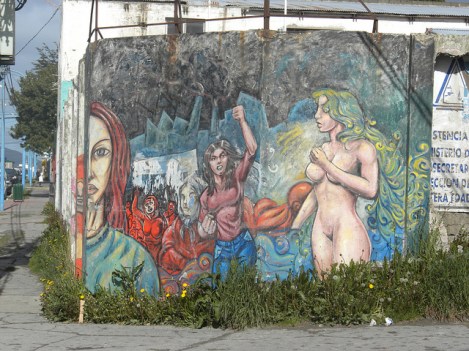
Mural Along Rivadavia in Ushuaia, Tierra Del Fuego

Mural Along Rivadavia in Ushuaia, Tierra Del Fuego

I remember my first vacation on my own. Despite protests from my parents, who, of course, wanted me to come to Cleveland and slip into the family ways like putting on a glove. But I was thirty years old, and I wanted to travel.

As a child, my travels were limited to places my parents wanted to go, places like Detroit; Lake Worth, Florida; Niagara Falls; and Passaic, New Jersey. My only choice as a child was a day trip to Schoenbrunn Village in Central Ohio, site of the first settlement in the state. (And the folks did not enjoy it, although my brother and I did.)

So, in November 1975, I decided to spend eighteen days in Yucatán visiting ancient Mayan ruins. It was a great trip, and it turned me around completely. No longer was I going to be satisfied by hanging out in Cleveland, a city from which all my friends had fled after high school.

Above is a mural on Rivadavia, a north/south street in the Tierra Del Fuego capital of Ushuaia. It also happens to be the street where I slipped on the ice in 2006 and cracked my right humerus, just one block north. No matter: Five years later I returned with Martine, stayed at the same bed & breakfast (the Posada del Fin del Mundo), and had a wonderful time.

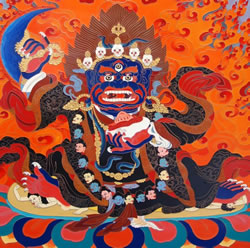
It’s like those Tibetan pictures of devils deliberately intended to frighten you, like the following:

Tibetan Demon

Tibetan Demon

According to the Tibetan Book of the Dead, if you are frightened of the demons, your soul will gravitate toward a copulating couple; and you will be reborn as their child. If you are not moved by fear, there is a chance that you will obtain Nirvana.

That’s why I would have no fear about traveling to Turkey, to Russia along the Trans-Siberian Railway, and any number of places. Of course, I have no intention of visiting Syria, North Korea, Somalia, or Mali. That would not be prudent.