Taking the Bus

Route #2 Took Us to Most of Our Destinations

As I planned for our trip to Hawaii, I had a bad feeling about the cost of renting and parking a car during our trip. I know that Americans as a rule tend to avoid public transportation like the plague, but Martine and I do not subscribe to that feeling. I figured that it would cost us well over $100 a day to rent a car, especially with liability and collision insurance. Added to that, most hotels charged between $25 and $50 a day to park the car overnight. Then add more bucks for gas and daytime parking. In no time at all, the cost would exceed $1,000.

Martine and I adopted a solution that cost a grand total of $30 for our transportation on O’ahu for the entire vacation!

How was that possible? First of all, both of us are seniors. Secondly, to use a Hawaiian pidgin term, we decided to be akamai (smart) about saving money. On our first day in Honolulu, we took the #2 bus from Waikiki to the Kalihi Transit Center at the end of the line and got two senior HOLO cards. They were ready in a few minutes, and I forked over the $30 in cash. And that was that!

We would simply tap our HOLO card on a special reader as we boarded the the bus and take our seats. The buses were comfortable and air-conditioned. At the Transit center, we had picked up all the schedules we needed, and the rest was pure gravy.

Are you on the mainland now and doing research for a trip? Go to TheBus.Org for schedules and route maps as well as more information on the different kinds of HOLO cards.

The Vacant Throne

The Throne Room at Iolani Palace, with King Kalakaua’s Ceremonial Uniform

On our first full day in Honolulu, Martine and I visited the Iolani Palace, which was the seat of the Hawaiian monarchy that was dethroned in 1893 by a cabal of crooked American businessmen, diplomats, and naval officers. Even after they succeeded, it was only the sinking of the Maine in Havana harbor in 1898 that led to Hawaii becoming a U.S. territory.

The story of the annexation of Hawaii is told in Stephen Dando-Collins’s Taking Hawaii: How Thirteen Honolulu Businessmen Overthrew the Queen of Hawaii in 1893, With a Bluff. The “founding fathers” of the annexation make Donald Trump look like a Boy Scout, what with their lies, braggadocio, and even cowardice. When the moment came to move, several of the members of the so-called Committee of Public Safety conveniently came down sick.

The Hawaiians of today revere their monarchy, especially Queen Lili’uokalani, who was an able ruler who failed only because she could not appease a cabal of American and European businessmen who did not even feel that Hawaiian natives should have the right to vote.

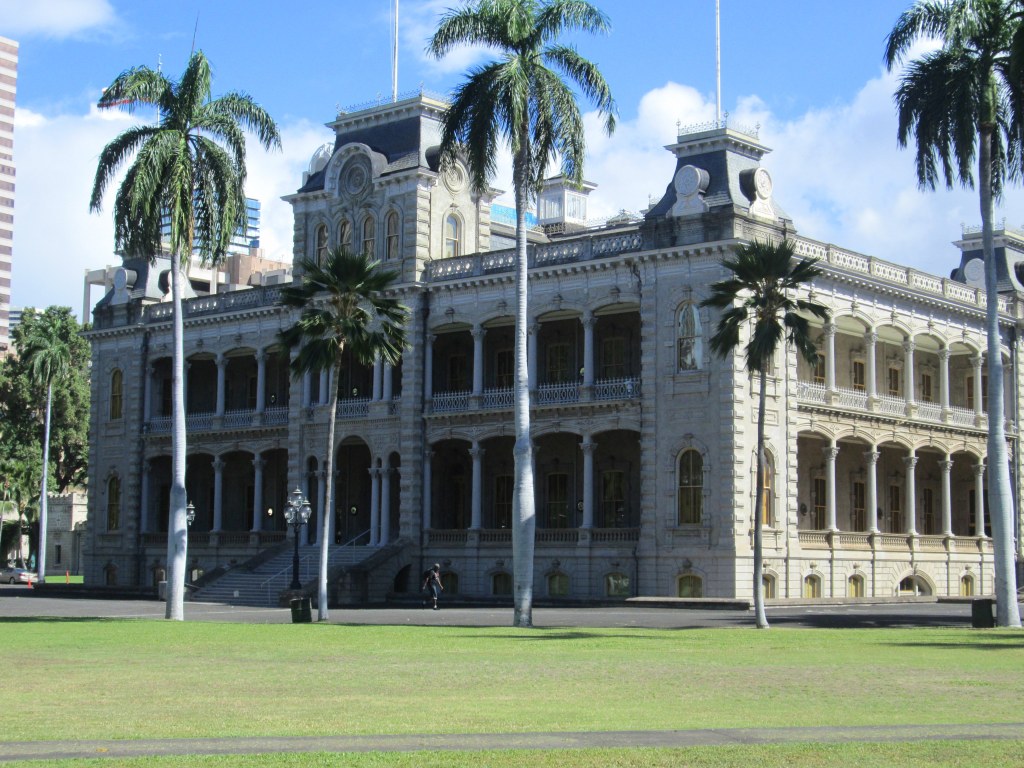
The Iolani Palace

The Palace was built by the penultimate ruler of the monarchy, King Kalakaua, in 1882. It is tastefully designed, with verandas on all sides permitting the cool ocean breezes to circulate through the building. Nowadays, all the windows are closed so that the paintings on the wall don’t fade prematurely.

Tiny Bubbles

Martine and I returned late last night from Hawaii. I decided to begin my vacation posts with a tribute to a Hawaiian singer much loved by Martine. I am referring to Donald Tai Loy Ho, better known as Don Ho (1930-2007). His most famous songs are“Tiny Bubbles” and “Pearly Shells.”

In the weeks before our flight to Honolulu, Martine spent hours on YouTube playing some of Don Ho’s songs. So I made a point of taking pictures of the street sign for Do Ho Street, which runs between Lewers St, and Royal Hawaiian Ave. for one block just south of the main drag at Kalakaua Avenue.

At the International Marketplace Shopping Center, there is a statue of Don Ho next to one of the escalators. Below is a picture of Martine in her aloha shirt standing next to the statue:

For those of you who are interested, here are the lyrics for Don Ho’s most iconic song, “Tiny Bubbles.” As many times as I heard Martine play the song, I never really got tired of hearing it:

Tiny bubbles (tiny bubbles)
In the wine (in the wine)
Make me happy (make me happy)
Make me feel fine (make me feel fine).

Tiny bubbles (tiny bubbles)
Make me warm all over
With a feeling that I‘m gonna
Love you till the end of time'

So here‘s to the golden moon
And here‘s to the silver sea
And mostly here‘s a toast
To you and me.

So here’s to the ginger lei
I give to you today
And here’s a kiss
That will not fade away.

Amboy: Signs of Life

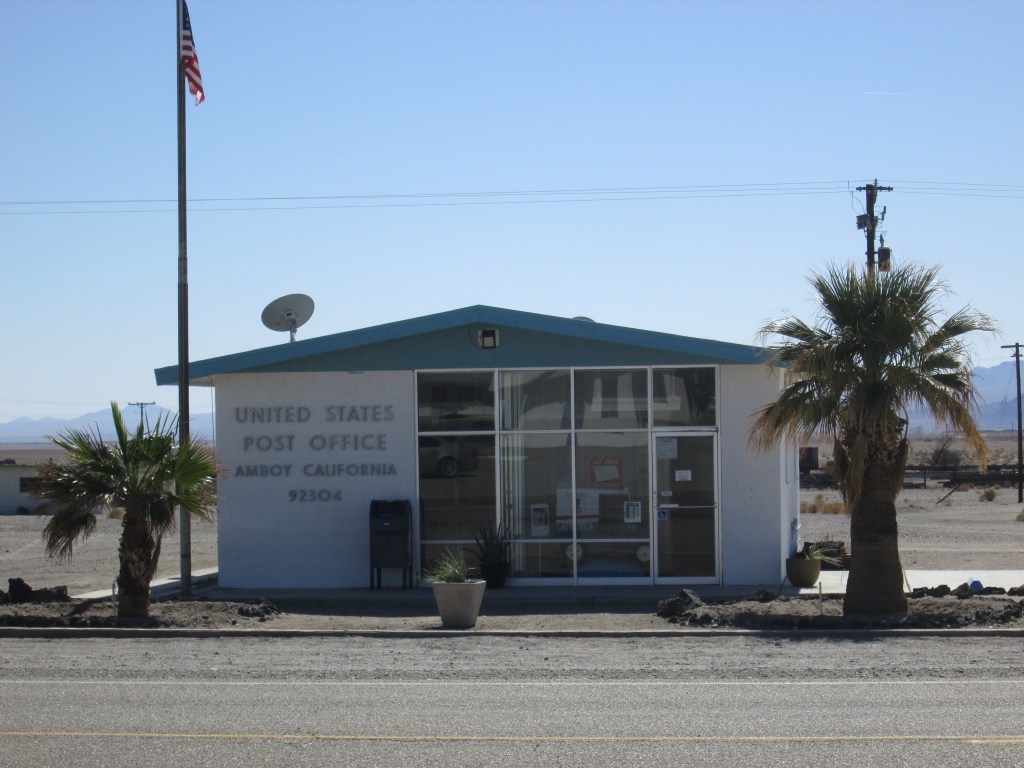
On our long road back from Las Vegas, we stopped for a few minutes in Amboy, on the “shore” of Bristol Dry Lake. In past years, I jokingly referred to Amboy as California’s equivalent of Tolkien’s Mordor. This time, the café was actually open; gas was being sold; and beverages and snacks were available.

One has to consider that Amboy is no longer really on the road to anywhere. It is where Old Route 66, the “Mother Road,” meets the road to Twentynine Palms. You can take Route 66 east from Barstow, but the road is closed past Kelbaker Road, which goes north to Kelso and ends up in Baker. That’s the way Martine and I took, staying on 66 only as far as the turnoff to Twentynine Palms, where Martine used to work as a civilian employee at the Twentynine Palms Marine Air Ground Task Force Training Command (MAGTFTC).

Although there was some human activity visible at Amboy, including a post office across the highway (?!), the desert heat is incredibly fierce. I can’t see anybody being comfortable there except for a few minutes around dawn or dusk. So I doubt you’ll see a McDonald’s or a Starbuck’s there any time soon.

Wretched Excess

Burger at Las Vegas’s Heart Attack Grill

I have mentioned the Heart Attack Grill in Las Vegas recently. Today, I called my friend Bill Korn, who was marveling at the menu of the place. Granted that Vegas is no stranger to wretched excess, but the Heart Attack Grill draws people to it who should—if they value their lives—be more careful about what they eat.

On Monday, Presidents’ Day, I was shocked to see the place full. Customers were chowing down on mountains of sugars and fats wearing hospital gowns and sitting in wheelchairs, being served by sexy waitresses in full nursing garb. It is a known fact that at least two customers have died at their tables from meals they should have avoided.

Standing outside on a cold and windy day, I shook my head and wondered what has happened to the American people.

Look, Guys, those nurse/waitresses are awfully cute, but they won’t accompany you to Valhalla or wherever it is that people who make bad decisions about their lives go.

There is something about Vegas that seems to cater to the worst side of the American id. Technically, sex for hire is against the law in Clark County (but not in nearby Pahrump and other rural towns in Nevada). But there’s nothing illegal about giving you obscene amounts of food.

Sometimes I think one gets more out of Vegas by observing than by participating. Come to think of it, we didn’t do any gambling, either.

For Chocoholics Only

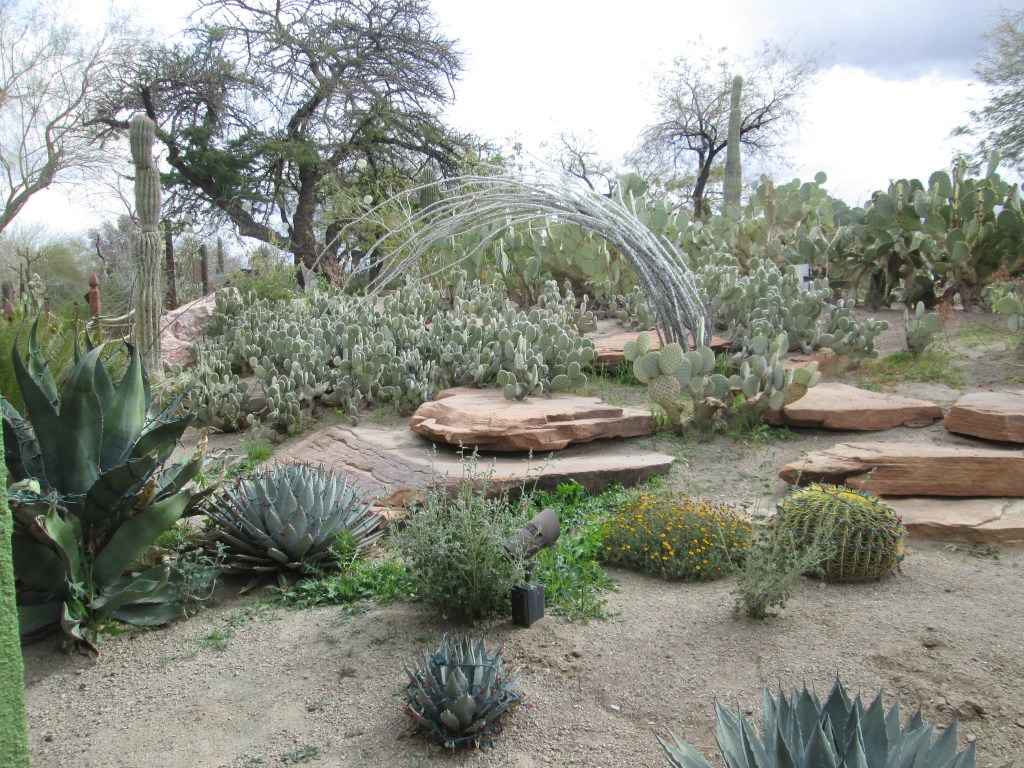
The Ethel M Cactus Garden

During the whole two years of the pandemic, I had difficulty convincing Martine to take any road trips with me (except for one day trip to Santa Barbara last June). I was interested in going to Las Vegas as I had read a couple of books about the Mafia control of the casinos in the 1970s and the early 1980s. But there was one argument I had which changed her mind: We would visit the Ethel M Chocolate Factory in Henderson, NV, just off the highway to the Boulder Dam.

That did the trick. I have eaten some scrumptious chocolate in my time, but none better than the candies produced by Ethel M. The “M” stands for Mars, the company which also produces M&Ms and is allied with Wrigley. As I understand it, Ethel Mars was the mother of the founders of the Mars candy empire, and the Ethel M Company is a subsidiary dedicated to her memory.

Martine at Ethel M’s Wall of Chocolates

It is fun to visit to factory—not only for the world class chocolates and the free yummy samples—but also for the extensive cactus garden which is maintained by the company.

This was perhaps our third visit to the Ethel M factory, and hopefully not our last.

Electrifying

That’s a strange picture of me, sitting in the electric chair at the Mob Museum in Las Vegas. You may recall I wrote about the museum a couple weeks back (click here). Martine and I visited it last Tuesday and spent all day walking its three floors of organized skulduggery.

Little did I know when I sat down on the electric chair that my head size (normally I wear a size 7½ hat) would shrink by half. Now, instead of a hat, I go around wearing a thimble on my head. There was also a gas chamber chair, but I resolved not to sit in it lest my head size would shrink even further.

I thought that the museum would concentrate on crime in Las Vegas, but it actually covered the whole spectrum, concentrating particularly on the Mafia, but also including such figures as John Dillinger and Machine Gun Kelly.

We liked the museum so much that we think it is one of the best historical oriented museums we have ever visited. It ranks right up there with the three Presidential Libraries Martine and I have seen (Richard Nixon, Ronald Reagan, and John F. Kennedy).

America as Seen from the “Fremont Experience”

The Fremont Experience at Night

I fully expected that our trip to Las Vegas last week would make for some great people watching. That it did, in spades. We were in the downtown area at the Plaza Hotel, which is at the west end of Fremont Street and of the four-block Fremont Experience. Even though we were in town on a Monday through Thursday after a three-day weekend, the Fremont Experience was crowded. I attribute this partly to the cold temperatures and biting winds, which made the enclosed space a particularly desirable destination.

Here’s what I noticed about the tourists in downtown Vegas:

  1. Most of the tourists were obese. Those who were proud of their fat congregated in large numbers at the Heart Attack Café, where they sat in wheelchairs wearing hospital gowns and being waited upon by sexy “nurses.” By the way, the restaurants went in for quantity more than quality of food.
  2. Among the men, a large percentage had beards and frequently extensive tattoos—and not a Maori in sight!
  3. Many of the older tourists (and some of the younger ones) were in fancy motorized wheelchairs. Some of these disabled visitors (or did they just get tired of walking any more?) were grotesquely obese.
  4. It seemed to be de rigeur for most of the males and some of the women to be always clutching super-sized cocktails as they walked around. In fact, I was surprised how much drinking was going on at all times.
  5. Very few tourists were to be seen even one block north or south of the Fremont Experience. Martine, who did not like the Experience, was happy to walk around it to get to our destinations.
  6. There was loud pop music everywhere, mostly of the “Wall of Sound” variety, which gets on one’s nerves after a while.

Probably the tourists we saw were not representative of most Americans. If they were, I think I would feel even more isolated than I usually do.

Fortunately, Martine and I enjoyed ourselves even though we were not obese lushes tattooed liked escapees from a carnival.

The Long Way Back

Back in the mid-1990s, Martine worked as a civilian employee at the Twentynine Palms Marine Air Ground Combat Center in the Yucca Valley. I remember when I picked her up there shortly after the 1995 Oklahoma City terrorist bombing and went with her through back roads in the Mohave Desert to Las Vegas.

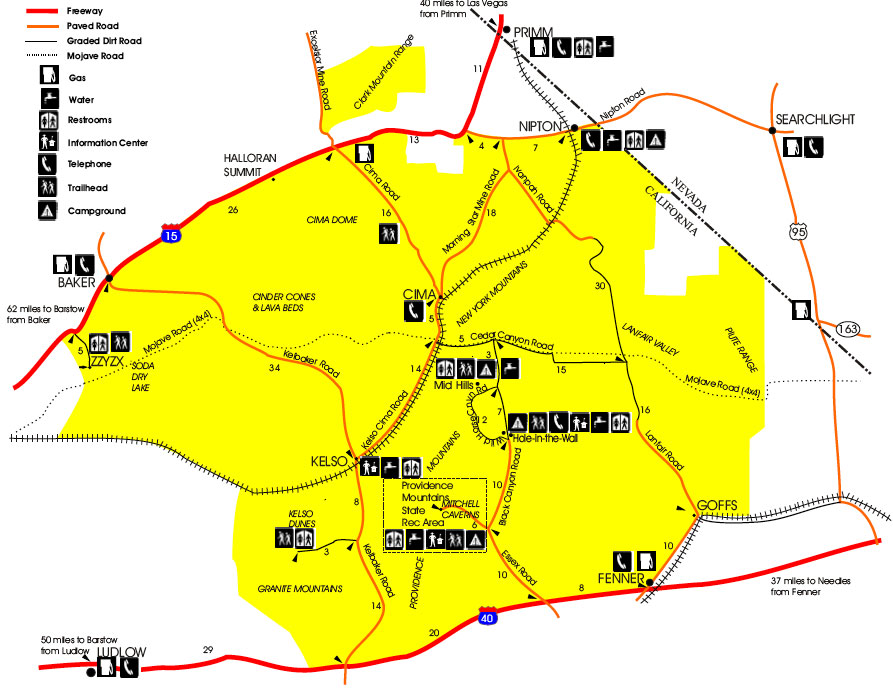
On Monday as we were driving to Vegas on Interstate 15, Martine wondered how far we were from Twentynine Palms and expressed interest in seeing it again. So on the way back, I took the same route through the Mohave. Going southwest from Vegas, we took the I-15 south, got off on the Nipton exit and after several miles, turned right onto what was posted as Cima Road. From there, we turned onto the Morningstar Mine Road and took it until it ended at Kelso. There, we turned left onto Kelbaker Road headed south to Amboy. That ended on the old Route 66, the so-called National Trails Highway. Turning right, we drove several miles to Amboy, site of the Bristol Dry Lake, which is mined by National Chloride. After Bristol, we crossed the railroad tracks and turned left on Amboy Road, which took us into Twentynine Palms.

Road Map of the Mohave National Preserve

This route was picturesque, especially with the Joshua Trees along Morningstar Mine Road and the huge Kelso Dunes, but it added over a hundred miles to our trip back, and had me driving to L.A. on Interstate 10 during evening rush hour.

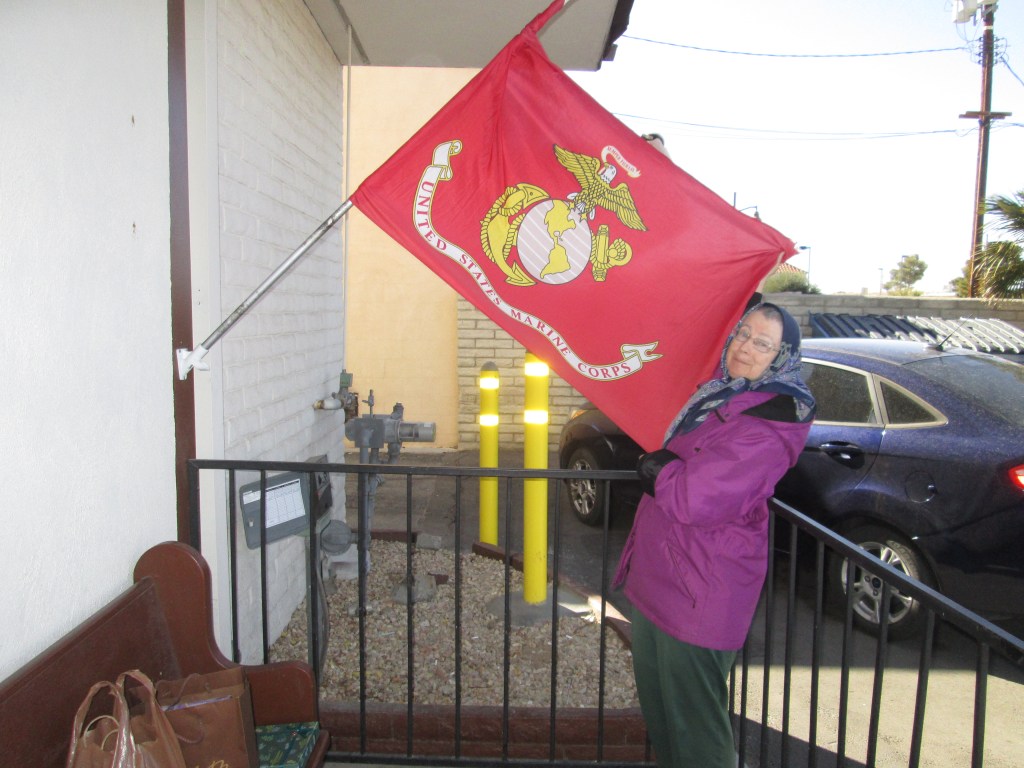
It was worth it, however. Martine got a chance to see how Twentynine Palms had changed over the years. In short, it was more populous, but still looked pretty much the same.

Martine Reminiscing with USMC Flag

I realize I haven’t said anything about Las Vegas yet. So I’m going backward. Stay tuned for more details about our trip, which will appear in the usual helter skelter order.