Martine and I are planning a trip to Hawaii this September, after all the kids are back in school. We plan to visit only the island of O’ahu, as that’s where all the museums and special attractions that Martine wants to see are located. This won’t be our first trip: We were there in 1996, staying at what then was called the Pacific Beach Hotel.
We plan to revisit some of the sights we saw then, including:
Some sights I would like to add to what we’ve already seen: Waimanalo Beach, Honolulu’s Chinatown, and the Ala Moana Shopping Center.
Some things have changed for the worse since our last visit. Not only are automobile rentals more expensive than ever, but some hotels charge as much as $50 a night just for parking. Then, too, many hotels now charge up to $50 a day for “resort fees,” whether or not you use their resort services. Since I am now on a fixed income, I will be particularly interested in saving money.
Before September, I would like to read some of O. A. Bushnell’s novels about Hawaiian history and see some movies set in Hawaii, such as Elvis Presley in Blue Hawaii and several movies featuring the Japanese attack on Pearl Harbor (Tora Tora Tora and From Here to Eternity).
One of the greatest of all science fiction films is a short consisting of nothing but black and white stills accompanied by a voice-over narration. I am referring to Chris Marker’s La Jetée, which is all of 28 minutes long. And yet for all its uniqueness, the film holds the viewer in its grasp until the last shot (shown above). Following is the film’s plot summary from Wikipedia:
A man (Davos Hanich) is a prisoner in the aftermath of World War III in post-apocalyptic Paris, where survivors live underground in the Palais de Chaillot galleries. Scientists research time travel, hoping to send test subjects to different time periods “to call past and future to the rescue of the present”…. They eventually settle upon the protagonist; his key to the past is a vague but obsessive memory from his pre-war childhood of a woman (Hélène Châtelain) he had seen on the observation platform (“the jetty”) at Orly Airport shortly before witnessing a startling incident there. He did not understand exactly what happened but knew he had seen a man die.
Apparently, motion is not necessary for a successful motion picture. As long as the images grab you, and as long as the story is well crafted, the result can be more than good. It can even be great.
See for yourself. The film is available in its full length on YouTube in French with English subtitles:
I never thought I would be alive at the age of 77. My father died at 74 years old; and my mother, at 79. When I was a student at St. Henry Elementary School, I thought, “Gosh, I’ll be 55 years old when we get to the year 2000.” I passed that milestone at a run.
In the illustration above, I am somewhere between the third and fourth figure. Thankfully, my health is good. I can get about without a cane, though I find going down a flight of stairs to be painful. Kneeling on a hard surface is out of the question.
When I think about aging, I call to mind the first stanza of Robert Browning’s poem “Rabbi Ben Ezra”:
Grow old along with me!
The best is yet to be,
The last of life, for which the first was made:
Our times are in His hand
Who saith “A whole I planned,
Youth shows but half; trust God: see all, nor be afraid!”
I see some of my friends fall by the wayside, some dying, some suffering personality disorders as they age, and some just isolating themselves.
This is not a subject anyone likes to think about. There are, however, dangers inherent in suppressing any important subject.
The times are always bad—and always have been. Yes, what is happening in Ukraine is terrible. But so was ducking under my school desk at St. Henry to practice for a Communist H-Bomb attack. So was World War Two. So was … oh … Genghis Khan.
I always wanted to be a writer. And in a manner of speaking, I am one. I don’t care about compensation or fame. Just sitting down around 9 o’clock most evenings and writing this blog is a worthwhile effort. It makes me feel good about myself.
We lost another great poet last year when Adam Zagajewsky died in Kraców, Poland. He is one of a handful of Central and Eastern European poets whose work I have come to love, poets like Joseph Brodsky, Czeslaw Milosz, Wisława Anna Szymborska, and Boris Pasternak. This is one of my favorites among his works:
Try to Praise the Mutilated World
Try to praise the mutilated world.
Remember June's long days,
and wild strawberries, drops of rosé wine.
The nettles that methodically overgrow
the abandoned homesteads of exiles.
You must praise the mutilated world.
You watched the stylish yachts and ships;
one of them had a long trip ahead of it,
while salty oblivion awaited others.
You've seen the refugees going nowhere,
you've heard the executioners sing joyfully.
You should praise the mutilated world.
Remember the moments when we were together
in a white room and the curtain fluttered.
Return in thought to the concert where music flared.
You gathered acorns in the park in autumn
and leaves eddied over the earth's scars.
Praise the mutilated world
and the gray feather a thrush lost,
and the gentle light that strays and vanishes
and returns.
Putin at Kremlin 2022 Victory Day Parade (Reuters)
I had thought that Vladimir Putin was going to make a major announcement at today’s Victory Day celebration in Moscow. In fact, other than making a number of the usual comments regarding the United States and NATO, Putin did not make any major announcements. He did not declare victory. He did not declare war. He did not brandish his nukes.
He is still keeping tight control over Russian media. By now, most of his people know that he his fighting Ukrainian Neo-Nazis that have threatened Russian security (by not wanting to be invaded?).
In a way, all he is doing is doubling down on his mistakes. Is he waiting for an elite Spetsnaz team to assassinate Zelensky? Does he think he could win by converting all of Ukraine to microscopic rubble?
At some point, I still suspect that Vlady will reap the whirlwind. But when or how is not something I can venture to guess.
Monday, May 9, is the anniversary of Russia’s winning the Great Patriotic War—or, as we know it, World War Two. The news media have been speculating for weeks that Vladimir Putin will make some sort of announcement of victory tomorrow. Or, he just might decide to declare war on the “Neo-Nazis” that have been depriving his troops of anything approaching victory.
There will, of course, be a big military parade. But does Putin have enough working tanks and armored personnel carriers to impress the crowds on Red Square? I am eager to see what that madman plans to do for an encore.
I have young friends who for the first time in their lives are afraid of a nuclear confrontation. There may be one, but only on a small scale because it would cause widespread outrage around the world (but not in Russia). Perhaps Putin has more to fear than my young friends. His Ukraine invasion made the Rodina (Motherland) look not only bad, but downright cheesy. It would be no surprise if the FSB replaced Putin with a new stooge and put Vlady in a psychiatric nursing home “for his benefit.”
Yesterday, I took the bus to the Getty Villa rather than pay the $20 parking fee. The museum had several exhibits about the civilizations of ancient Persia. The above gypsum relief is typical of the art of the Palace of Ashurbanipal in Assyrian Nineveh.
I have always been interested in ancient Persia. It’s not a subject typically taught to American students. The impression I came away with is that virtually all the art is in glorification of the existing monarchy. Comparing it to the literature and art of ancient Greece, I find that in the latter there is more in it for the people. I will always remember the philosophical dialogues of Plato, the tragedies of Sophocles and Euripides, and Greek statuary.
As for ancient Persia, I am reminded of these lines from Rudyard Kipling’s “Recessional”:
 Far-called, our navies melt away;
   On dune and headland sinks the fire:
Lo, all our pomp of yesterday
   Is one with Nineveh and Tyre!
Judge of the Nations, spare us yet,
Lest we forget—lest we forget!
When nothing is left of an ancient civilization is the dusty memory of its regal pomp, there is not much for succeeding generations to hold on to. Still, I plan to learn more about the Assyrians and the Persians that followed in their wake. Greece and Rome spent centuries fighting the Persian menace; and today we are only endangering ourselves when we fail to understand other civilizations.
Some months ago, I made a stab at re-reading Charles Dickens’s David Copperfield but gave up. Somehow, I was just not in the mood. (That happens, but fairly rarely.) Today, I made another attempt, with vastly improved results.
What got to me before was the character of Edward Murdstone and his sister Jane. Murdstone marries David’s mother, Clara, but begins raising David in an abusive even sadistic manner. But before the grim scenes of marriage, with Clara being forced to suppress her love for Davy, there intervenes the magical Chapter III, “I Have a Change.”
Magic is rare in fiction, but not with Dickens at his best. Davy goes with his mother’s maid Clara Peggotty to visit her family in Yarmouth on the Isle of Wight. There, he stays in an odd beach house built from an old boat, with Peggotty’s brother Daniel as head of household. In the boat house live Ham Peggotty, an orphaned nephew; Little Em’ly, an orphaned niece; and the morose Mrs Gummidge, widow of a fishing partner of Daniel’s. It is an odd mixed-up family that somehow seems to work.
It all starts with the first view of the boat house on the sands:
Ham carrying me on his back and a small box of ours under his arm, and Peggotty carrying another small box of ours, we turned down lanes bestrewn with bits of chips and little hillocks of sand and went past gas-works, rope-walks, boat-builders’ yards, shipwrights’ yards, caulkers’ yards, riggers’ lofts, smiths’ forges, and a great litter of such places, until we came out upon the dull waste I had already seen at a distance; when Ham said,
‘Yon’s our house, Mas’r Davy!’
I looked in all directions, as far as I could stare over the wilderness, and away at the sea, and away at the river, but no house could I make out. There was a black barge, or some other kind of superannuated boat, not far off, high and dry on the ground, with an iron funnel sticking out of it for a chimney and smoking very cosily; but nothing else in the way of a habitation that was visible to me.
‘That’s not it?’ said I. ‘That ship-looking thing?’
‘That’s it, Mas’r Davy,’ returned Ham.
If it had been Aladdin’s palace, roc’s egg and all, I suppose I could not have been more charmed with the romantic idea of living in it. There was a delightful door cut in the side, and it was roofed in, and there were little windows in it; but the wonderful charm of it was, that it was a real boat which had no doubt been upon the water hundreds of times, and which had never been intended to be lived in, on dry land. That was the captivation of it to me. If it had ever been meant to be lived in, I might have thought it small, or inconvenient, or lonely; but never having been designed for any such use, it became a perfect abode.
Davy stays in the boat house for a couple of weeks, allowing his mother to be married to the grim Murdstone and provide an unhappy surprise when Davy returns to The Rookery at Blunderstone, only to find Murdstone in charge as paterfamilias.
Until then, there are a couple of weeks of grace, during which little Davy falls in love with Little Em’ly, and is showered with kindnesses he was no longer able to receive at home.
I remember the chapter vividly from my own childhood, when I read an abridged edition of David Copperfield. Even in its mutilated form, it was magical then; and now, it’s still magical.
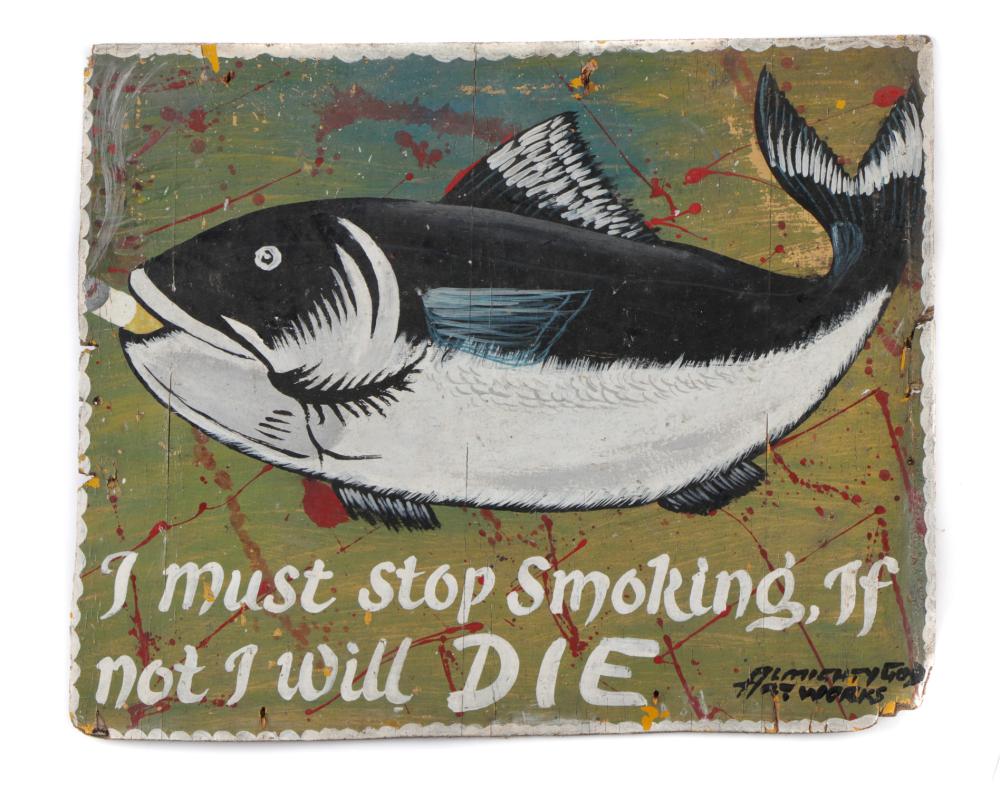
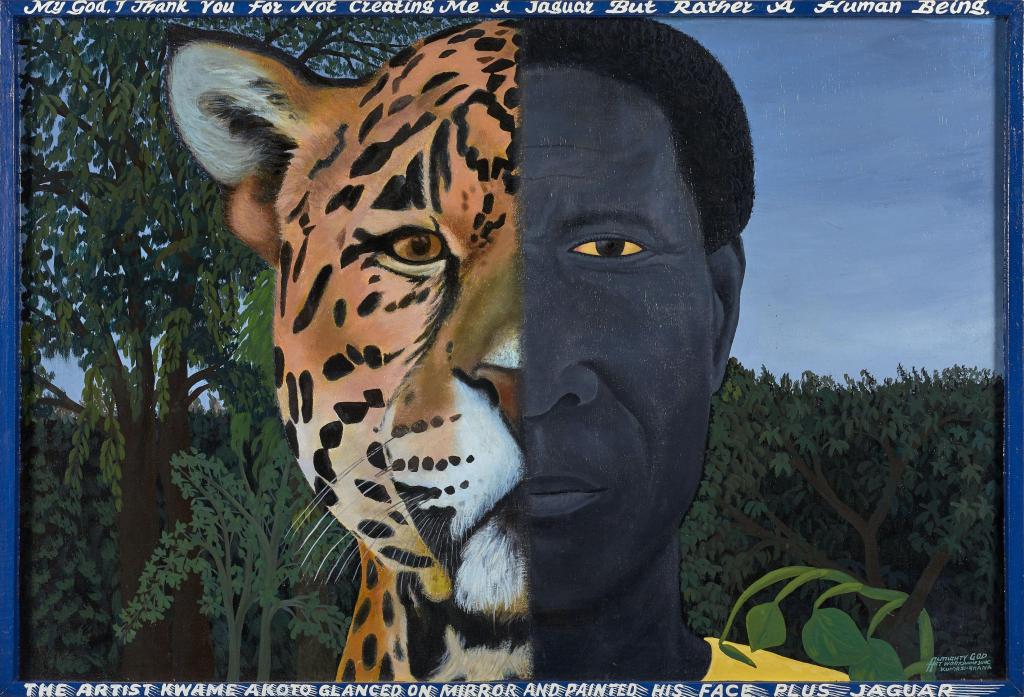
The Almighty God Art Works in Kumasi, Ghana, is run by Kwame Akoto, an artist whose primitive but powerful work has garnered attention far from his native land. Akoto, who styles himself as “Almighty God,” is a convert to a Pentecostal Christian sect whose teachings have become the subject of much of his work. In one of his paintings, the following free verse appears:
The Supernatural eyes of God the Father
Sees all things.
So we must be extra careful.
When you go under the sea, the great eyes have seen you.
I am afraid of the eyes of God
If you hide under a mortar God have seen you
God saw you be careful

On Sunday afternoon, Akoto’s work impressed me when I visited the Fowler Museum at UCLA. His work, as well as the patterned textiles produced by the Aborigines of Northern Australia, convinced me that the art of Western Civilization is not the only game in town.
.
The Almighty God Art Works is not only in the art business: Akoto paints signs for local merchants, signs that are every bit as good as his other work.
I suspect that our world is tired of works by Jackson Pollock, Mark Rothko, Willem de Kooning, and others of that ilk, of art that speaks only to the artist.
I am alternately in love with and terrified by Joan Didion. Behind that seeming fragility is a mountain of strength and eyes that cut through the obscuring fog. On one hand, the young Joan Didion was beautiful; but her marriage to John Gregory Dunne was a stormy one, and her relationship with him and her adopted daughter Quintana Roo was interrupted by their early deaths. I keep thinking of her heroine Maria Wyeth in Play It As It Lays:
She took his hand and held it. “Why are you here?”
“Because you and I, we know something. Because we’ve been out there where nothing is. Because I wanted—you know why.”
Joan was never a safe, sensible woman. She saw clearly to the heart of things, yet dulled herself with large amounts of alcohol and was rarely photographed without a cigarette in her hands. The daughter of a rancher, she was raised in Sacramento, a fifth-generation Californian, whose ancestors just escaped being part of the Donner Party in the winter of 1846-1847. There is in her eyes both wildness and clarity. She, too, has been out there where nothing is.
Though in one sense she terrifies me, I love her work. When she died last December, I felt that California had lost its muse.




 Tarnmoor
You must be logged in to post a comment.