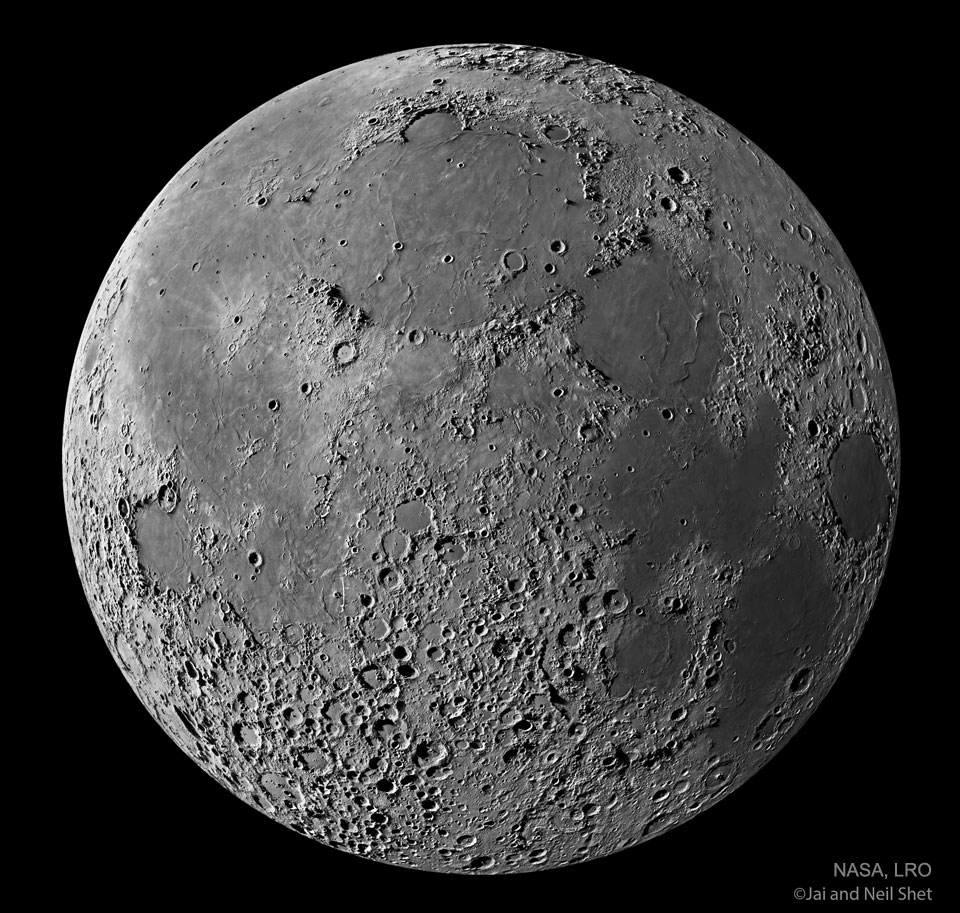
What’s different about this Moon? It’s the terminators. In the featured image, you can’t directly see any terminator — the line that divides the light of day from the dark of night. That’s because the image is a digital composite of 29 near-terminator lunar strips. Terminator regions show the longest and most prominent shadows — shadows which, by their contrast and length, allow a flat photograph to appear three-dimensional. The original images and data were taken near the Moon by NASA’s Lunar Reconnaissance Orbiter. Many of the Moon’s craters stand out because of the shadows they all cast to the right. The image shows in graphic detail that the darker regions known as maria are not just darker than the rest of the Moon — they are flatter.
Photo Taken by New York Times Photographer Tyler Hicks
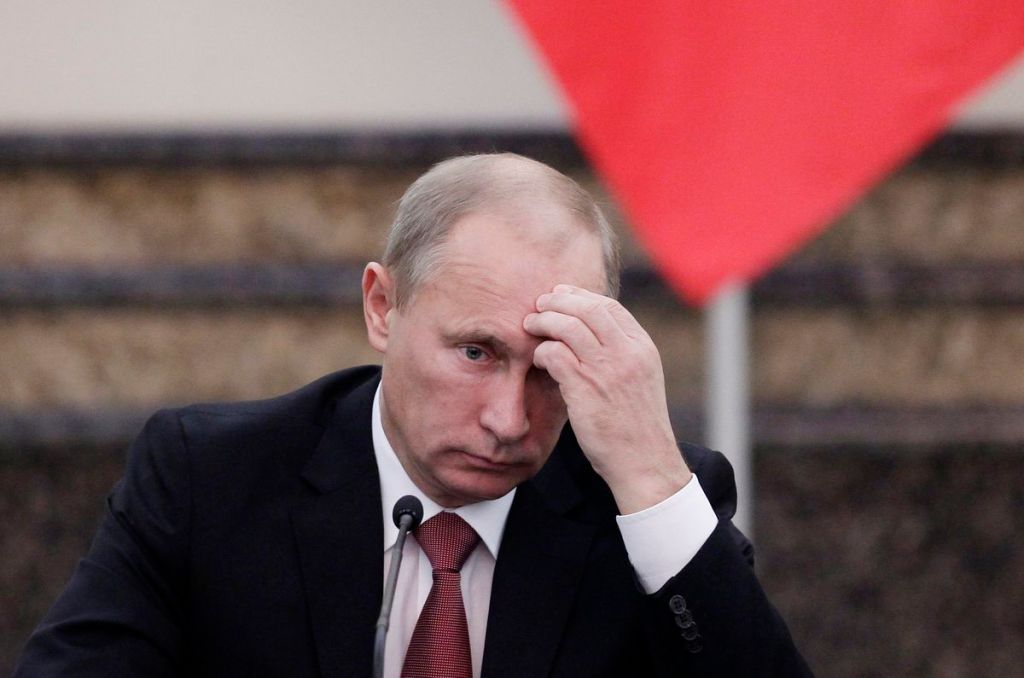
If you were to fight in one of America’s wars and happened to die, your next of kin would be informed; and your body would be flown back to the U.S. for burial. Apparently, if you are one of the 15,000 Russian dead in Ukraine, the existence of your body is an embarrassment to Vladimir Putin, who would just as soon say to the parents and family that their Ivan or Dmitri is “missing” and leave it at that.
That way Russians who believe the lies that Putin is slinging would not be surprised at the large number of dead bodies filling trucks and trains heading to cities and towns across the Motherland. The Russian dead serve only to make Putin look as bad as he really is.
Now imagine how that makes the Russian troops invading Ukraine feel. They know it’s a war. They know that Putin is lying through his teeth. The morale of the Russian Army must be at low ebb, such that I would not be surprised there isn’t some sort of mutiny like the one that occurred on the front lines during World War One while the Russian Revolution of 1917 was taking place.
Yes, I know that Putin is evil. But to that I will also add that he is stupid and is likely to be overthrown.
By the way, the Ukrainians are collecting bodies of the Russian dead and using facial recognition software to identify them and notify the families themselves. I saw this news item on BBC’s website today. Oh oh.
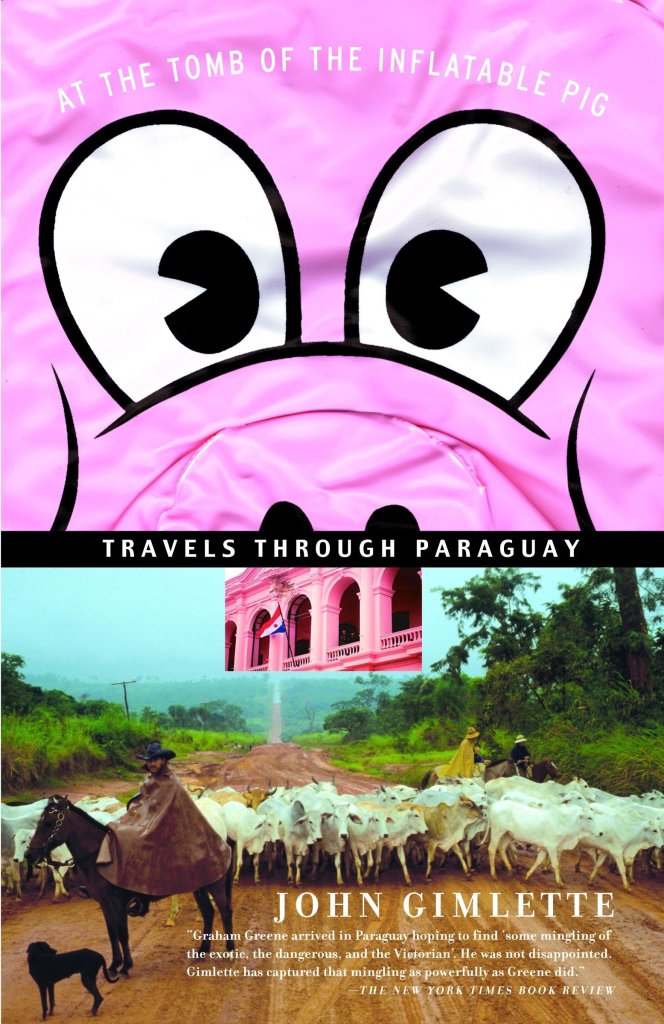
Definitely on my travel bucket list is one of South America’s two landlocked countries (the other one is Bolivia, which had a seaport on the Pacific until they lost it in an 1870s war with Chile). I am speaking, of course, of Paraguay, which is surrounded by Argentina, Brazil, and Bolivia. I personally know no one who has been to Paraguay, yet I am yearning to visit it.
What piqued my interest was John Gimlette’s At the Tomb of the Inflatable Pig, which captures the insane history of this little known country, which is known for:
The Paraguayan War (1864-1870) against, simultaneously, Argentina, Brazil, and Uruguay, in which 50% of the population lost their lives.
The Chaco War (1930s) against Bolivia, in which two armies confronted each other in a waterless desert and which, surprisingly, Paraguay won despite horrendous casualty rates.
The dictatorship of Alfredo Stroessner (1954-1989) in which the country welcomes fleeing Nazis.
While it is theoretically possible to fly into the capital, Asunción, I would rather enter by bus from Argentina. When I visited Iguazu Falls in 2015, I was only a few miles from Ciudad del Este, which is a known hangout of smugglers and Hezbollah terrorists—but I chose not to visit it at that time. (Actually, probably never would suit me.)
If I went to Paraguay, I would be interested in visiting the old Jesuit missions that were destroyed by the Brazilians. At one time, in the 18th century, Paraguay was controlled by the Jesuits and was considered a paradise on earth. To corroborate, read Voltaire’s Candide and see Roland Joffe’s 1986 film The Mission with Robert De Niro and Jeremy Irons. But after the missions were destroyed, things went bad.
And I would like to stay in Asunción sipping Tereré, a cold preparation made with Yerba Mate. If I had time, I would like to see a little bit (a very little bit) of the Chaco region in the northwest.
A good number of dwarves will fill the screen in the upcoming movie, The Hobbit: An Unexpected Journey, but they’re just a few of the hundreds of characters J.R.R. Tolkien created for Middle-Earth.
As I am re-reading J.R.R. Tolkien’s The Hobbit for the second time, I thought I might reprint the words from one of the songs in the book—probably the most evocative of them all.
Far over the misty mountains cold
To dungeons deep and caverns old
We must away ere break of day
To seek the pale enchanted gold.

The dwarves of yore made mighty spells,
While hammers fell like ringing bells
In places deep, where dark things sleep,
In hollow halls beneath the fells.

For ancient king and elvish lord
There many a gleaming golden hoard
They shaped and wrought, and light they caught
To hide in gems on hilt of sword.

On silver necklaces they strung
The flowering stars, on crowns they hung
The dragon-fire, in twisted wire
They meshed the light of moon and sun.

Far over the misty mountains cold
To dungeons deep and caverns old
We must away, ere break of day,
To claim our long-forgotten gold.

Goblets they carved there for themselves
And harps of gold; where no man delves
There lay they long, and many a song
Was sung unheard by men or elves.

The pines were roaring on the height,
The winds were moaning in the night.
The fire was red, it flaming spread;
The trees like torches blazed with light.

The bells were ringing in the dale
And men looked up with faces pale;
Then dragon’s ire more fierce than fire
Laid low their towers and houses frail.

The mountain smoked beneath the moon;
The dwarves, they heard the tramp of doom.
They fled their hall, to dying fall
Beneath his feet, beneath the moon.

Far over the misty mountains grim
To dungeons deep and caverns dim
We must away, ere break of day,
To win our harps and gold from him!
It’s now called the Class of 1953 Commons, but when I was attending Dartmouth College between 1962 and 1966, it was called Thayer Hall. All students were required to eat there, which for me was a disaster. The meat was like slabs of granite, accompanied by bland potatoes and overcooked vegetables.
Supposedly it has improved since the days when Miss Jeanette Gill (who was reputed to be a retired marine) ruled the dining hall with an iron spatula. But then there were troops of dogs fighting for table scraps. When we saw the truck from the Precinct Pig Farm parked outside of Thayer, we were wondering whether they were picking up to slop the hogs or delivering to slop the students.
When I returned to Cleveland for Christmas vacation in December 1962, I managed to get a doctor’s note excusing me from eating at Thayer because it was making me sick. Which it was.
That left the handful of restaurants in Hanover, New Hampshire for me to explore. Probably my favorite was Lou’s Restaurant, owned by Louis Bressett, who, once every blue moon, served a devilish good spaghetti with meatballs. There was the usually reliable College Inn, and always the possibility of a splurge at the Hanover Inn.
I also enjoyed a local restaurant called Minichiello’s. Let me quote a 2015 post:
One of the places I ate was Minichiello’s: They had good pizza and were friendly. The only problem was they thought I was such a nice boy. You must remember that when I was a college senior, I looked as if I were still twelve; and I was subject to bullying by the local high schoolers until they saw I was carrying a college ID. So there I was, munching away at my pizza, when they introduce their daughter to me. She was very cute in a bad girl sort of way, and here her parents were holding me up as an example she should follow—instead of those bad boys who worked at the local garage.
God knows, if it weren’t for the fact that I was seriously ill with a pituitary tumor and, as a result, had not yet physically reached the age of puberty, I would much rather be doing with her those things her parents feared she was doing with the bad boys.
So for the rest of my college career, I avoided Thayer Hall. Where food is concerned, there’s a lot to be said for the privilege of being able to choose.
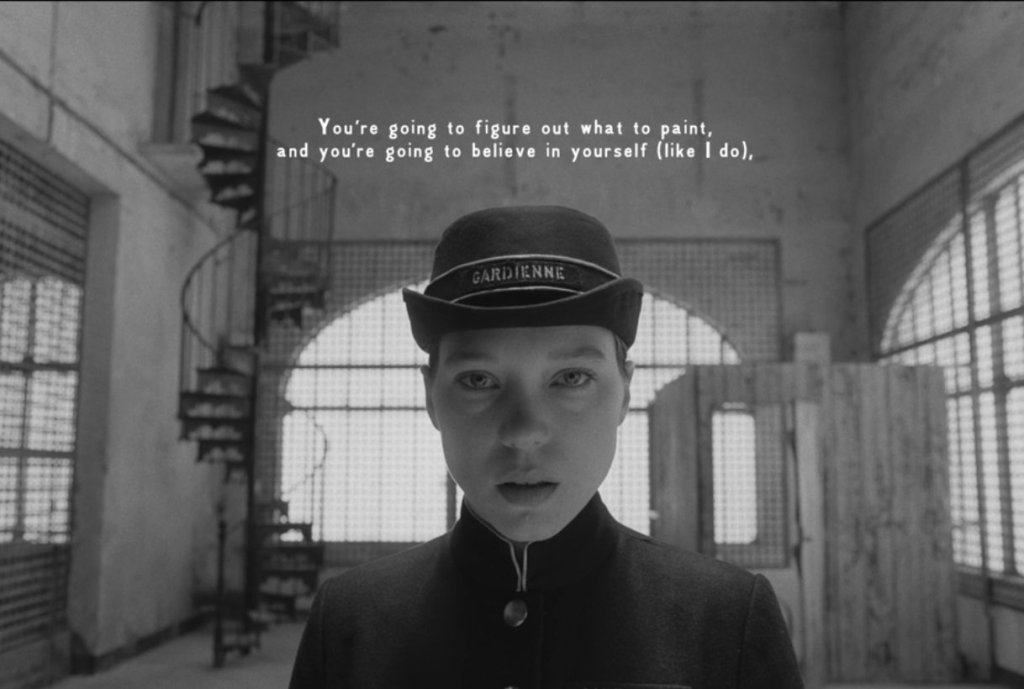
Films can be amazing, even they are not great. A couple of months ago, I viewed Wes Anderson’s The French Dispatch (2021) in Palm Desert with my brother and sister-in-law. The film sets were nothing less than outstanding, and the cast was to die for. But, overall it just didn’t make the cut.
But I fell in love with the actress who played Simone, the prison asylum guard who poses nude for the imprisoned painter Moses Rosenthaler (Benicio del Toro). The part was played by Léa Seydoux, a stunning French actress with wide-spaced eyes. The memory of those eyes has made me watch her scenes several times.
Simone in Uniform
Although I will never think of The French Dispatch as a great film, there are scenes in it that I will never forget. Perhaps, in the end, it is a better film than I thought.
Did you ever wonder what happened to the old Soviet KGP? Apparently, it went the way of the Cheka, the NKVD, the OGPU, and the MGB. It just changed its name to the FSB (ФСБ in Cyrillic) or Federal Security Service and it continues its usual depredations on the Russian people.
Do you remember what happened to Nikita Khrushchev after the Cuban Missile Crisis of 1962? He was sent to do gardening in the Ukraine and replaced by Brezhnev and Kosygin. I do believe that Vladimir Putin is risking the same sort of coup by the FSB and other Russian state security services—all because he squandered Russian resources in a madcap attempt to take over Ukraine.
Putin comes from the Russian state security services. He was a top officer in the KGB and spent time heading up security in East Germany. So he knows that the main threat to his rule over Russia is not the voters, not the oligarchs, not even the military, but actually the Federal Security Service (or Федеральная служба безопасности Российской Федерации) and its allied agencies. They made Putin, and they can just as easily unmake him.
Consider the following actions which make Russia look bad in the eyes of the world, and particularly in the eyes of the FSB:
Putin assumed the invasion would be met by welcoming Ukrainians bearing candy and flowers, and not stinger missiles and Molotov Cocktails.
After three weeks, the ground invasion has stalled.
Some 5,000 Russian soldiers are dead—twice the number of American deaths in 20 years fighting in Afghanistan.
The Russians are unable to supply their advance units with gasoline, food, trucks, tanks, or ammunition.
Putin has reportedly asked China for help in quelling the Ukrainians.
There are rumors of Putin employing mercenaries from Syria and elsewhere to shore up the depleted ground forces.
In the end, Ukraine may fall to the Russians, but only at an exorbitant cost.
The one part of Asia that I would like to visit is the island nation of Singapore. To me, it is like China and India rolled into one convenient package, yet not too far from its British colonial heritage to force me to learn a difficult new language.
What particularly earns it a spot on my travel bucket list is the cuisine. I love both Chinese and Indian food, and Singapore is known for both, as well as several adjoining cuisines such as Thai and Malayan.
In fact, I cannot imagine myself losing weight during a Singapore visit. And that’s when I’m not drinking cold beers at the Writers’ Bar at the Raffles Hotel—the height of colonial decadence,
Of course I would fly there on Singapore Airlines and hang out a while at Changi Airport, reputed to be the most interesting airport in the world.
I came late to driving. In fact, I did not get my license until I was forty. Starting late as I did, I did not have many youthful bad habits exercising a baneful effect on my driving.
Other than adhering religiously to speed limits, what probably characterizes my driving more than anything else is, whenever possible, knowing what lane I want to be in and sticking to it, unless I feel I absolutely must pass some slow-moving vehicle.
Returning home from the desert, for example, I prefer to take the Pomona Freeway (California 60). I start out in lane 2 and change to lane 1 as I approach Interstate 5. That lane in turn becomes lane 3, giving me several miles to change to lane 2. If I stay on lane 2 as the highway becomes the Santa Monica Freeway (Interstate 10), I can ride it all the way to my exit ramp at Centinela Avenue fifteen miles farther on.
Why change lanes unless you have to? One of my beefs with performance cars is they feel as if they fail to change lanes every hundred feet, Elon Musk or Ferdinand Porsche will come and painfully twist their privates and take away their car keys. I estimate that, on the same trip, frequent lane changers drive 10-15% more miles as a result of traveling sideways.
One of my favorite travel books is Paul Theroux’s The Tao of Travel. When my favorite travel writer writes on the subject of travel literature, the result is nothing less than armchair satori. Take the following quote from his The Old Patagonia Express (1979), my first introduction to South America:
Travel is at its best a solitary enterprise: to see, to examine, to assess, you have to be alone and unencumbered. Other people can mislead you: they crowd your meandering impressions with their own; if they are companionable they obstruct your view, and if they are boring they corrupt the silence with non sequiturs, shattering your concentration with, “Oh, look, it’s raining” and “You see a lot of trees here.
It is hard to see clearly or to think straight in the company of other people. What is required is the lucidity of loneliness to capture that vision which, however banal, seems in your private mood to be special and worthy of interest.
Theroux’s book is full of such gems, such as this one from Mark Twain’s The Innocents Abroad (1869):
Travel is fatal to prejudice, bigotry and narrow-mindedness and many of our people need it sorely on those accounts. Broad, wholesome, charitable views of men and things cannot be acquired by vegetating in one little corner of the earth all one’s lifetime.
Here is a poetic contribution from Rudyard Kipling (“The Winners”:
Down to Gehenna or up to the Throne,
He travels the fastest who travels alone.


In Virginibus Puerisque, Robert Louis Stevenson imparts this wisdom:
Little do ye know your own blessedness; for to travel hopefully is a better thing than to arrive, and the true success is to labor.
As I return to this book, which I do often, I just want to set out for somewhere, anywhere. Well, maybe not Cleveland. Been there, done that!










 Tarnmoor
You must be logged in to post a comment.