The Equatorial Bulge

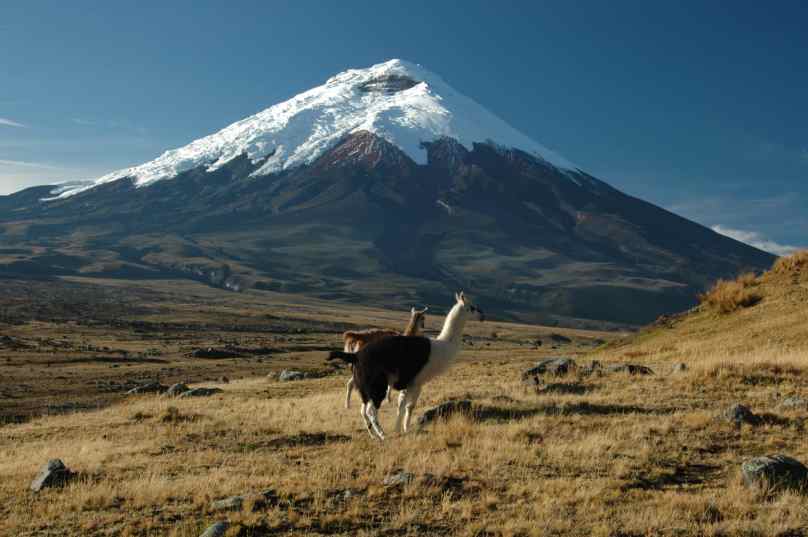
Mount Cotopaxi in Ecuador (19,347 Feet or 5,897 Meters)

The Earth is by no means a perfect sphere. If you are standing at either the North or South Pole, you are some 21 km nearer to the center of the planet than if you were near the Equator. The reason for this is that the rotation of the planet exerts a centrifugal force that makes of the Earth more of an oblate ellipsoid. The illustration below exaggerates this phenomenon, but gives you the general idea:

Earth as an Oblate Ellipsoid

One upshot of this phenomenon is that some of the mountains nearer the Equator are actually higher than any of the Himalayas, including Mount Everest. The so-called Equatorial Bulge calls for a more accurate measure of a mountain’s altitude than distance above sea level—especially as the bulge means that sea level is correspondingly higher. A more accurate measure is distance from the center of the Earth.

Using this measure, Mount Everest just barely makes the top ten list:
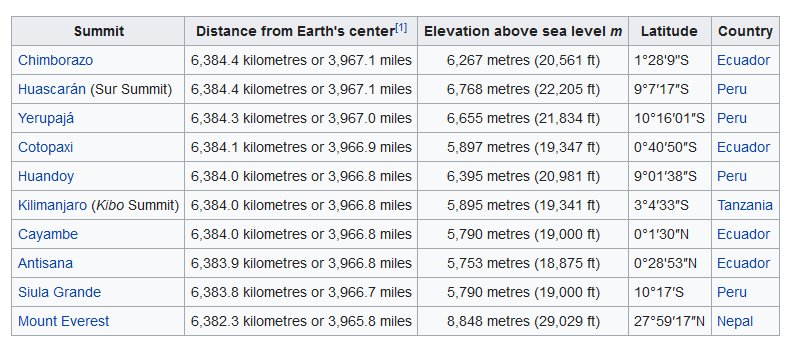
The Highest Mountains on Earth Measured by Distance from the Earth’s Center

According to this chart, the highest mountain is a virtual tie between Chimborazo in Ecuador and the South Summit of Huascarán in Peru. In fact, by this measure eight of the ten highest mountains in the world are in the Andes, the only exceptions being Kilimanjaro in Tanzania and Everest in Nepal.

Tomorrow, I will repost a blog I wrote about my visit to Mount Chimborazo in 2016.

A Day in Quarantine

How to Maintain One’s Sanity During Hard Times

To begin with, I have no problem about getting from 9 to 9½ hours of sleep. In fact, during the last year I have slept better than at any other time in my life. I wake at 9 or 9:30 am, stumble out into the living room to say good morning to Martine, who always wakes up before me, and take my pills, give myself a shot of insulin, and perform a finger-prick test for my sugar level. Only then am I ready for breakfast.

Almost all mornings, I make a pot of hot tea, the current choice being Ahmad of London’s Darjeeling. It is usually accompanied by scrambled eggs with chiles, oatmeal, toast, a fried egg sandwich on a muffin, or grits and sausage. While I breakfast, I always read the Los Angeles Times, devoting particular attention to the KenKen and Sudoku puzzles and the comics page.

By the time I am finished, it is close to noon; so I futz around on the computer for a while, either playing chess with the computer at Chess.Com or one of the free games on Arkadium.Com.

Lunch is not usually a big meal for me, so I delay it into the early afternoon, after which I either see a movie on TCM’s website or Amazon Prime Videos, or I read a book. My current read is Paul Theroux’s Sir Vidia’s Shadow: A Friendship Across Five Continents, which is about the author’s long friendship with V. S. Naipaul (1932-2018). Both are among my favorite authors.

At supper, we usually have a hot home-cooked meal. Today, it was turkey burgers with steamed carrots. Tomorrow, I’ll have to shop for and prepare another meal, about which I must first consult with Martine. She’s the one with the trick digestive system. Last week, we have baked ziti with Italian sausage—one of my better efforts.

After we’ve eaten, Martine washes the dishes while I repair to my library with my current book, where I both read and talk to friends on the phone until about 9 pm. That’s the hour when I write my book reviews for Goodreads.Com and my blogs for WordPress.Com.

By the time I am done, I watch TV until shortly before midnight, concentrating on such shows as Carol Burnett (MeTV), Bill Maher and John Oliver (HBO), Trevor Noah’s “The Daily Social Distancing Show” on Comedy Central, and the opening monologue on Steven Colbert (CBS).

Martine has a much more difficult time of it than I do. She either takes long walks or sleeps while playing an AM talk radio station. She goes to bed for the night much later than I do and wakes up earlier, as she is bedevilled by a bad case of nerves. As I always tell her, nerves are a bad business; so I don’t have any.

Boardwalk

Pacific & Windward, the Center of Venice, California

If you squint hard when you look at the above picture, you can see the set of the Mexican border town in Orson Welles’s Touch of Evil (1958) in which Charlton Heston plays a Mexican drug enforcement officer—one of his weirder roles.

Now it’s just ground zero for one of Los Angeles’s main tourist attractions: The Venice Boardwalk. The boardwalk runs roughly between the Santa Monica Pier and the Venice Pier. It’s only when you cross the border from Santa Monica into Venice that the fun begins. There are scores of tattoo parlors, cafés, tourist junk shops, fortunetellers, psychics, and handcrafts. including a lot of dubious art. The Midwestern tourists who come by the busload see what they think is the “real” Los Angeles, whereas what they see has been created largely for their benefit.

I sort of enjoy the tatty atmosphere of the Boardwalk, but I mainly go because it contains one of Los Angeles’s last surviving bookshops, Small World Books. Today I picked up a copy of James M. Cain’s last novel, The Cocktail Waitress, and a book by Alan Watts about Buddhism. Then I had a slice of pepperoni pizza from Rey’s and trundled back to my car, which was parked at a confusing intersection of streets a few blocks away near Electric and Abbot Kinney.

If you go a few blocks south on Pacific, you will find the bridge over the Venice canal that was the scene of where Joseph Calleia plugs Orson Welles’s corrupt Captain Hank Quinlan.

The Month of Reading Dangerously

Author Marilynne Robinson (Born 1943)

I dedicated last month to reading books only written by women. On March 5, I posted a TBR (To Be Read) list from which I would choose the titles I would undertake to read and review. As was typical, I wound up reading about half the books on the list, adding to them some last-minute choices. Here is the list of what I read:

  • Celeste Ng (United States), Little Fires Everywhere **** †
  • Joyce Carol Oates (United States), The Man Without a Shadow ****
  • Virginia Woolf (Britain), The Waves *****
  • Marilynne Robinson (United States), Gilead ***** †
  • Ludmilla Petrushevskaya (Russia), The Time: Night ****
  • Patricia Highsmith (United States), The Black House (Short Stories) *****
  • Silvia Moreno-Garcia (Mexico), Gods of Jade and Shadow ***** †
  • Colette (France), The Pure and the Impure ****
  • Eve Babitz (United States), L.A. Woman ****
  • Sofi Oksanen (Finland/Estonia), The Purge **** †
  • Rosario Santos—Editor (Bolivia), The Fat Man from La Paz (Short Stories) **** †
  • Clarice Lispector (Brazil), The Hour of the Star *****

There wasn’t a stinker in the bunch, and four of the choices were superb (Woolf, Moreno-Garcia, Highsmith, and Lispector). Five of the books marked with a dagger [†] were by authors I had never read before (Ng, Robinson, Moreno-Garcia, and Santos). On my original TBR list, I thought I had never read any Ludmilla Petrushevskaya before, but I was mistaken.

I will continue to read more books by women authors than I have in the past, though I may not repeat the intensity of March’s reading project. It was an interesting experiment, as all the choices were pretty high quality.

Tiwanaku

Tiwanaku: Gate of the Sun

I must think I’m going to live forever.Trapped in my apartment during the quarantine, I am thinking more and more about returning to Peru and including the altiplano of Bolivia. Here I am at age 76, thinking of a strenuous trip at high altitude to one of the most fascinating (albeit difficult) places on Earth.

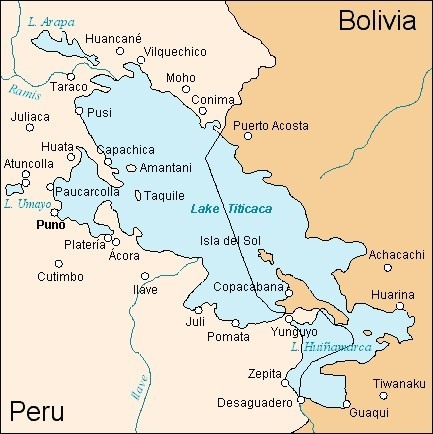
In 2014, I spent some time on the western shore of Lake Titicaca, on the Peru side. I even took a tour on a launch to Isla Taquile and one of the Uros Isles, but as the boat left the dock, I discovered that I was beginning to suffer the effects of food poisoning. The former afternoon at Sillustani, I ate something in a farmer’s house that violently disagreed with me. What is more, I was hours away from a toilet. Under the circumstances, I was not able to appreciate the beauties of Lake Titicaca, and in fact I took no pictures that day.

Map of Lake Titicaca, Showing the Location of Tiwanaku at Lower Right

Just as I returned to Tierra Del Fuego after breaking my shoulder there in 2006, I plan on returning to the Peruvian side of the lake, and adding some parts of Bolivia to the mix. I find myself suddenly interested in the Aymara-speaking peoples of the Andes.

A funny thing happened to me in Puno during my last visit. It was a bitterly cold morning, as it frequently is at that altitude (12,000 feet or 3,700 meters). I had neglected to bring a scarf with me, and I badly needed one. Enter a poor Aymara woman laden down with hand-knitted handicrafts. I walked up to her and brought a beautiful scarf at a reasonable price. Apparently, I made that woman’s day. She broke into a big smile and was almost prepared to welcome me into her family.

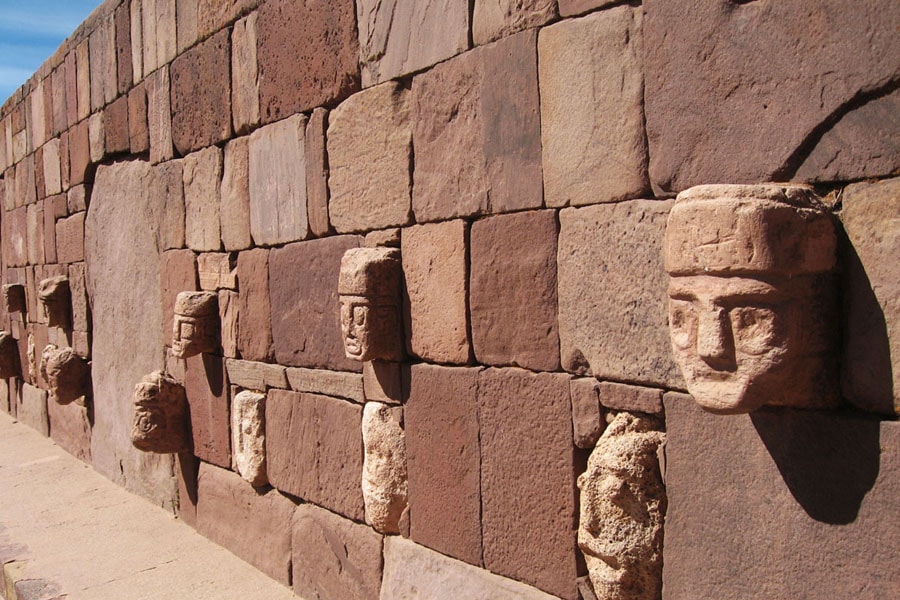
Over a thousand years ago, there was an Aymara empire centered at Tiwanaku in modern-day Bolivia. It lasted until AD 1100 when a massive and persistent drought led to a drop in the level of Lake Titicaca, leaving the Aymara fields high and dry. Hundreds of years later, the Inca took over; but their empire was short-lived once the Spanish conquistadores began to move in.

Walls of the Kalasaya Complex at Tiwanaku

Since the eco-catastrophe that destroyed the Aymara empire a thousand years ago, the Aymara have become a scattered people indulging in subsistence agriculture and the herding of llamas and alpacas.

Cerro Rico

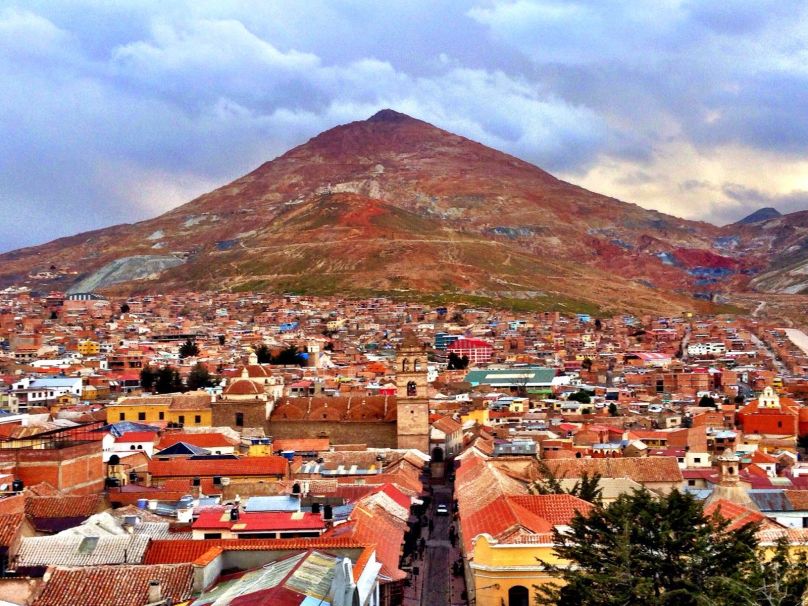
The Cerro Rico, or “Rich Hill,” in San Luis Potosí, Bolivia

One thinks of mines as delving deep into the earth. The silver mines at Cerro Rico in San Luis Potosí, Bolivia, are no exception—except for one little fact: The mines are at an altitude of 15,000 feet plus (4,700 meters), high enough that the miners must chew coca leaves so that they could work without the debilitating effects of soroche, acute mountain sickness.

In his book Valley of the Spirits: A Journey into the Lost Realm of the Aymara, Alan L. Kolata writes:

Silver was the prize that inspired unbridled lust in the Europeans who conquered the Andean world in the sixteenth century. The frenzy for veins of silver from the majestic Andes destroyed whole nations of Indians. After decades of warfare, pestilence and famine, the ravaged native populations were subjugated into slave labor in the hellish mines of Potosí in southern Bolivia. Desperate for laborers to work the fabulously rich deposits, Spanish overlords laid claim to the traditional laborers, the mit’a, that the Indian nations rendered to their native monarchs. More than one-seventh of the native population between Cuzco in southern Peru and Tarija in southern Bolivia were pressed into service in the mines of Potosí. Conditions in the mines were bestial. Even the Spanish dogs of war were treated with more compassion than the native conscripts who died in unremembered numbers.

“Conditions in the Mines Were [and Are] Bestial”

They still are bestial. The Cerro Rico is still being mined, though with diminishing rewards. Between the 16th and the 18th century, 80% of the world’s silver supply came from this mine. According to Wikipedia:

After centuries of extractive mining methods that severely damaged the local ecology the mountain continues to be mined for silver to this day. Due to poor worker conditions, such as a lack of protective equipment against the constant inhalation of dust, many of the miners contract silicosis and have a life expectancy of around 40 years. The mountain is still a significant contributor to the city’s economy, employing some 15,000 miners.

According to the Lonely Planet guidebook for Bolivia, it is possible to tour the mines, though I seriously doubt the sanity of travelers who make the attempt.

The silver mined at Potosí was sent by caravan to Lima, Peru, from where it was transshipped from the Port of Callao to Panama, portaged across the isthmus to Colón, and placed on Spanish treasure ships bound for Spain. Many of those ships never made it, being sunk by Atlantic storms and pirates.

And the upshot? For all the gold and silver went into financing Spain’s wars, which were generally mishandled. In the end, Spain was taken by Napoleon who put an end to the Spanish monarchy of the time.

Diamond Princess

The USS Petri Dish, I Mean the USS Diamond Princess

I have just watched a brief HBO documentary about the cruise ship Diamond Princess, whose passengers had the unenviable role of being the first people outside of China to come down with the coronavirus. It was called “The Last Cruise” (which it was for the 14 passengers who died of the virus).

In all my travels, I have avoided cruise ships—not because of the spread of infectious diseases, but because I don’t like to be in the position of having to be nice to the same bunch of wealthy strangers for multiple days in a row and because I don’t like my vacations to be highly regimented.

Another reason: I remember a cartoon in the New Yorker a number of years ago in which we saw a cruise ship whose name was S.S. All You Can Eat. Even under normal conditions, I’m fighting the “Battle of the Bulge” and certainly don’t need unlimited access to calorific foods.

The documentary consisted largely of cell phone videos taken by passengers and crew. It was evident that the filmmakers were aghast at the conditions of the crew, who were forced to associate with one another in close quarters while an epidemic ranged throughout the ship.

The ship sailed between Yokohama and several ports in Southeast Asia including Okinawa, Hong Kong, and a Vietnamese port not named. As the ship was homeward bound to Yokohama, it was discovered that a passenger boarding in Hong Kong had come down with Covid-19. When the ship reached Yokohama, it was put on quarantine for over a month, as cases spread like wildfire through the ship, infecting some 700+ passengers and an unspecified number of crew members. Passengers who had come down with the virus were carted off to Japanese hospitals.

Eventually, most of the American passengers were put on a military aircraft and returned to the U.S.

A Thin Slice of Watermelon

A Great Writer? The Jewish-Ukrainian-Brazilian Clarice Lispector (1920-1977)

As my month of reading only women authors comes to an end, I find I have made a number of discoveries, especially Clarice Lispector, who was born Chaya Pinkhasivna Lispector in Chechelnyk, Ukrainian SSR in 1920. As a child, she emigrated with her family to the Northeast of Brazil, moving eventually to Rio de Janeiro. I am currently reading her last work before she died of ovarian cancer at the age of 57, a novelette entitled The Hour of the Star, from which the following is taken:

That girl didn’t know she was what she was, just as a dog doesn’t know it’s a dog. So she didn’t feel unhappy. The only thing she wanted was to live. She didn’t know for what, she didn’t ask questions. Maybe she thought there was a little bitty glory in living. She thought people had to be happy. So she was. Before her birth was she an idea? Before her birth was she dead? And after her birth she would die? What a thin slice of watermelon.

Also:

She thought she’d incur serious punishment and even risk dying if she took too much pleasure in life. So she protected herself from death by living less, consuming so little of her life that she’d never run out. This savings gave her a little security since you can’t fall farther than the ground.

The portraits of Lispector haunt me, with her high cheekbones. And her writing haunts me. I can see myself reading everything I can find by her.

Does Anyone Want To Be Unhappy?

Well, Now, That’s Hardly a Surprise

Happiness is a very fickle thing. At one time or another, we all think that it can be secured and held on to and never let go. Perhaps we associate it in our minds with wealth, or finding (and retaining) the ideal spouse or significant other.

But then I always think of one of our former millionaire accounting clients who entered into a deal from which he expected to lose his fortune. So he blew his brains out. After the funeral, it was discovered that the deal far from depleting his fortune added considerably to it. It helped pay for a first class funeral.

In Buddhism, there is something called the Four Noble Truths, expressed by Gautama Buddha as follows:

Now this, bhikkhus, is the noble truth of suffering: birth is suffering, aging is suffering, illness is suffering, death is suffering; union with what is displeasing is suffering; separation from what is pleasing is suffering; not to get what one wants is suffering; in brief, the five aggregates subject to clinging are suffering.

Now this, bhikkhus, is the noble truth of the origin of suffering: it is this craving [taṇhā, “thirst”] which leads to re-becoming, accompanied by delight and lust, seeking delight here and there; that is, craving for sensual pleasures, craving for becoming, craving for disbecoming.

Now this, bhikkhus, is the noble truth of the cessation of suffering: it is the remainderless fading away and cessation of that same craving, the giving up and relinquishing of it, freedom from it, non-reliance on it.

Now this, bhikkhus, is the noble truth of suffering: birth is suffering, aging is suffering, illness is suffering, death is suffering; union with what is displeasing is suffering; separation from what is pleasing is suffering; not to get what one wants is suffering; in brief, the five aggregates subject to clinging are suffering.

The term “bhikkhus” refers to the Buddhist monks to whom this teaching was addressed.

Essentially, desires and cravings lead to suffering. Happiness is something that just happens and is not necessarily linked to our desires. But it is almost always transitory. In my life, I am sure I have been happy for minutes at a time in my 75+ years of existence.

So I hope that Sharon Stone appreciates what happiness passes her way.

Carvaganza

A Perfect Car for the Road in Los Angeles

This weekend, a number of museums opened up for Covid-weary Angelenos, among whom are Martine and me. First we ate—indoors—at Du-Par’s Restaurant at the Original Farmers’ Market at 3rd and Fairfax. Then we breezed down Fairfax to the Petersen Automotive Museum at the corner of Fairfax and Wilshire.

Unfortunately, the current exhibits were more oriented toward the bearded and tattooed grundgerati. The museum’s former emphasis on the history of the automobile has been replaced by racing cars, including Maseratis, Lamborghinis, and others. In addition, there were a number of fantasy cars such as the monster above, which was designed for some movie which I likely never saw.

A Lamborghini Racing Car for the Cash-Non-Challenged

Still and all, it was nice to go eat out at a restaurant and visit a museum—quite a change from the previous twelve months. The Petersen was packed to overflowing with visitors who had no idea what social distancing was and why it is still essential. On the plus side, the wearing of masks was de rigeur.

Finally, here is a peak of the dashboard of the original Back to the Future car:

Dash and Front Seat of the Original Back to the Future Car