Does Anyone Want To Be Unhappy?

Well, Now, That’s Hardly a Surprise

Happiness is a very fickle thing. At one time or another, we all think that it can be secured and held on to and never let go. Perhaps we associate it in our minds with wealth, or finding (and retaining) the ideal spouse or significant other.

But then I always think of one of our former millionaire accounting clients who entered into a deal from which he expected to lose his fortune. So he blew his brains out. After the funeral, it was discovered that the deal far from depleting his fortune added considerably to it. It helped pay for a first class funeral.

In Buddhism, there is something called the Four Noble Truths, expressed by Gautama Buddha as follows:

Now this, bhikkhus, is the noble truth of suffering: birth is suffering, aging is suffering, illness is suffering, death is suffering; union with what is displeasing is suffering; separation from what is pleasing is suffering; not to get what one wants is suffering; in brief, the five aggregates subject to clinging are suffering.

Now this, bhikkhus, is the noble truth of the origin of suffering: it is this craving [taṇhā, “thirst”] which leads to re-becoming, accompanied by delight and lust, seeking delight here and there; that is, craving for sensual pleasures, craving for becoming, craving for disbecoming.

Now this, bhikkhus, is the noble truth of the cessation of suffering: it is the remainderless fading away and cessation of that same craving, the giving up and relinquishing of it, freedom from it, non-reliance on it.

Now this, bhikkhus, is the noble truth of suffering: birth is suffering, aging is suffering, illness is suffering, death is suffering; union with what is displeasing is suffering; separation from what is pleasing is suffering; not to get what one wants is suffering; in brief, the five aggregates subject to clinging are suffering.

The term “bhikkhus” refers to the Buddhist monks to whom this teaching was addressed.

Essentially, desires and cravings lead to suffering. Happiness is something that just happens and is not necessarily linked to our desires. But it is almost always transitory. In my life, I am sure I have been happy for minutes at a time in my 75+ years of existence.

So I hope that Sharon Stone appreciates what happiness passes her way.

Carvaganza

A Perfect Car for the Road in Los Angeles

This weekend, a number of museums opened up for Covid-weary Angelenos, among whom are Martine and me. First we ate—indoors—at Du-Par’s Restaurant at the Original Farmers’ Market at 3rd and Fairfax. Then we breezed down Fairfax to the Petersen Automotive Museum at the corner of Fairfax and Wilshire.

Unfortunately, the current exhibits were more oriented toward the bearded and tattooed grundgerati. The museum’s former emphasis on the history of the automobile has been replaced by racing cars, including Maseratis, Lamborghinis, and others. In addition, there were a number of fantasy cars such as the monster above, which was designed for some movie which I likely never saw.

A Lamborghini Racing Car for the Cash-Non-Challenged

Still and all, it was nice to go eat out at a restaurant and visit a museum—quite a change from the previous twelve months. The Petersen was packed to overflowing with visitors who had no idea what social distancing was and why it is still essential. On the plus side, the wearing of masks was de rigeur.

Finally, here is a peak of the dashboard of the original Back to the Future car:

Dash and Front Seat of the Original Back to the Future Car

Three Modern Day Gods

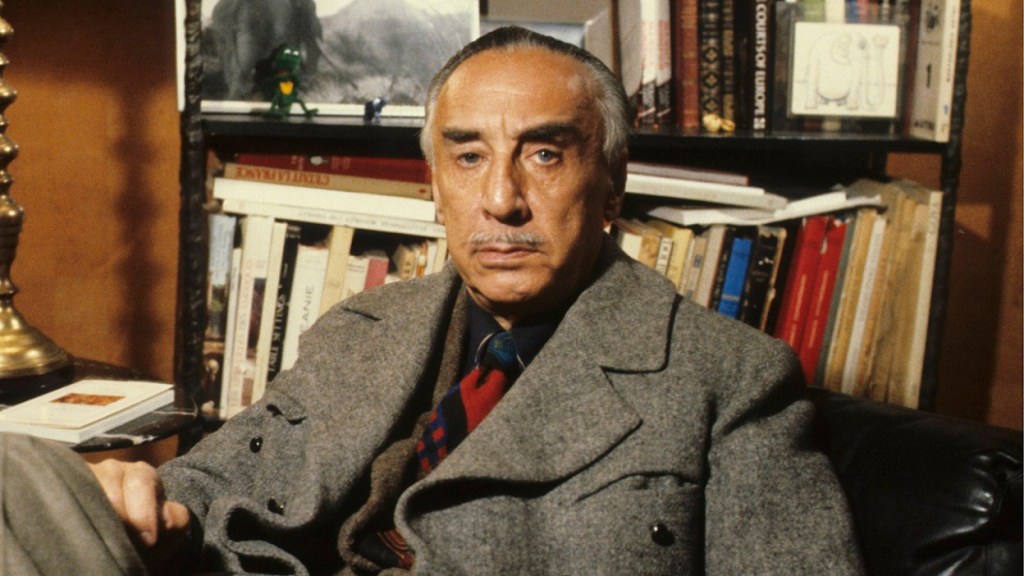
Romain Gary (1914-1980), French writer, at his place the day before his suicide. Paris, on December 1st, 1980.

There I was, reading the August 21, 2020 issue of the Times Literary Supplement in an article on the Franco-Lithuanian novelist Romain Gary, I suddenly came upon a new pantheon for our times:

  • Totoche, the god of stupidity
  • Merzavka, the god of absolute ideas
  • Filoche, the god of bigotry

The article goes into greater detail:

Totoche is a red-arsed monkey, adored by all who hurry humanity towards destruction: dim politicians who thump tubs, pure scientists who release genies from bottles, social psychologists who lead us up blind alleys, and demagogues who shout and bully. Merzavka is a cossack who stands gleefully, horsewhip in hand, on heaps of corpses industrially produced by concentration camps and torture chambers. Half of us lick his boots and the other half live or die by the religious, political and moral ideologies by which he rules and kills. Filoche is a concierge waiting to pounce on petty infringements of house rules, a hyena scavenging for scraps of racism, intolerance and orthodoxy with which to justify lynchings, holy wars and persecution.

The article, entitled “Brought to Book,” was written by David Coward.

In many ways, Gary’s invented deities were to perfectly describe the United States during the Trump Administration, even though Gary himself had long since (1980) passed on.

I Might As Well Be Back in Cleveland

Southern California Is Being Buffeted by Winds

When I lived in Cleveland and in New Hampshire, I was the plaything of various seasonal allergies. There was the sneezing (and the bloody noses), the itching eyes, and borderline asthma. Now with the Winterspring Complex we are now experiencing, it’s back again. Not only do my eyes itch, but the discharge is sticky, such that I have to open my eyes with my fingers in the morning. And I am going through handkerchiefs like they’re going out of style. (I don’t use Kleenex because I feel bad about destroying trees just so I can blow my nose in them.)

As my friend Bill Korn says, these winds are usually accompanied by winter rainstorms, but we have had precious few of those. The current rainy season, which will end soon, is another bad one—just a few inches of mostly occasional showers and only one thorough wetting.

California is well on its way to becoming the next Atacama Desert, which is the world’s driest desert, clocking in at less than 3 mm of precipitation a year. That’s not even as big as one of my sneezes.

The Atacama Desert of Chile and Peru

When the weather starts getting hot, my allergies will gradually disappear. But then I’ll start complaining about the heat.

Eve Babitz’s L.A.

The Sunset Strip, Where L.A. Came to a Head

Whenever I read Eve Babitz, I think of L.A. the way it was when I first came here from Cleveland by train at the tail end of 1966. Being a stuck-up Easterner and a graduate of an Ivy League college, I naturally thought there was something fundamentally wrong about the West Coast. In time (lots of time) I grew even to love it.

I just finished reading Eve Babitz’s novel L.A. Woman, which brought memories rushing into my brain:

And I was an L.A. woman. In fact, looking back on those one-night stands, I must have been crazy. Yet there were thousands of girls living between Sunset and Santa Monica in between La Brea and La Cienega who painted the town red like me—and who got away with it too.

When I arrived, Eve was hanging out with Jim Morrison of the Doors, whom she just refers to as Jim in the novel. Every weekend when the weather permitted, thousands of Teeny-Boppers rioted on the Sunset Strip. The war in Viet Nam was entering a new and uglier phase, and I thought that nowhere else were there women quite so beautiful as the ones I saw on the street every day.

Eve Babitz When She Was Younger

Eve Babitz was, to put it mildly, a righteous babe. What set her apart from all the others was that she had a brain and was able to describe her wild life without prejudice.

If you want to see Los Angeles from a different perspective, I recommend these books of hers as an excellent place to start:

  • Eve’s Hollywood (1974)
  • Slow Days, Fast Company: The World, The Flesh, and L.A. (1977)
  • Sex and Rage: Advice to Young Ladies Eager for a Good Time (1979)
  • L.A. Woman (1982)
  • Black Swans: Stories (1993)

I have read all five of the above and look forward to reading her recently published collection of essays entitled I Used to Be Charming: The Rest of Eve Babitz (2019).

Women of Adventure

Dame Freya Madeline Stark (1893-1993)

Some of the world’s most intrepid travelers were women. I am thinking particularly of Freya Stark, who tromped all through the Middle East and Afghanistan, in the processing writing a couple dozen excellent books, and died at the ripe age of 100. In her book Baghdad Sketches (1937), she wrote:

To awaken quite alone in a strange town is one of the pleasantest sensations in the world. You are surrounded by adventure. You have no idea of what is in store for you, but you will, if you are wise and know the art of travel, let yourself go on the stream of the unknown and accept whatever comes in the spirit in which the gods may offer it. For this reason your customary thoughts, all except the rarest of your friends, even most of your luggage – everything, in fact, which belongs to your everyday life, is merely a hindrance. The tourist travels in his own atmosphere like a snail in his shell and stands, as it were, on his own perambulating doorstep to look at the continents of the world. But if you discard all this, and sally forth with a leisurely and blank mind, there is no knowing what may not happen to you.

In her book Valleys of the Assassins (1934), she added:

To awaken quite alone in a strange town is one of the pleasantest sensations in the world. You are surrounded by adventure. You have no idea of what is in store for you, but you will, if you are wise and know the art of travel, let yourself go on the stream of the unknown and accept whatever comes in the spirit in which the gods may offer it. For this reason your customary thoughts, all except the rarest of your friends, even most of your luggage – everything, in fact, which belongs to your everyday life, is merely a hindrance. The tourist travels in his own atmosphere like a snail in his shell and stands, as it were, on his own perambulating doorstep to look at the continents of the world. But if you discard all this, and sally forth with a leisurely and blank mind, there is no knowing what may not happen to you.

This woman makes Ernest Hemingway look like a wussy boy in short pants.

And Freya Stark is not the only woman traveler who dared to go solo into the uncharted areas of the earth. There was also Isabella L. Bird (1831-1904), who traveled extensively in Asia, and Mary Kingsley (1862-1900), whose destination was West Africa. In fact, Wikipedia compiled a list of female explorers which sets one to thinking. You can find it here.

The Golden Circle

Thingvellír on Iceland’s Golden Circle Tour

If you should be so lucky as to visit Iceland, I highly recommend taking the Golden Circle tour offered by several tour bus companies. It attempts—and successfully—to highlight the uniqueness of the country by visiting three or four major attractions within a short distance of the capital at Reykjavík.

Before it got gobbled up by Norway, Iceland was governed by an annual outdoor meeting at Thingvellír, where the laws were read out loud and cases were tried to resolve conflicts. It also is a significant site geologically, as the line between the North American and Eurasian tectonic plates runs right through it. You can see how much the plates have moved since the early days of the 9th century AD.

The Waterfall at Gullfoss

Not far from Thingvellír is the huge waterfall at Gullfoss (“Golden Falls”) on the Hvitá River. The falls is in three “steps” before plunging 11 metres or 36 feet, and 21 metres or 69 feet as seen in the above picture. One of the most incredible things about Iceland is that, throughout the country, I saw hundreds of waterfalls of various sizes.

The Geyser Strokkur at the Original Geysir

The word geyser comes from the name of a famous erupting hot spring which, for many reasons, does not erupt any more. Not to worry: There are dozens of other geysers, especially Strokkur, which erupts several times an hour. There are numerous bubbling hot springs throughout Iceland, necessitating considerable care to avoid boiling your extremities as the result of a misstep.

Some of the Golden Circle tours also include sa visit to a geothermal power plant on the route back to Reykjavík. It was incredible to me that the whole city of Reykjavík has central heating: no coal, no oil, no gas—but steam as the result of drilling strategic holes in the earth’s crust near lava and sending water down the hole.

Iceland is one of the most eerily beautiful countries on earth, even if it isn’t very green.

Ladies of the Road

Another Fun Event at the Automobile Driving Museum: The Women’s Car Show

On Saturday, Martine and I dropped in at the Automobile Driving Museum in El Segundo to see a car show dedicated to the wheels of women auto enthusiasts. This weekend, for the first time I began to detect a spring of hope in this grim pandemic season. Americans are getting vaccinated, and businesses are slowly beginning to open up again. (For the first time in over a year, we ate indoors at Ye Olde King’s Head Restaurant in Santa Monica.)

I was curious to see what a Women’s Car Show would be like, and found that the ladies liked vintage cars as much as men do. The men, however, would not accompany it with a fashion show.

Poster for the Women’s Car Show

Martine has developed a real fondness for the Automobile Driving Museum and its various events. I enjoy going because there are so few things that she likes so much. I also enjoy being with car enthusiasts, because many of the old cars are indeed works of art that I can well appreciate.

Multipleheaded Spirits

Trevor Noah of the “Daily Social Distancing Show” on Comedy Central

The Nigerian novelist Chinua Achebe, author of Things Fall Apart, once wrote that the criss-cross of Africa to Euroamerica is a place of “a certain dangerous potency; dangerous because a man might perish there wrestling with multipleheaded spirits, but also he might be lucky and return to his people with the boon of prophetic vision.”

There are several people I could think of who have weathered that crossing and managed to have come out ahead in the process. Trevor Noah on Comedy Central’s “The Daily Social Distancing Show” is one such African. According to his autobiographical Born a Crime, Noah’s very existence as a mixed-race baby of South African and Swiss parentage was a violation of Apartheid at the time of his birth in Johannesburg in 1984. After his successful hosting of the 2021 Grammy Awards Show, his show biz career is looking up.

I watch his show on Comedy Central whenever I can.

Franco-Senegalese Novelist Marie NDiaye

One of the greatest contemporary French novelists is Marie NDiaye, who although born in France, has produced stunning body of work (My Heart Hemmed In, Three Strong Women, and The Cheffe, to name just three) that I think puts her on the track to the Nobel Prize for Literature. It’s even harder to do this in France than here in America.

Nigerian-American Novelist Teju Cole

Finally there is Teju Cole, born in Kalamazoo, MI of Nigerian parents. He is the author of Open City, Every Day Is for the Thief, and Known and Strange Things.I have read the first two titles and found them a revelation, the first about life in New York City, the second about life in Nigeria.

It is my belief that Africa has a lot to give us. The old Anglo-Saxon literary and artistic hegemony is in tatters, and the same goes for Europe. It is infuriating that people see the Africans as a threat. The descendants of the slaves have given us our music and excelled in the performance arts. More recent Africans continue to make this a more interesting country to live in—if only we let them!

Wrong Direction: U-Turn Required

Two Paintings by Mark Rothko (1903-1970)

I feel that with abstract expressionism, American art took the wrong direction. Instead of the painting becoming something for the viewing public, it became something produced because the painter had to work out something not quite communicable in his or her own mind.

It was during my college years during the mid-1960s that I first developed my dislike of what had become the dominant movement in American painting. (Fortunately, it no longer is.) In fact, it was Mark Rothko who first came to my attention—and I didn’t like him from the first.

It was Anais Nin who wrote in Volume 1 of her Diary: “I am essentially human, not intellectual. I do not understand abstract art. Only art born of love, passion, pain.”

Jackson Pollock’s “Convergence”(1952)

There are many abstract expressionist painters I do not like, so I am highlighting the three who particularly came to my attention: Rothko, Jackson Pollock, and Willem de Kooning. If I somehow came into possession of one of their works, I would not under any circumstances put it on display. Instead, I would find some fool to pay hard cash for it. It would be ideal for a corporate head office, and not at all for the residence or office of a person who has chosen not be be schooled to appreciate such work.

Willem de Kooning’s “Untitled” (19 Something or Other)

I have come under fire from some of my friends over my attitude on modern art. I don’t dislike all modern art, just art that is divorced from reality as I know and understand it. I do not care a fig for whatever reality is in the mind of the artist if it does not in some way intersect with my reality.

Very interesting rectangles, Mark. I’ll let you know if I’m in the market for any. Oh, Jackson, I hope you’re not doing any graffiti in my neighborhood. And Willem, you built yourself quite a career with your multicolor daubs of an indiscriminate nature.

There really is not anything else I have to say. I’m not the artist, and certainly not the artist’s psychoanalyst.