
Gliese 832c

Could It Be the Closest Inhabitable Exoplanet?

Could It Be the Closest Inhabitable Exoplanet?

From NASA comes a photo comparing Earth with the planet Gliese 832c. According to the Astronomy Picture of the Day website:

This planet is only 16 light years away—could it harbor life? Recently discovered exoplanet Gliese 832c has been found in a close orbit around a star that is less bright than our Sun. An interesting coincidence, however, is that Gliese 832c receives just about the same average flux from its parent star as does the Earth. Since the planet was discovered only by a slight wobble in its parent star’s motion, the above illustration is just an artistic guess of the planet’s appearance—much remains unknown about Gliese 832c’s true mass, size, and atmosphere. If Gliese 832c has an atmosphere like Earth, it may be a super-Earth undergoing strong seasons but capable of supporting life. Alternatively, if Gliese 832c has a thick atmosphere like Venus, it may be a super-Venus and so unlikely to support life as we know it. The close 16-light year distance makes the Gliese 832 planetary system currently the nearest to Earth that could potentially support life. The proximity of the Gliese 832 system therefore lends itself to more detailed future examination and, in the most spectacularly optimistic scenario, actual communication—were intelligent life found there.

Since Neil deGrasse Tyson very effectively demonstrated that none of the other planets or planetoids in our solar system is inhabitable, I guess I’ll have to cancel my vacation plans for the Big Red Spot on Jupiter. (You really should see the video clip that comes with this link: He’s really quite good.)

By the way, you’ll notice in the above quote that NASA fudged a bit on the “photo” of Gliese 832c. If you’ll look closely you’ll see Spain, France, and North Africa through the clouds. I guess the point was to make Gliese 832c a more welcoming destination than, say, Syria, Pakistan, the Gaza Strip, or anywhere Ken Ham chooses to call home.

Historical Shoe Shine

Paris 1838: Do You See the Man at the Lower Left?

Paris 1838: Do You See the Man at the Lower Left?

This is one of my favorite firsts: In 1838, Louis Daguerre photographed a man getting a shoeshine on the Boulevard du Temple. Is it strange that no one else is around? Actually, the street is crowded with vehicles and pedestrians; but because they’re all in motion, the long exposure time (ten minutes) required for the first daguerrotypes didn’t pick them up. The man at the lower left getting a shoeshine, on the other hand, is standing still. Because the shoe shiner’s arms are in motion, they don’t show up in the image, making him look armless, like a fire hydrant. Neither person has ever been identified.

Below is a close-up of the man getting his shoeshine:

The Red Arrow is Pointing at the First Man Photographed

The Red Arrow is Pointing at the First Human Being Ever To Be Photographed

See PetaPixel, my source for this posting.

Beyond the Master Forger’s Ability

Giovanni Bellini’s “The Transfiguration” (1480)

Giovanni Bellini’s “The Transfiguration” (1480)

Yesterday, I was drawn to the television by a segment on “Sixty Minutes” about the noted German art forger, Wolfgang Beltracchi. When Bob Simon of CBS asked him what painters he couldn’t forge, Beltracchi, without hesitation, answered Bellini. I took him to mean Giovanni Bellini (1430-1516) and not his brother Gentile (they were both brothers-in-law of the great Andrea Mantegna). The only time I remember ever seeing or original Giovanni Bellini was at the Frick Collection in New York City, which has a superb “St. Francis in Ecstasy” also painted in 1480. I have included an image below.

There is such an incredible sense of detail in a Bellini oil that I feel as if I could pick a background segment (say 1/64th of the total) and enlarge it to full size without losing anything. And the detail would be almost as fascinating as the foreground. Look at that fence following the upward path in “The Transfiguration” (above), and note the minor variations from post to post.Look at that dead tree at the lower left, or that couple meeting in the upper right near the tree.

I can almost imagine Bellini in an ecstasy such as St. Francis in the painting below.


St. Francis in Ecstasy (1480) at the Frick Collection

St. Francis in Ecstasy (1480) at the Frick Collection

Some people I know are put off by the Christian religious themes of Renaissance painting. The great ones would be great even if they were depicting a shoelace or a dirty dish. It’s almost as if the subject were irrelevant.


My Brother Sets Me Straight

Now I Know What I’m Going to See There!

Now I Know What I’m Going to See There in Peru!

Last night, my brother left the following comment on my status on reading Nigel Davies’s book The Incas on Facebook: “How about The Dinky Incas”? That set me back for a minute. Who in blue blazes were the Dinky Incas? Well, there was only one way to find out: I Googled it. Then it all came back to me. There was an animated television series around 1959-1960 called “Clutch Cargo,” starring a ruggedly good-looking hero with an enormous jaw named Clutch Cargo who flew to strange locales with a small freckle-faced boy named Spinner and a dachshund named Paddlefoot. They engaged in the type of exotic adventures I recall from reading Carl Barks’s Uncle Scrooge comic books.

By the time my brother was of an age to enjoy the limited animation adventures of “Clutch Cargo,” I was already a teenager who was much too sophisticated for that type of stuff. Dan, on the other hand, was eight or nine years old and watched every episode.

Now You, Too, Can Follow Their Adventures

Now You, Too, Can Follow Their Adventures

The series on the “Dinky Incas” was about a missing archaeologist who was on a dig in Peru which resembled, more than anything else, a Mayan pyramid in the jungle. (The real Incas didn’t build pyramids and they preferred the higher-elevation altiplano to the jungles of the Amazon.) Clutch, Spinner, and Paddlefoot run into two unsavory characters who try to do away with them, because, of course, they’re after all the gold and jewels. But Clutch and his sidekicks take care of them right quick, as you can see for yourself if you have twenty minutes to watch the whole series, which is available by clicking here.

Sweating at Pepperdine

The Malibu Campus of Pepperdine University

The Malibu Campus of Pepperdine University

Because I forgot to bring my camera today, I’m using one of my old Minolta pictures of the Pepperdine University Campus in Malibu. Martine likes to walk around the hilly campus, and it’s great exercise. Today, however, we’ve been hit by the northern edge of another Mexican monsoon. The result was incredibly muggy and sweaty weather that felt like Florida this time of year. At several points during the walk, I just wanted to lie down on the grass and take a nap … but we pressed on.

As California is in the middle of a heinous drought, the campus looks much browner today than the above photo. Usually, we would see several groups of deer wandering between the buildings and feeding on the grasses. Today, we saw only two of them from a distance.

It’s strange to consider that (1) we are in a drought, but (2) we can’t just wring all the moisture out of the air so that it drains into the ground.

It will be a month or two before get the really dry Santa Ana winds that make the skin around our fingernails peel painfully. By then, I will be in Peru, high in the Andes, trying to keep from freezing my butt off.


A Week of Very Very Bad News

Omigosh, Where Do I Begin?

Omigosh, Where Do I Begin?

Every once in a while, all the bad news seems to clump up at one time. If you spend a lot of time following this news, you will feel very very bad and have to take some pharmaceutical products that are unlikely to do you any good. For those of you who have been consulting a sage on some remote mountaintop over the last seven days, here’s a brief summary of what has been clogging the pipes:

  • That Malaysian plane that was shot down by the Russkis or their BFFs is still in the middle of a battle zone, and investigators have been told the area is now mined. How’s that for hiding evidence?
  • Somebody did something to some Israelis or Hamas members, so the Israelis went and killed a couple thousand Arabs while Hamas still lobs cherry bombs and hammerheads into Israel.
  • Ebola is spreading like wildfire. For the sake of justice, we are bringing some afflicted Americans back to the States, where Donald Trump will be emptying their bedpans and giving them sponge baths.
  • Immigration? Congress does a bunk and gives Boehner another reason for a very public faceplant. Wait a sec, we’re paying those clowns to take apart the Legislative Branch of the U.S. Gummint?
  • Drought-stricken California is in even worse shape, now that the UCLA campus was flooded by several million gallons of water after a water main break. Is there any certainty that USC was not involved?
  • The stock market has taken a giant dump while we still consider investing in such ad-driven media as Facebook, Twitter, and SnapChat. Wait, don’t advertising budgets suffer first when the economy goes south?

You can laugh at anything—provided that you concentrate on cultivating your garden rather than bearing the world’s unsolvable ills on your back.


3989 East 176th Street

Where I Lived 1948-1964

Where I Lived 1948-1964

When I looked up my old street address on Google, I was also given the opportunity to get a photographic view of the house where I spent most of my childhood up to fifty years ago. The house in the middle fronts on where Eldamere runs into East 176th Street. On the left side of us lived the Smiths; on the right, the Fordosis, our “enemies.” The photograph makes the front yards look much bigger than they were by about a quarter. The tree hides the window to my second story attic room, where I spent much of my time doing my homework and reading.

We were just a few houses in from Harvard Avenue, where Charley Fontana’s corner grocery store was located. Once, when I was little, William Boyd, the star of the Hopalong Cassidy television series, stopped at Fontana’s and was mobbed by little kids, one of whom was me. He handed out embossed plastic commemorative coins stamped with the name Hopalong Cassidy.

About half a mile left on Harvard was Saint Henry’s Church and School, where I attended grades two through eight. (Don’t tell anyone this, but, to my eternal shame, I never finished first grade.) Then I spent four years at Chanel High School in Bedford, which was renamed St. Peter Chanel before it blinked out of existence last year.

It was a pretty nice neighborhood when we moved there in the late 1940s. Because most of the houses were pretty new back then, the streets were barren. Now they are flanked by large trees that were just getting started when we moved to Parma Heights. By then I was at Dartmouth College and was way too sophisticated to care.

What made us move out was a real estate practice known as blockbusting. The early 1960s were a time of racial tension. When real estate salesmen paraded potential black buyers to neighborhood houses, the existing residents—including my family—panicked and sold out. We thought the neighborhood would become an evil slum like the Hough District just east of downtown. It never did: The new owners apparently were just as intent on making it a nice place to live as the Hungarians and Poles who left the area.

When I returned in 1998 to look around with my brother, we were pleasantly surprised.


Independence Day 1821

Declaring Independence Was One Thing, But Winning It Another

Declaring Independence Was One Thing, But Winning It Another

Peru is now celebrating the 193rd anniversary of its own Declaration of Independence by José de San Martin in Lima, as shown in the famous painting above by Juan Lepiani. As with our own Declaration of Independence, there was still a lot of fighting to come. Worse still, disunity was rampant. So much so that San Martin left for Europe in disgust and remained there until his death in 1850. Compared to what happened in South America, our own struggle for independence was a cakewalk, thanks largely to Admiral de Grasse and the French navy.

Let me give you a brief timeline. First there were the native peoples of what is now Peru, who were mostly gobbled up by the Inca empire. Then the Spanish came in under Francisco Pizarro, defeated the Incas, and set up a European-based government. All went somewhat smoothly under the Peninsular War of the early 19th century, in which the English, abetted by Spanish guerrillas, drove Napoleon’s French out of the Iberian Peninsula—at the cost of messing up their colonies in the New World. All criollo (native-born white) officials were replaced by new administrators from Spain. So, feeling disenfranchised, the criollos rebelled under Bolivar, San Martin, Sucré, O’Higgins and others. They won, effectively driving the Spanish from South America.

Even to this day, Peru is largely a criollo-run country, even though whites constitute only 15% of the population. Naturally, the 45% who are Amerindians and the 37% who are Mestizo (mixed races) currently feel disenfranchised. Is Peru due for another revolution? In a way, it had one in the 1980s and 1990s under the Shining Path and the MRTA guerrillas, who were defeated in a series of bloody confrontations in which thousands of innocent people were killed.

It is inevitable that the non-whites in power will be replaced by more of the people from the Altiplano and jungle regions as time goes on. There may be other Independence Days to come. Who knows?

After all, there are people who feel the same way in the United States, people who dress in 18th century costumes with tea bags dangling from their hats.

Monsoon Monday

Mexican Monsoon Clouds Over Arizona

Mexican Monsoon Clouds Over Arizona

Generally speaking, it doesn’t rain in Southern California between March and December. The only exception is when we catch the northern edge of a Mexican monsoon, as we did yesterday and today. When we stepped out of the Albertson’s Supermarket yesterday around 2 pm, Martine and I were surprised to see the ground was wet and our car was covered with droplets. “Oh great!” I thought. “This’ll be another dirty drizzle that craps up my car windshield.”

It was more however. In nearby Venice, a young man died when he was struck by lightning, and ten people were hauled off to the hospital. While waiting for our friends Bill and Kathy to arrive, we heard thunder. Then, this morning, one of my co-workers from Redondo Beach said that she had lost her power three times during the night and that there was frequent lightning. Neither Martine nor I experienced anything like that in West Los Angeles,  only about twelve miles north of her.

One would think that the rain—such as it was—would at least ameliorate our dire drought conditions. No such luck! The rain evaporated within minutes, leaving behind only a sticky and uncomfortable humidity.

It reminds me of Florida. My mother moved to a senior condo in Hollywood several years after my father died in 1985. I would visit her from time to time, but I could never find a comfortable season. Every time I stepped off a plane in Florida, I felt as if I were being hit in the face with a big wet towel; and that feeling would persist the whole time of my visit.

I could never be comfortable in a humid climate. The summers in Cleveland were, I thought, dreadful. When a Peruvian acquaintance suggested I visit the jungle area around Iquitos, I begged off quickly. The humidity is bad enough, but the mosquitoes and tropical diseases were more than I could stand. Don’t forget, I like to take vacations in places like Iceland, Patagonia, and the Andes.

Hot Dog Stick

The Original on the Boardwalk in Santa Monica

The Original on the Boardwalk in Santa Monica

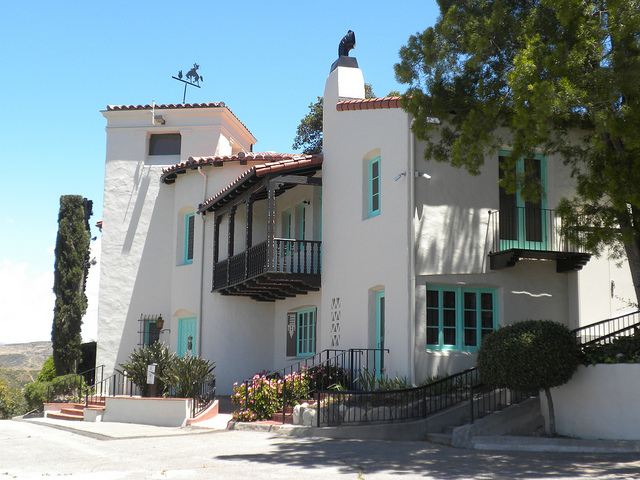
We got together with our friends Bill and Kathy Korn today and did something a little bit different. Bill had been visiting restaurants featured on the late Huell Howser’s television programs and decided he wanted to try the Original Hot Dog on a Stick restaurant on the Santa Monica Boardwalk, just a few steps from the Santa Monica Pier. The above picture shows the restaurant, which somehow never had the connective words “on a” painted on its sign that is now part of the company name. So it was to the original stand dating back to 1946 to which we repaired to dine on a delicious hot dog stick.

Martine was not particularly enthralled with having to sit on a wall that was liberally decorated with dried bird droppings, and even less having to maneuver through the massive crowds on the pier; but she put up with it. Bill and Kathy are from a part of Los Angeles where going outdoors in July is, to say the very least, uncomfortable. Just to get an idea of the crowds, see the picture below:

Crowds on the Beach North of the Santa Monica Pier

Crowds on the Beach North of the Santa Monica Pier

Curiously, we had some rain this afternoon. Not only did we have rain, but also a rare lightning strike that killed one twenty-year-old male and injured several other people. By the time we went, about an hour and a half later, the storm, such as it was, had moved eastward.

Speaking of Hot Dog on a Stick, I remember visiting the Pier one Sunday morning in 2009 and wandering into the middle of several hundred young men and (mostly) women dressed in the standard uniform for a corporate meeting:

Hot Dog on a Stick Meeting 2006

Hot Dog on a Stick Meeting 2006