
My Safe Spaces

Day of the Dead Celebration in the San Fernando Valley

Ever since my first visit to Mexico in 1975, I no longer felt myself superior to Mexican-Americans. It didn’t take long before I felt that way about African-Americans and Asian-Americans. My safe space was becoming larger with each year. Now when I encounter prejudiced white people, I don’t even regard myself as being white. In fact, I’ve always felt particularly safe thinking of myself as a Hungarian.

That is a bit of a joke, really, as I am only 25% Hungarian. I am also 25% Slovak, 25% Czech, and 25% Bavarian German. The only difference is that Hungarian was my first language, and I can still think in Hungarian.

At the Los Angeles Times Book Festival this past weekend, I enjoyed the work of three black poets (Roger Reeves, Courtney Faye Taylor, and D. Manuel II) and one Hispanic poet (Brenda Cárdenas). Oh, and don’t forget Eloise Klein Healy, a white poet from El Paso, Texas, whose courage impressed me so much (see yesterday’s post).

I was presented with multiple templates of Los Angeles, all of which I accepted—if not exactly as my own, still as plausible worlds understandable to me. Probably the scariest Los Angeles was that of Eloise Klein Healy, because she fought successfully against the horrors of encephalitis and aphasia and recovered her verbal skills as a poet.

My reaction to the paranoia of white supremacists like Tucker Carlson is to regard them as broken people who are unable to join in the incredible richness of other ethnicities.

LA Times Poets: Eloise Klein Healy

Former Los Angeles Poet Laureate Eloise Klein Healy

As I mentioned in my previous post, what I enjoyed most at the Los Angeles Times Book Festival were the poetry readings at the Poetry Stage sponsored by Small World Books of Venice. One poet that impressed me for her sheer cojones was the 80-year-old Eloise Klein Healy who clawed her way back from aphasia. Let the introduction to her poetry collection Another Phase tell the story:

You cannot understand what you hear or read. You cannot speak or write and be understood. Your use of language has been lost. You speak and write words in a nonsensical manner. You hear what people say, but it makes no sense.

Her post-aphasia collection entitled Another Phase consists of haiku-like five-line poems that discuss her triumph. Below is one of them, entitled “Another Phase,” which lends its title to the collection:

Another Phase

It’s hard for me to read the L.A. Times.
I want to relearn, to refine part of me.
How did my brain twist?
How did the whack of it phase me?
Every page. Every word blank.

The subject of her rehab in the world of poetry is also covered in a poem entitled “Problem”:

Problem

When first I wrote a poem,
I couldn't change anything.
Didn't plan to edit or write another.
“Brain fry” was my reality time.
Step two wasn't there yet.

What I learned from listening to Healy read her poetry and then reading the poems in Another Phase was the woman’s courage and persistence in the face of calamity. She is still a little unsteady on her pins, but I find her to be an inspiration to me. And that’s not something I say about a lot of people.

The LA Times Book Festival

Book Dealers at the 2023 Los Angeles Times Book Festival

I have always loved attending the Los Angeles Times Book Festival at the University of Southern California (USC). Last year, Martine and I showed up; but I wasn’t feeling well, so we didn’t stick around for long. This year, I feel fine; and I intend to attend both days of the festival. Today was uncomfortably warm. Fortunately, the morning was comfortable. Around two in the afternoon, I took the E-Line back to West L.A.

As in previous festivals, I was most interested in the poetry readings, which are sponsored by Small World Books on the Venice Boardwalk. I listened to several readings, and after lunch I dropped in at the Kurt Vonnegut Library’s booth. (Kurt and I go way back, at least half a century since I first read Slaughterhouse Five.)

By the afternoon, the festival was starting to get too crowded. Morning is definitely the best time to attend. I hope to write several posts in the coming week describing my impressions.

“The Echo Elf Answers”

Photo by Ed Weinman

Thomas Hardy (1840-1928) is best known for his novels. Although I admire them as much as anybody, I now like his poetry even more. His subjects seem to be on the somber side, but I love their simplicity and rugged construction, such as this one:

The Echo Elf Answers

How much shall I love her?
For life, or not long?
“Not long.”

Alas! When forget her?
In years, or by June?
“By June.”

And whom woo I after?
No one, or a throng?
“A throng.”

Of these shall I wed one
Long hence, or quite soon?
“Quite soon.”

And which will my bride be?
The right or the wrong?
“The wrong.”

And my remedy – what kind?
Wealth-wove, or earth-hewn?
“Earth-hewn.” 

Zero Tolerance Policy

The Twin Towers Correctional Facility in Downtown Los Angeles

Martine likes to spend a day in downtown L.A. once a week. While there, she spends some time around the Twin Towers Correctional Facility operated by the Los Angeles County Sheriff’s Department. It holds more than 2,000 inmates. Crumpled up outside the jail are interesting sheets of paper which give a lurid picture of life in stir.

Today, Martine handed me an information sheet entitled “Prison Rape Elimination Act (PREA) Comprehensive Inmate Education.” It and other informative pieces of paper are tossed away by released inmates. At the top of the sheet is the usual administrative huffing and puffing by the Sheriff’s Department (which refers to itself as the LASD):

LASD maintains a ZERO TOLERANCE POLICY for sexual harassment or sexual abuse of all inmates in its custody.

This means you have the right to be free from sexual harassment and sexual abuse by anyone, including staff, volunteers, contractors, medical and mental health staff, and other inmates, while in LASD’s custody.

You have the right to report if you have been sexually abused/sexually harassed, or if you know of someone else who has been or is being sexually abused/sexually harassed. No one deserves to be sexually abused/sexually harassed.

You have the right to report if you have a suspicion or know of threats that you or someone else will be sexually abused/sexually harassed.

Of course, if you have a ZERO TOLERANCE POLICY, it pretty much means that it is probably widespread across the institution. It is typical that the prison administrators will wish the problem away by burying it in reams of paperwork, of which this Inmate Education sheet is an example. It gives detailed information on whom to contact and how. Also included are the following tips on how to protect yourself from being victimized:

  • Stay away from gambling or trading goods with other inmates.
  • Do not use drugs or alcohol [about which there is another ZERO TOLERANCE POLICY]. Being intoxicated puts you at higher risk for sexual abuse.
  • Do not accept gifts or offers of protection from other inmates.
  • Keep this information sheet with you for future reference.
  • There are PREA posters in each housing unit that provide this information.
  • You will also see a video about PREA in your housing unit that is played on a regular basis.
  • PREA is also discussed during town hall meetings with staff.

Nowhere is the point made that if you stay out of prison, you are more likely not to be raped, abused, or harassed.

Traffic Island Paradise

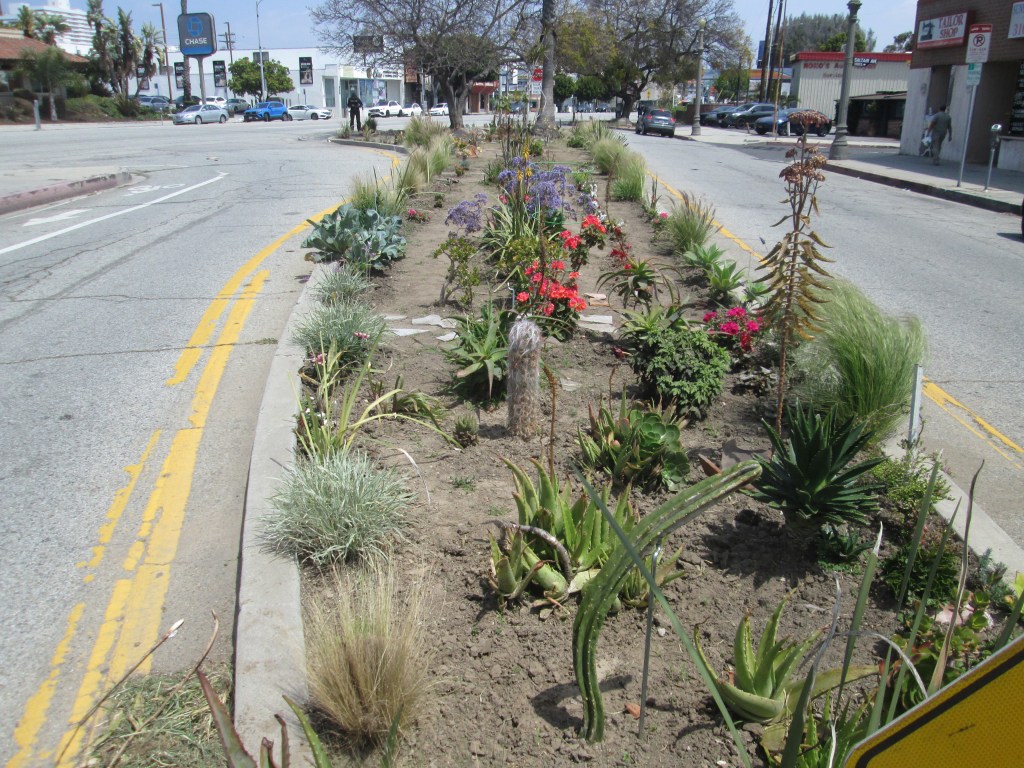
The Traffic Island at the Corner of Ohio Avenue and Santa Monica Blvd

You have not heard me say many good things about the legions of homeless that live in the streets of Los Angeles. Today, I will make an exception. Two blocks east of me is a little traffic island where Ohio Avenue intersects at an angle with Santa Monica Blvd.

The City of Los Angeles does not get the credit for digging up the earth of the island and planting it with succulents and other water-saving plants. The man responsible is a homeless man who lives in a tent to the left of the traffic island. Martine and I have seen him at work planting and weeding.

It is more often the case that the homeless who live in tents in West Los Angeles are known for accumulations of garbage, vandalism, panhandling, and getting into fights with other homeless in the wee hours of the morning.

I have not spoken to the man who created this little garden, but I wish him well. May he find a home where his talent at gardening will be more appreciated. I also hope that some idiotic city administrator does not decide to dig up the garden and replace it with something more boring.

Pink Hubris

Sophia Loren Giving a Busty Jayne Mansfield Serious Side-Eye

Jayne Mansfield was one of the sex queens of Hollywood, along with Marilyn Monroe. She looked even more overtly sexy than Marilyn, and she ended sadly, even as Marilyn did. Although it is not true that she was decapitated in a 1967 New Orleans auto accident, all manner of stories abounded regarding her life. Apparently both John and Robert Kennedy enjoyed her favors. She bared her all in a 1955 issue of Playboy. Several times when she was appearing in public, her top flew off, exposing her ample breasts to the waiting paparazzi.

I just finished reading a zine by David Hankins entitled “Pink Palace” about the house she lived in with her second husband, Hungarian-born body-builder Mickey Hargitay between 1957 and 1964. Martine found it on one of her walks and became absorbed in reading it. The author had fallen in love with Hargitay and Mansfield’s pink house on Sunset Boulevard and lovingly described its heart-shaped pool, shag-carpeted bathroom, its 700-pound chandelier, its many fireplaces, and the bits of quartz mixed with the pink paint to make it sparkle in the sunlight. There was even a fountain that spritzed pink Champagne.

Jayne in Her Heart-Shaped Tub (Note the Pink Shag Carpeting)

In addition to the grandiloquent fixtures of the house, Jayne and Mickey had a private zoo on the premises, which included rabbits, goats, monkeys, ocelots, a burro, an elephant, a water buffalo, as well as numerous dogs and cats. I was reminded of the Charles Foster Kane character in Orson Welles’s Citizen Kane who also had a zoo on the premises of Xanadu. He didn’t end well either.

All this is leading up in my mind to a Chinese expression. When the Chinese do not want to tempt fate by flaunting their prosperity, they say, “Bad rice! Bad rice!” There is something about a too-lavish lifestyle that makes you fear thunderbolts from the angry gods.

I am by no means a famous person, nor want to be. While it would seem nice to win loads of money in the lottery, I would be afraid of appearing to live too large. And no one who sees me as I am would think me a fashion plate—nor would they if I had the money to be one in fact. I’ve read too many ancient Greek tragedies not to be aware of the Erinyes, also known as the Furies and the Eumenides. Thank you, but I prefer to live small.

Bad rice, indeed!

Keep Him Occupied

Trump Appearing in New York for Another Deposition

Yesterday, I was surprised that Bill Maher on “Real Time with Bill Maher” came out against the 34 felonies with which the Trumpster is charged relating to the Stormy Daniels case. Apparently, he thinks that Americans don’t care about sex-related charges against our presidents, thinking of how Bill Clinton’s popularity soared despite the whole Monica Lewinsky affair.

I say that it is best to keep MAGA Man busy with lawsuits and criminal charges—enough to keep him busy for the rest of his days. This is on the same principle that it is best to keep a toddler busy so that he doesn’t get into more mischief. And here the stakes are considerably higher than mere mischief.

Wear the man out defending himself, looking out for ever more lawyers to stiff. When he is kept busy in this way, there will be fewer incendiary rallies en route to becoming president again. It’s like tying a 100-pound weight to his legs.

If you read this blog, you know I dislike the man. That doesn’t stop me from seeing the humor of the situation.

All these court cases are like the death of a thousand cuts. One can make a case for him being a martyr the first time, but what about the 70th time? or the 7 times 70th time? It may just do the trick.

The Kingdom of Lundy

Block of Four 16-Puffin Stamps from Lundy Island

A small island of the north coast of Devonshire was once owned by a man who called himself a king, issued his own postage stamps, and even—until he was fined for doing so—his own coinage. Martin Coles Harman, who owned the island until his death in 1954, denominated the stamps (and coins) in monetary units of his own devising, which he called Puffins, after the bird which used to congregate on the island. One puffin equaled one British penny.

The stamps were in use to provide postage to Biddeford, Devon, as the Royal Mail had cancelled services to Lundy in 1927. The reason given? There were just two few people resident on the island to justify postal services. So Harman undertook to deliver the mail to Biddeford upon payment of a prescribed number of Puffins. The Lundy stamp appeared on the back of the envelope, so that it would not confuse the Royal Mail employees. On the front of the envelope appeared the appropriate British stamp.

Today, Lundy Island is controlled by the Landmark Trust and still issues its own stamps. And they are still denominated in Puffins. Only now they are good not only for the cross-channel hop to Biddeford, but to whatever destination the sender wishes, with the Royal Mail getting its cut. This is made possible because some 25,000 tourists a year visit the island and send letters and postcards therefrom using the new stamps.

When I used to collect stamps, I had a few Lundy stamps in my possession. At the time, the stamps from the island were considered to be “cinderellas,” that is to say, “anything resembling a postage stamp, but not issued for postal purposes by a government postal administration.” There is a wide variety of cinderella stamps, such as those printed for promotional use by businesses, churches, political or non-profit groups.

Totem Poles

Totems at Quw’utsun’ Cultural and Conference Center in Duncan, BC (2004)

The First Nations tribes of the Pacific Northwest have created a unique art form in the totem pole. They are truly multipurpose. According to Wikipedia:

The carvings may symbolize or commemorate ancestors, cultural beliefs that recount familiar legends, clan lineages, or notable events. The poles may also serve as functional architectural features, welcome signs for village visitors, mortuary vessels for the remains of deceased ancestors, or as a means to publicly ridicule someone. They may embody a historical narrative of significance to the people carving and installing the pole. Given the complexity and symbolic meanings of these various carvings, their placement and importance lies in the observer’s knowledge and connection to the meanings of the figures and the culture in which they are embedded.

The above totem poles were from the Quw’utsun’ Cultural and Conference Center in Duncan on Vancouver Island.

Interestingly, totem poles till being carved. In Port Alberni on Vancouver Island, I took this picture of a First Nations member carving a new totem pole.

Carving a New Totem Pole

I hope to take a trip to Southeast Alaska and visit the totem poles in Ketchikan, Prince of Wales Island, and other locations. Instead of taking a cruise, I prefer to fly to Ketchikan and travel using the oceangoing ferries of the Alaska Marine Highway. That way, Martine and I can concentrate on seeing the sights—and not schmoozing with cruise ship passengers.