Battlefield Director

Tsutomo Yamazaki (Left) in Kurosawa’s High and Low (1963)

This is an unusual thing to say, but if I were to look at all the great film directors with a point of view of selecting the one that would make the best general on the battlefield, my choice would be Japan’s Akira Kurosawa (1910-1998).

Yesterday evening I did not post here because I was watching Kurosawa’s great noir film High and Low for the third time. The tale follows Toshiro Mifune as a shoe manufacturer whose son is kidnapped and held for ransom. Except it turns out that it is actually his live-in chauffeur’s son who is taken. In paying the ransom anyhow, Mifune impoverishes himself, losing his business, his house, and even his furniture.

Why do I feel that Kurosawa would make an able general? In no other film (except one, that I shall mention later) is there so much intelligently conveyed detail that enables a viewer to follow the police investigation in all its aspects during its 143 minute length without feeling lost. And the film gallops along like a 73 minuter Poverty Row quickie.

During its course, Kurosawa takes us into such a realistic picture of heroine addiction that, even today, would be too much for Hollywood to handle.

The only other film that so capably marshals s vast amount of detail is the same director’s Seven Samurai (1954). This is actually a film about a 16th century military campaign in which seven masterless samurai help farmers fight back an invasion of forty mounted bandits who are after their crops. Throughout the film’s 207 minute length, we are aware of what is happening in every part of the battlefield as the samurai and farmers battle the bandits. As with High and Low, the film zips along at a fast pace despite a vast amount of detail without losing its audience.

Compare these with the average current Hollywood production in which 120 minutes seems like a lifetime and the audience is slogging through a swamp shortly after the opening credits.

A Creative Drought

Poster for Akira Kurosawa’s Dodes’ka-den (1970)

In the first twenty-two years of his film career, Akira Kurosawa had directed twenty-three films, many of them internationally recognized as classics. His career has another twenty-eight years to run, but he was to complete only seven more films.

After the success of Red Beard (1965), the Japanese film industry began to show weakness—a weakness that was to lead to the fall of the hitherto successful studio system in Tokyo within a few years, as a giant real-estate bubble was to make the land on which the studios sat more valuable than anything possible at the box office. Kurosawa turned to the United States, working first on a project call Runaway Train, which was never made. Then he was to direct the Japanese side of Tora! Tora! Tora! (1970) from which he was fired for not seeing eye-to-eye with the producers at 20th Century Fox.

Scene from Dodes’ka-Den (1970)

Not having completed a film in five and a half years, Kurosawa was hurting. So he picked up a book of short stories by Shugoro Yamamoto entitled A Town Without Seasons. With a shooting schedule of only twenty-eight days, Dodes’ka-Den (1970) was Kurosawa’s first film in color.

Although it opened to worldwide critical praise, the film bombed in Japan, leaving its director so despondent that he attempted to commit suicide by slashing his wrists. I happen to think the film is beautiful, continuing the director’s exploration of the humanity of the poor begun with Red Beard. The name of the film is based on the sound made by a teenaged boy pretending to be a trolley working its way through a slum that resembles a city dump. Around him are stories of other residents of the slum as they deal with poverty, ill-health, crime, starvation, and even love. It is a film that made me feel good, such that I will try to find a DVD of it to purchase.

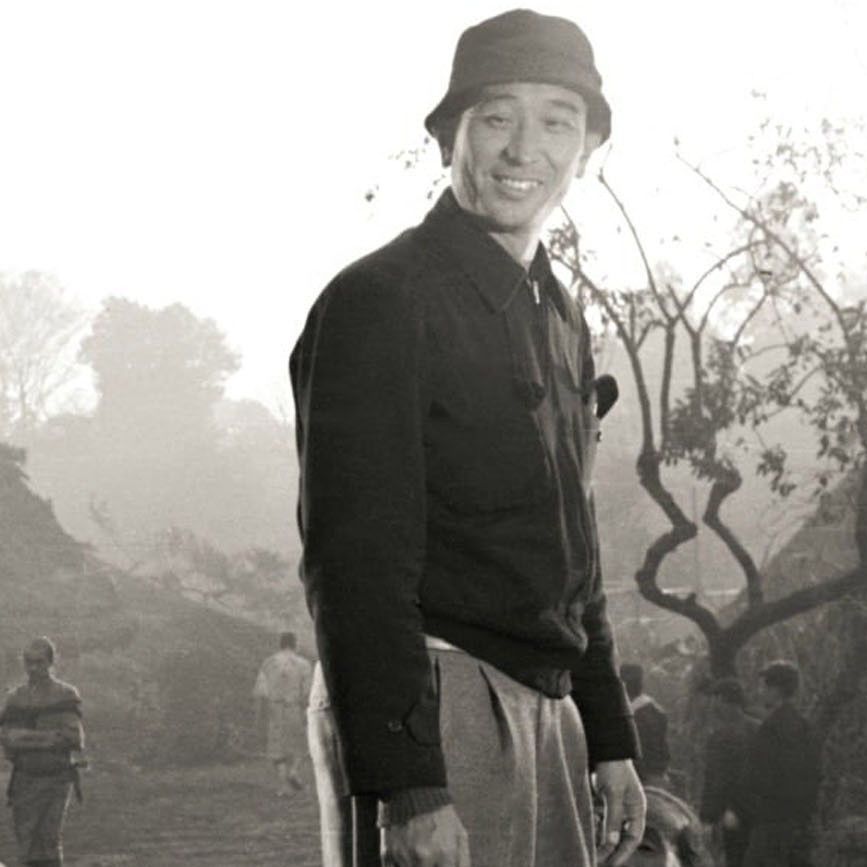
Film Director Akira Kurosawa (1910-1998)

Although Kurosawa is not my favorite Japanese director (I would pick either Kenji Mizoguchi or Yasujiro Ozu for that), I love seeing his films again and again—and his films are more readily available than those of Mizoguchi and Ozu.


Favorite Films: The Seven Samurai (1954)

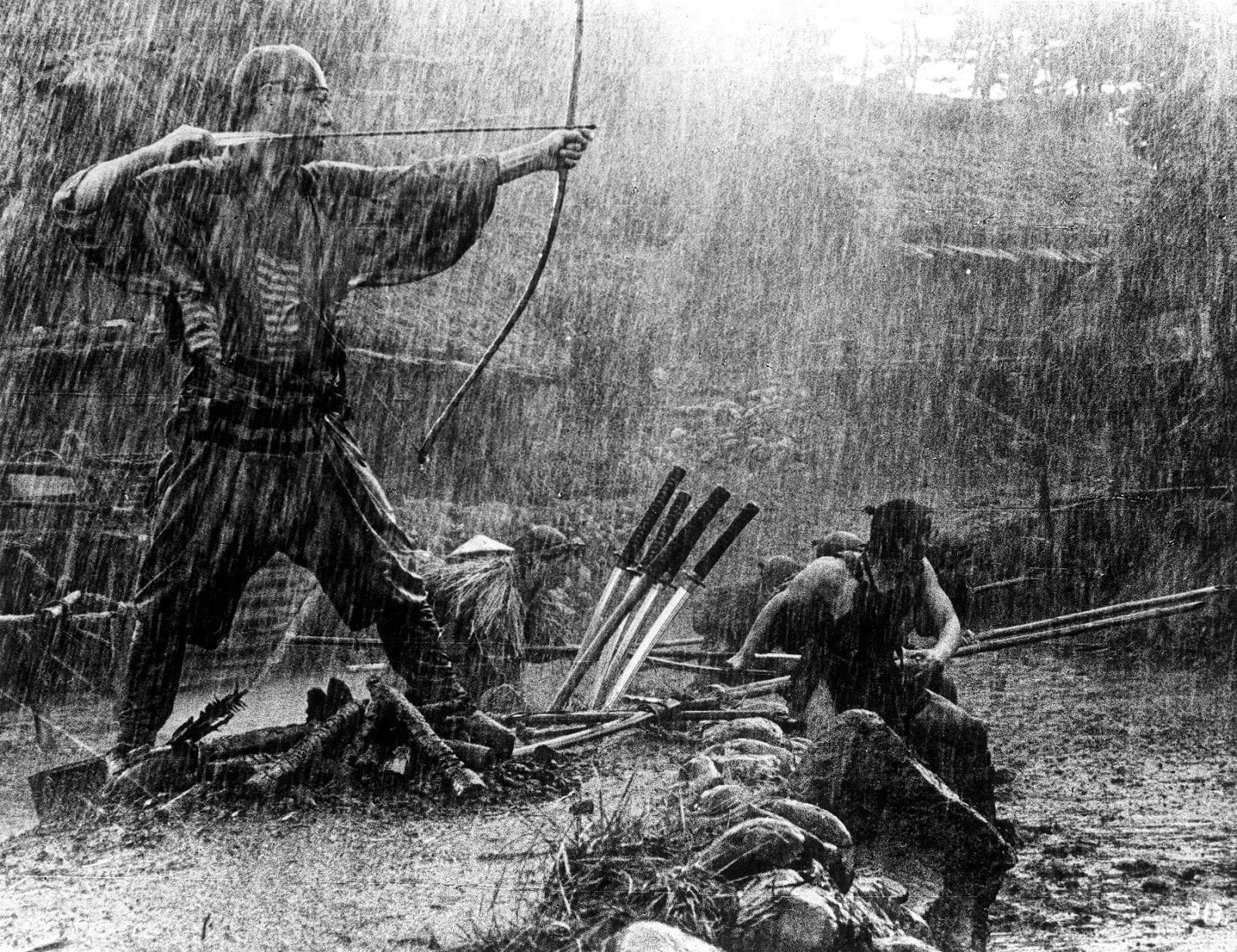
Takashi Shimura and Toshiro Mifune in the Final Battle with the Brigands

From the first time I saw the film in college, I have regarded Akira Kurosawa’s The Seven Samurai as the greatest action film ever made. It had one thing that action films rarely have: An amazing clarity so that you as the viewer knew exactly what was happening, where, and with whom. In Hollywood, action has become synonymous with CGI animation which actually has the opposite effect, blurring the actions and the outcomes and papering it over with loud noises.

The action of The Seven Samurai is simple enough: Seven ronin (i.e., masterless samurai) agree to serve as low-paid mercenaries to protect a village of farmers against a band of mounted brigands who periodically raid to steal as much of the harvest as they can. These brigands also have several guns, which were imported by Portuguese traders around the 16th and 17th centuries but disdained by the samurai. The samurai are outnumbered approximately forty to seven. In the end, the samurai and their villager auxiliaries slaughter the bandits, losing four of their men in the fight.

Although The Seven Samurai runs well over three hours, it seems only half that long. Kurosawa makes everything so crystal clear that we viewers almost feel as if we were part of the action. There are crude maps of the village, showing where the bandits are likely to attack; a symbol for each bandit, crossed out when he is killed; and the great acting of Takashi Shimura as the leader of the samurai, who patiently explains everything.

Over the years, I have seen the film over six times. I would be willing to see it six more times because I am not anywhere near through with it yet.