Tequila Volleyball

Every Afternoon at 2:30

Every Afternoon at 2:30

From our hotel room at the Playa Grande we would hear raucous male chants every afternoon around 2:30. There was “GO! GO! GO! GO!” followed by animalistic grunts of the Tim Allen variety. I decided to get to the bottom of this, so I ventured forth in fearful anticipation of some giant iguana surrounded by young men armed with spears. But no, it was only Tequila Volleyball, a daily event sponsored by the Playa Grande in which two teams of men were fed with free tequila and launched into a pool with a net across the middle. A cute señorita sporting a referee shirt and whistle threw out a volleyball, and the gladiatorial combat would begin.

What did I expect? Cabo is a party town, and here I was, a dour Puritan who was only trying to read a biography of Alan Turing, progenitor of the computer, assailed by misguided darts of raw testosterone. Naturally, I retreated to the cover of my room until order was restored.


The Enigma

Alan Turing on a £10 Banknote (Rejected!)

Alan Turing on a £10 Banknote Design (Rejected!)

No, no such £10 banknote exists. It would have been a nice idea, though. After all, Alan Mathison Turing contributed as much, if not more, to modern life as Albert Einstein, Charles Darwin, or Niels Bohr. During the Second World War, the Germans had an encryption machine which generated a code that was thought to be unbreakable. At Bletchley Park in Buckinghamshire, the British ran a decrypting project whose star quickly became Turing. His solution was brilliant: Create a universal computing machine that could not only solve the code, but ultimately any code constructed along logical lines. Such a machine was referred to as a Turing machine. We now call it a computer.

During the middle of the War, Turing’s machine, called Colossus, began breaking the Nazi code, and continued to do so through the war. The trick was not to react in such a way that the Germans knew that the code was cracked. Bletchley Park worked closely with British MI6 (Military Intelligence, Section 6) to feed selected information carefully to the Russians and to their own allied forces. During the course of the War, the Germans never did find out that they were communicating as much with Sir Winston Churchill as with their forces in the field. It is thought that Turing’s invention saved the lives of millions of men and shortened the war by as much as two years. (It’s not provable, of course, but it’s nice to think so.)
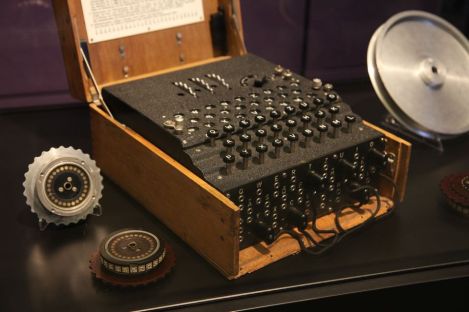
A German Enigma Machine

A German Enigma Machine

Why Alan Turing is not better known is owing to a shameful episode in history. The Cambridge mathematician who was as much of a hero as any allied general in the conflict was a homosexual, and under the laws in Britain, was a criminal. In 1952, he was caught and offered the choice of prison or accepting hormone therapy. He chose the latter, but the result of taking the primitive medicines, he lost his edge as one of the greatest mathematicians in history. In 1956, he committed suicide rather than continue the therapy.

Yesterday, I reviewed The Imitation Game, which tells the story of Turing at Bletchley park. While it simplifies what actually happened, it is in large part true to its subject.


Films: The Imitation Game

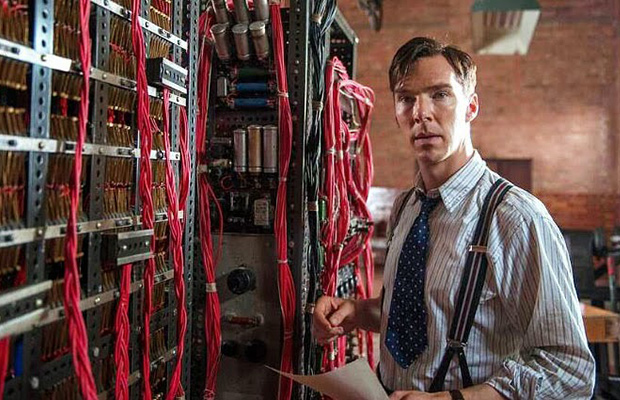
Benedict Cumberbatch as Alan Turing

Benedict Cumberbatch as Alan Turing

I knew I would love The Imitation Game even before I saw it. I’ve been working with computers for half a century. Back in the 1960s, they were still often called Turing Machines in honor of the perverse mathematical genius who almost single-handedly invented the first digital computer, code-named Christopher.

Ironically, what brought Turing down were England’s anti-homosexuality laws. Given a choice between prison and a regimen of hormonal drugs to “cure” him, he chose the latter. Within a couple of years, frustrated by the drugs’ effect on his intellect and libido, Turing finally committed suicide in 1956, a scant nine years before I started working on my first computer, a GE 600 series at Dartmouth College, using the world’s first timesharing system and the world’s first higher-order programming language, BASIC.

As you may know, I don’t see too many current films, especially when they are of the self-indulgent “indie” variety. The Imitation Game, on the other hand, is about a man whose way of thinking and feeling is radically different from most of us. And yet he is one of the greatest geniuses of the Twentieth Century, along with Einstein, Von Neumann, Szilard, Teller, Oppenheimer, and a handful of others.

I liked The Imitation Game so much that I intend the read the biography by Andrew Hodges on which it based, Alan Turing: The Enigma. Enigma was the code name of the cryptography machine the Nazis used during World War Two for all their most top secret communications. Turing and his assistants not only cracked the code, but did it in such a way that the Germans could not know that the code was cracked—so they continued using it throughout the war.

Benedict Cumberbatch was superb as the code-breaker, as was Keira Knightley as his talented assistant.