
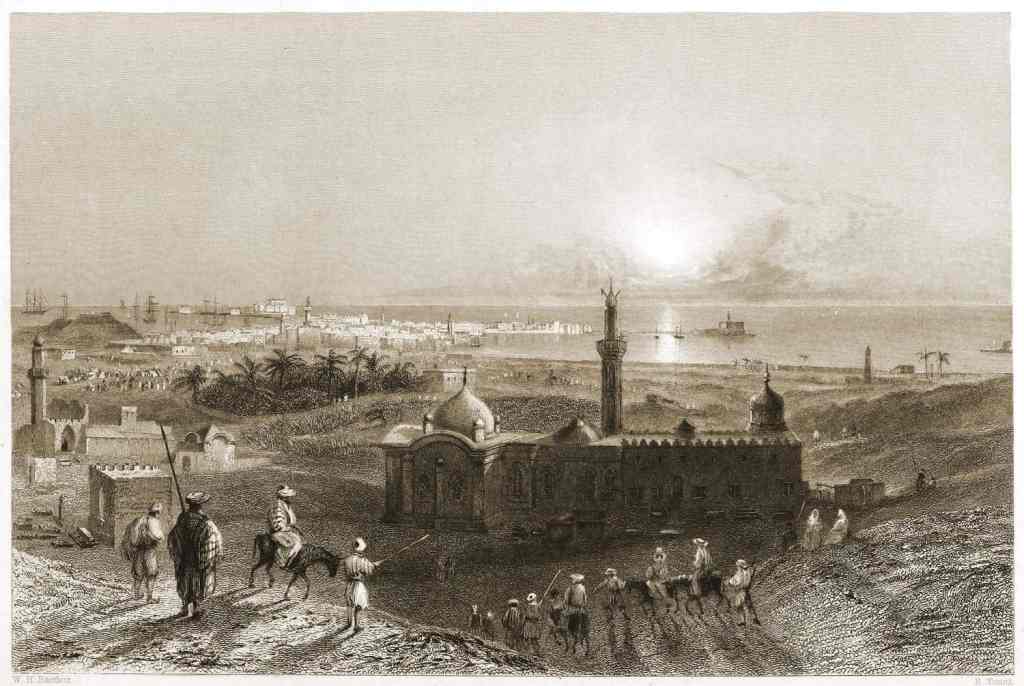
“The City”

Alexandria, Egypt in the 19th Century

Every once in a while, when I’m feeling restless, I think of the poet of Alexandria, Egypt: Constantine P.Cavafy (1863-1933). I first learned about him from reading Lawrence Durrell’s The Alexandria Quartet, where he is referred to as “the poet of the city.” Appropriately, here is one of his best poems, which is called, simply:

The City

You said: “I’ll go to another country, go to another shore,
find another city better than this one.
Whatever I try to do is fated to turn out wrong
And my heart lies buried like something dead.
How long can I let my mind moulder in this place?
Wherever I turn, wherever I look,
I see the black ruins of my life, here,
where I’ve spent so many years, wasted them, destroyed them totally.”

You won’t find a new country, won’t find another shore.
This city will always pursue you.
You’ll walk the same streets, grow old
in the same neighborhoods, turn gray in these same houses.
You’ll always end up in this city. Don’t hope for things elsewhere:
there’s no ship for you, there’s no road.
Now that you’ve wasted your life here, in this small corner,
you’ve destroyed it everywhere in the world.

The God Abandons Antony

Marc Antony on Cleopatra’s Barge

It was in the first century AD that Plutarch first mentioned the tale that, as he was to face ultimate defeat from both Octavian (later Augustus) and his love Cleopatra, that he was visited by a strange vision:

During this night, it is said, about the middle thereof, while the city was quiet and depressed through fear and expectation of the future, all at once certain harmonious sounds from all kinds of instruments were heard, and shouts of a crowd with Evoes and satyric leapings, as if some company of revellers not without noise were going out of the city; and the course of the procession seemed to be through the middle of the city to the gate leading outwards in the direction of the enemy, and at this point the tumult made its way out, being loudest there. And those who reflected on the sign were of opinion that the god to whom Antonius all along most likened himself and most claimed kinship with was deserting him.

In his play Antony and Cleopatra, Shakespeare makes mention of this vision in Act IV, Scene 3.

But it was the Greek poet Constantine Cavafy, a citizen of Alexandria, who wrote one of his greatest poems on the subject:

Constantine P. Cavafy

The God Abandons Antony

When suddenly, at midnight, you hear
an invisible procession going by
with exquisite music, voices,
don’t mourn your luck that’s failing now,
work gone wrong, your plans
all proving deceptive—don’t mourn them uselessly.
As one long prepared, and graced with courage,
say goodbye to her, the Alexandria that is leaving.
Above all, don’t fool yourself, don’t say
it was a dream, your ears deceived you:
don’t degrade yourself with empty hopes like these.
As one long prepared, and graced with courage,
as is right for you who proved worthy of this kind of city,
go firmly to the window
and listen with deep emotion, but not
with the whining, the pleas of a coward;
listen—your final delectation—to the voices,
to the exquisite music of that strange procession,
and say goodbye to her, to the Alexandria you are losing.

The poem is mentioned in Lawrence Durrell’s Justine and even printed there, but in Durrell’s translation. I have chosen instead to include the translation by Edmund Keeley and Philip Sherrard.

“In the month of Athyr …”

Mummy Portrait of Deceased

Early Christian Mummy Portrait of Deceased

One of my favorite poets of the last century was Constantine P. Cavafy, who lived most of his life in Alexandria, Egypt. I have just finished reading E. M. Forster’s Pharos and Pharillon: A Novelist’s Sketchbook of Alexandria Through the Ages, which ends which a chapter on “The Poetry of C. P. Cavafy.”

In it, he talks about meeting Cavafy in the street and having a marvelous conversation with him:

It is delivered with equal ease in Greek, English, or French. And despite its intellectual richness and human outlook, despite the matured charity of its judgments, one feels that it too stands at a slight angle to the universe: it is the sentence of a poet.

What a wonderful line! “It too stands at a slight angle to the universe.”

The Poet

The Poet

In his book, Forster quotes (and, I suspect, translated) this fragmentary funerary poem of a young man who died one November (“Athyr”), probably not unlike the mummy facial covering illustrated above:

It is hard to read . . . on the ancient stone.
“Lord Jesus Christ” … I make out the word “Soul”,
“In the month of Athyr … Lucius fell asleep.”
His age is mentioned … “He lived years …”—
The letters KZ show … that he fell asleep young,
In the damaged part I see the words … “Him … Alexandrian”.
Then came three lines … much mutilated.
But I can read a few words … perhaps “our tears” and “sorrows”.
And again: “Tears” … and: “for us his friends mourning”.
I think Lucius … was much bloved.
In the month of Athyr … Lucius fell asleep ….

In case you have never heard of Cavafy before, he was a major inspiration for Lawrence Durrell’s The Alexandria Quartet.