At the Greek Tailor’s

It’s Greek to Them

It’s Greek to Them

It’s a stupid little joke, but it highlights an important lack in our education. I saw it as a cartoon in a magazine when I was a child. I understood it at once, but only because I had a good classical education.

A man wearing a toga walks into a Greek tailor shop:

Tailor: Euripides? (“You rip these?”)
Customer: Eumenides! (“You mend these!”)

Euripides was, of course, a great Greek tragedian (ca. 480-406 B.C.), author of Medea and eighteen other surviving plays.

But who was or were the Eumenides? Eumenides was the name of a play by Aeschylus in the Oresteia trilogy, which also consisted of Agamemnon and The Libation Bearers.

Another name for the Eumenides is the Erinyes, probably better known as the Furies, Greek goddesses of vengeance, mostly invoked by the gods when someone has sworn a false oath. I believe the Eumenides gave George W. Bush a hard time over “weapons of mass destruction” in Iraq, from which he is still suffering.

By the time I was in high school, I had read Edith Hamilton’s The Greek Way and The Echo of Greece, as well as a number of the Greek tragedies, so I was fairly conversant with classical literature. Now virtually no one reads the works of ancient Greece and Rome, let alone books about them. But that’s where it all began.

If you don’t know your origins, you won’t know where you’re headed.

The Modesty of the Ancients

An Unedited Face from 2,300 Years Ago

An Unedited Face from 2,300 Years Ago

Going to a great art museum always makes me think. Although my two most recent posts regarding my visit to the Getty Center on Saturday are (partly) repeats, there is one thing that hit me between the eyes: In the exhibit entitled “Power and Pathos: Bronze Sculpture of the Hellenistic World ,” I saw that in the ancient world, verisimilitude took precedence over vanity. In the bust of Seuthes III (above), a Thracian monarch, for example, we have a face that does not attempt to prettify its subject. If the face on the statue was not considered to be recognizable to viewers, it was a failure. Unlike today, there was no equivalent to “Photoshopping.”

The same goes for Roman coins. Consider the following examples:

The Emperor Nero

The Emperor Nero

With that massive bull neck, the Emperor Nero was no beauty, yet all representations of him from his day do not hesitate to show his bad features, of which there were many.

The same goes for the Emperor Nerva:

The Emperor Nerva with Massive Schnozz

The Emperor Nerva with Massive Schnozz

Now here is a case of a look that a good plastic surgeon could do something about with a rhinoplasty. Nerva reminds me of that exchange in W.C. Fields’s The Bank Dick (1940):

Boy in Bank: Mommy, doesn’t that man have a funny nose?
Mother in Bank: You mustn’t make fun of the gentleman, Clifford. You’d like to have a nose like that full of nickels, wouldn’t you?


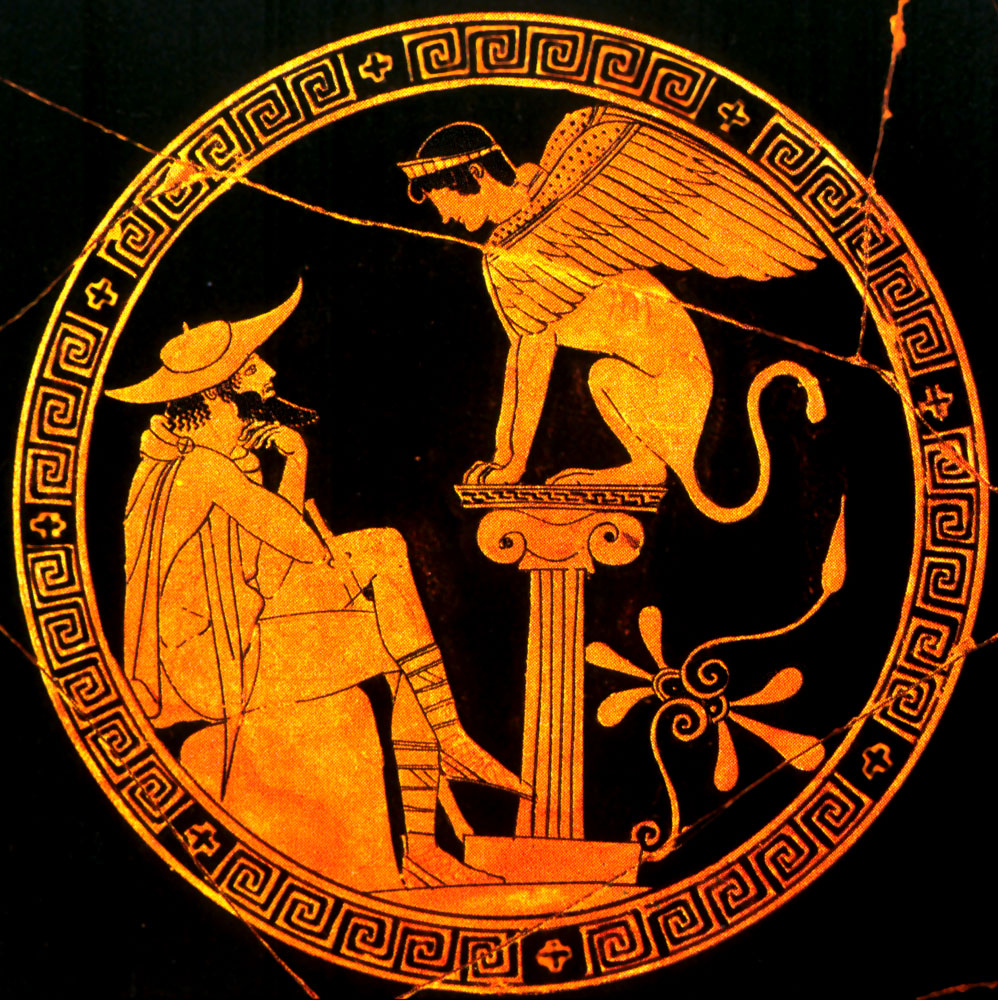
It’s Greek To Me

Oedipus & Sphinx

Oedipus & Sphinx

Nothing grows clearer to me year by year than that the nature of the Greeks and of antiquity, however simple and universally familiar it may seem to lie before us, is very hard to understand, indeed is hardly accessible at all, and that the facility with which the ancients are usually spoken of is either a piece of frivolity or an inherited arrogance born of thoughtlessness. We are deceived by a similarity of words and concepts: but behind them there always lies concealed a sensation which has to be foreign, incomprehensible or painful to modern sensibility.—Friedrich Nietzsche, Daybreak, Book III

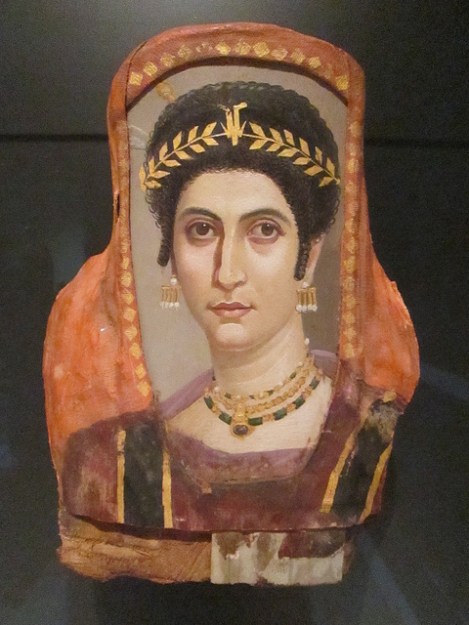
She Could Be Someone’s Mummy

Hellenistic Mummy Burial Mask of a Young Woman

Hellenistic Mummy Burial Mask of a Woman

Rather than joining the throngs at the shopping centers for Black Friday, Martine and I visited the Getty Villa in Malibu. Not to be confused with the Getty Center off the San Diego Freeway, the Getty Villa is primarily a museum of the ancient world, concentrating on Greece and Rome.

The big draw today, however, was the Cyrus Cylinder, a cuneiform clay cylinder distributed by the Emperor Cyrus in 539 B.C. upon the occasion of the conquest of Babylon. The museum was crowded with Persian families visiting one of the most important historical milestones in their country’s history. The cylinder is shown below:

Cyrus Cylinder

Cyrus Cylinder

We tend to ignore ancient history because, well, it’s “ancient history.” What we don’t take into account is the often startling realism of portraiture, particularly by the Romans and Hellenistic Greeks. Shown at the top is a painted fabric mask applied to a mummy of a woman who died around the Fourth Century A.D. Several of the exhibit halls are filled with uncomplimentary busts of Roman emperors and commoners. One classic example is a somewhat sinister bust of Caligula, and another of a bearded old man. Roman coins, for example, make no attempt to “photoshop” their emperors with a more beautiful or imposing face. Being realists, the Romans wanted the plebs to know what their leaders really looked like.

Because we get four days off for Thanksgiving Weekend, I have usually made a reservation at the Villa for the day after Thanksgiving. Unfortunately, the idea seems to have caught on. Especially toward the end of the afternoon, the place was jammed. No matter, there is a serenity about art that has lasted for two thousand odd years. Will ours be venerated two thousand years from now? I think not.


No matter, we had a great time strolling through the