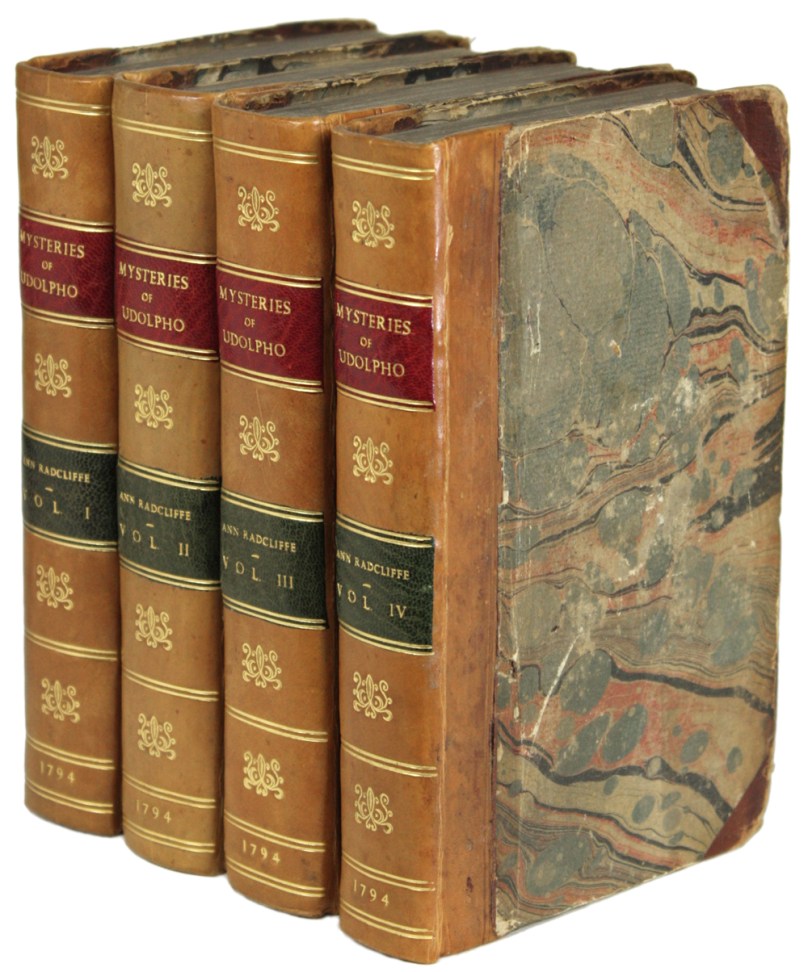
The Four Volumes of Ann Radcliffe’s The Mysteries of Udolpho
I have been spending some time lately reading 18th century English literature. As an English major at Dartmouth College, my favorite course was Chauncey Chester Loomis’s survey of the 18th century English novel. Although he is known primarily for his work on Arctic exploration, I admired his teaching and only now am filling in some of the gaps of what he taught me, which gaps were mostly the result of my own laziness at the time.
Over the last month, I have read Horace Walpole’s The Castle of Otranto, which I didn’t much like, and Laurence Sterne’s The Life and Opinions of Tristram Shandy, Gentleman, which I thought was fantastic (reprising my reaction back in the 1960s). Tonight, I have completed Ann Radcliffe’s The Mysteries of Udolpho, which was not on my course syllabus, but which was highly regarded as a work of the gothick sensibility of the times.
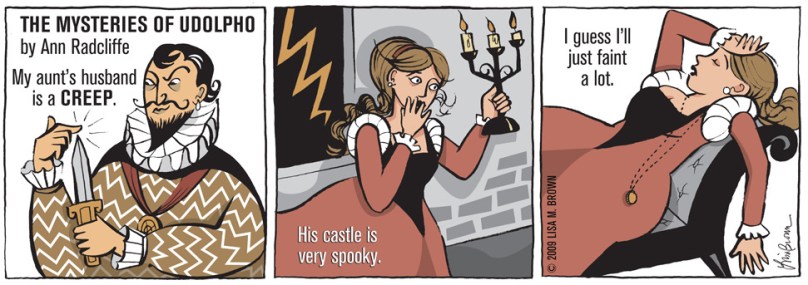
The Plot of Udolpho (Much Condensed)
The setting for the middle third of the book is the grim Castle of Udolpho in the Pennine Mountains near Venice, Italy. Emily Saint-Aubert, being a minor,must submit to the will of her cruel, unfeeling aunt, Madame Cheron, who marries a dubious Italian bandit chief known as Count Montini.

The Grim Castle of Udolpho
In many ways, the highly atmospheric castle with all its ruined galleries, secret passages, outlandish tapestries, and the cavorting banditti who make the castle their headquarters is the star of the novel. It is hard for a 21st century male such as myself to admire a frequently fainting heroine such as Mlle. Saint-Aubert. I managed to stick it out for the novel’s full 620 pages because Ann Radcliffe is really a superior writer. The things I didn’t like about it were more the result of the culture of the times than any deficit in the author’s abilities. There are some beautiful passages and not a few negligible verses.
34.052234
-118.243685



 Tarnmoor
You must be logged in to post a comment.