
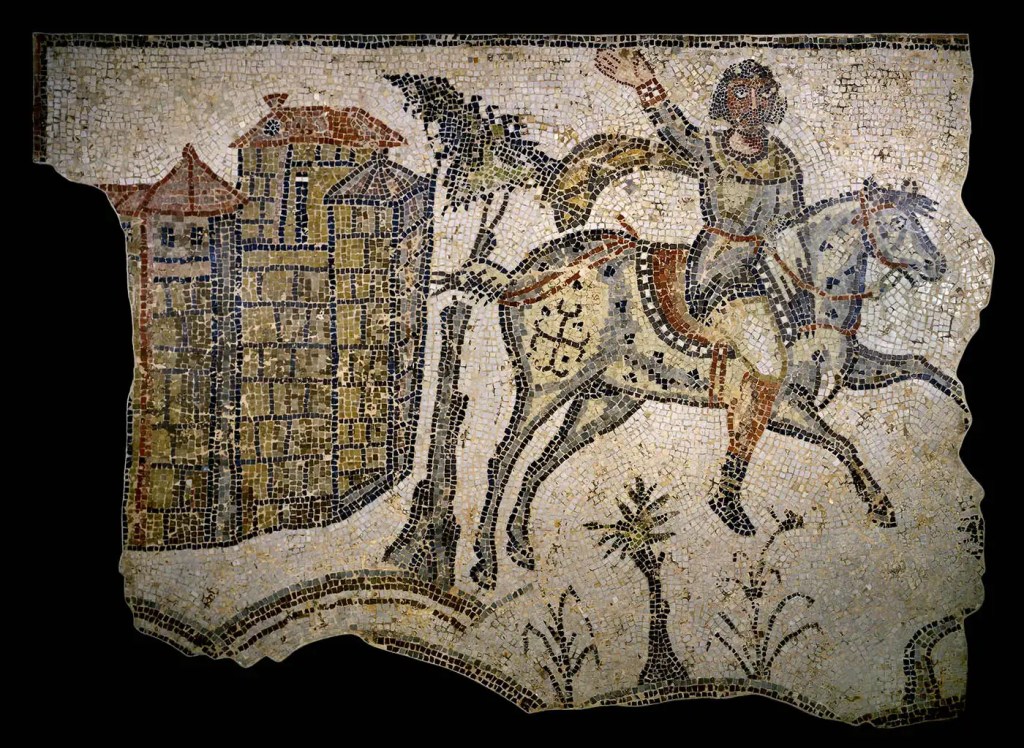
Invading Vandal Horseman
I have just finished reading Volume II of Thomas Hodgkin’s monumental Italy and Her Invaders, which tells of the Hun and Vandal invasions and the Herulian Mutiny that unseated the last of the Western Roman Emperors in CE 476. In essence, it tells of the painful last twenty-five years of the Empire, during which most of the emperors were murdered in a year or two.
There was no benefit to wearing the imperial purple in those last few years. A couple of days ago, I posted a blog in which Apollinaris Sidonius explained why it was no fun in being chosen as emperor.
Those last years of the empire were no fun. Not only were the invading Huns and Vandals brutal, but the empire itself was brutal to its own citizens, taxing them to death to pay for the huge military required to protect the borders.
It makes me think about our own situation. Our problem is not barbarian invasions (unless you don’t particularly like Canadians or Latin Americans), but our seemingly unbridgeable political divisions. The insurrection of January 6, 2021, was, to me, very like Gaiseric and the Vandals’ sack of Rome in CE 455. They may have been barbarians in the end, but they were our very own native-born barbarians. The result, in the end, is no better than the sad end of Rome.
I keep thinking of a poem by the Greek poet Constantine P. Cavafy entitled:
Waiting for the Barbarians
What are we waiting for, assembled in the forum?

      The barbarians are due here today.


Why isn’t anything going on in the senate?
Why are the senators sitting there without legislating?

      Because the barbarians are coming today.
      What’s the point of senators making laws now?
      Once the barbarians are here, they’ll do the legislating.


Why did our emperor get up so early,
and why is he sitting enthroned at the city’s main gate,
in state, wearing the crown?

      Because the barbarians are coming today
      and the emperor’s waiting to receive their leader.
      He’s even got a scroll to give him,
      loaded with titles, with imposing names.


Why have our two consuls and praetors come out today
wearing their embroidered, their scarlet togas?
Why have they put on bracelets with so many amethysts,
rings sparkling with magnificent emeralds?
Why are they carrying elegant canes
beautifully worked in silver and gold?

      Because the barbarians are coming today
      and things like that dazzle the barbarians.


Why don’t our distinguished orators turn up as usual
to make their speeches, say what they have to say?

      Because the barbarians are coming today
      and they’re bored by rhetoric and public speaking.


Why this sudden bewilderment, this confusion?
(How serious people’s faces have become.)
Why are the streets and squares emptying so rapidly,
everyone going home lost in thought?

      Because night has fallen and the barbarians haven't come.
      And some of our men just in from the border say
      there are no barbarians any longer.


Now what’s going to happen to us without barbarians?
Those people were a kind of solution.

 Tarnmoor
You must be logged in to post a comment.