One Word Makes a Difference

Argentinian Writer Jorges Luis Borges (1899-1986)

Argentinian Writer Jorge Luis Borges (1899-1986)

There is a wonderful novel by José Saramago called The History of the Siege of Lisbon (1989) in which a historian introduces a single word—“not”—to indicate that Crusaders failed to help lift the Portuguese king lift the siege of the city of Lisbon from the attacking Moors. The other day, I saw an article in the I Love Chile News in which the word “not” was inadvertently omitted, changing the whole sense of the passage.

In an interview with Maria Kodama, Borges’s widow, the I Love Chile News said that the Nobel Prize Committee actually wanted Borges to accept an honor from dictator Augusto Pinochet. It is generally thought that the Committee refused to give the Nobel Prize for Literature to Borges because he was hobnobbing with rightist dictator. Following is the text of the story as it was printed:

According to an interview with the Spanish newspaper El País, before traveling to Chile in 1976 to receive an honorary award of the Faculty of Philosophy and Humanities of the University of Chile, the author received a call from Stockholm.

He was awarded the Nobel Prize and they warned him that he should [here’s where the “not” belongs] go forward with his visit to the South American country.

According to Kodama, Borges told the Nobel Foundation member: “Look, gentleman: I am grateful for your kindness, but after what you just told me my duty is to go to Chile. There are two things that a man can not allow: bribe or be bribed. Thank you very much, good morning.”

Historical Background

Borges arrived in Chile in mid-September, in the same days in which the socialistic ex-chancellor Orlando Letelier was murdered in Washington.

A few months earlier, Borges had already received the Order of Bernardo O’Higgins from the Chilean embassy in Buenos Aires. It was the highest honor you could receive from the military dictatorship as a foreigner at the time.

In his acceptance speech in Santiago, Borges paid tribute to the repression by saying that “in this era of anarchy in here, between the mountains and the sea, there is a strong country. (The Argentine poet Leopoldo) Lugones preached strong homeland when he spoke of the time of the sword. I declare to prefer the sword, the clear sword, to the furtive dynamite,” he said, quoting a verse.

“And I say this knowing very clearly, very precisely, what I say. Well, my country is emerging from the swamp, I think, with happiness. I think we deserve to go out of the morass in which we were. We are already going through the work of swords, exactly. And here they have already emerged from the swamp. And here we are: Chile, the region, the country, which is both a long country and an honorable sword,” said Borges.

At the time Argentina was under the dictatorship of General Jorge Videla, who according to official figures killed thousands of people during the repression.

The next day, Borges also met Pinochet and said “he is an excellent person, his warmth, his goodness … I’m very satisfied … The fact that here, also in my country, and in Uruguay, the freedom and the order is saved, especially in an anarchy continent, a continent undermined by communism. I expressed my satisfaction, as an Argentine, of which we should have here nearby a country of order and peace.”

There are several things questionable about the story. I doubt that the Nobel Prize Committee would have been so overt about dangling the award in front of Borges. It may well be true that kowtowing to Pinochet cost Borges his Nobel, but Ms. Kodama has been known to embroider the facts on occasion.

Demoted!

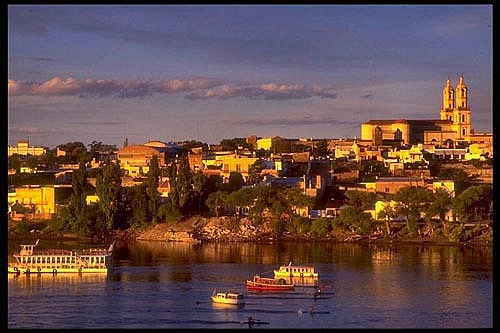
Carmen de Patagones Seen from Viedma

Carmen de Patagones Seen from Viedma

The two cities sit on opposite banks of the Rio Negro. Carmen de Patagones, on the north bank, is the southernmost city of the State of Buenos Aires; Viedma, occupying he south bank, is the capital of the State of Rio Negro, which extends west as far as the Andes and the Chilean border.

It seems that the current edition of the Lonely Planet Guide to Argentina no longer has chapters for the twin cities on the Rio Negro. I guess they’re not Disneyfied enough to draw all the tour groups. For travelers driving from Buenos Aires to Patagonia, it is at best a stopping place for the night before big chunk of attractions around Puerto Madryn and Trelew.

Viedma also happens to be the terminus of the Tren Patagonico, about which I wrote yesterday. From there, it goes clear across the State of Rio Negro to the Patagonian Lake District around San Carlos de Bariloche. Today, I finally got an e-mail response from the Tren Patagonico people telling me they’ll be ready to take my reservation for November in a week or so.

If my reservation is confirmed, I’ll spend a couple of nights in either Viedma or Carmen de Patagones and wander around both towns seeing the local museums.

In 2001, I remember being the only visitor in a two-hour period to the old fish canning museum in Heimaey in Iceland’s Vestmanneyjar Islands. I loved every minute. The curator gave me a personal tour and explained how Heimaey was the main fishing port in Iceland, a country whose GDP is based on their fish catch. Even though the museum is no more (I looked for it in 2013 but couldn’t find it), I have special memories of my visit. And that is much better than being jostled by huge crowds of tourists who distractedly push their way past all the exhibits on their way to the next destination.

So Viedma and Carmen de Patagones have been demoted! So much more for me to see!

Argentina: One Remaining Question

An Overnight Train Trip Clear Across Patagonia

An Overnight Train Trip Clear Across Patagonia

Right smack in the middle of my trip, there is a question of how I’m going to get from Buenos Aires to San Carlos de Bariloche. Most people would probably elect to fly, but I want to minimize my exposure to Aerolineas Argentinas, a state-run airline with a laughably intricate labor union structure. There are a dozen or more unions, any of which can decide to call a strike any time. In 2011, they decided to fly us to Ezeiza’s Ministro Pistarini Airport rather than Aeroparque Jorge Newberry, necessitating a fifty dollar cab ride in the middle of the night to our hotel in the Congreso district.

(As currently planned, I will use Aerolineas to fly from Puerto Iguazu to Aeroparque, and Santiago, Chile, to Aeroparque. Let’s see how badly they screw me up this time.)

What I would like to do is to take an overnight bus to Viedma on the coast, and the Tren Patagonico from Viedma to Bariloche. Below is a map of the route:

Cutting Across the State of Rio Negro

Cutting Across the State of Rio Negro

Part of this was traveled by Paul Theroux on the trip covered by his book The Old Patagonian Express—except he got off at Ingeniero Jacobacci and transferred to a southbound narrow-gauge train from Jacobacci to Esquel.

The only problem is that I have not so far succeeded in making a reservation for the November 13 train. If they do not respond to my reservation request by October 15, I will take a bus from Buenos Aires to San Martín de los Andes. From there, I will take the scenic Ruta de Siete Lagos (Route of the Seven Lakes) to Bariloche. In either case, I have a reservation for Bariloche beginning November 14.

Either way, I’ll probably have a good time.


Felix Culpa

I Profit from My Booking Error

I Profit from My Booking Error

Until a few days ago, I thought my flight to and from South America was going to set me back slightly over $2,200. That’s mostly because flights from Santiago, Chile to Los Angeles are not cheap. Poring over my ticket confirmation, I find that the $900 for my flight to Buenos Aires via São Paolo is actually a round trip flight. Instead of forking over $1,300 for a flight from Santiago, I just need a much cheaper flight (about $300) from Santiago to Buenos Aires—provided I fly back on Thanksgiving Day via TAM Airlines, again via São Paolo.

I’m not sure how this all happened, but I have verified that my TAM ticket is round trip, and that I will have almost one thousand dollars more to spend on my vacation. Of course, I will have to loll around for six hours at São Paolo’s Guarulhos International Airport, but that’s all right with me. I will have my two Kindles fully charged and can sample some tasty Brazilian chow at my leisure.

As far as missing out on some turkey on Thanksgiving, too bad. Don’t like it much anyhow.


The Man from La Boca

He Was the Painter of the Port of Buenos Aires

He Was the Painter of the Port of Buenos Aires

Benito Quinquela Martín (1890-1977) is a painter not widely known in the art world of New York, London, or Paris. In Argentina, his work is a different story altogether. Martín was known primarily for painting port scenes around La Boca, which, for most of his life, was the port of Buenos Aires. Today, La Boca is primarily known for cheap souvenir shops and dancers who assume tango positions for pesos for the tourists. Near the tour buses at Caminito, however, sits the Escuela Pedro de Mendoza, which happens to contain the Museo de Bellas Artes Benito Quinquela Martín dedicated to his work.

Boca is not the nicest part of the port city, and it is no longer the port, which has been moved east. The polluted Riachuelo, also known as the Matanza, flows past the museum and the brightly colored buildings decorated with leftover marine paints and inspired by Quinquela Martín’s port views.

Unloading Cargo at La Boca

Unloading Cargo at La Boca

Aside from the tourist ghetto around Caminito and the nearby Boca Juniors football stadium known as the Bombonera, or candy box, Boca is a rough neighborhood from which tourists do not stray far. A century ago, however, it was the port of entry for thousands of Italian, Spanish, and other European immigrants who came to South America looking for a better life. And many of them found it. During the First World War, most soldiers on both sides were fed with canned beef from Argentina and Uruguay; and silent movies like The Four Horsemen of the Apocalypse (1921) starring Rudolph Valentino showed the lives of Argentinian millionaires.

Another Port Scene from Martín

Another Port Scene from Martín

Today, Benito Quinquela Martín is considered to be one of the greatest Argentinian painters of the Twentieth Century; and his work in found in museums throughout Buenos Aires.


Blue Dollars

Officially, They’re Illegal, Yet There’s an Official Rate

Officially, They’re Illegal, Yet There’s an Official Rate

If you go to Argentina, you can pay one dollar to get 9.07 pesos. Alternatively, you can also pay one dollar to get 13 pesos. Now which rate would you prefer? When you go to the bank, you’ll be offered the 9.07 peso rate. But if you go to certain money changers on Calle Florida and wave a few crisp, new Benjamins (that’s $100 notes) at them, you might possibly get the 13 peso rate.

Last week, the Argentinian government went after several “blue dollar” traders and announced hefty fines against firms involved in the exchanges.

And yet, each day, one could find the official and the blue dollar rate published on the Buenos Aires Herald website. If trading at the blue dollar rate is illegal, why does the government condone promulgation of the rates? It’s as if the DEA published today’s rate for opium, crack cocaine, and heroine as a means of assisting drug dealers standardize their rates.

I am following the issue closely, because I am not averse to getting blue dollars at the black market rate, providing I could do so safely. I will ask around at my hotel when I get there.


Eager Beavers

In South America, the Friendly Beaver Is an Enemy

In South America, the Friendly Beaver Is an Enemy

About seventy-five years ago, someone thought it would be a great idea to introduce beavers to Tierra del Fuego, at the southernmost tip of South America, so that it could be hunted for its fur. The 20 beavers brought over from Manitoba in 1940 have now multiplied to 150,000—even outnumbering the 134,000 human residents of the area.

As is usually the case, the well-intentioned people who introduced the beavers did not consider the vastly different ecosystem. The dams built by the invaders do not help the ecosystem as wetlands do not form due to the type of flora, and the forests of native Nothofagus trees are being destroyed by the beavers, which have no native predators. Residents of Patagonia are afraid of the species’ spread northward, as they have no difficulties crossing salt water on their trek to the mainland.

Seeing the devastation wrought by the busy little rodents in Tierra del Fuego, New Zealand has prohibited the introduction of the beaver under its Hazardous Substances and New Organisms Act of 1996.


Ytinerary: Iguazu Falls

Rainbow Over the Falls

Rainbow Over the Falls

My doctor suggested I see it, my niece suggested I see it, my friends suggested I see it; so I decided to add Iguazu Falls to my itinerary. It is considered by some to be the most spectacular waterfalls on earth. It lies at a point where the borders of three countries meet: Argentina, Brazil, and Paraguay. About 20% of the falls are on Brazilian territory, and 80% on Argentinian territory. Nearby Paraguay gets 0%. To see the best long-distance view, I have to pay the $140 visa reciprocity fee to Brazil, even if I just sneak across the border for an hour or two. (I have already paid the Argentinian fee in 2011, which is good for ten years.)

I plan to spend two nights at Puerto Iguazu on the Argentinian side. To get there from Buenos Aires, I plan to take a Via Bariloche bus with their tutto letto service with 180º degree reclining bed/seats. The trip takes upwards of eighteen hours, though I get the chance to see a lot of countryside. On the way back, I will take a plane—carefully avoiding Aerolineas Argentinas to the maximum extent possible. (We had horrendous luck with them back in 2011.)

Whether I will spend $140 to see the Brazilian side of the falls for a few hours is still a moot point. My doctor said it’s worth it, but a lot of tourists have written that once you get close up to the Garganta del Diablo (the Devil’s Throat), everything else is secondary.

As I have written earlier, I have avoided the falls on earlier trips because of my hatred of mosquitoes. I will take a 100% DEET insect repellent with me and avoid spending too much time in the jungle areas around dusk. Instead, I will read a book in air conditioned comfort.


Cartoneros and the Tren Blanco

The Recyclers Come Out at Night ...

The Recyclers Come Out at Night …

There are always two sides to the coin. The other day, I wrote a post about Buenos Aires that perhaps gilded the lily overmuch. I have to keep reminding myself that one can easily love someone, something, or someplace that is far from perfect. Take Los Angeles, for example, from which my cousin Peggy from Cleveland fled because, as she said, she couldn’t find anyone who spoke English. (I don’t think she tried very hard.)  Many of my friends from other parts of the country do not hold Southern California in high regard, especially if they haven’t given the place a chance to work its way into their bones, the way it has with me.

So back to Buenos Aires. As with many huge cities, there is a lot of poverty lurking behind the picturesque façades. In Argentina, these usually take the form of what are sardonically called villas miserias (“misery villas”) due to the habit of calling the areas surrounding the urban core with names beginning with Villa, such as Villa Lugano, Villa Lynch, Villa Crespo, and the spectacularly awful Villa 31 (see below) adjoining the posh neighborhood of Retiro. This used to be the docks area for the Port of Buenos Aires, before they moved east.

Villa 31 with the Microcentro in the Background

Villa 31 with the Microcentro in the Background

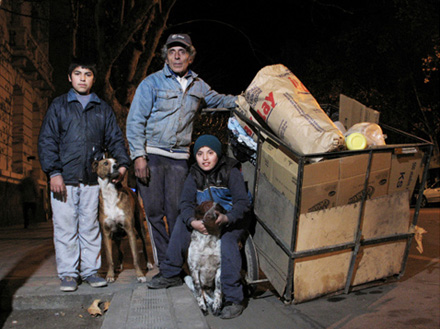
After dark, the streets of Buenos Aires fill up with cartoneros, whole families with large carts who go through the garbage for cardboard and other recyclable items for which they can earn a few pesos. After the economic crisis of 2001, the government wisely has begun to recognize them and even facilitated their scavenging by creating the tren blanco, or “white train,” to bring them from the villas miserias, where they live, to the center of the city. These trains consist of old rolling stock with the seats removed (to allow for carts to loaded) and sometimes even without lighting.

Aboard the Tren Blanco

Aboard the Tren Blanco

I have seen the cartoneros at work the few times I wondered the streets of the city at night. For the most part, they are diligent and friendly as they go about their work; but there were stories at the Posada del Sol youth hostel about backpacks and wallets that were stolen. Fortunately, I escaped being mugged.

Again, there are parts of Los Angeles about which I would say the same thing. Except here, there is a higher chance of violence and rape accompanying the mugging.

In the Jungles of This Earth

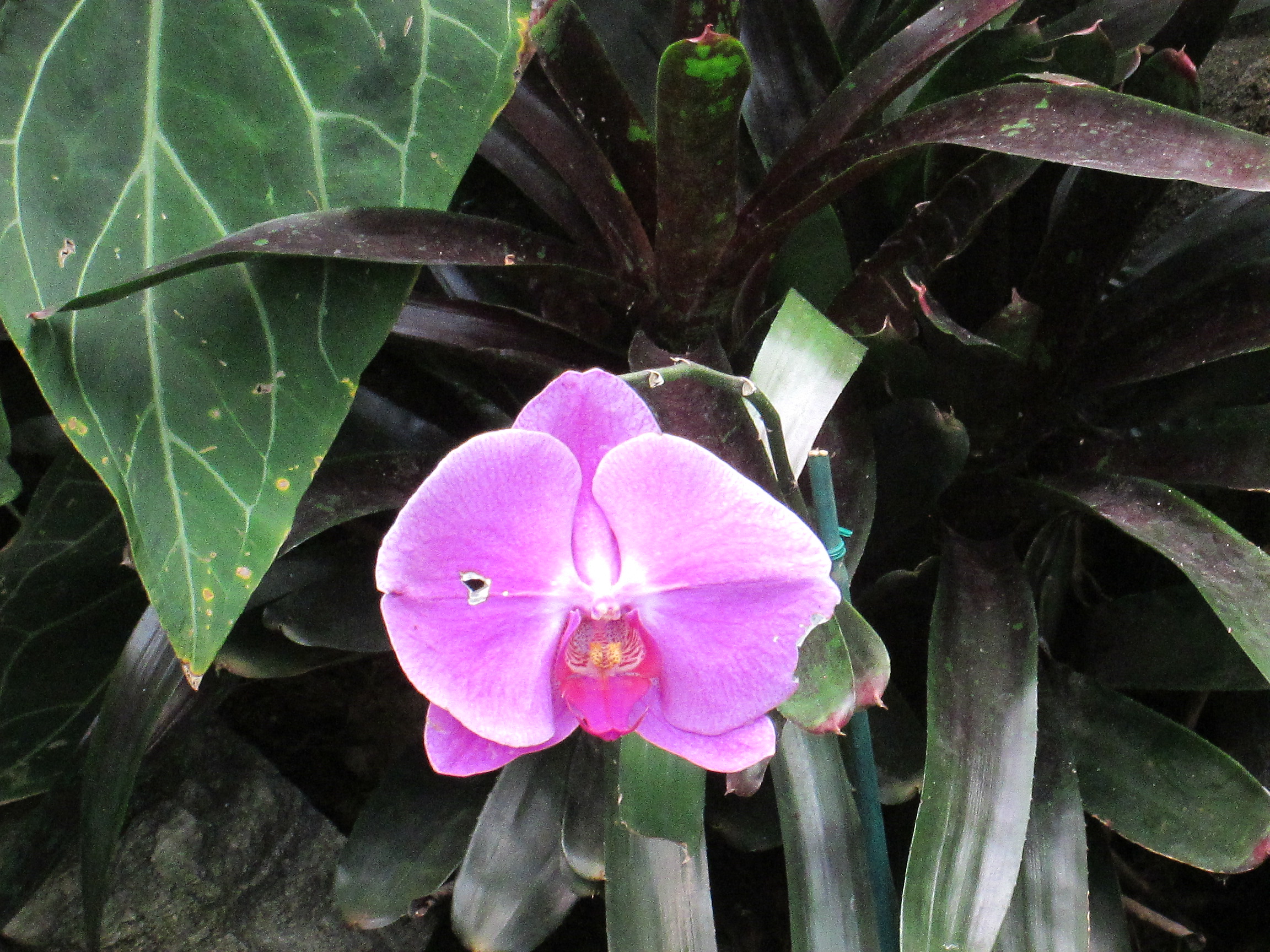
Orchid in L.A. Arboretum Greenhouse

Orchid in L.A. Arboretum Greenhouse

In various posts I have made to this blog, I have expressed some distaste about visiting the tropics. In November, I will make a two-day exception by visiting Iguazu Falls at the junction of Argentina, Brazil, and Paraguay. Since I share with Martine an abhorrence of mosquitoes and the diseases they pass on to humans, I will wear insect repellent and avoid going out at dusk, when they are most active. I shall also ask my physician—who herself has visited the falls—whether I should also take chloroquine, which I could buy over the counter in Buenos Aires.

My curiosity has been piqued by all the great waterfalls I saw In iceland, especially at Dynjandi and Gullfoss, in 2013. For someone living in an extreme drought zone like California, the thought of all that water is intriguing.

I shall take an overnight bus from Retiro bus station in B.A. to Puerto Iguazu and fly back to B.A. after two days.

Despite my reluctance to pick up some tropical disease, I will probably take one or two of the jungle trails around the falls (just not at dusk) to see all the rich plant and animal life. Tourists at the falls are assailed by troops of coatimundi (see below). They are cute little buggers, but extremely voracious and aggressive.

Cute But Dangerous

Cute But Dangerous


After my broken shoulder, all I need are some nasty coatimundi bites, possibly rabid.