Blues vs Greens

Constantinople’s Politics Were Dictated by Chariot Races

Of late, I have become fascinated by literary and historical antecedents of our present divided political situation. In the United States, we have the Blue States versus the Red States. In a post from December 9, 2022, when I wrote about Charles Dickens describing the Blues and the Buffs at a parliamentary election at Eatanswill. One of the most amazing tales on the subject comes from Edward Gibbon’s The Decline and Fall of the Roman Empire when he describes the racing factions of the Hippodrome during the reign of Justinian in the 6th Century A.D. in Constantinople:

Constantinople adopted the follies, though not the virtues, of ancient Rome; and the same factions which had agitated the circus, raged with redoubled fury in the hippodrome. Under the reign of Anastasius, this popular frenzy was inflamed by religious zeal; and the greens, who had treacherously concealed stones and daggers under baskets of fruit, massacred, at a solemn festival, three thousand of their blue adversaries. From this capital, the pestilence was diffused into the provinces and cities of the East, and the sportive distinction of two colors produced two strong and irreconcilable factions, which shook the foundations of a feeble government. The popular dissensions, founded on the most serious interest, or holy pretence, have scarcely equalled the obstinacy of this wanton discord, which invaded the peace of families, divided friends and brothers, and tempted the female sex, though seldom seen in the circus, to espouse the inclinations of their lovers, or to contradict the wishes of their husbands. Every law, either human or divine, was trampled under foot, and as long as the party was successful, its deluded followers appeared careless of private distress or public calamity. The license, without the freedom, of democracy, was revived at Antioch and Constantinople, and the support of a faction became necessary to every candidate for civil or ecclesiastical honors. A secret attachment to the family or sect of Anastasius was imputed to the greens; the blues were zealously devoted to the cause of orthodoxy and Justinian, and their grateful patron protected, above five years, the disorders of a faction, whose seasonable tumults overawed the palace, the senate, and the capitals of the East. Insolent with royal favor, the blues affected to strike terror by a peculiar and Barbaric dress, the long hair of the Huns, their close sleeves and ample garments, a lofty step, and a sonorous voice. In the day they concealed their two-edged poniards, but in the night they boldly assembled in arms, and in numerous bands, prepared for every act of violence and rapine. Their adversaries of the green faction, or even inoffensive citizens, were stripped and often murdered by these nocturnal robbers, and it became dangerous to wear any gold buttons or girdles, or to appear at a late hour in the streets of a peaceful capital. A daring spirit, rising with impunity, proceeded to violate the safeguard of private houses; and fire was employed to facilitate the attack, or to conceal the crimes of these factious rioters. No place was safe or sacred from their depredations; to gratify either avarice or revenge, they profusely spilt the blood of the innocent; churches and altars were polluted by atrocious murders; and it was the boast of the assassins, that their dexterity could always inflict a m mortal wound with a single stroke of their dagger. The dissolute youth of Constantinople adopted the blue livery of disorder; the laws were silent, and the bonds of society were relaxed: creditors were compelled to resign their obligations; judges to reverse their sentence; masters to enfranchise their slaves; fathers to supply the extravagance of their children; noble matrons were prostituted to the lust of their servants; beautiful boys were torn from the arms of their parents; and wives, unless they preferred a voluntary death, were ravished in the presence of their husbands. The despair of the greens, who were persecuted by their enemies, and deserted by the magistrates, assumed the privilege of defence, perhaps of retaliation; but those who survived the combat were dragged to execution, and the unhappy fugitives, escaping to woods and caverns, preyed without mercy on the society from whence they were expelled. Those ministers of justice who had courage to punish the crimes, and to brave the resentment, of the blues, became the victims of their indiscreet zeal; a præfect of Constantinople fled for refuge to the holy sepulchre, a count of the East was ignominiously whipped, and a governor of Cilicia was hanged, by the order of Theodora, on the tomb of two assassins whom he had condemned for the murder of his groom, and a daring attack upon his own life. An aspiring candidate may be tempted to build his greatness on the public confusion, but it is the interest as well as duty of a sovereign to maintain the authority of the laws. The first edict of Justinian, which was often repeated, and sometimes executed, announced his firm resolution to support the innocent, and to chastise the guilty, of every denomination and color. Yet the balance of justice was still inclined in favor of the blue faction, by the secret affection, the habits, and the fears of the emperor; his equity, after an apparent struggle, submitted, without reluctance, to the implacable passions of Theodora, and the empress never forgot, or forgave, the injuries of the comedian. At the accession of the younger Justin, the proclamation of equal and rigorous justice indirectly condemned the partiality of the former reign. “Ye blues, Justinian is no more! ye greens, he is still alive!”

The Factions of the Hippodrome

Of late, I have become fascinated by literary and historical antecedents of our present divided political situation. In the United States, we have the Blue States versus the Red States. In a post from December 9 when I wrote about Charles Dickens describing the Blues and the Buffs at a parliamentary election at Eatanswill. One of the most amazing tales on the subject comes from Edward Gibbon’s The Decline and Fall of the Roman Empire when he describes the racing factions of the Hippodrome during the reign of Justinian in the 6th Century A.D. in Constantinople:

Constantinople adopted the follies, though not the virtues, of ancient Rome; and the same factions which had agitated the circus, raged with redoubled fury in the hippodrome. Under the reign of Anastasius, this popular frenzy was inflamed by religious zeal; and the greens, who had treacherously concealed stones and daggers under baskets of fruit, massacred, at a solemn festival, three thousand of their blue adversaries. From this capital, the pestilence was diffused into the provinces and cities of the East, and the sportive distinction of two colors produced two strong and irreconcilable factions, which shook the foundations of a feeble government. The popular dissensions, founded on the most serious interest, or holy pretence, have scarcely equalled the obstinacy of this wanton discord, which invaded the peace of families, divided friends and brothers, and tempted the female sex, though seldom seen in the circus, to espouse the inclinations of their lovers, or to contradict the wishes of their husbands. Every law, either human or divine, was trampled under foot, and as long as the party was successful, its deluded followers appeared careless of private distress or public calamity. The license, without the freedom, of democracy, was revived at Antioch and Constantinople, and the support of a faction became necessary to every candidate for civil or ecclesiastical honors. A secret attachment to the family or sect of Anastasius was imputed to the greens; the blues were zealously devoted to the cause of orthodoxy and Justinian, and their grateful patron protected, above five years, the disorders of a faction, whose seasonable tumults overawed the palace, the senate, and the capitals of the East. Insolent with royal favor, the blues affected to strike terror by a peculiar and Barbaric dress, the long hair of the Huns, their close sleeves and ample garments, a lofty step, and a sonorous voice. In the day they concealed their two-edged poniards, but in the night they boldly assembled in arms, and in numerous bands, prepared for every act of violence and rapine. Their adversaries of the green faction, or even inoffensive citizens, were stripped and often murdered by these nocturnal robbers, and it became dangerous to wear any gold buttons or girdles, or to appear at a late hour in the streets of a peaceful capital. A daring spirit, rising with impunity, proceeded to violate the safeguard of private houses; and fire was employed to facilitate the attack, or to conceal the crimes of these factious rioters. No place was safe or sacred from their depredations; to gratify either avarice or revenge, they profusely spilt the blood of the innocent; churches and altars were polluted by atrocious murders; and it was the boast of the assassins, that their dexterity could always inflict a mortal wound with a single stroke of their dagger. The dissolute youth of Constantinople adopted the blue livery of disorder; the laws were silent, and the bonds of society were relaxed: creditors were compelled to resign their obligations; judges to reverse their sentence; masters to enfranchise their slaves; fathers to supply the extravagance of their children; noble matrons were prostituted to the lust of their servants; beautiful boys were torn from the arms of their parents; and wives, unless they preferred a voluntary death, were ravished in the presence of their husbands. The despair of the greens, who were persecuted by their enemies, and deserted by the magistrates, assumed the privilege of defence, perhaps of retaliation; but those who survived the combat were dragged to execution, and the unhappy fugitives, escaping to woods and caverns, preyed without mercy on the society from whence they were expelled. Those ministers of justice who had courage to punish the crimes, and to brave the resentment, of the blues, became the victims of their indiscreet zeal; a præfect of Constantinople fled for refuge to the holy sepulchre, a count of the East was ignominiously whipped, and a governor of Cilicia was hanged, by the order of Theodora, on the tomb of two assassins whom he had condemned for the murder of his groom, and a daring attack upon his own life. An aspiring candidate may be tempted to build his greatness on the public confusion, but it is the interest as well as duty of a sovereign to maintain the authority of the laws. The first edict of Justinian, which was often repeated, and sometimes executed, announced his firm resolution to support the innocent, and to chastise the guilty, of every denomination and color. Yet the balance of justice was still inclined in favor of the blue faction, by the secret affection, the habits, and the fears of the emperor; his equity, after an apparent struggle, submitted, without reluctance, to the implacable passions of Theodora, and the empress never forgot, or forgave, the injuries of the comedian. At the accession of the younger Justin, the proclamation of equal and rigorous justice indirectly condemned the partiality of the former reign. “Ye blues, Justinian is no more! ye greens, he is still alive!”
A sedition, which almost laid Constantinople in ashes, was excited by the mutual hatred and momentary reconciliation of the two factions. In the fifth year of his reign, Justinian celebrated the festival of the ides of January; the games were incessantly disturbed by the clamorous discontent of the greens: till the twenty-second race, the emperor maintained his silent gravity; at length, yielding to his impatience, he condescended to hold, in abrupt sentences, and by the voice of a crier, the most singular dialogue that ever passed between a prince and his subjects. Their first complaints were respectful and modest; they accused the subordinate ministers of oppression, and proclaimed their wishes for the long life and victory of the emperor. “Be patient and attentive, ye insolent railers!” exclaimed Justinian; “be mute, ye Jews, Samaritans, and Manichaeans!” The greens still attempted to awaken his compassion. “We are poor, we are innocent, we are injured, we dare not pass through the streets: a general persecution is exercised against our name and color. Let us die, O emperor! but let us die by your command, and for your service!” But the repetition of partial and passionate invectives degraded, in their eyes, the majesty of the purple; they renounced allegiance to the prince who refused justice to his people; lamented that the father of Justinian had been born; and branded his son with the opprobrious names of a homicide, an ass, and a perjured tyrant. “Do you despise your lives?” cried the indignant monarch: the blues rose with fury from their seats; their hostile clamors thundered in the hippodrome; and their adversaries, deserting the unequal contest spread terror and despair through the streets of Constantinople. At this dangerous moment, seven notorious assassins of both factions, who had been condemned by the præfect, were carried round the city, and afterwards transported to the place of execution in the suburb of Pera. Four were immediately beheaded; a fifth was hanged: but when the same punishment was inflicted on the remaining two, the rope broke, they fell alive to the ground, the populace applauded their escape, and the monks of St. Conon, issuing from the neighboring convent, conveyed them in a boat to the sanctuary of the church. As one of these criminals was of the blue, and the other of the green livery, the two factions were equally provoked by the cruelty of their oppressor, or the ingratitude of their patron; and a short truce was concluded till they had delivered their prisoners and satisfied their revenge. The palace of the præfect, who withstood the seditious torrent, was instantly burnt, his officers and guards were massacred, the prisons were forced open, and freedom was restored to those who could only use it for the public destruction. A military force, which had been despatched to the aid of the civil magistrate, was fiercely encountered by an armed multitude, whose numbers and boldness continually increased; and the Heruli, the wildest Barbarians in the service of the empire, overturned the priests and their relics, which, from a pious motive, had been rashly interposed to separate the bloody conflict. The tumult was exasperated by this sacrilege, the people fought with enthusiasm in the cause of God; the women, from the roofs and windows, showered stones on the heads of the soldiers, who darted fire brands against the houses; and the various flames, which had been kindled by the hands of citizens and strangers, spread without control over the face of the city. The conflagration involved the cathedral of St. Sophia, the baths of Zeuxippus, a part of the palace, from the first entrance to the altar of Mars, and the long portico from the palace to the forum of Constantine: a large hospital, with the sick patients, was consumed; many churches and stately edifices were destroyed and an immense treasure of gold and silver was either melted or lost. From such scenes of horror and distress, the wise and wealthy citizens escaped over the Bosphorus to the Asiatic side; and during five days Constantinople was abandoned to the factions, whose watchword, Nika, vanquish! has given a name to this memorable sedition.

The Parliamentary Election at Eatanswill

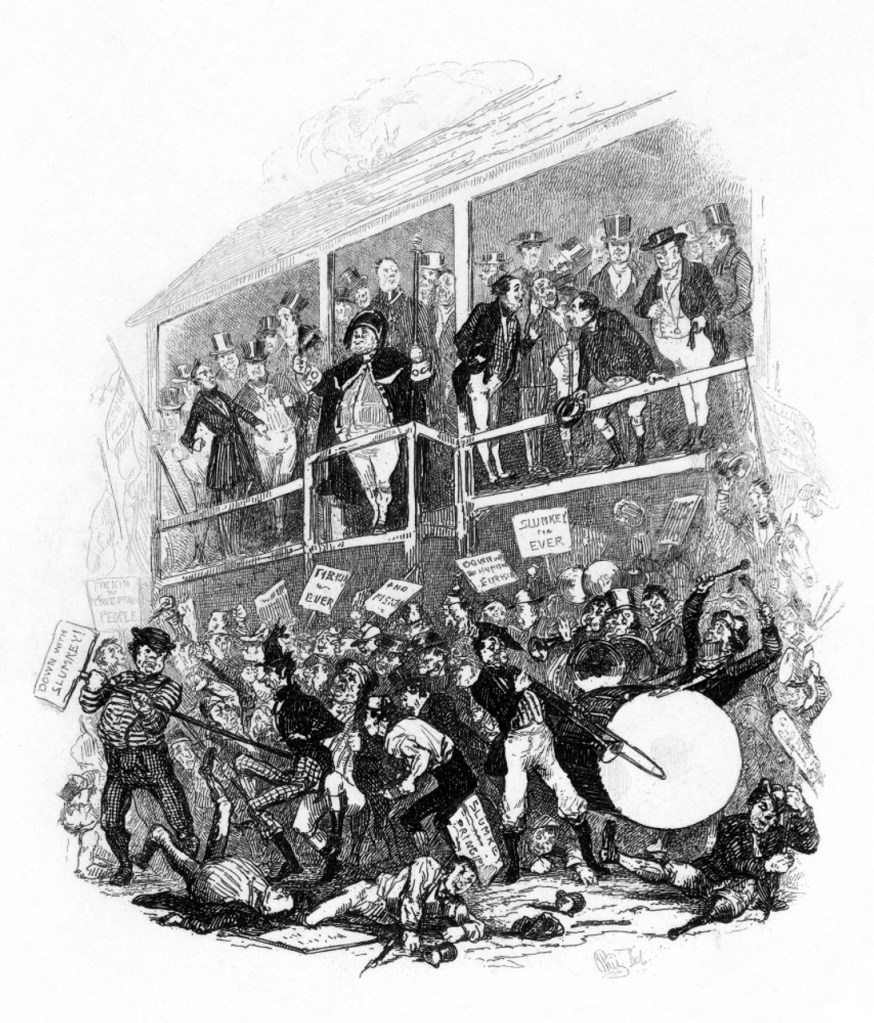
Illustration by “Phiz” for The Pickwick Papers by Charles Dickens

If you think the political division between the Democrats and Republicans is a new think, you should read Charles Dickens’s The Posthumous Papers of the Pickwick Club (1837), particularly in the scenes describing the parliamentary election at Eatanswill (“Eat and Swill”), one of the most savage satires by the British writer. Here is his masterful description of the state of things at Eatanswill:

It appears, then, that the Eatanswill people, like the people of many other small towns, considered themselves of the utmost and most mighty importance, and that every man in Eatanswill, conscious of the weight that attached to his example, felt himself bound to unite, heart and soul, with one of the two great parties that divided the town—the Blues and the Buffs. Now the Blues lost no opportunity of opposing the Buffs, and the Buffs lost no opportunity of opposing the Blues; and the consequence was, that whenever the Buffs and Blues met together at public meeting, town-hall, fair, or market, disputes and high words arose between them. With these dissensions it is almost superfluous to say that everything in Eatanswill was made a party question. If the Buffs proposed to new skylight the market-place, the Blues got up public meetings, and denounced the proceeding; if the Blues proposed the erection of an additional pump in the High Street, the Buffs rose as one man and stood aghast at the enormity. There were Blue shops and Buff shops, Blue inns and Buff inns—there was a Blue aisle and a Buff aisle in the very church itself.

Of course it was essentially and indispensably necessary that each of these powerful parties should have its chosen organ and representative: and, accordingly, there were two newspapers in the town—the Eatanswill Gazette and the Eatanswill Independent; the former advocating Blue principles, and the latter conducted on grounds decidedly Buff. Fine newspapers they were. Such leading articles, and such spirited attacks!—‘Our worthless contemporary, the Gazette’—‘That disgraceful and dastardly journal, the Independent’—‘That false and scurrilous print, the Independent’—‘That vile and slanderous calumniator, the Gazette;’ these, and other spirit-stirring denunciations, were strewn plentifully over the columns of each, in every number, and excited feelings of the most intense delight and indignation in the bosoms of the townspeople.

The Weary Blues of Langston Hughes

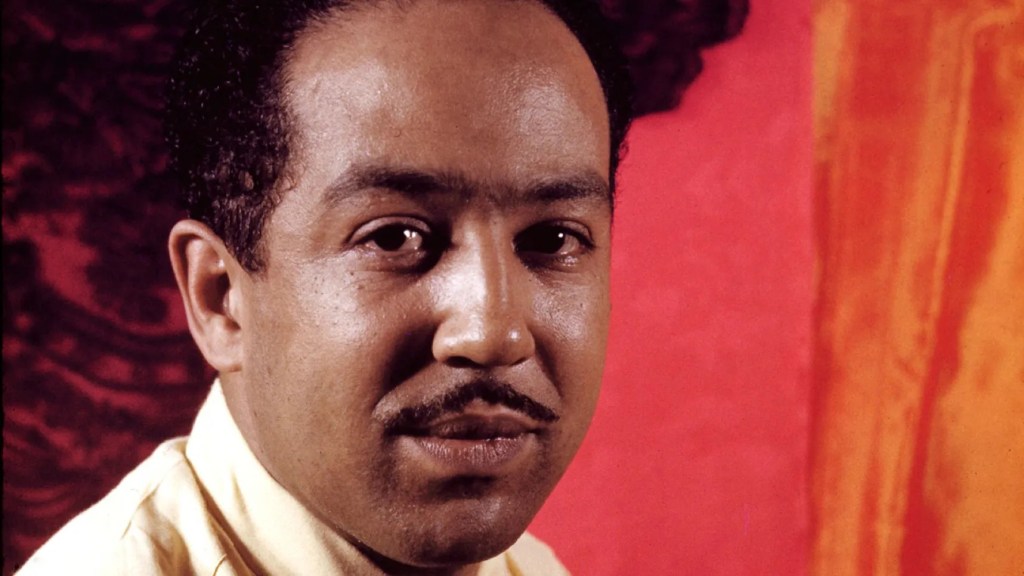
American Poet Langston Hughes (1902-1967)

Great poetry is not necessarily white. Sometimes it comes from something deeper, like the centuries-old suppression of the black man in America. It becomes even more interesting when it is tied to the blues, as this poem is:

The Weary Blues

Droning a drowsy syncopated tune,
Rocking back and forth to a mellow croon,
     I heard a Negro play.
Down on Lenox Avenue the other night
By the pale dull pallor of an old gas light
     He did a lazy sway . . .
     He did a lazy sway . . .
To the tune o’ those Weary Blues.
With his ebony hands on each ivory key
He made that poor piano moan with melody.
     O Blues!
Swaying to and fro on his rickety stool
He played that sad raggy tune like a musical fool.
     Sweet Blues!
Coming from a black man’s soul.
     O Blues!
In a deep song voice with a melancholy tone
I heard that Negro sing, that old piano moan—
     “Ain’t got nobody in all this world,
       Ain’t got nobody but ma self.
       I’s gwine to quit ma frownin’
       And put ma troubles on the shelf.”

Thump, thump, thump, went his foot on the floor.
He played a few chords then he sang some more—
     “I got the Weary Blues
       And I can’t be satisfied.
       Got the Weary Blues
       And can’t be satisfied—
       I ain’t happy no mo’
       And I wish that I had died.”
And far into the night he crooned that tune.
The stars went out and so did the moon.
The singer stopped playing and went to bed
While the Weary Blues echoed through his head.
He slept like a rock or a man that’s dead.

Real Genius

Hank Williams (1923-1953)

Where is the real artistic genius of America to be found? Sad to say, it’s not literature. It’s not painting or sculpture. Near as I can say, what the United States will be most remembered for is music—not only jazz, blues, soul, bluegrass, rockabilly, zydeco, gospel, country & western, but much of rock & roll as well. Names like Elvis Presley, Hank Williams, Miles Davis, Muddy Waters, John Coltrane, and a host of others will answer the question: What has America produced that will stand the test of time?

As a self-proclaimed intellectual, I am aware that such a title cuts no mustard in the U S of A. Far from it. It’s almost a term of opprobrium.

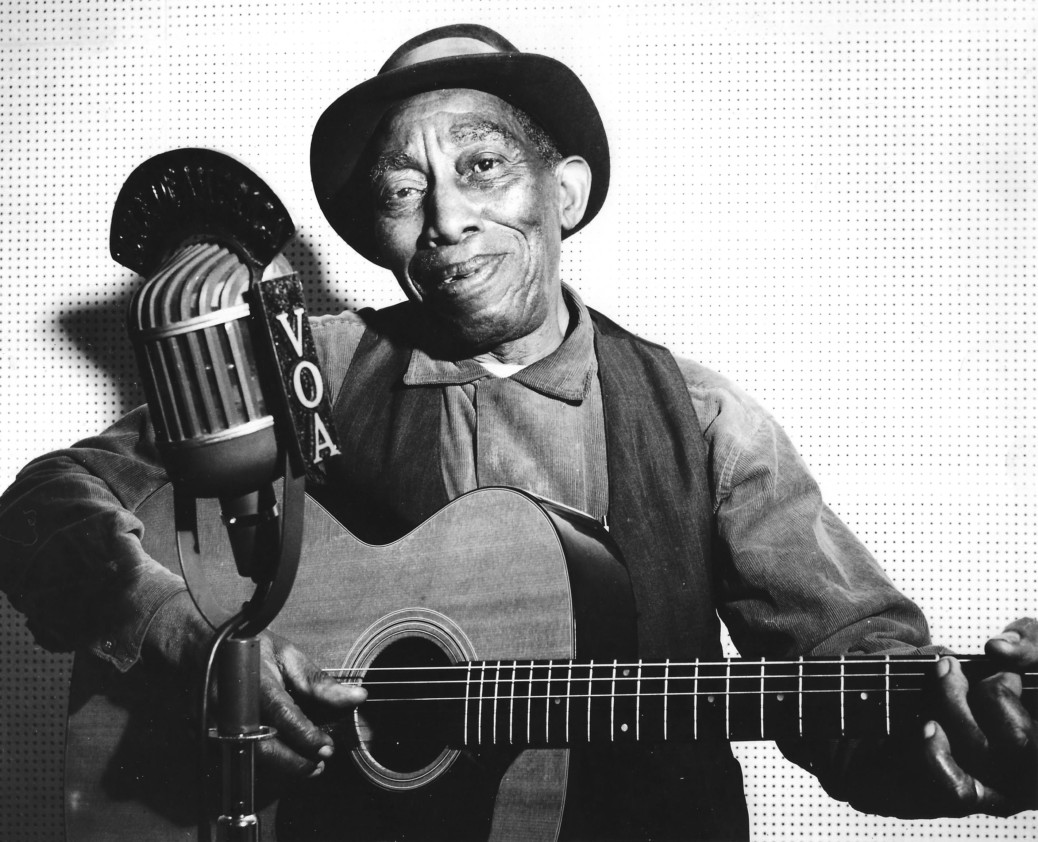
Mississippi John Hurt (1892-1966)—A Favorite of Mine

Curiously, in such a racist country as ours, it’s the only place that comfortably cuts through the racial divide.Black artists copied from the whites, though not nearly as much as white artists copied from African-Americans.

Of course, there is no Nobel Prize for music. It registers in the heart—and, typically American, at the Box Office.

“Too Blue”

This Poem Is the Essence of the Blues

I have been paging through Kevin Young’s Everyman collection of Blues Poems and came across this one by Landston Hughes. Mind you: It’s not the way I’m feeling right now, but it is a beautiful statement of what the blues can feel like when it lurches into your life. It’s called “Too Blue”:

I got those sad old weary blues.
I don’t know where to turn.
I don’t know where to go.
Nobody cares about you
When you sink so low.

What shall I do?
What shall I say?
Shall I take a gun
And put myself away?

I wonder if
One bullet would do?
As hard as my head is,
It would probably take two.

But I ain’t got
Neither bullet nor gun—
And I’m too blue
To look for one.