Puno Gets No Respect

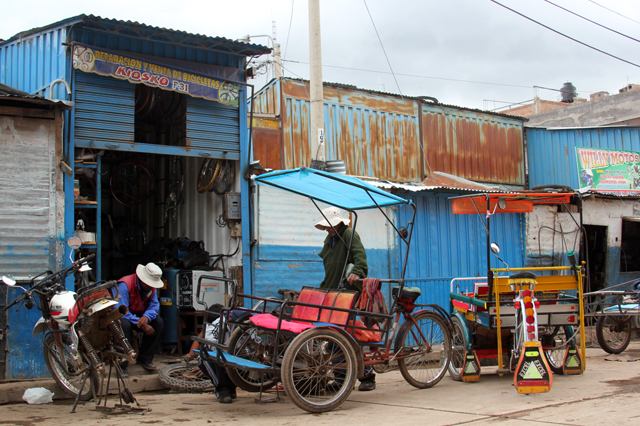
Bicycle Repair Shop in Puno

Bicycle Repair Shop in Puno

As one who lived the first seventeen years of his life in Cleveland, Ohio, I am well aware that some places come as a major disappointment to travelers. Cleveland was usually referred to as “The Mistake on the Lake” and, parodying the Chamber of Commerce motto of “The Best Location in the Nation,” “The Worst Location in the Nation.” And on the old Dobie Gillis TV show, wasn’t that hippie Maynard G. Krebs always going to see a movie called The Monster That Devoured Cleveland.

Well, Puno is one of those cities that gets no respect. A major entrepot for goods being trucked from Peru to Bolivia and vice versa. It is also one of Peru’s major centers of indigenous population, including both Quechuas and Aymaras.

If you take a look at the books written by travelers, you get a pretty dim view of the place. Paul Theroux (The Old Patagonian Express) and Christopher Isherwood (The Condor and the Cows) didn’t even give the place a chance: They arrived at night and left that same night on a boat bound across lake Titicaca for Copacabana, Bolivia. Since there are now no boat crossings to Bolivia—unless one is on an expensive catamaran tour—that option no longer exists.

When Patrick Leigh Fermor visited in the early 1970s (Three Letters from the Andes), he didn’t have much good to say about the place:

There was little for the eye to feast on outside. Puno is an assembly of corrugated iron roofs, sidings and goods yards sprawling round a church like a Gothic mud pie. We picked our way through the debris and squatting Aymara Indians—treading softly lest we tread on their dreams—to a ramshackle lacustrine port where an old steamer lay at anchor, brought piecemeal overland long before the railway, so that each plate was cut down to the weight a mule can carry, and sometimes a llama, then welded and riveted together again on the lake shore.

Fermor describes being met at the train station by a gaggle of unruly Aymara porters “seizing our luggage and bickering and punching each other all the way across the tracks to the repellent Ferrocarril hotel,” which had mislaid all the partys reservations.

Some years later, Michael Jacobs (The Andes), had this to say about Puno: “Neither of us was keen to stay any longer than necessary in Puno, which looked, under bright sunlight, even uglier than I had remembered it. The sun accentuated its resemblance to a waste tip of dirty brown boxes washed up by the lake.”

In Cut Stones and Crossroads, Ronald Wright damns the city with faint praise: “Puno has improved: I’ve found a hotel with hot water and a restaurant with hot food.” In The White Rock, Hugh Thomson considers Puno a “‘one-nighter,’ if that.”

Given all that bad publicity, I am sure that I will enjoy Puno. There isn’t much to see in the city proper (or should I say improper?), but there are the burial towers at Sillustani and the Islands of Taquile and Amantani in the middle of the lake. Plus, I will be trying to outlast the soroche I am sure will overtake me there at the elevation of 12,500 feet. Hey, nothing can surprise me: I’m from Cleveland.


The High Point of My Trip


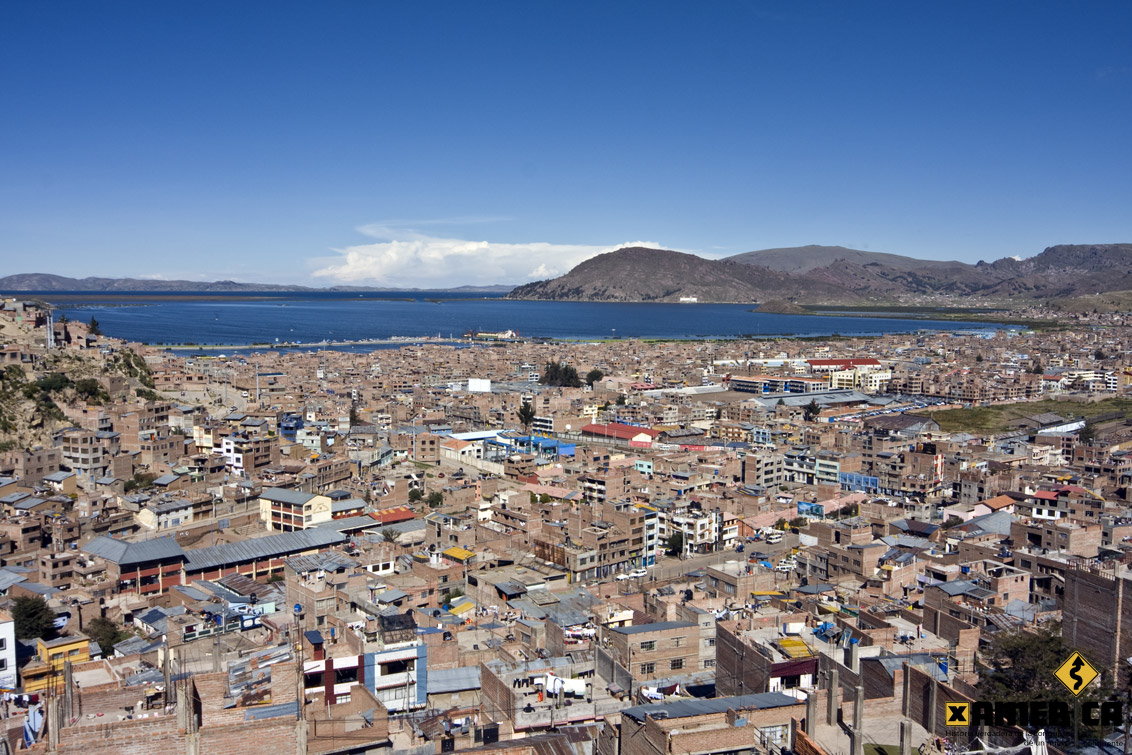
Puno on the Shore of Lake Titicaca

Puno on the Shores of Lake Titicaca

If my upcoming Peru vacation is a success, it will be because I was able to withstand life at 12,000 feet (3,650 meters) altitude. The high point (both literally and figuratively) of my trip will be at Puno, a somewhat ungainly city on the shores of Lake Titicaca. There will be short times during which I will be at 15,000 feet (4,570 meters) or more as I go over mountain passes between Arequipa and Chivay, between Arequipa and Puno, and between Puno and Cusco.

The hotel at which I will be staying—the Casa Andina Classic Tikarani on Jirón Independencia—provides oxygen for its guests as well as mate de coca if I am beginning to feel the onset of acute mountain sickness, or soroche, as the natives call it.

In the end, it is possible I am making too much of all this, but I will be traveling by myself. I have to be prepared to take immediate action in case I am one of the 1-2% of travelers in danger of High Altitude Cerebral Edema (HACE) or High Altitude Pulmonary Edema (HAPE). If that happens, I will immediately return to Arequipa and figure out a Plan B that involves visits to Tacna, Peru and Arica, Chile, cities that figured in the War of the Pacific (1879-1883), in which Bolivia lost its seacoast. (Even so, they still have admirals.)

If I find I can take the altitude, I’ll spend a night on Isla Taquile, which involves a 400 foot climb up a trail to reach the center of town. There, I will spend a night with one of the local families before returning to Puno by launch the next day.

After Puno, I head downhill to Cusco, and later still further downhill to Ollantaytambo and Machu Picchu.


Caudillismo

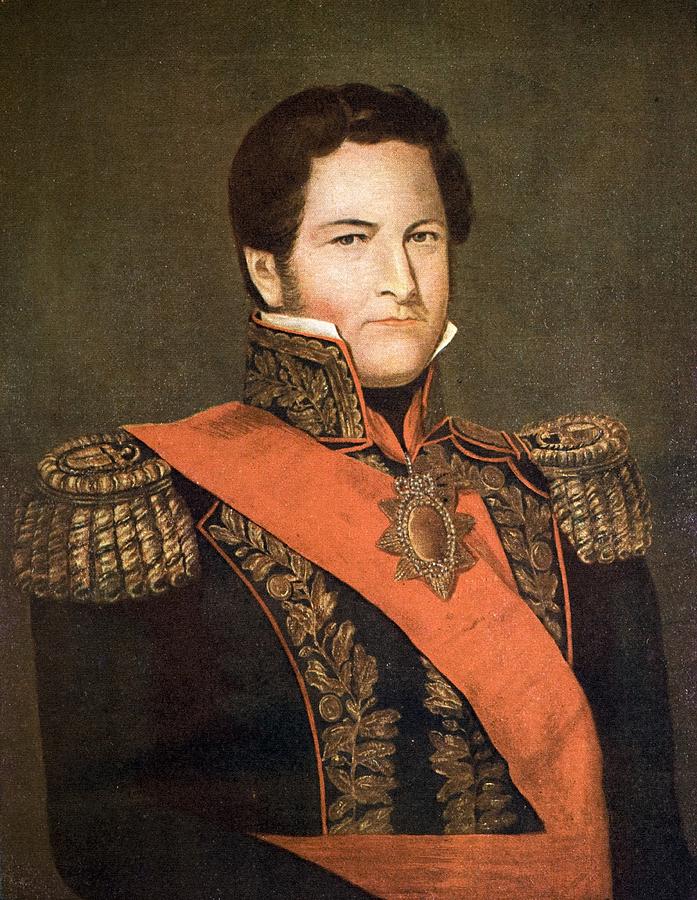
Juan Manuel de Rosas Ruled Argentina 1929 to 1952

Juan Manuel de Rosas Ruled Argentina 1929 to 1952

When we think of South America, we usually think of the military dictators, or caudillos, who seemed to rule most of the time. Why is it that the continent has had so much difficulty transitioning to a democratic form of government? I think the reason goes all the way back to the expulsion of Spain from her colonies. The Spanish forces were sent back, but the criollos were still very much in charge. They were mostly white, with rarely some Indian admixture, but they held the reins of power. Simón Bolívar, José de San Martín, and Bernardo O’Higgins were all criollos. All the big landowners, almost without exception, were criollos. Only rarely did an Indian come into power, and then usually only for a short time.

The armies of the South American countries were, until late in the Twentieth Century, pretty much in charge. They acted as a kind of Praetorian Guard to their favorites, who were usually the caudillos. God help them, however, when the favorites were no longer favored. Eric Lawlor in his excellent book In Bolivia enumerates the country’s heads of state who met violent ends:

The list of presidents and former presidents to die violently is extensive. Pedro Blanco was assassinated in 1829; Sucre in 1830; Jorge Córdova in 1861; Belzú in 1866; Melgarejo in 1871; Augustín Morales in 1872; Hilarión Daza in 1894; and José Manuel Pando in 1917. Nor did the tradition end in 1946: President René Barrientos died in a highly suspicious helicopter crash in 1969, and former President Torres was gunned down in Buenos Aires in 1972. Becoming chief of state in this country often amounts to signing one’s death warrant.

Actually, the most spectacular Bolivian President’s demise was that of Gualberto Villaroel, who was hanged by a mob on a lamp post across the street from the Presidential Palace in 1946. As Lawlor write, “A sobering sight for incumbent presidents, it [the lamp post, which still exists] may explain why so many Bolivian communities are still without streetlights.”

Bolivia might be the most spectacular bad example of misgovernment, but virtually every South American country has its own bad examples, from Juan Manuel de Rosas of Argentina, who set some type of caudillo longevity record; to General Augusto Pinochet Ugarte of Chile; to Ramón Castilla y Marquesado of Peru; to José Antonio Páez of Venezuela; to José Artigas of Uruguay. Of the independent countries, Chile and Brazil had the fewest; and probably Bolivia had the most.

There is a nice PDF file on “The Rise of the Caudillos,” which deals with the issue in outline format.


Dreams at High Altitude

A City Surrounded by Mountains

A City Surrounded by Mountains

The other night I dreamed of Bolivia. I was in La Paz, one of the country’s two capitals—the other is Sucré in the South. I was trying to navigate between two locations within the city, but all I had was a two-dimensional street map that didn’t give me any idea whether I had to go uphill or downhill. The Lonely Planet guide to Bolivia lists the altitude of La Paz at 12,007 feet (3,660 meters), but isn’t that just an average? Even higher than La Paz is the erstwhile suburb of El Alto, which is, at 13, 620 feet, not only the highest major metropolis in the world with a million people, most of them Aymara, but also is home to the La Paz’s international airport,the world’s highest.

I am obsessing about La Paz: It is a city that pops up in my dreams because it is set in a huge bowl under several conical volcanoes, the most spectacular of which is Illimani at 16,350 feet. I keep thinking of traveling up and down the city by taxi and on foot, gasping all the while because of the high altitude.

Currently, I am thinking of starting my vacation in Lima and traveling through southern Peru to Lake Titicaca and then on to La Paz. From there, I plan to fly “open jaws” back to Los Angeles. That saves me time and money from having to deadhead back to Lima.

The big question is my susceptibility to Soroche, or altitude sickness. If, upon arriving in Cusco, I appear to have the beginnings of either HAPE (high altitude pulmonary edema) or HACE (high altitude cerebral edema), I will turn around and return to Arequipa, going on to Tacna (in Peru) and Arica (in Chile), possibly as far as Antofagasta. In that case, I would deadhead back to Lima and fly home from there.

So if that alternate scenario takes place, I would have to have a flight from La Paz to Los Angeles that I can cancel if necessary. Is that possible? It remains to be seen.

Addendum: These two quotes from Christopher Isherwood’s South American diary, The Condor and the Cows, add an eyewitness’s observations to the city :

Sixty miles from the lake [Titicaca] the plain suddenly ends. You look over its edge into a deep horse-shoe valley and there is La Paz, fourteen hundred feet below. The view makes you gasp, for it is backed by the enormous snow-peak of Illimani, which fills the sky to the south. Illimani is rather higher than Mount Pelion would be if it were piled not on Ossa but upon Mont Blanc.

Believe it or not, I actually had the following scene in my dream:

Many of the side streets are so steep that you could scarcely hold your footing on the worn pavement. The Paceños have learned to slither down it in long strides, like skaters. What with the altitude, the gradients, the scarcity of elevators and the shortage of taxis, you spend most of the day painfully out of breath, and envy the Indians, whose enormous lungs enable them to trot uphill without the least sign of strain.


Can It Ever Get This Bad Here?

Mariano Melgarejo, Dictator of Brazil 1864-1871

Mariano Melgarejo, Dictator of Bolivia 1864-1871

I have just finished re-reading Eric Lawlor’s In Bolivia. In the process, I found a political leader who was probably the most incompetent, yet tyrannical ever to rule outside of North Korea. I am referring to General Mariano Melgarejo (1829-1871), the 18th President of Bolivia. Following are a few anecdotes about his rule—some of which may be apocryphal—but all with enough truth in them to be believable.

At a diplomatic function in 1867, the British ambassador refused to drink a glass of chicha, a cloudy but potent drink made of fermented maize. This incensed Melgarejo so much that he made him drink a whole bowl of liquid chocolate and then had him mounted ass-backwards and naked on a donkey and paraded three times around the Plaza Murillo, afterwards ordering him back to London. When the ambassador explained to Queen Victoria how he was treated, Her Majesty promptly ordered the British fleet to shell La Paz, the capital. Fortunately, someone in the Admiralty had the good sense to remind Her Majesty that Bolivia was a landlocked country, and that his ships’ projectiles could not penetrate that far. Whereupon, good Queen Vicky asked for a map of South America and drew a big letter “X” over it, declaring, “Bolivia does not exist.” In fact, diplomatic relations were not restored until 1910.

During the Franco-Prussian War in 1870, Melgarejo wished to come out on the side of Napoleon III and the Second Empire. Unfortunately, he had no idea where France was located, so he sent his army marching eastward. When some brave soul on his general staff commented that the army would have to cross the Atlantic Ocean, the generalissimo shot back, “Don’t be stupid! We’ll take a short cut through the brush!”

In another version of this story, which sounds equally apocryphal, the Bolivian army sent to relieve France ran into some rainy weather. As Lawlor tells it, “Melgarejo, jealous of his comfort, ordered his soldiers back to their barracks.” The rest is history: The Germans overran France and sent Napoleon III packing.

Lawlor continues:

Another told of Melgarejo returning to La Paz after touring the provinces to discover that a former president, Manuel Isidoro Belzú, had deposed him. Anticipating trouble, Belzú had filled Plaza Murillo with thousands of his followers. But Melgarejo was not cowed so easily. Drawing his pistol, he strode into the presidential palace and shot the interloper dead.

The gun still smoking in his hand, Melgarejo then addressed the mob. “Belzú is no more,” he said. “Who rules Bolivia now?” The crowd pondered the question but a moment. “Viva Melgarejo!,” it called back. “Viva la patria!

From the comfort of our couches, we can laugh at Bolivia; but remember it could get that bad over here. If some miserably ignorant Tea Partier ever got to be president, we would have to look away from Kim Kardashian’s ass for a second to consider how far we have sunk.