Noir

"William Irish" Was a Pen Name Used by Cornell Woolrich

“William Irish” Was a Pen Name Used by Cornell Woolrich

Over the past several months, I have been reading the large Library of America omnibus volume entitled Crime Novels: American Noir of the 1930s and 40s. Included were the following titles:

  • James M. Cain’s The Postman Always Rings Twice (filmed by Tay Garnett starring John Garfield and Lana Turner)
  • Horace McCoy’s They Shoot Horses, Don’t They? (Sidney Pollack’s 1969 film of this starred Jane Fonda)
  • Edward Anderson’s Thieves Like Us (made into a great Nicholas Ray film called They Live by Night)
  • Kenneth Fearing’s The Big Clock (made into a great John Farrow film with Ray Milland and Charles Laughton)
  • William Lindsay Gresham’s Nightmare Alley (another great John Farrow film, this time with Tyrone Power)
  • Cornell Woolrich’s I Married a Dead Man (published under the pen name William Irish)

So many of the noir novels of the period were turned into classic films that I begin to think the whole genre is a mirror in which we as Americans see ourselves. Although the British are just as famous with their detective novels, it was an American who invented the genre with Edgar Allan Poe’s stories such as “The Gold Bug,” “The Purloined Letter,” and “The Murders in the Rue Morgue.” And while Arthur Conan Doyle, Agatha Christie, Josephine Tey, and countless others were practicing their craft in Britain, their American counterparts created works that were more urban, more mean, and more essentially American.

Frankly, I came to the novels by way of the films. I was a collaborator (though in a minor way) with my friends Alain J. Silver and James Ursini in their genre-defining book Film Noir: The Encyclopedia published by Overlook Press. Other great resources are the same authors’ The Noir Style (also Overlook) and the Taschen Book entitled Film Noir.

Both the novels and the films generally tend to be excellent and well worth your time.

Judging a Book by Its Cover

In 1960, This Looked Ultra-Cool

In 1960, This Looked Ultra-Cool

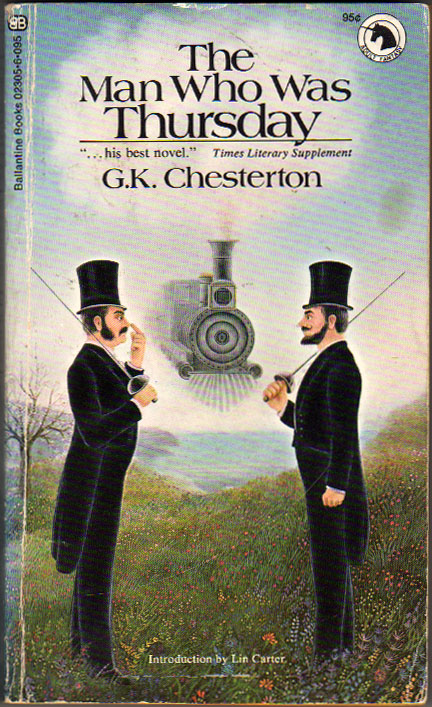
It is always a good idea to re-examine from time to time a book or movie that had particularly impressed you. I decided yesterday to re-read A. E. Van Vogt’s Empire of the Atom (1957), which I first read around 1960, and twice subsequently. Its hero, Lord Clane is a mutant as a result of exposure to radioactivity. The time is at some remote point in the future, presumably after a nuclear war. All of Earth is under control of the House of Linn, which rules the planet as if it were the Roman Empire.

So very much, in fact, like the Roman Empire that the first half of the book was cribbed from Robert Graves’s 1934 classic I, Claudius. There is a one-to-one correspondence between Van Vogt’s characters and Graves’s Romans: Clane is Claudius; Creg, Germanicus; the Lord Leader, Augustus; Lydia, Augustus’s wife Livia; and Lord Tews, Livia’s son Tiberius. Only about 60% into the story does Van Vogt escape from his slavish borrowing. At least he doesn’t try to muddy his story by introducing an equivalent to Caligula. It bothers me that I did not notice all this when I re-read the book in 1990, years after I had read the Graves books and seen the BBC I, Claudius TV series.

Still, even with the plagiarism, there are numerous incongruities. The Linns have spaceships with which they conduct wars on Venus and Mars; yet their main weapons are bows and arrows, lances, and swords. They use nuclear energy, but regard it as a “gift from the gods.” Their gods, in fact, are Uranium, Plutonium, Radium, and Ecks (“X”?).

Well, then, what was it that drew me to this book? Pure and simple, I loved the cover (shown above). As a teen, I was a rather sickly individual with frequent headaches—by this time I already was suffering from the pituitary tumor (chromophobe adenoma) that was to reach a climax six years later. Clane was actually a handsome man provided he wore the flowing temple robes that hid his deformities:

After re-reading the message, [Clane] walked slowly to the full-length mirror in the adjoining bathroom, and stared at his image.

He was dressed in the fairly presentable reading gown of a temple scientist. Like all his temple clothing, the cloth folds of this concealed the “differences” from casual view. An observer would have to be very acute to see how carefully the cloak was drawn around his neck, and how tightly the arm ends were tied together at his wrists.

Whoever was responsible for the book’s dust jacket was a genius. Man, I wouldn’t have minded being a mutant if I had a face like that! But, like many teens, especially short, chubby ones, I used fantasy to escape the realities of my situation. Now, half a century and more onward, it doesn’t seem to matter as much any more. I am what I am, and I do not look unkindly on what and who I have become.

“A Heart-Breaking Shop”

Bookstore Window

Bookstore Window

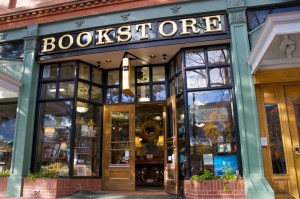
But what were even gold and silver, precious stones and clockwork, to the bookshops, whence a pleasant smell of paper freshly pressed came issuing forth, awakening instant recollections of some new grammar had at school, long time ago, with “Master Pinch, Grove House Academy,” inscribed in faultless writing on the fly-leaf! That whiff of russia leather, too, and all those rows on rows of volumes, neatly ranged within—what happiness did they suggest! And in the window were the spick-and-span new works from London, with the title-pages, and sometimes even the first page of the first chapter, laid wide open; tempting unwary men to begin to read the book, and then, in the impossibility of turning over, to rush blindly in, and buy it! Here too were the dainty frontispiece and trim vignette, pointing like hand-posts on the outskirts of great cities, to the rich stock of incident beyond; and store of books, with many a grave portrait and time-honored name, whose matter he knew well, and would have given mines to have, in any form, upon the narrow shelf beside his bed at Mr Pecksniff’s. What a heart-breaking shop it was!—Charles Dickens, Martin Chuzzlewit

Support Your Local Bookseller

Alpine Village, Central Europe at the Edge of the Desert

Alpine Village, Central Europe at the Edge of the Desert

Today I got off early from tax work, so I suggested to Martine that we go to Captain Kidd’s Fish Market in Redondo Beach for a seafood lunch, followed by a visit to Alpine Village in nearby Torrance. At Alpine Village is not only an excellent European food market with great meats, but an excellent used bookstore that goes under the names of Collectible Books and Michael Weinstein, Bookseller.

Since tax season will get only worse as April 15 approaches, my food preparation will now eschew the fanciful and time-consuming. This next week, we will have knockwurst or German wieners with Brussels Sprouts, cauliflower, or other steamed vegetables. Perhaps the week after, it will be Hungarian Gyulai kólbasz sausage sautéed with onions, potatoes, and paprika—a dish my mother frequently cooked for us back in Cleveland when she was pressed for time.

I was a little disingenuous with Martine because I didn’t mention until later that I also wanted to visit the little used bookstore at Alpine Village, various called Collectible Books and Michael R. Weinstein, Bookseller. There I purchased three items:

  • R. R. Palmer’s Twelve Who Ruled: The Year of the Terror in the French Revolution. I had read this before, but made the mistake of selling it when I wanted to re-read it.
  • Percy Bysshe Shelley’s Selected Poems in a compact hardbound Oxford World Classics edition, suitable for travel.
  • A lovely Lakeside Press edition of William S. Hart’s My Life East and West, the autobiography of the silent cowboy star whose house in Newhall we visit two or three times a year. It is now a museum administered by the Los Angeles Museum of Natural History.

Not a bad haul for thirty bucks. I know, I know: I have too many books. But reading great books is what puts the light in my eyes. Martine knows that, so she forgives me my little vice.

Finding Old Books Has Changed

It’s Become Easier to Find Old Rare Books

It’s Become Easier to Find Old Rare Books

There was a time when I would have paid a hundred dollars for even a ratty copy of Sir Francis Galton’s The Art of Travel, or Shifts and Contrivances Available in Wild Countries (1872). This book was a vade mecum for Victorian explorers, such as Sir Richard Francis Burton, whose works I collect and love to read. Other books that Burton and his fellow Victorian explorers took with them on their jaunts into the wild places of the world are Randolph Barnes Marcy’s The Prairie Traveler: The 1859 Handbook for Westbound Pioneers (Burton himself edited later editions) and Harriet Martineau’s How to Observe: Morals and Manners (1838).

Now how much do you suppose these rare titles would cost you today? Remember, these books (even the one on the Prairies of North America) were taken into the darkest parts of Africa and South America. According to Monte Reel’s article entitled “How to Explore Like a Real Victorian Adventurer,” reprinted in The Best American Travel Writing 2012, the answer is Zero. Zip. Nil. Provided, of course, you have a Kindle e-reader.

If you do, you can easily put together a library of works which are no longer under copyright for nothing or next to nothing.

Oh you can expect to pay for the latest Stephenie Meyer twinkling vampire books or the latest New York Times best-sellers.

Now, you ask yourself, why would I be interested in these old general guides on travel to unexplored areas? The fact of the matter is that I love old travel books. Burton’s own First Footsteps in East Africa, or An Exploration of Harar (1855) and his voluminous A Personal Narrative of a Pilgrimage to Al-Madinah and Mecca (1855-56), in which he disguised himself as an Arab and did all the Holy Places of Islam, are two of the most exciting books ever written.

Going farther afield, there are writers like W. H. Hudson on Argentina and Uruguay, H. M. Tomlinson’s The Sea and the Jungle (1912) about a voyage to the interior of Brazil; George Gissing’s By the Ionian Sea (1901) about a trip along the heel and sole of the Italian boot; and Captain Irving Johnson’s The Peking Battles Cape Horn (1932) about the last big sailing ship through the storms of Cape Horn.

These are just a few authors and titles that come to mind. How can I forget Robert Byron’s The Road to Oxiana (1937)? Or Bruce Chatwin’s In Patagonia (1977) or The Songlines (1987)? Or Paul Theroux’s The Old Patagonian Express (1979)?

One of these days, I will put together a more organized list of my favorite travel books—but that will take a little time!

If Books and Reading Are Important to You …

... Then You Belong Here!

… Then You Belong Here!

After dinner, most people repair to their television sets and begin the process of becoming one with their couches or La-Z-Boys while a host of pundits, would-be stars and celebrities, and announcers with expensive hair-dos fill the hours of their lives with … noise. Just noise. Nothing much else but noise.

What I do after dinner is sit in my library and read. And you can track all the books I read by visiting my website at Goodreads.Com. There you can obtain my own personal review of every book I read. Right now, I am reading two short Fyodor Dostoevski novels, Poor Folk and A Little Hero. When I am finished, you can see the review.

Generally, I read between eight and twelve books a month, depending mostly on their length, The whole first half of January was taken up with Vasily Grossman’s Life and Fate, which was worth the trouble at any length.

There is an excellent New York Times article on Goodreads.Com, which you can bring up by clicking here.

Some people say that the reading of books as an activity is dying. No, I do not think so. I think that people who don’t read are finding a way to kill off their brains. Every hour in front of a TV set kills off several hundred brain cells. Every hour reading a good book stimulates your brain cells and—most especially—your imagination.


The Wrong Type of Book-Lover

old books1

Some People Just Like to Read Books, Not Snool Over Them

Yesterday, I visited the antiquarian book fair held at the Santa Monica Civic Auditorium. I had visited book fairs in the past, and actually found some good buys—most notably a four-volume edition of the works of Sir Thomas Browne—but I found that most of the books exhibited were not my cup of tea. Well, this time it was even worse.

It seemed that the median price of the books on sale was around $650, and virtually all the books were:

  • Signed first editions of famous 20th century authors
  • Lavishly illustrated oversize books filled with old engravings
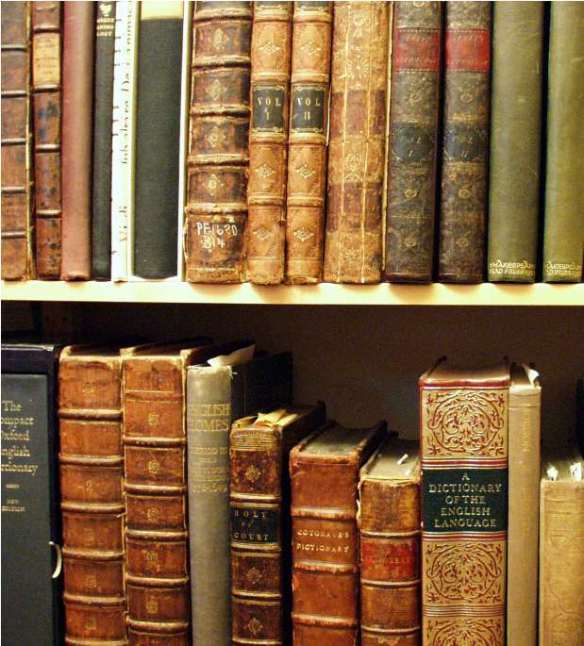
  • Leather-bound books like the ones in the photograph above
  • Seemingly endless books about the Old West

I got the impression that the book fair was primarily for those whose notion of a book does not go beyond the dust jacket, the binding, the front endpapers, and the page showing the edition and printing. That impression was confirmed when I heard some of these people talking to the dealers in the kind of pseudo-cultivated tone adopted by the very wealthy who wish to impress others with knowledge they don’t have. For one thing, they don’t actually read books!

The upshot was that I didn’t buy anything there, though I spent $10 for parking and $5 for admission. Right afterwards, I drove to a real bookstore, Sam Johnson Books in Mar Vista, where I had difficulty choosing what to buy. I finally settled on an interesting-looking book by Adam Sisman entitled The Friendship: Wordsworth and Coleridge. I had previously read Sisman’s book on James Boswell and loved it.

Expires Soon!

Don’t Be a Sucker for Sales!

Don’t Be a Sucker for Sales!

I used to follow all the sales, and I would be mobilized into action by hearing that the low price would “expire soon” As a result, I bought a lot of junk I didn’t need. And instead of saving money, I ran up my credit cards thinking I was getting a terrific bargain. Now I get this cynical smirk on my face when being offered a low price. Remember: You will be paying an even lower price if your spending is zero.

Unfortunately, with the economy being the way it is today, it would help if more people were spendthrifts—but not if, by so doing, they got into serious debt.

For me, the biggest temptation was—and still is—books. On Sunday, Martine and I took a walk on the campus of Loyola-Marymount University in Westchester. Because I’ve seen as much of the campus as I want to, I usually accompany Martine for only the first half of the walk and spend the rest of the time in the nice new Hammond Library.

While there, I took a look at a relatively new book by Karl Schlögel entitled Moscow, 1937. It was a fascinating picture of the Soviet capital during Stalin’s purges. I was so enthralled that I read the first chapter in its entirety (about Mikhail Bulgakov’s The Master and Margarita) and scanned the rest of the book page by page. The illustrations and maps were amazing.

Needless to say, I was sold. That evening, I found a cheap new copy on eBay and purchased it. As you can see, I can present myself as a bit of a cheapskate; but I still have, hidden not so deep within myself, a raging spendthrift.


“A Naked Stranger”

David Lindsay’s VOYAGE TO ARCTURUS

The sea tempted him. He made up his mind to bathe, and at once walked toward the shore. The instant he stepped outside the shadow line of the forest trees, the blinding rays of the sun beat down on him so savagely that for a few minutes he felt sick and his head swam. He trod quickly across the sands. The orange-coloured parts were nearly hot enough to roast food, he judged, but the violet parts were like fire itself. He stepped on a patch in ignorance, and immediately jumped high into the air with a startled yell.

The sea was voluptuously warm. It would not bear his weight, so he determined to try swimming. First of all he stripped off his skin garment, washed it thoroughly with sand and water, and laid it in the sun to dry. Then he scrubbed himself as well as he could and washed out his beard and hair. After that, he waded in a long way, until the water reached his breast, and took to swimming—avoiding the spouts as far as possible He found it no pastime. The water was everywhere of unequal density. In some places he could swim, in others he could barely save himself from drowning, in others again he could not force himself beneath the surface at all. There were no outward signs to show what the water ahead held in store for him. The whole business was most dangerous.

He came out, feeling clean and invigorated. For a time he walked up and down the sands, drying himself in the hot sunshine and looking around him. He was a naked stranger in a huge, foreign, mystical world, and whichever way he turned, unknown and threatening forces were glaring at him. The gigantic, white, withering Branchspell, the awful, body-changing Alppain, the beautiful, deadly, treacherous sea, the dark and eerie Swaylone’s Island, the spirit-crushing forest out of which he had just escaped—to all these mighty powers, surrounding him on every side, what resources had he, a feeble, ignorant traveller to oppose, from a tiny planet on the other side of space, to avoid being utterly destroyed?… Then he smiled to himself. “I’ve already been here two days, and still I survive. I have luck—and with that one can balance the universe. But what is luck—a verbal expression, or a thing?”—David Lindsay, A Voyage to Arcturus


Follow the Bouncing Ball

Argentinean Author César Aira

Most traditional literature is somewhat like a series of nested matryoshka dolls: You come back out the way you go in. In the process, all unresolved issues are neatly resolved (one hopes), and one has experienced a real 19th century experience.

Well, that doesn’t seem to be happening any more, except perhaps in some whodunits. It certainly isn’t happening in the slim novels of César Aira, an Argentinean from Coronel Pringles who writes the way a Roomba vacuum cleaner robot cleans: He just moves in a straight line until he encounters a barrier that sends him off in another direction.

In Varamo, we are in the city of Colón in Panama some 20 years after the Panama Canal was built. Varamo is the name of a Chinese-Panamanian who works for one of the government ministries in Colón. The story begins when, as his pay, he is handed 200 counterfeit pesos which he at once recognizes and is afraid to cash. He walks to the cafe one evening and witnesses an accident in which one of the government ministers is severely injured. That makes him late to the cafe, where he runs into three pirate publishers who urge him to write a book, which Varamo gladly does. It turns out to become a Central American poetry classic: The Song of the Virgin Boy.

Along the way, he encounters other adventures, but this will do for now. In the last paragraph, Aira gives a kind of apologia for his own highly individualistic writing style:

The result was Varamo’s famous poem, except that it was less a result in itself than a way of transforming what had preceded it into a result. It produced a kind of automatism or mutual fatality, by which cause and effect changed places and became the same story. Far from diminishing the poem’s initial vigor, this circle intensifies it. Which is, in fact, what always happens. If a work is dazzlingly innovative and opens up unexplored paths, the merit is not to be found in the work itself, but in its transformative effect on the historical moment that engendered it. Novelty makes its causes new, giving birth to them retrospectively. If historical time makes us live in the new, a story that attempts to account for the origin of a work of art, that is, a work of innovation, ceases to be a story; it’s a new reality, and yet a part of reality as it has always been for everyone. Those who don’t believe me can go and see for themselves.

Now there’s a manifesto! Aira’s “new reality” has, with me, fallen on receptive ears. I have read every Aira book that I could get my hands on. They are all relatively short, but always succeed in defying any attempt at speed-reading. This Argentinean knows how to throw curve balls that bounce all over the place. Following their trajectory across space and time is not only great fun, but also profound, in a weird way.

Photo Credit: The above picture—a favorite of mine—comes from the Buenos Aires BAFICI website (dedicated to independent filmmakers).