Faulkner & Hemingway

William Faulkner (1897-1962) and Ernest Hemingway (1899-1961)

Both of them won the Nobel Prize for Literature, Faulkner in 1949 and Hemingway in 1954. I have been carrying on a running conversation with a friend of mine who is a devotee of Hemingway, mostly on the basis of two short stories, “The Big Two-Hearted River” and “The Snows of Kilimanjaro.” I, on the other hand, hold with Faulkner. I have read many of his short stories and all of his novels. Oh, and I also read most of Hemingway’s novels.

The problem with Hemingway is that he was essentially shallow, a wannabe alpha male who didn’t quite make it. In the end, he blew his brains out for reasons that are discussed in this website. In his last years, Hemingway’s writing was not up to his early standard.

William Faulkner, on the other hand, not only continued to write interesting novels (with a couple of duds, especially The Fable), but he had a distinguished career as a scriptwriter in Hollywood, participating in several film masterpieces directed by Howard Hawks, especially The Big Sleep and (ironically) the film version of Hemingway’s To Have and Have Not.

Currently, I am re-reading Faulkner’s Sanctuary (1932), ostensibly a pot-boiler written to make money, but also a devastating picture of rural and small-town evil that includes a rape, murder, perjury, and a lynching of an innocent man.

In the time that remains to me, I hope to re-read more of Faulkner’s novels and tackle all his short stories. Ever since I was in high school, Faulkner has left a decided imprint on my writing. And Hemingway? Alas, he has not worn well over the years.

Why I Am a Bookworm

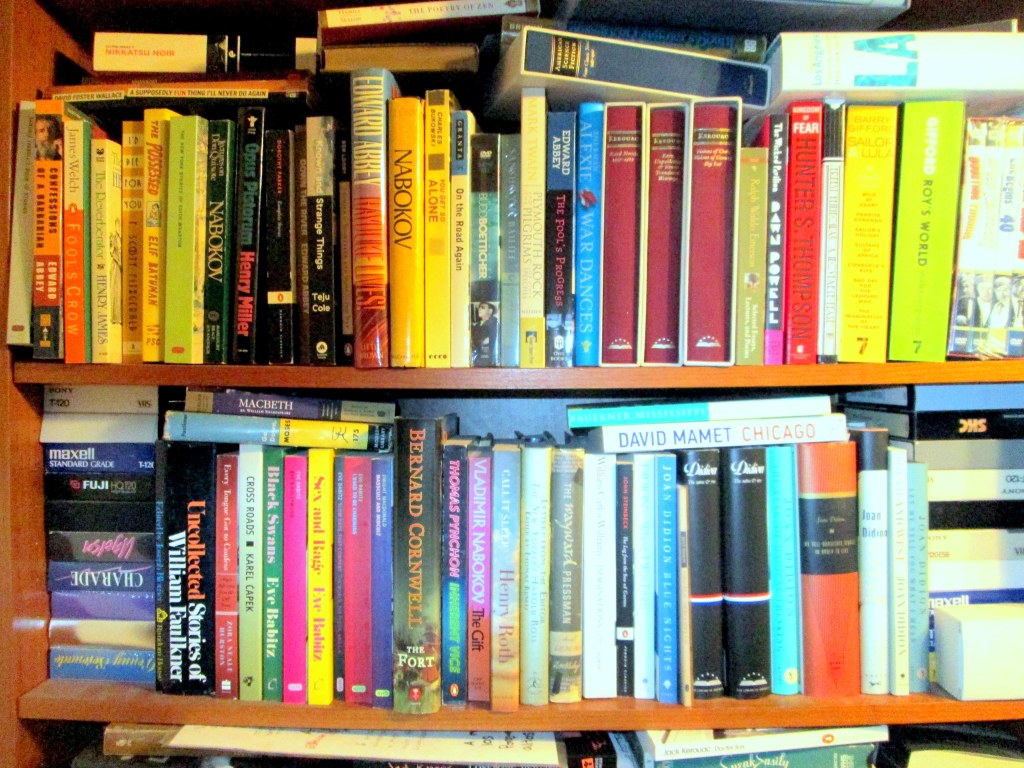
Just a Few of My 6,000 Books

Here I am, in my late 70s and surrounded on all sides by a huge book collection. If my apartment were hit by burglars, my fear is that I would be sued for them because they would get a hernia carrying away my books. In fact, I am in the position of trying to find a home for the books I do not plan to re-read or consult.

What I had been doing is donating books to either a local thrift shop or library, but as the IRS standard deduction keeps increasing, I no longer have to keep records of my donations. All I really want to do is find a home for my discards.

What I have been doing lately is using are the display boxes of the Little Free Library (“Take a Book; Share a Book”), of which there a a number of “free libraries” in my neighborhood. So when I take a walk or go shopping, I usually have three or four books in my bag to donate. How do I make a donation? I simply take the books from my bag and put them on the shelves of the Little Free Library.

How did I ever get in this predicament? Well, to tell the truth, to the extent that I am a fairly happy well-adjusted person, I owe it all to my upbringing (I was lucky with my parents) and to the fact that books were a major form of escape for me—from the age of eight onward.

I remember the time that my little neighbor Patsy Strohmeier got me a hardback of Mark Twain’s The Adventures of Tom Sawyer. While I was reading the book, my cousin Emil came to visit and was angered to see me with my face in a book. He picked up the novel and slammed it hard on the floor, saying “THIS is what I think of your books!” By that time, I was already so hooked that my first reaction was that he was, in effect, saying “THIS is what I think of YOU!” I wasn’t offended because I knew that Emil was a good-hearted person who just didn’t like to read.

Simply put, I became a bookworm because I was a sickly child. In fact, between the ages of 10 and 21, I was walking around with a brain tumor in my pituitary gland that stunted my growth and, in pressing on my optic nerve, caused severe frontal headaches on most days. Even with a headache, I could still read—though I was useless when it came to baseball, football, basketball, and most childhood sporting activities.

Somehow, in the course of time after I had brain surgery in 1966, I became a fairly healthy person. Oh, to be sure, I am a diabetic, have asthma and chronic rhinitis, but I seem to survived surprisingly well. (Bad rice! Bad rice!)

Glorious Fourth

As I write these words, the air is thick with explosions as juvenile delinquents of all ages set off fireworks, terrorizing their pets and injuring themselves in an orgy of carelessness. This is what the anniversary of our independence has come to mean: explosions and barbecues.

Forgive me i I choose not to join in the festivities. At one time, I did; but the combination of too much charred meat and too many overcrowded fireworks displays has, in time, soured me.

Instead I took a walk to the Colorado Center’s park, at a central point called The Landing, where there is shade, a roof, and metal seating. On weekends and holidays, I am more likely to see janitors and security guards going from building to building than locals. There was a bench with two girls, a couple of serious kickboxers practicing, and two or three people walking their dogs.

I had planned to begin reading Georges Simenon’s The Shadow Puppet, an early (1932) Inspector Maigret novel; but I found had already finished the book same under another title, namely Maigret Mystified. No matter, I merely reveled in the peace and quiet with relatively few fireworks explosions in the background.

Then I walked the mile and a half back to my apartment and continued my reading of an interesting history of Spain by John A. Crow entitled Spain: The Root and the Flower.

“Only a Mean Person Won’t Enjoy It”

Novelist Charles Portis (1933-2020)

Now that I have read four of his five novels and will in all likelihood have read most of his work before the end of the year, I can say that Charles Portis is one of my favorite American novelists of the Twentieth Century. He is perhaps the best thing to ever come out of Arkansas, the state where he was born, lived most of his life, and died.

First of all, here are his five novels:

  • Norwood (1966)
  • True Grit (1968)
  • The Dog of the South (1979)
  • Masters of Atlantis (1980)
  • Gringos (1991)

Undoubtedly, you have heard of True Grit. Hollywood turned it into two enjoyable movies, one starring John Wayne as Rooster Cogburn, and the other (produced by the Coen Brothers) starring Jeff Bridges, Matt Damon, and Josh Brolin.

The only Portis novel I have not read so far is Masters of Atlantis. He also produced a collection of essays in 2012 called Escape Velocity. The name comes from a quote from one of his novels: “A lot of people leave Arkansas and most of them come back sooner or later. They can’t quite achieve escape velocity.”

Like J. D. Salinger, Charles Portis was a man who avoided the limelight. He would point out, however, that his phone number was in the Little Rock phonebook.

Everything I have read by Portis can best be described as gentle humor. As one reviewer said of True Grit, “Only a mean person won’t enjoy it.” Too true!

The End of the Beginning

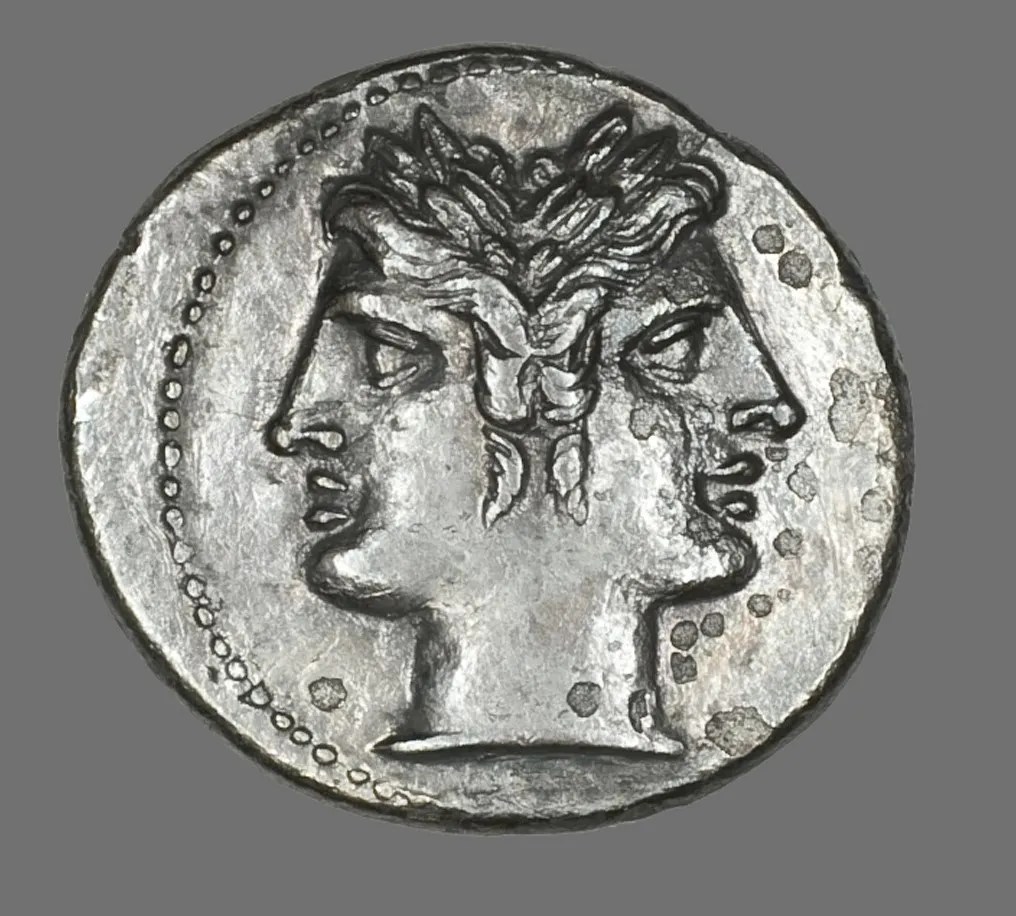
My Janus-Faced January Reading Program

As I wrote in my post dated January 1 of this year, I like to devote a whole month out of each year reading authors I have never read before. As this is the last day of my Januarius Project for January 2023, I thought I’d report on the authors I have discovered.

I have read eleven books this month. Six of them turned out to be excellent:

  • Thomas Hodgkin. Barbarian Invasions of the Roman Empire. I. The Visigothic Invasion. The first of eight volumes and 5,000 pages on the Barbarian Invasions. Excellent scholarship and exciting even!
  • Magda Szabo. The Door. A superb Hungarian novel about a writer and her domineering housekeeper.
  • Laszló F. Földényi. Melancholy. Another Hungarian author dealing with the history of melancholy in Western literature and civilization. Not an easy book to read, but worth the effort.
  • Lawrence Ferlinghetti. Writing Across the Landscape. Travel Journals 1960-2010. It’s always fascinating to see other places from a poet’s perspective.
  • Lucretius. The Nature of Things. An ancient Roman poet describes the science of his day—in verse. Reading Lucretius tells me we may have advanced in some respects, but not all.
  • Juan Rulfo. The Plain in Flames. Why have I not heard of this Mexican author before? Like John Webster, he could see the skull beneath the skin; and his short stories are powerful and gemlike.

The remaining five were merely really good:

  • Vilmos Kondor. Budapest Noir. A top-notch mystery set in the Budapest of the 1930s, on the track of a young woman’s murder.
  • Han Kang. The Vegetarian. A young woman goes from vegetarianism to pushing the envelope of what is human. The author is Korean.
  • Don Carpenter. Hard Rain Falling. A noir crime novel about a pool shark whose life goes from bad to worse. The beginning is particularly powerful.
  • Yu Miri. Tokyo Ueno Station. The author is a Japanese woman of Korean ancestry. A powerful look at urban homelessness in Tokyo.
  • Horacio Quiroga. 7 Best Short Stories. One for the kiddies. A Uruguayan author writes stories about the Argentinian jungle that are reminiscent of Kipling’s The Jungle Book.

I can see myself reading other works by Hodgkin, Szabo, Ferlinghetti, and Rulfo in the year to come.

The Januarius Budapest Trifecta

Having finished my jaunt to the decaying Roman Empire during the Visigothic invasions, I decided to read three books in a row written by Hungarian authors:

  • Vilmos Kondor’s Budapest Noir (2008), a first novel about a murder on the streets of Budapest.
  • Magda Szabo’s The Door (1987), a novel about the relationship between two women, a writer and a peasant.
  • Laszló F. Földényi’s Melancholy (1984), a history of melancholy through the ages.

As we begin 2023, I find the farther I get from my own Hungarian roots, the more at loose ends I feel. There is a figure in Greek mythology called Antaeus, about whom Wikipedia writes:

Antaeus would challenge all passers-by to wrestling matches and remained invincible as long as he remained in contact with his mother, the earth. As Greek wrestling, like its modern equivalent, typically attempted to force opponents to the ground, he always won, killing his opponents. He built a temple to his father using their skulls. Antaeus fought Heracles as he was on his way to the Garden of Hesperides as his 11th Labour. Heracles realized that he could not beat Antaeus by throwing or pinning him. Instead, he held him aloft and then crushed him to death in a bear hug.

Returning to my Hungarian roots is like Antaeus renewing himself by touching the earth. (If, however, I run into Heracles, I will pointedly avoid wrestling with him.)

So far, I am on schedule with my Januarius reading program.

Baker’s Dozen

Indian Novelist Anita Desai (Born 1937)

On this last day of November, I am happy to report that my month of reading only books by women authors was both highly successful and satisfying. In a post I made at the beginning of November, I wrote:

For the month of November, I will be reading only women writers, both fiction and non-fiction. Some of the authors will be new to me; some of the books will be re-reads.I began by reading a short story collection entitled Dead-End Memories by the Japanese author Banana Yoshimoto.When I finish, I will re-read Joan Didion’s Salvador.

From there, a number of possibilities present themselves, including Virginia Woolf, Edwige Danticat, Joyce Carol Oates, Wisława Szymborska, Dorothy B. Hughes, Patricia Highsmith, Freya Stark, Norah Lange, Dawn Powell, and Elizabeth Hardwick.I’ll just see where the spirit moves me. At the end of the month, I will summarize the discoveries I have made.

In the end, I came pretty close to my aim. Here is the final list:

  • Banana Yoshimoto, Dead-End Memories (short stories)
  • Joan Didion, Salvador (travel/history) – reread
  • Virginia Woolf, Jacob’s Room (fiction)
  • Jane Austen, Northanger Abbey (fiction) – reread
  • Freya Stark, Rome on the Euphrates: The Story of a Frontier (history)
  • Anita Desai, Journey to Ithaca (fiction)
  • Mary Austin, One-Smoke Stories (short stories)
  • Patricia Highsmith, Found in the Street (fiction)
  • Joyce Carol Oates, Wild Nights! Stories About the Last Days of Poe, Dickinson, Twain, James, and Hemingway (short stories)
  • Elizabeth Hardwick, Sleepless Nights (autobiography/fiction)
  • Norah Lange, The People in the Room (fiction) – reread
  • Edwidge Danticat, Create Dangerously: The Immigrant Artist at Work (autobiography/essays)
  • Dorothy B. Hughes, In a Lonely Place (noir fiction)

That makes a full baker’s dozen of thirteen books.

The best three were Jacob’s Room, Northanger Abbey, and Sleepless Nights. Writers I had never read before included Banana Yoshimoto, Elizabeth Hardwick (a real find!), and Edwidge Danticat.

I may well do this again next year. Too long I have been ignoring the real talent of great women authors.

Life Itself

Billie Holiday in Concert

In this month of reading only works by women authors, I have made an interesting discovery. The only works I have read this month that have the feeling of life itself are Virginia Woolf’s Jacob’s Room (1922) and Elizabeth Hardwick’s Sleepless Nights (1979). 1920s London and Postwar Manhattan come alive in these books in a way that even James Joyce’s Dublin in Ulysses failed to with all the literary allusions.

Woolf and Hardwick make us feel present in a simple and direct fashion. It is almost as if they were writing their own autobiographies as they lived their lives. Sleepless Nights even reads like an autobiography. For instance, she knew Billie Holiday and writes about her as if she were a close friend:

A genuine nihilism; genuine, look twice. Infatuated glances saying, Beautiful black star, can you love me? The answer: No.

Somehow she had retrieved from darkness the miracle of pure style. That was it. Only a fool imagined that it was necessary to love a man, love anyone, love life. Her own people, those around her, feared her. And perhaps she was often ashamed of the heavy weight of her own spirit, one never tempted to the relief of sentimentality.

She goes on for several pages about the singer, all of them more real and vivid than anything I have read about any performing artist.

In the same way, Virginia Woolf in Jacob’s Room and Mrs. Dalloway (1925) make the reader feel he or she is walking the streets of the London of George V. One does not feel one is in the past: She makes the past feel like the present.

Even Marcel Proust, whose description of the states of mind of his characters is without peer, cannot put the reader on the street running for a trolley and registering the sights and sounds of the city.

I am not sure I have expressed myself properly. I will have to investigate the matter more deeply. Stay tuned.

“Wise and Most Possible”

It was one of the most meaningful Twitter posts ever written when Maya Angelou said, “‎The desire to reach the stars is ambitious. The desire to reach hearts is wise and most possible.”

For the month of November, I will be reading only women writers, both fiction and non-fiction. Some of the authors will be new to me; some of the books will be re-reads.I began by reading a short story collection entitled Dead-End Memories by the Japanese author Banana Yoshimoto.When I finish, I will re-read Joan Didion’s Salvador.

From there, a number of possibilities present themselves, including Virginia Woolf, Edwige Danticat, Joyce Carol Oates, Wisława Szymborska, Dorothy B. Hughes, Patricia Highsmith, Freya Stark, Norah Lange, Dawn Powell, and Elizabeth Hardwick.I’ll just see where the spirit moves me. At the end of the month, I will summarize the discoveries I have made.

And there are sure to be discoveries. Already I love Banana Yoshimoto’s stories, which deal with subjects that men feel uncomfortable with. And that where the Maya Angelou quote comes into play.

Pumpkins and Skeletons

This last Saturday, Martine and I visited the Grier Musser Museum, which had just re-opened to the public after the Covid-19 lockdown. I have always particularly loved their Halloween antiques, art, and other displays, such as the above throw pillow. Martine wore her witch costume (see yesterday’s post: Decidedly a Good Witch). We both resolved to re-visit them just before Christmas, when their displays will be less horrific.

Tonight, I watched four horror films in a row, three of which were the original Universal Frankenstein releases:

  • Frankenstein (1931)
  • Bride of Frankenstein (1935)
  • The Son of Frankenstein (1939)
  • The Plague of Zombies (1966)—a Hammer horror film

I waited by the door just in case some trick-or-treaters would come. As usual none came. I don’t think any have climbed the stairs for upwards of thirty years. I thought this year would be different because my downstairs neighbors are Ukrainian refugees with two young daughters.

Now that Halloween is almost past, I realize we are in the HallowThanksMas Continuum, where three Holidays seem to come one after the other like falling dominoes.

This October, I read four horror-related books in celebration of Halloween:

  • Tales of Terror from Blackwood’s Magazine (1817-1834)
  • Ann Radcliffe’s The Romance of the Forest (1791), the first half of which is set in a spooky abandoned monastery
  • Edith Wharton’s Ghosts (1937), selected by the author
  • Peter Ackroyd’s The Casebook of Victor Frankenstein (2008), a re-telling of the original Mary Shelley story