Budapest. Keleti Pályudvar. 1977.

Keleti Pályudvar (Train Station) in Budapest

In the summer of 1977, I joined my parents in Budapest for a visit to locations in Hungary and Czechoslovakia (as it was called then). They flew to Budapest from Hungary, while I flew first to London and bought an Austrian Airlines ticket to Budapest by way of Vienna.

After a few days in Budapest, we decided to take a train to meet my relatives in Prešov in what is now Slovakia. We made our way to the Keleti Pályudvar from where trains went to Košice, where we would be met with our cousin Miroslav driving his trusty Škoda.

This was during the days of Communist rule, when things were a bit disorganized at times. As our train was pulling into the station, we jumped into a first class compartment for six and took our seats. In a few minutes, as the train was departing, another man jumped into our compartment. As it turn out, the man was Romany, a gypsy, or in Hungarian, a cigány.

Central and Eastern Europe are strongholds for many types of racism. So it is not surprising that my father’s first instinct was to grab the interloper by the collar and throw him off the slow-moving train, all the while calling him a büdös cigány (stinking Gypsy).

I sat there shocked not quite knowing how to react. Obviously things were different in this part of the world. This was confirmed for me when we went through a border inspection as we crossed into Czechoslovakia at Čaňa and my father bribed an inspector with a pack of Marlboro cigarettes.

That was an interesting trip. It involved my pretending to be a Hungarian railway worker so that we could use a MÁV (Hungarian State Railways) hostel in Szeged. (My cousin Ilona worked for MÁV in Budapest.) Apparently I was able to carry off the impersonation by grunting whenever spoken to.
In Hot Water

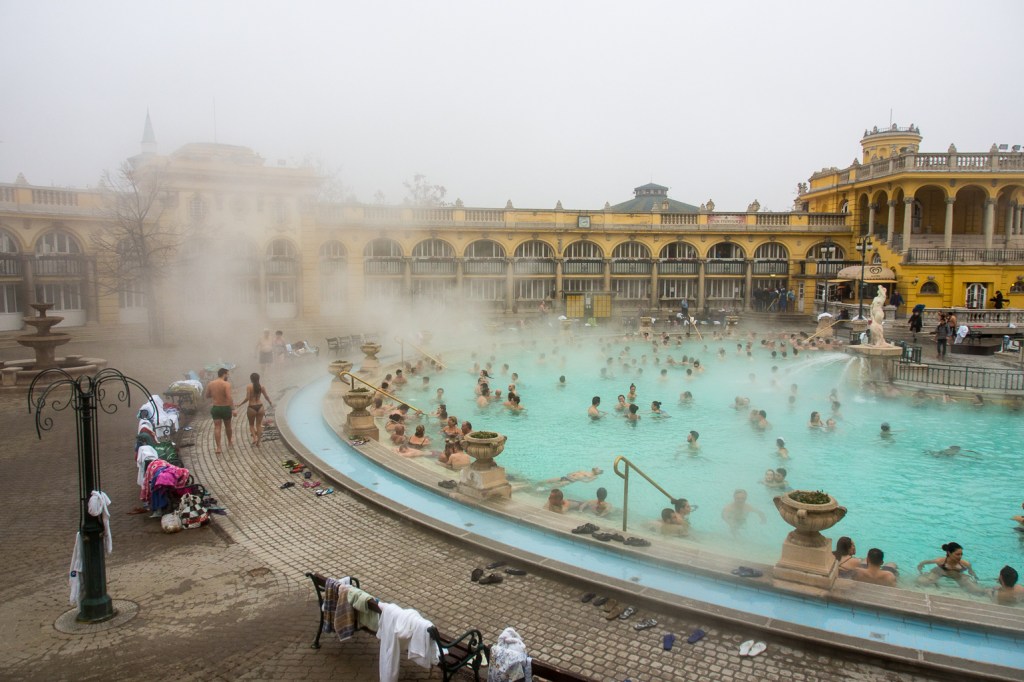
Széchenyi Baths in Budapest, Hungary

I’ve only been to Hungary once, back in 1977. One of my happiest times alone with my father was the two of us visiting Budapest’s Széchenyi (SAY-chen-yee) baths and chatting for hours in the thermal pools. Of course, an opportunity gained can also be an opportunity lost. During that time, my mother went back to Felcsut in the Fehérmegye countryside, where she was raised as a young girl on a farm by her grandparents. I never did get to see Felcsut.

Although I spent so little time in Hungary, I am proud to say that I still somehow bear inside of me the seed of the Magyar culture and language. When I was a little boy in Cleveland, television was just coming in; so, living in a Hungarian neighborhood, I was blissfully unaware that the English language even existed. Until I showed up for kindergarten classes at Harvey Rice Elementary School.

That set off a whole chain of events, from moving to the suburbs, even though my father always yearned to be back in the old Buckeye Road neighborhood, to my majoring in English at an Ivy League school. But that is another story.

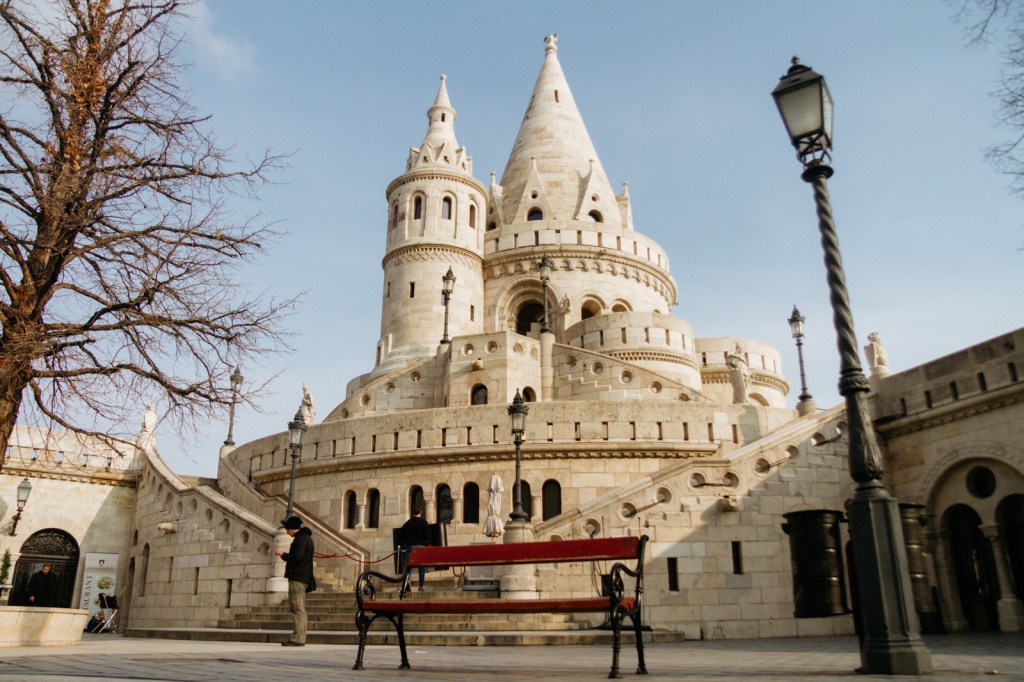
Halászbástya

It looks as impressive as all get-out, but the Fisherman’s Bastion (Halászbástya) on Budapest’s Buda bank was actually built between 1895 and 1902 to serve as a viewpoint over the Danube. The myth behind it is that during the Middle Ages, it was the role of the Fishermen’s (Halász) Guild, located in the general vicinity, to protect that reach of the river from invaders.

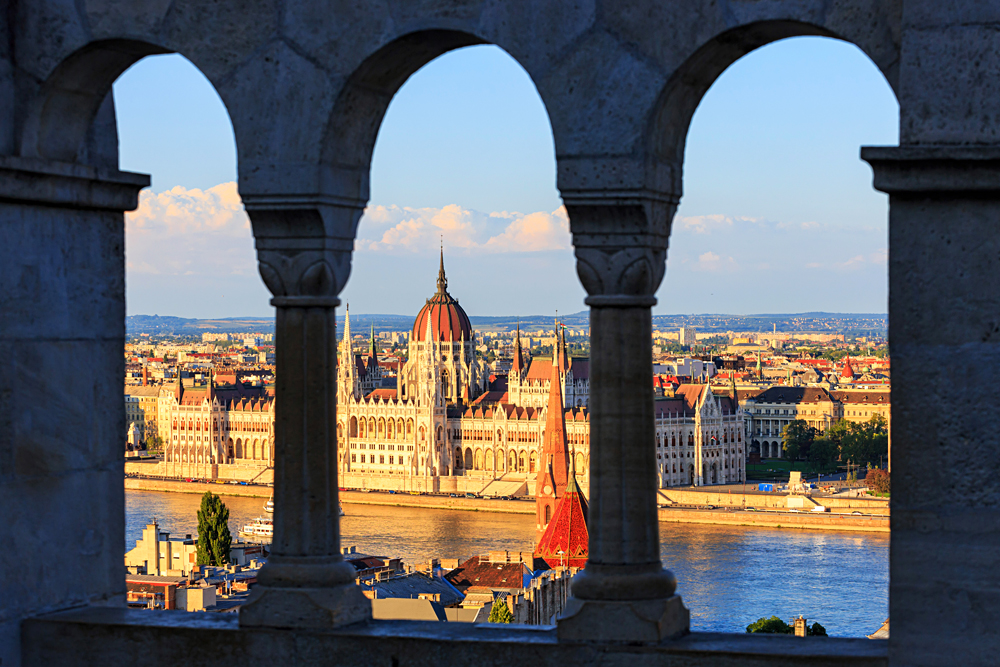
Sitting across the Danube from the Bastion is the Hungarian Parliament, built around the same time. There was a lot of construction in Budapest around that time because 1896 was the thousandth anniversary of the settlement of the Magyar peoples under Arpad in the plain that was to become Hungary.

And here is the view of Parliament from the arches of the Bastion.

I was in Hungary and Czechoslovakia with my parents in 1977 and saw the sights with my cousin Vörös Ilona, who worked for the Hungarian State Railways (MÁV). It was an interesting trip. In addition to Budapest, we hung out at Lake Balaton, visited a huge opera festival in Szeged (where, to stay in a railway workers’ hostel, I had to pretend to be a Hungarian railway worker), and travel to where my father was born in the present day Slovak Republic.

Like Poland, Hungary was on one of the main invasion paths into Europe. Its history was a tragic one, fighting off (not always successfully) the Mongols, the Austrians, the Germans, and the Russians. Now it’s ruled by a rightist dictator named Viktor Orbán, who is smarter than Donald J. Trump, but in the same political ballpark.